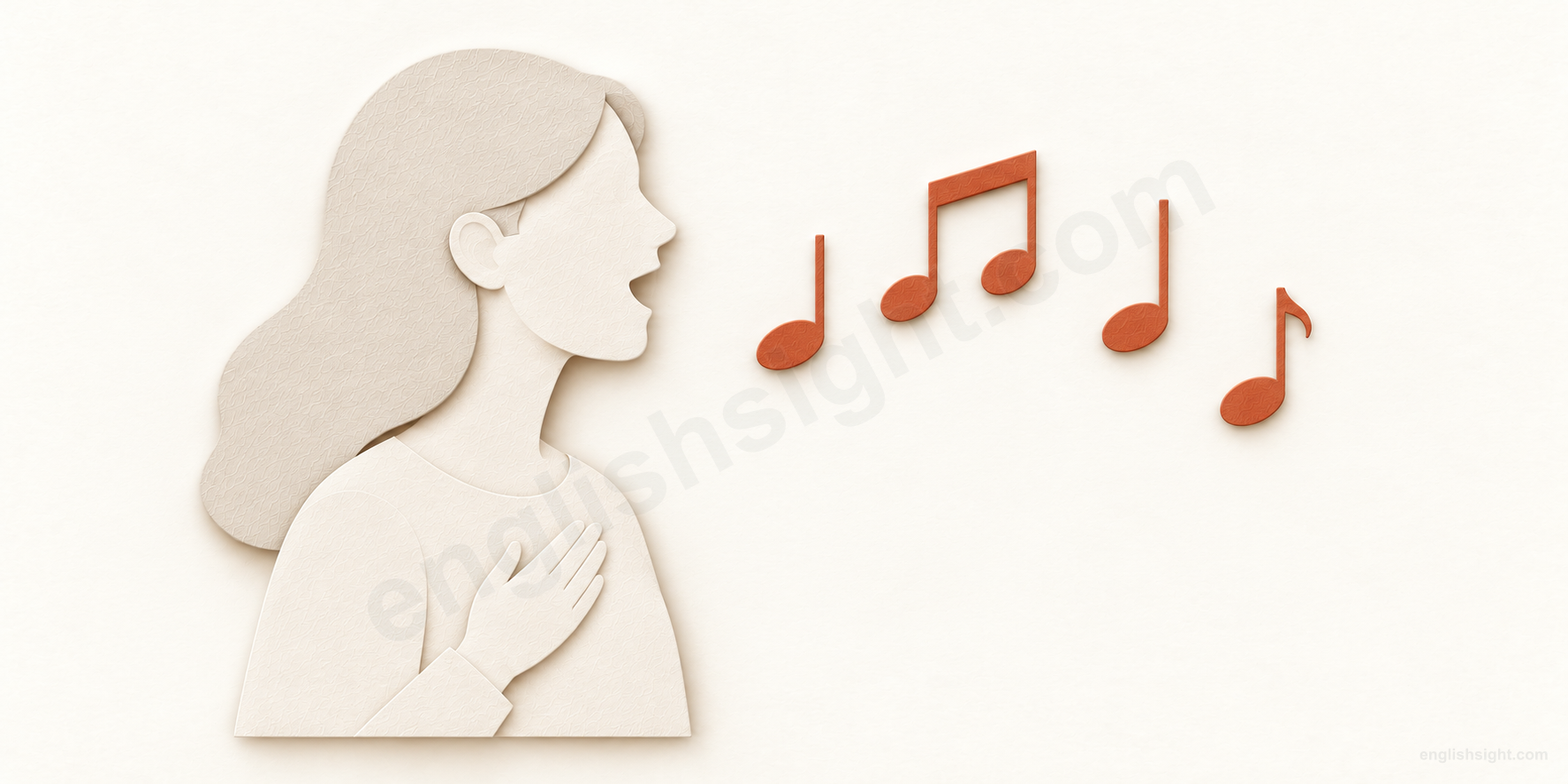
Recognize a song, describe singing, and read the whole idiom.
A voice carries words through a melody
A voice carries words through a melody
Words and a melody to sing
song
A recognizable piece for the voice
A singer brings words and melody together.
A song usually joins words and melody for the voice; the notes symbolize the sung tune.
In the central human use, a song is a musical work for the voice, usually bringing words and melody together.
This teaching model centers on the familiar human song. Bird song has no human lyrics, an instrumental version need not have a singer, and fixed idioms require their own meanings.
A song is usually something you can sing: words organized with a melody as a recognizable musical work. You can count songs, remember their tunes, and hear different versions of the same one.
Song also names singing as an activity, songs considered collectively, and the musical sounds of birds. Fixed expressions take it into other settings, where the complete wording matters more than the music picture.
01
A piece you can sing, play, or share
Start with an individual musical work. Count it, identify it, and choose a verb for what someone does with it.
01
a / the / my + song; number + songs
a song / two songs
an individual musical work normally made for singing
Situation / starting point
You recognize a melody and the words that belong to it.
What is meant
You can name and count the complete piece.
A song is a work; lyrics are its words and a tune is its melody.
In the everyday countable sense, a song combines words with music for the voice. Use a song, this song, or three songs. Music is the broader category: I like music, but I know three songs. An instrumental piece is usually a piece of music rather than a song in careful general usage.
The words are the lyrics, or simply the words of the song. The tune is the melody you can hum. You can forget the lyrics while remembering the tune. A recording is one version of the work: two singers can record the same song. An instrumental version can still be called a version of that song, even with no singer in that performance.
In a sentence
I know the tune of that song, but I have forgotten the words.
Watch the difference Use sing as the verb: She sings a song, not She songs a song.
02
song about + topic; song by + artist; song from + work; song on + album; song called + title
a song about… / by… / from…
identify a song’s subject, artist, or source
Situation / starting point
Several songs are being discussed.
What is meant
A short phrase tells the listener which one you mean.
The preposition identifies a different relationship to the same musical work.
About introduces the subject: a song about leaving home. A song of love or a song of praise describes what it expresses and can sound more literary than a song about love. By links the song to an artist or writer; context tells us whether authorship or performance is intended. Say written by or sung by when that distinction matters.
From identifies a source such as a film or show; on locates a song on an album. A song called “Morning Window” gives its title. These are ordinary noun phrases, not phrasal verbs. Which song is this? asks for identification; How does the song go? asks you to recall or demonstrate its words or tune.
In a sentence
Is this a song from the film, or a new song by the same singer?
Watch the difference A song by a singer does not always mean that the singer wrote it.
03
sing / play + a song; sing + someone + a song; sing a song to + someone
sing / play a song
perform the work vocally, instrumentally, or through a recording
Situation / starting point
A familiar song is available to perform.
What is meant
A person sings it, musicians play it, or a device plays a recording.
The verb tells us how the song reaches the listener.
Sing a song puts the voice at the center. Sing someone a song and sing a song to someone both identify a listener: Will you sing the baby a song? The baby receives a performance, not ownership of a physical object.
Play a song can mean perform it on instruments or start a recording. Compare I played the song on the piano with I played the song on my phone. You may sing along with a recording rather than perform alone. The noun still names the same work; play does not turn every sound into a song.
In a sentence
She played the song on the piano, and we sang along.
Watch the difference Play a song does not by itself tell you whether there was a live performance or a recording.
04
write / record / release / hear + a song; listen to + a song
write / record / listen to a song
create a work, capture a performance, or hear it
Situation / starting point
A songwriter has a new idea.
What is meant
The work can be written, recorded, released, and heard.
Different verbs describe stages and choices, not different senses of song.
Write a song means create the work, often its words and music. Record a song means make a recording of a performance; the person recording it need not be its writer. Release a song means make it publicly available. A track is an individual item on a recording or playlist and may be a song or an instrumental piece.
Listen to a song describes giving it your attention; hear a song says it reaches your ears. I heard a song in the café does not necessarily mean I deliberately chose to listen. Download or stream a song concerns access to the recorded music, not composing it.
In a sentence
I heard her new song in a shop and listened to it again at home.
Watch the difference Keep to after listen: listen to a song, not listen a song.
05
modifier + song: love / folk / pop / protest / theme / title / cover / hit
love song / folk song / theme song / cover song
specify a song’s topic, tradition, role, or version
Situation / starting point
You want more than the general label song.
What is meant
A modifier says what sort of song or version it is.
Modifiers classify the work in different ways.
A love song concerns love; a protest song voices opposition or a demand for change. A folk song belongs to a folk tradition, while pop song and rock song describe broad musical styles. A hit song is successful or widely popular; hit is not a different kind of melody.
A theme song is strongly associated with a show, film, person, or campaign; in this label, song can even refer to an identifying instrumental melody. A title song shares or supplies the title of a film or album. A cover song is a new performance or recording of a song previously performed or recorded by another artist. Compare an original song, created as a new work. These labels can overlap: a cover can become a hit.
In a sentence
Her cover of an old folk song became the show’s theme song.
Watch the difference A cover song is a new version of an existing work; it need not be a copy of the earlier recording.
02
Singing and the sounds of birds
Song can name singing as a form of expression, the start of singing, or a bird’s patterned vocal sounds. Countability follows the meaning.
06
in / through + song; song and dance
in song / through song
use singing as a medium of expression
Situation / starting point
People want to tell a story or celebrate something.
What is meant
They communicate by singing.
Uncountable song names the activity or art, rather than one item.
Tell a story through song means use singing to tell it. Express something in song likewise describes the medium. In these patterns there is no a because you are not counting individual works. The activity may involve one song or many.
Compare They told the story in a song, which points to one particular work, with They told the story through song, which highlights the form of expression. Song and dance can also be literal: a song-and-dance routine includes actual singing and dancing. Do not confuse that performance with the idioms below.
Uncountable song can also refer to songs considered collectively, as in A history of popular song explores changes in songs and songwriting over time. Here song names a body or tradition of works, rather than one piece or one occasion of singing.
In a sentence
The children told the story through song and dance.
Watch the difference Do not replace every a song with song: She sang a song still counts an individual piece.
07
person + burst / break into song
burst / break into song
start singing, often suddenly
Situation / starting point
Someone is speaking or sitting quietly.
What is meant
Their voice changes to singing.
Into marks the beginning of an activity in this established expression.
Burst into song gives a lively or sudden start to singing. Break into song also means begin to sing, often unexpectedly. The person does not enter a physical song or damage it. The phrase works without naming the particular piece.
After the news, he burst into song can suggest spontaneous excitement; a musical character may break into song during a conversation. Neither expression tells us whether the singing is good. Compare sing a song, which describes the performance without emphasizing its onset.
In a sentence
When the cake arrived, everyone burst into song.
Watch the difference Use burst into song to highlight the start of singing in general. The expression does not identify a particular song.
08
a bird’s song; the song of + bird; birdsong; whale song
a bird’s song / birdsong
a bird’s musical sequence of vocal sounds
Situation / starting point
A bird produces a recognizable pattern of sounds.
What is meant
You hear or recognize its song.
Song extends to patterned animal sound; it does not require human words.
A blackbird’s song names the musical sound pattern the bird makes. Song can be countable when you distinguish a particular bird’s pattern or separate songs, and uncountable when you describe the sound generally. Birdsong is a useful uncountable word for this natural sound.
The song of a blackbird and a blackbird’s song describe the same relationship. A bird call is another vocal signal; ordinary speakers sometimes use the words loosely, but not every short call is usually called a song. The wider animal use also permits whale song. No human lyrics are implied.
In a sentence
We stopped to listen to the blackbird’s song outside the window.
Watch the difference Do not assume that animal song contains words or follows the human song model exactly.
03
Expressions that need the whole phrase
These expressions concern price, performance, fuss, agreement, and attraction. Learn their wording and tone; the basic music picture does not predict them.
09
buy / sell / get + something + for a song; something + go for a song
buy / sell something for a song
pay or receive a surprisingly small price
Situation / starting point
An item would normally cost much more.
What is meant
It changes hands at a very low price.
For a song evaluates the price, not the method of payment.
I bought it for a song is an informal way to call it a bargain. You paid money, not a musical performance. The expression also works with sell, get, or go: The old desks are going for a song means they are being offered very cheaply.
The price is small relative to what the speaker expects; there is no fixed amount. Selling a valuable instrument for a song may suggest a poor deal for the seller even though the buyer is pleased. The complete phrase supplies this meaning.
In a sentence
I bought this solid wooden table for a song at a neighbour’s sale.
Watch the difference For a song means cheap, not necessarily free.
10
person / team / machine + be on song
be on song
be performing particularly well
Situation / starting point
A team or performer has a task.
What is meant
Their actions work smoothly and effectively.
The idiom evaluates performance rather than musical pitch.
A team that is on song is playing well; a performer or machine can also be described this way when functioning effectively. The expression is especially associated with British informal usage and sports discussion.
Our forwards were on song praises their performance. It does not say that they sang during the match. In a literal music discussion, in tune concerns correct pitch, while on song is a broader informal judgment that things are going well.
In a sentence
Our goalkeeper was on song and saved three difficult shots.
Watch the difference This is an informal expression; performing well is a clearer neutral alternative.
11
make a (big) song and dance about + noun / -ing
make a song and dance about something
draw more attention to something than the speaker thinks necessary
Situation / starting point
There is a small change or problem.
What is meant
Someone complains or makes a conspicuous fuss about it.
The speaker criticizes the amount of attention, not a literal performance.
In British informal use, make a song and dance about something often criticizes excessive complaint or fuss. Don’t make a song and dance about the new seats asks someone not to treat the change as a major issue.
It can also concern conspicuous publicity rather than a complaint: She helped without making a song and dance about it says she did not advertise her help. The judgment belongs to the speaker; the other person may consider the matter important. Compare a literal song-and-dance act in a theatre.
In a sentence
He replaced the broken handle without making a song and dance about it.
Watch the difference This can sound dismissive when someone has a serious concern.
12
give + someone + a song and dance + about + something
give someone a song and dance
offer a long, unconvincing explanation or excuse
Situation / starting point
You ask why a promised task was not done.
What is meant
You receive an elaborate story that you distrust.
The North American idiom describes evasive talk.
In informal North American usage, a song and dance can be a drawn-out explanation or excuse, especially one the speaker finds misleading. Give someone a song and dance highlights what the listener has to hear; it is not the same meaning as the British make a song and dance about pattern.
He gave me a song and dance about the missing receipt implies dissatisfaction with his story. It does not establish that the story was false; it reports the speaker’s skeptical attitude. The situation and verb help distinguish this idiom from actual singing and dancing.
In a sentence
The driver gave us a song and dance about why the meter was off.
Watch the difference The British fuss meaning and North American excuse meaning overlap in tone but are not interchangeable in every sentence.
13
people + sing from the same song / hymn sheet
sing from the same song sheet
present a shared position or message
Situation / starting point
Several representatives may give conflicting accounts.
What is meant
They communicate a consistent position.
The shared sheet is a metaphor for coordinated public statements.
Sing from the same song sheet, also sing from the same hymn sheet, is an informal British expression. People saying the same things publicly appear united, as singers following one sheet would perform together.
Before a press interview, a team might agree on its message so that everyone sings from the same song sheet. The idiom concerns expressed agreement; it does not prove everyone privately believes the same thing. No music or physical sheet is necessary.
In a sentence
Before the announcement, the two departments agreed to sing from the same song sheet.
Watch the difference Use the whole expression; the same song alone does not always carry this precise coordinated-message meaning.
14
the same old song; sing a different song
the same old song / sing a different song
repeat a familiar position or change one’s stance
Situation / starting point
You recognize someone’s repeated argument.
What is meant
They repeat it again, or adopt a different position.
A familiar song can metaphorically represent a familiar line of talk.
The same old song can refer to a repeated complaint, claim, or excuse rather than music. Old often conveys impatience: It’s the same old song about having no time suggests that you have heard this explanation before.
Sing a different song can describe expressing a changed opinion: They opposed the plan, but now they’re singing a different song. The new position need not be false. The metaphor helps connect the phrases, but context still decides whether someone is discussing actual music.
In a sentence
It was the same old song: he was too busy to help.
Watch the difference In a music conversation, the same old song may simply mean the familiar piece. Read the context.
15
someone’s swan song; a swan song; swansong
someone’s swan song
a final notable performance, work, or act
Situation / starting point
A person is nearing the end of a career or activity.
What is meant
One last work or appearance marks the ending.
The compound points to a farewell contribution, not necessarily to music.
A director’s final film may be her swan song. A sports appearance can also be described this way when it ends a career. The phrase is often used in reviews and reporting rather than as the ordinary word for every final task.
The writing swansong is also used. The name draws on a traditional story about a swan singing before death; the modern expression does not claim the person dies, nor does it establish a zoological fact. Retirement or departure can supply the ending.
In a sentence
The exhibition was the artist’s swan song before she retired.
Watch the difference A swan song is not simply a song about a swan, and the work need not be musical.
16
the siren song of + appealing thing; resist + a / the siren song
the siren song of something
an appeal that strongly tempts someone, often with hidden risks
Situation / starting point
An offer or idea sounds highly attractive.
What is meant
Its appeal pulls someone toward a choice that may be unwise.
The compound names an enticing appeal rather than an actual song.
The siren song of easy money describes how the promise draws people in. This expression often warns that the attraction may mislead or be dangerous; it can also describe a powerful temptation without asserting a specific deception.
In an article about risky investments, resist the siren song of instant wealth urges the reader to look beyond the appealing promise. The warning comes from the complete compound and the surrounding context. It does not refer to the sound of an emergency siren.
In a sentence
She resisted the siren song of instant success and checked the offer carefully.
Watch the difference This is a figurative expression often found in commentary; temptation is a plainer alternative.
Keep the work, the activity, and the idiom distinct
A noun, with two count patterns
Use a song / songs for individual works and song for singing as an activity, as in through song, or for songs collectively, as in the history of popular song. The ordinary verb is sing: sing, sang, sung; song is not its past tense. Noun phrases such as song lyrics can use song before another noun without an -s.
Related words are not identical
Music is the broad category, a tune is a melody, lyrics are the words, and a track is an item on a recording or playlist. A song can remain the same work across different recordings and arrangements.
Extensions have boundaries
Bird song and whale song need no words. Unusual instrumental titles can use song too. This lesson prioritizes ordinary vocabulary and familiar expressions; it does not classify every specialist musical form or poetic use.
Do not generate idioms from the picture
For a song, on song, and a song and dance have established meanings. The noun has no productive phrasal-verb, causative, or passive family of its own; verbs around it supply those grammatical patterns.
Choose the meaning in context
Decide whether song names a work, singing, or a complete fixed expression.
1. You want three individual pieces with words and melody. Which sentence fits?
2. You remember what to hum, but not what to sing. What have you forgotten?
3. The room is quiet, then everyone suddenly starts singing. Which wording emphasizes the start?
4. A friend says she bought a table for a song. What is she saying?
5. Managers agree to sing from the same song sheet at a press conference. What is the plan?
6. In a North American conversation, someone complains: “He gave me a song and dance about the missing keys.” What did he give?
Sources and teaching notes
Dictionary entries were consulted for meanings, patterns, and register. The explanations, examples, and diagram are original teaching material; the visual model has stated limits.
The diagram is a teaching aid, not a picture shared by every native speaker.