Connect the noun for a kind with the verb for arranging, then learn the expressions that go further.
Shared features make groups
Shared features make groups
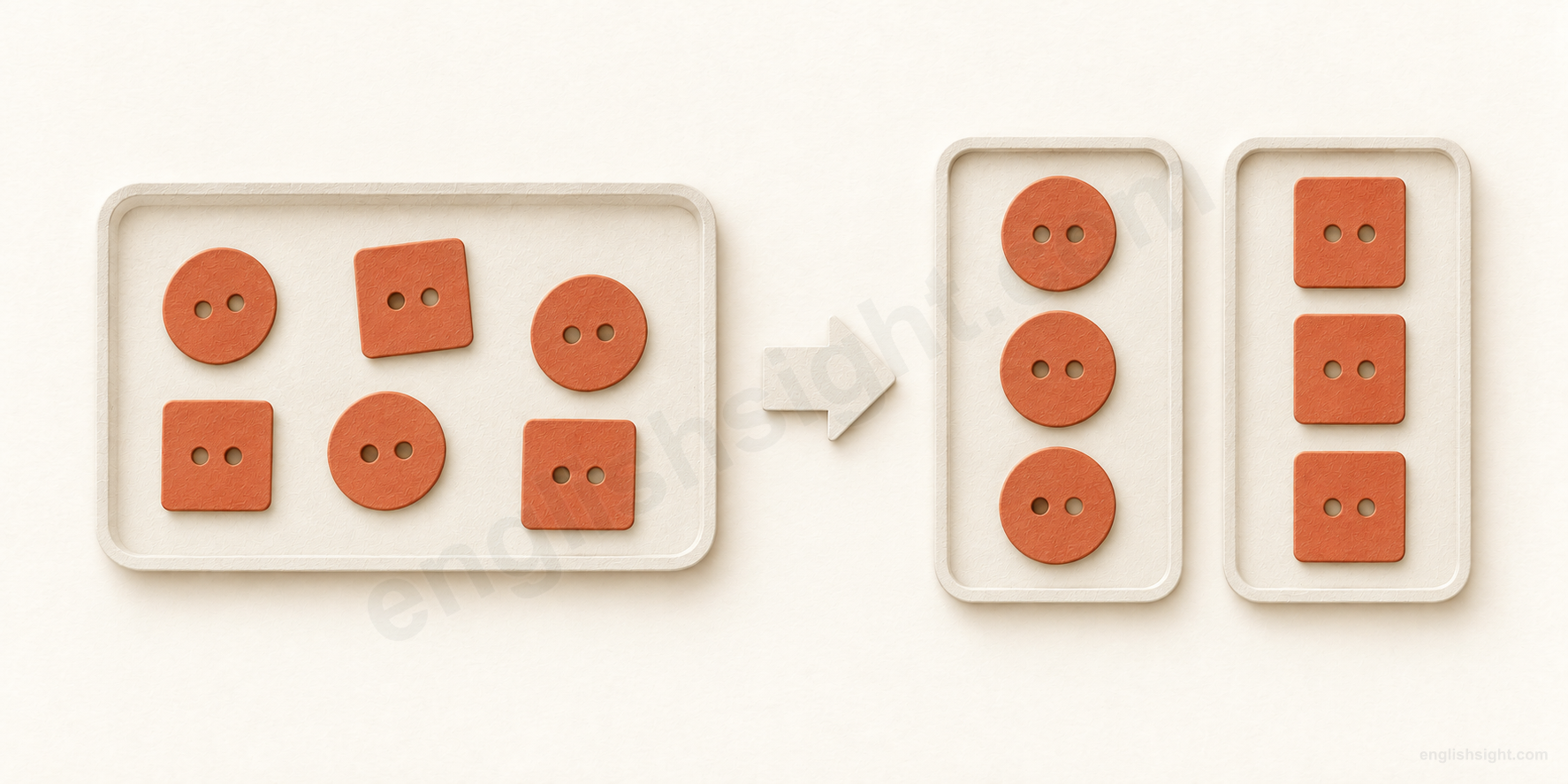
Three round buttons and three square buttons are mixed in one tray.
sort
Round buttons form one group and square buttons form the other.
Arrange the same buttons by shape.
The buttons stay the same; sorting changes their grouping.
A sort is a kind defined by shared features; to sort things is to arrange them by a chosen feature or order.
The noun names a kind without requiring any physical action. The sketch shows the grouping use of the verb. Ordering, problem-solving, and fixed expressions need the distinctions explained below.
A sort is a kind of thing or person. To sort things is to arrange them using a feature or an order. These uses share attention to distinctions: what is alike, what belongs together, and what should be kept apart.
Everyday expressions also use sort for approximate descriptions and for handling practical difficulties. Learn their whole patterns; a picture of grouping cannot predict the meaning of every expression.
01
Name a kind or describe a person
The countable noun sort places people or things in a category. The words around it tell you whether the category is precise, broad, or unspecified.
01
a / this / that sort of + noun; what sort of + noun; these / different sorts of + noun
this sort of / what sort of
a category of things or people
Situation
Several kinds of tea are available.
Meaning in context
You ask which kind your guest prefers.
Sort names the category, not the act of arranging it.
What sort of tea do you like? asks about a kind, such as green or black tea. This sort of question identifies a category of questions. Kind and type often work here too; the situation, rather than sort itself, supplies the defining feature.
A useful starting pattern is this sort of question but these sorts of questions. With an uncountable noun, keep that noun uncountable: this sort of information; different sorts of information. You will also meet the sort of books I enjoy and different sorts of bird, so the noun after of is not governed by one exceptionless singular/plural rule.
In informal questions such as What sort of price are you looking for?, the speaker asks for a rough range. What sort of time do you call this? is a conventional complaint about someone arriving late, rather than a neutral request for the time.
In a sentence
What sort of tea would you like with breakfast?
Watch the difference In careful writing, use these sorts of questions or this sort of question. These sort of questions occurs in very informal speech but is disputed.
02
all sorts of + plural / uncountable noun; all sorts
all sorts of
many different kinds of
Situation
A shop stocks a wide variety of materials.
Meaning in context
You describe the variety without listing every kind.
All sorts emphasizes variety; it does not promise literally every possible kind.
All sorts of fabric means many different kinds of fabric. With a countable noun, all sorts of people or all sorts of questions is a useful pattern. Sorts is plural, while an uncountable noun such as fabric stays uncountable.
All sorts can stand alone when the topic is clear: What books do they sell? All sorts. In all sorts of trouble, the expression broadly emphasizes many difficulties; it is not a precise count of categories.
In a sentence
The market sells all sorts of fresh bread.
Watch the difference Keep the plural in all sorts of. A lot of bread emphasizes amount; all sorts of bread emphasizes variety.
03
(examples), (and) that sort of thing; things of that sort
that sort of thing
other things similar to the examples mentioned
Situation
You mention a few activities.
Meaning in context
The listener understands a wider class of similar activities.
Thing points back to examples instead of naming a precise category.
After listing examples, that sort of thing invites the listener to recognize what they have in common. I like walking, cycling, that sort of thing suggests related activities, without giving a complete list.
And things of that sort has a similar reference. This is still the noun meaning kind: there is no sorting action, and it is different from the hedge sort of in I sort of like it.
In a sentence
We need paper, pens, folders, and that sort of thing.
Watch the difference The phrase relies on context. Without useful examples, that sort of thing may leave the listener unsure what you mean.
04
noun + of some sort; some sort of + noun; noun + of one sort or another
of some sort / of one sort or another
a kind that is unknown or left unspecified
Situation
You hear a sound but cannot identify it.
Meaning in context
You give a broad description without choosing an exact kind.
Some sort leaves the category open.
A tool of some sort is a tool whose exact type you cannot or do not need to name. Some sort of tool puts the same uncertainty before the noun. Depending on tone, some sort of can also sound dismissive; uncertainty itself is not necessarily criticism.
Of one sort or another leaves room for several possible kinds. For example, Repairs of one sort or another kept us busy all week means various repairs, without specifying all their types.
In a sentence
There is an alarm of some sort ringing downstairs.
Watch the difference Of some sort leaves the kind unspecified. Of sorts usually questions how good or complete an example it is.
05
the sort of person who + clause; the sort to + verb; a good / decent sort
a good sort / the sort of person who…
describe someone’s character or usual behavior
Situation
You notice that a colleague is consistently helpful.
Meaning in context
You describe the kind of person she is.
The category concerns character rather than physical appearance.
The sort of person who checks every detail describes a characteristic habit. She is not the sort to give up uses a to-infinitive for behavior that would or would not fit her character.
A good sort means a pleasant or decent person, especially in informal British English. It is a personal evaluation, not a statement that someone has sorted objects well. Calling people our sort can suggest social exclusion, so attend to context and tone.
In a sentence
Mara is the sort of person who remembers everyone’s birthday.
Watch the difference Sort is a countable noun here: She is a good sort, not She is good sort.
02
Approximation and fixed expressions
These expressions do more than name categories. Read the whole phrase to recognize a cautious description, a denial, a mood, or a comment about different people.
06
a sort of + noun; a + adjective + sort of + noun
a sort of
something approximately like the description that follows
Situation
A room is used for several purposes.
Meaning in context
You offer a convenient description that is not exact.
The category label fits approximately.
A sort of studio presents studio as a useful but imperfect label. The room may also be a bedroom or may lack the usual studio equipment. Compare a sort of apple, which can simply mean a particular variety of apple: context decides whether the classification is approximate.
A funny sort of feeling and in a strange sort of way similarly leave the description loose. These are noun phrases or part of a larger phrase; they are different in grammar from sort of modifying the verb in I sort of understand.
In a sentence
We use the spare room as a sort of studio.
Watch the difference An approximate description does not always imply poor quality. A studio of sorts more clearly suggests a limited or inadequate example.
07
sort of + verb / adjective / description; “Sort of.” as a reply
sort of
qualify a description or give a partly positive answer
Situation
You recognize part of an explanation but not all of it.
Meaning in context
You give a qualified answer instead of a firm yes.
The fixed phrase makes the statement less exact or less categorical.
I sort of understand means something like I understand to some extent or I understand, but that wording is not fully accurate. Sort of can modify a verb, an adjective, or another description: I sort of expected it; I am sort of nervous. It is informal.
As a short answer, Sort of means partly or in a way: Are you ready? Sort of. Here sort is not a countable category noun, and of is not introducing a missing object. The phrase works as a familiar conversational unit.
Kind of often gives a similar informal hedge. Sorta represents casual pronunciation in very informal writing; use sort of in ordinary written lessons and messages.
In a sentence
“Do you understand the instructions?” “Sort of, but could you show me once?”
Watch the difference Do not add a when modifying an adjective or verb: I am sort of nervous, not I am a sort of nervous.
08
noun + of sorts; noun + of a sort
of sorts / of a sort
an imperfect or limited example of something
Situation
Someone offers a brief response that barely counts as an apology.
Meaning in context
You acknowledge it as an apology while expressing reservations.
The expression qualifies the adequacy of the example.
An apology of sorts counts as an apology only in a limited sense: perhaps it avoids accepting responsibility. Of a sort can convey a similar reservation. Unlike of some sort, the point is normally adequacy or quality, not simply an unidentified category.
The phrase follows its noun: a meal of sorts, a solution of sorts. It does not necessarily mean a total failure; the speaker may recognize something useful while signaling that it falls short.
In a sentence
He offered an apology of sorts, but he still blamed everyone else.
Watch the difference Keep of sorts after the noun. A sort of apology and an apology of sorts can overlap, but the latter more strongly signals a limited example.
09
do / be + nothing of the sort; “Nothing of the sort!”
nothing of the sort
strongly reject what has just been said or suggested
Situation
Someone suggests that you shouted at a colleague.
Meaning in context
You firmly deny that description of your behavior.
The phrase rejects a preceding claim.
I did nothing of the sort means I did not do the thing you have suggested. The wording is emphatic and may sound defensive or indignant. The listener supplies the rejected action from the preceding conversation.
It can also reject a description: Selfish? She is nothing of the sort. Nothing of the kind is a similar expression. Do not interpret nothing as an instruction to stop sorting objects.
In a sentence
“You shouted at him.” “I did nothing of the sort; I asked him quietly.”
Watch the difference Use the fixed article: nothing of the sort. The phrase needs an earlier claim or a clear implied claim to reject.
10
be / feel / look + (a bit) out of sorts
out of sorts
not feeling well or not in a good mood
Situation
You feel unlike your usual comfortable self.
Meaning in context
You describe mild illness, irritability, or an unsettled mood.
This is an established expression about someone’s condition.
Feel out of sorts can describe feeling a little unwell, upset, or irritable. The surrounding conversation tells the listener whether health, mood, or both are involved. The expression is especially associated with British English, although American dictionaries also record it.
Keep the phrase together. It does not mean outside several categories, and its meaning cannot be reliably calculated from the sorting diagram.
In a sentence
I have felt a bit out of sorts since I woke up.
Watch the difference Keep sorts plural. Out of sort is not the usual expression, and out of order normally concerns something different.
11
it takes all sorts (to make a world)
It takes all sorts.
people have different, sometimes surprising tastes or habits
Situation
A friend describes a hobby you find unusual.
Meaning in context
You comment that people differ.
The saying acknowledges a range of people and preferences.
It takes all sorts, sometimes extended to It takes all sorts to make a world, comments on people being different. It often follows behavior the speaker finds surprising or strange.
It may express tolerant acceptance, but tone can make it sound dismissive or critical. The ordinary noun meaning kinds helps you remember it; the saying’s conversational attitude must be learned with context.
In a sentence
“He spends his holidays watching trains.” “Well, it takes all sorts.”
Watch the difference This is a saying about people’s differences, not a neutral request for many kinds of supplies.
03
Group, order, separate, and look through
The verb sort concerns arranging or examining things. Into gives the resulting groups or order; by names the criterion; from identifies what is being separated.
12
sort + object + into + groups; be sorted into + groups
sort things into groups
put things together according to a shared feature
Situation
Buttons of different shapes are mixed together.
Meaning in context
Each shape has its own group.
The objects stay the same; their arrangement changes.
Sort the buttons into groups names an action and its result. The person or machine doing the work is the subject; the buttons are the object; into introduces the resulting groups. You can also simply sort the laundry when the relevant grouping is clear.
The passive The buttons were sorted into two groups focuses on the objects and result, without needing to name the sorter. We are sorting the laundry naturally describes an action in progress. The groups need not be ranked from best to worst.
In a sentence
We sorted the buttons into two groups: round ones and square ones.
Watch the difference Into names the resulting groups. By names the criterion: sort them by shape.
13
sort + object + by + criterion; sort + object + into + order; a sort (computing noun)
sort by date / into alphabetical order
arrange things using a chosen rule or sequence
Situation
Files appear in no useful order.
Meaning in context
Their sequence follows the date or another chosen criterion.
Sorting can create a sequence rather than separate piles.
Sort the files by date names the field used to arrange them. According to their date gives a similar criterion. Sort the names into alphabetical order names the resulting sequence. By size can produce ordered items or size groups; the context determines which.
On a computer, sorting usually changes how records or results are ordered. Filtering selects which records are shown. In this computing context, the noun a sort can name one sorting operation: Run a sort on the date column. Algorithm names are outside this lesson.
In a sentence
The app sorts the photos by date, with the newest first.
Watch the difference By date alone does not specify oldest first or newest first. Add the direction when it matters.
14
sort + A + from + B; sort out + object; sort + object + out; sort the wheat from the chaff
sort A from B / sort out the useful ones
separate wanted items or distinguish one kind from another
Situation
Useful notes and duplicates are mixed together.
Meaning in context
You identify and separate the useful notes.
From names the contrasting or surrounding material.
Sort the useful notes from the duplicates separates two kinds. Sort out the useful notes can select the wanted items from a larger collection. You can also say sort the useful notes out. With a pronoun, put it between sort and out: sort them out.
The same distinction can be abstract: sort out fact from rumor means distinguish them, rather than physically move them. Sort the wheat from the chaff is an established metaphor for distinguishing valuable material or people from what is less useful. For example, A careful review helps sort the wheat from the chaff among these proposals.
In a sentence
Can you sort the usable parts out from the broken ones?
Watch the difference Say sort them out, not sort out them. The selection meaning differs from solving a problem, even though both can use sort out.
15
sort through + collection + (for + wanted item)
sort through
examine a collection while searching or putting it in order
Situation
Many papers are in a box.
Meaning in context
You go through them to find a particular document.
The phrase describes examining the collection, not necessarily reaching a finished arrangement.
Sort through the papers follows your attention across the items. You may be searching for something, arranging them, or deciding what to keep. For introduces what you hope to find: sort through the papers for a receipt.
Through is followed by the collection: sort through it. Compare sort it out, which may focus on getting it organized or resolving a difficulty. Their pronoun positions differ.
In a sentence
I sorted through the old papers for the insurance receipt.
Watch the difference Say sort through them, not sort them through for this meaning. Searching does not itself guarantee that you find the item.
04
Tidy things and deal with problems
Sort out extends beyond physical grouping to practical organization. The object and the situation distinguish solving a problem, helping a person, getting organized, and making a threat.
16
sort out + object; sort + object + out; a sort-out
sort out a cupboard
organize or tidy its contents
Situation
A cupboard contains a mixture of useful and unwanted things.
Meaning in context
Its contents are organized and easier to use.
The phrase can name the container while the work concerns what is inside.
Sort out the cupboard can involve checking its contents, removing unwanted things, and arranging what remains. It overlaps with physical sorting, but it describes the practical task more broadly than simply putting everything into categories.
Sort the cupboard out is also possible. With a pronoun, use sort it out. A sort-out is a related informal noun for such a clear-up, especially in British English: The cupboard needs a sort-out.
In a sentence
We sorted out the cupboard and donated the things we never used.
Watch the difference Sort out a cupboard usually means organize its contents. It does not normally mean repair the cupboard’s broken door.
17
sort + problem + out; sort it (out); get / have + object + sorted (out); be sorted
sort out a problem / get it sorted
deal successfully with a difficulty
Situation
A payment error is causing trouble.
Meaning in context
Someone takes effective action to resolve it.
The result is a workable situation, not a set of physical groups.
Sort out a problem or sort a problem out means do what is needed to resolve it. Sort it out is the pronoun pattern. This is an established practical meaning, not a rule that out always means completion.
Especially in informal British English, sort can have this meaning without out: Can you sort it? The passive It has been sorted reports a result. Get the problem sorted means bring about its resolution; you might handle it yourself or arrange help, so the construction does not always imply employing someone.
Sorted is also used as an informal British adjective meaning dealt with or organized: It is all sorted. The short reply Sorted! can announce that a task is done. Compare sorted files, which may simply mean files put in order.
In a sentence
I called the bank and got the payment problem sorted out.
Watch the difference Use got it sorted out, not got sorted it out. The object and context distinguish resolution from physical sorting.
18
sort out + arrangements / details / tickets; sort + object + out + for + person
sort out the travel details
make the necessary practical arrangements
Situation
A trip is planned, but the tickets and timings are undecided.
Meaning in context
Someone takes care of those details.
A task may need organizing even when nothing has gone wrong.
Sort out the tickets can mean arrange to obtain them and deal with the practical details. It need not mean separate tickets into kinds or correct an existing mistake. The object and situation choose the interpretation.
I will sort it out for you offers to handle the task for someone. For names the person who benefits; out belongs to the verb expression. A noun object can appear on either side of out, while it must precede out.
In a sentence
I will sort out the train tickets once you confirm the dates.
Watch the difference Sorting out the tickets does not by itself specify whether you buy, collect, print, or change them.
19
sort + myself / yourself / himself / herself / ourselves / themselves + out
sort yourself out
get your affairs, behavior, or emotional state into a workable condition
Situation
You feel overwhelmed and cannot organize what to do.
Meaning in context
You regain enough calm or order to act effectively.
The person organizing and the person affected are the same.
I need time to sort myself out can concern personal difficulties, practical affairs, or recovering emotional composure. Context supplies what needs attention. The reflexive pronoun marks the same person as subject and object.
Sort yourself out! can be a blunt instruction to become organized or behave sensibly. It is especially associated with British usage. Compare sort itself out, where a problem improves without deliberate action from a person.
In a sentence
Give me ten minutes to sort myself out before we talk.
Watch the difference Choose the reflexive for the subject: I sort myself out; we sort ourselves out. The expression is broader than tidying your appearance.
20
sort + person + out; sort + pronoun + out
sort somebody out
deal with someone’s practical needs or difficulties
Situation
Guests arrive and their booking cannot be found.
Meaning in context
A staff member helps them resolve the difficulty.
The person as object stands for the needs being handled.
In a helpful context, We will sort you out means we will take care of what you need or deal with your problem. The surrounding details should make the intended help clear. This use is especially associated with British English.
The same words can have a hostile meaning. A receptionist offering help and an angry person making a threat are not doing the same thing. If the context is unclear, I will help you with the booking states the friendly intention more explicitly.
In a sentence
Our booking was missing, but the receptionist soon sorted us out.
Watch the difference Sort you out is context-sensitive. Do not assume that every person object makes the phrase a threat or that it always offers help.
21
sort + person / pronoun + out (disciplinary or hostile context)
I will sort him out.
deal firmly with someone’s bad behavior, sometimes by punishment or attack
Situation
Someone is angry with a person they blame for trouble.
Meaning in context
They threaten to take action against that person.
A disciplinary or hostile context distinguishes this use from offering help.
In informal British English, sort someone out can mean deal firmly with their bad behavior, through a warning, punishment, or even an attack. An angry speaker saying I will sort him out may be making a threat. The coach sorted the troublemakers out describes action already taken, rather than a threat about the future.
Out does not independently mean punishment. The meaning belongs to the established expression together with its personal object and disciplinary or hostile context. Keep pronouns before out: sort him out. Learn this use to recognize it in dialogue; it is not a neutral synonym for help.
In a sentence
“If he bothers you again, I will sort him out,” Dan said angrily.
Watch the difference This use does not necessarily involve physical violence: firm words or punishment may be intended. It can sound threatening, so use a clearer expression when offering help.
22
problem / situation + sort + itself / themselves + out
sort itself out
a problem becomes resolved without deliberate intervention
Situation
A temporary difficulty exists.
Meaning in context
It stops being a difficulty without someone having to fix it.
The situation is the subject, rather than a person solving it.
The problem will sort itself out presents the difficulty as resolving without anyone needing to take action. It is a prediction or hope, not a guarantee that leaving every problem alone is wise.
Match the reflexive to the subject: The difficulties may sort themselves out. Compare I will sort it out, where I take responsibility for acting, and I will sort myself out, where I deal with my own situation.
American English also has an intransitive pattern such as We will see how things sort out, meaning how they develop or turn out. This differs from sort itself out: it does not necessarily say that a problem will disappear.
In a sentence
The problem may sort itself out over the next few days.
Watch the difference For the automatic-resolution meaning taught here, use it sorts itself out. It sorts it out makes it the agent dealing with a different object and does not express the same relation.
Choose the whole pattern
Forms and grammar
The noun has singular sort and plural sorts. Verb forms are sort, sorts, sorted, sorted, sorting; sorted ends with an extra syllable, /ɪd/. The action allows a progressive and a passive: We are sorting the mail; The mail was sorted. Sort out is separable with an object, but sort through takes the collection after through. By, into, and from introduce a criterion, result, or contrast; they do not all form the same kind of particle verb.
A kind, a hedge, or a limited example?
This sort of tool names a kind. I sort of understand qualifies a statement. A tool of some sort leaves the exact kind unspecified. A tool of sorts suggests that it only partly meets the description. The position of the words and the context matter.
British and informal uses
Plain sort meaning resolve, the reply Sorted!, a good sort, and sort somebody out are especially associated with informal British usage. Sort out a problem is also used beyond Britain. Out of sorts is especially British, but is recorded in American English too. These labels describe tendencies, not absolute borders.
What the drawing can explain
Grouping connects the noun kind and one central verb use. The order of a list is another arrangement; resolving trouble is an established practical extension. Out of sorts and conversational sort of must be learned as expressions. This diagram is a teaching model, not a claim about one image shared by all English speakers.
Read the pattern and the situation
Choose the expression that fits the intended meaning.
1. You want to know which kind of music a friend enjoys. Which question fits?
2. You want shirts arranged according to color. Which wording correctly names the criterion?
3. The payment problem needs to be resolved. Which sentence has the usual pronoun position?
4. Someone gave an apology, but it barely accepted any responsibility. Which description signals that limitation?
5. You examine old papers to look for a receipt. Which phrase describes that activity?
6. You expect a temporary difficulty to disappear without anyone taking special action. Which sentence fits?
Sources and teaching notes
Usage was checked against the dictionary pages below. The explanations, examples, and grouping diagram were created for this lesson; the visual connection is a teaching interpretation.
The grouping sketch illustrates one central use; the full expression determines other meanings.