Hear a sound, describe how things sound, and keep the separate meaning “reliable or intact” clear.
From a vibrating source to hearing
A source produces vibrations that can be heard
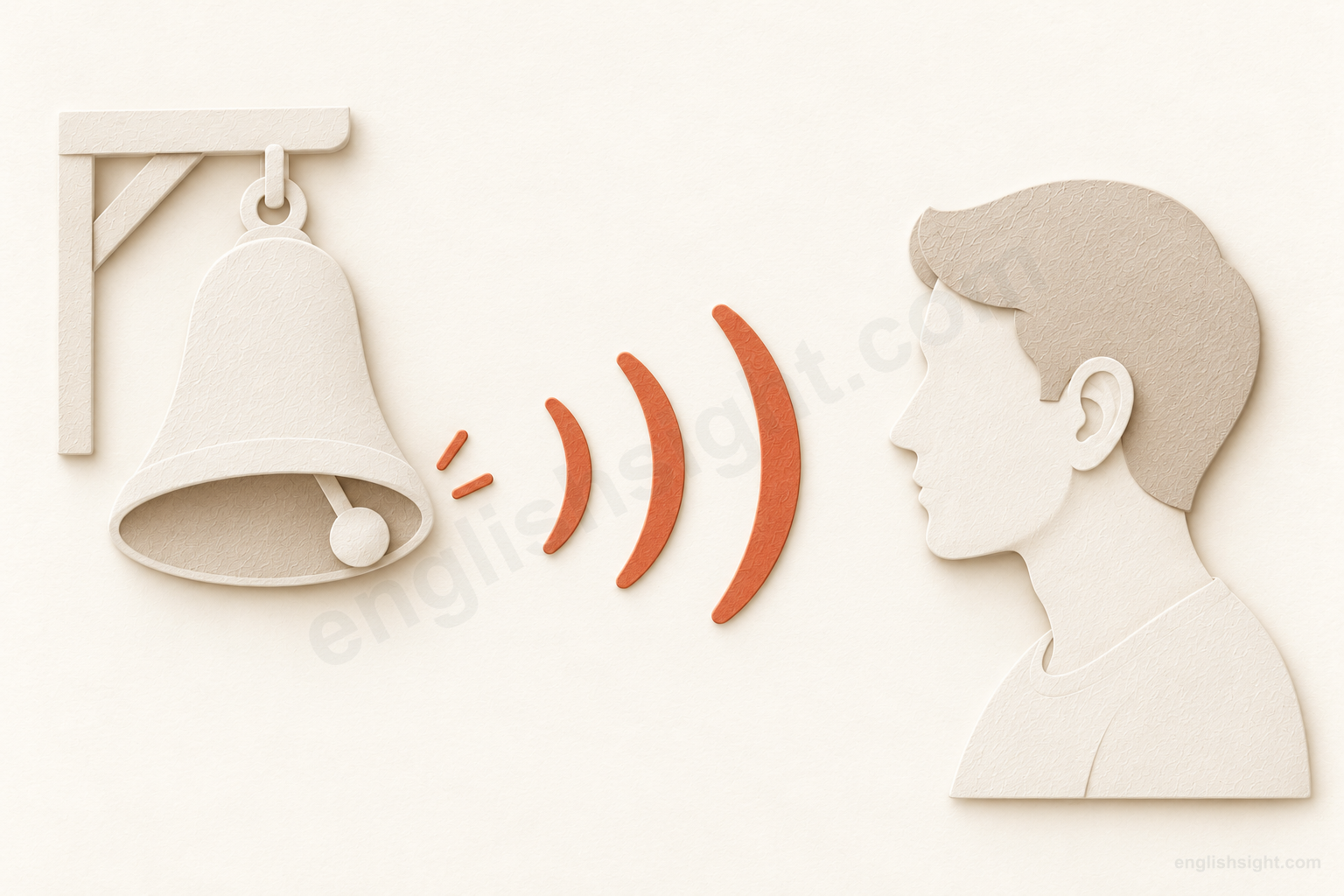
The bell rings as its clapper meets the rim.
sound
The listener can hear the bell.
Vibrations spread through the air.
Sound travels from a vibrating source to a listener; the arcs symbolize its propagation.
A source vibrates, the vibration travels through a material, and a listener may hear the resulting sound.
The curves connect a ringing bell with an ear. Sound good extends to an impression from information, including writing. The adjective meaning reliable or intact and the sea noun are separate branches, not effects of vibration.
Sound names what reaches our hearing; as a verb it can describe producing that effect or the impression a voice or description creates. The same spelling also has separate meanings, including the adjective in sound advice and the geographical noun on a map.
Use the source-to-hearing sketch as a starting point for the acoustic family. It is a teaching model with limits, not a universal picture in every English speaker’s mind.
01
Things we hear
Distinguish an individual sound, sound as a physical phenomenon, recorded audio, and the characteristic sound of a voice or music.
01
hear / make + a sound; not + a sound
a sound / sounds / not a sound
an individual thing that you hear
Situation or evidence
Something happens out of sight.
Meaning or result
Your ears detect a particular noise.
Sound names what is heard; hear names perception.
A sound can be a click, a laugh, a musical note, or another audible event. Use a for one event and sounds for several: Two short sounds came from the speaker.
Not make a sound and not hear a sound emphasize complete quiet. Noise often suggests an unwanted disturbance; sound is a more neutral choice. A voice is specifically the sound a person produces when speaking or singing.
In a sentence
I heard a faint sound behind the cupboard.
Watch the difference Use hear a sound for perception, not sound a sound. Say too much noise when complaining generally about a disturbance.
02
the sound of + noun / someone doing something; at the sound of…; without a sound
the sound of… / at the sound of…
identify a source or a reaction to hearing it
Situation or evidence
Rain begins tapping on the roof.
Meaning or result
You recognize what produces the noise.
Of names the source; at can introduce the trigger for a reaction.
The sound of rain identifies what you hear. The sound of someone doing something can name an activity: the sound of children singing. The of-phrase need not describe ownership.
At the sound of the bell, everyone stood up describes a response when the bell was heard. Without a sound means silently. These are noun phrases with prepositions, not phrasal verbs.
In a sentence
I relaxed at the sound of rain tapping on the roof.
Watch the difference The sound of the rain is the audible effect; the rain itself is the source.
03
sound + travels / carries; the speed of sound; a sound wave
sound travels / the speed of sound
talk about sound as a physical phenomenon
Situation or evidence
A source vibrates.
Meaning or result
Vibrations travel through a material and may reach an ear.
Uncountable sound refers to the phenomenon rather than one audible event.
In Sound travels through water, sound has no a because we are discussing the phenomenon generally. A sound wave and two sound waves count waves instead.
The speed of sound names a physical quantity. Break the sound barrier refers to moving faster than sound in the surrounding medium. This physical branch motivates the sketch, but it does not explain the unrelated adjective sound.
In a sentence
Sound can travel through both air and water.
Watch the difference Sound needs a material medium; the sketch’s curves are a symbol for propagation, not visible objects.
04
turn + the sound + up / down / on / off; sound quality / effects / system
turn the sound up / down / off
control or describe recorded audio
Situation or evidence
A video is playing too quietly.
Meaning or result
You increase its audio level.
Sound here is the audio component, not one noise.
The sound can mean the audio from a device or recording. Turn the sound up/down changes volume; turn it off removes the audio. Turn it on restores it.
Sound quality describes clarity or other qualities of the audio. Sound effects are added noises in a film or game, and a sound system is equipment for playing audio. In turn the sound off, turn is the verb: this is different from the verb phrase sound off.
In a sentence
The picture is clear, but the sound keeps cutting out.
Watch the difference For a general audio problem, say There is no sound, not There is no voice unless a person’s voice is specifically missing.
05
a vowel / consonant sound; sound + a letter
a vowel sound / sound the letter
distinguish pronunciation from written spelling
Situation or evidence
You see a written word.
Meaning or result
You identify the spoken sounds or pronounce a letter.
A letter is a written symbol; a sound is heard.
A speech sound is a unit heard in pronunciation. A vowel sound or consonant sound is not the same thing as the name of a letter. In ship, sh represents one consonant sound.
The verb sound can also mean pronounce a written letter: In this pronunciation, we do not sound the final r. This wording is often used in explanations of pronunciation; say or pronounce is an accessible alternative.
In a sentence
The letters ph represent the /f/ sound in phone.
Watch the difference Do not assume that each written letter produces a separate sound.
06
someone’s sound; develop / change + a sound
the band’s sound
describe a characteristic musical style or tone
Situation or evidence
A group combines voices and instruments.
Meaning or result
Listeners recognize a distinctive musical effect.
Sound can describe how the whole music comes across.
A band’s sound includes its characteristic tone, arrangement, and style. Their sound is warmer on this album compares an overall effect, not simply the volume.
We tried several sounds can refer to different musical tones or styles. In a music context, informal sounds may also mean music, but the singular their sound is useful for describing a distinctive identity.
In a sentence
The band has a gentle sound built around acoustic guitars.
Watch the difference A louder recording is not necessarily a different musical style.
02
How something sounds to someone
The linking verb describes an impression from a voice, a noise, or information. The complement says what sort of impression you mean.
07
like + the sound of + noun / pronoun; by / from the sound of it / things
like the sound of it / by the sound of it
react to an idea or infer a situation from information
Situation or evidence
Someone describes a possible trip.
Meaning or result
You judge the prospect without experiencing it.
Sound can refer to the impression conveyed by a description.
I like the sound of that expresses a positive reaction to a suggestion or prospect. I don’t like the sound of it can express concern about what someone reports.
By the sound of it and from the sound of things mean judging from the information available. The information can be written; an actual noise is not required. It and things refer back to the situation already under discussion.
In a sentence
A small cabin beside the lake? I like the sound of that.
Watch the difference This is a reaction to a prospect, not necessarily a comment about its acoustics.
08
person / voice / noise + sound + adjective
sound tired / sound strange
describe a voice or what it suggests about a person
Situation or evidence
A friend speaks slowly over the phone.
Meaning or result
You infer tiredness from the voice.
A linking verb connects the subject to a description.
You sound tired describes an impression of the person, often from their voice. Your voice sounds strange describes the audible quality itself. Neither sentence says the person deliberately makes a particular noise.
Use an adjective after linking sound: She sounds happy. To describe how she performs the action of speaking, use an adverb with speak: She speaks happily. The choice depends on what is being described.
In a sentence
You sound tired; shall we talk tomorrow?
Watch the difference Sounds happily does not ordinarily replace sounds happy in this linking construction.
09
thing / idea + sound + adjective + (to someone); make + object + sound + adjective
sound good to me / make it sound easy
evaluate information or shape someone’s impression
Situation or evidence
You read an outline of a plan.
Meaning or result
You assess it from the description.
The impression can come from information rather than a literal noise.
The plan sounds practical means that, from what you know, it seems practical. To me identifies the evaluator. Sound does not guarantee the plan will work.
Make something sound easy means describe or present it so that it seems easy. Make supplies the causative structure; sound still describes the impression: The instructions make the repair sound easy, but it takes practice. Use make it sound, without to, after make.
In a sentence
The new timetable sounds reasonable to me.
Watch the difference It sounds good reports an impression; it is good makes a more direct evaluation.
10
sound like + noun phrase; sound + noun phrase (especially British English)
sound like + a person or thing
compare an audible effect or a described situation
Situation or evidence
You hear a rhythmic noise.
Meaning or result
You compare it with a familiar source.
Like introduces the thing used as a comparison.
Sound like a drum compares the noise with a drum’s sound; it does not prove a drum is present. You sound like your sister can compare voice, wording, or attitude, depending on context.
That sounds like a good idea evaluates a suggestion. Sound + noun phrase without like is also possible, particularly in British English: That sounds a sensible choice. Sound like a sensible choice is a useful general pattern. Sounds suspiciously like… often humorously suggests excessive similarity or copying.
In a sentence
That tapping sounds like someone typing.
Watch the difference Use sounds good with an adjective and sounds like a good idea with a noun phrase; do not add like before every adjective.
11
sound + as if / as though + clause; sound like + clause (informal)
sound as if / as though…
give an impression about a whole situation
Situation or evidence
A person speaks with obvious excitement.
Meaning or result
You infer something about their news.
A clause expresses the situation suggested by the evidence.
It sounds as if you got the job means the evidence suggests that you got it. You sound as though you are pleased connects the impression to the person speaking.
Sound like + clause is common in conversation: Sounds like you had fun. As if or as though is a useful choice in formal writing. Sound does not normally take seem’s to-infinitive pattern: use He sounds tired or It sounds as if he is tired, rather than He sounds to be tired.
In a sentence
It sounds as though the meeting finished early.
Watch the difference As if does not automatically mean the situation is unreal; here it can introduce a reasonable inference.
12
(that / it) sounds good; (it) sounds like a plan; (does that) sound familiar?
Sounds good! / Sounds like a plan! / Sound familiar?
accept a suggestion or invite recognition
Situation or evidence
Someone suggests a time and place.
Meaning or result
You signal agreement in a short reply.
Conversational replies can leave out an understood subject.
Sounds good! and Sounds like a plan! commonly accept a suggestion. We could meet at six. — Sounds good! means you agree to the arrangement. These are uses of the linking verb, not promises that a noise will be pleasant.
Sound familiar? is short for Does that sound familiar? It asks whether someone recognizes a description or recurring situation. The full question uses does + sound, while the statement That sounds familiar has sounds.
In a sentence
“Shall we meet outside the library?” “Sounds like a plan!”
Watch the difference Sounds good can also literally describe audio; the preceding suggestion makes the agreement meaning clear.
03
Making sounds, giving signals, and speaking
These are actions rather than simply impressions. Learn the whole expression, especially the two different uses of sound out.
13
device + sound; person + sound + horn / bell / alarm
the alarm sounded / sound the horn
produce an audible signal or cause it to be produced
Situation or evidence
The timer reaches zero or a driver needs to warn someone.
Meaning or result
A device emits a signal.
The subject may be the source or the person activating it.
The alarm sounded describes a device making a noise. The driver sounded the horn has a person as subject and the sound-producing device as object. The second pattern causes the device to sound; it does not mean the driver heard it.
You can also say the horn was sounded, though an active sentence is often simpler. Horn wording varies: honk the horn is especially familiar in American English. Sounded is the past tense and past participle; sounding can describe an action in progress, as in The siren is sounding.
In a sentence
The guard sounded the bell when the visitors arrived.
Watch the difference An object is possible in this action use, unlike the linking verb in The bell sounds harsh.
14
sound the alarm about / over + issue; sound a note of + caution / optimism
sound the alarm / sound a note of caution
warn people or publicly express an attitude
Situation or evidence
Someone notices a serious risk.
Meaning or result
Other people are alerted to it.
A signal can be a spoken or written warning rather than a ringing device.
Sound the alarm can mean activate an alarm or warn people about danger. In Researchers sounded the alarm about falling water levels, no siren is required.
Sound a note of caution means express a cautionary view. A note of optimism expresses hopefulness instead. Note supplies the idea of a particular tone or attitude; learn these combinations together rather than treating every noun after sound as a warning.
In a sentence
The report sounded a note of caution about the rapid expansion.
Watch the difference Sound the alarm and raise the alarm overlap; sound alarmed instead describes how worried someone seems.
15
event + sound the death knell for + something
sound the death knell for…
signal or bring about the end of something
Situation or evidence
A project depends on its last source of funding.
Meaning or result
That support disappears and the project faces its end.
An established bell metaphor conveys final failure.
A death knell was a bell associated with a death. Figuratively, an event that sounds the death knell for a business, hope, or practice signals or brings about its end.
This dramatic expression is useful when reading news and commentary. It is stronger than sounding a note of caution: caution allows for avoiding trouble, while the death-knell image presents an ending.
In a sentence
Losing the grant sounded the death knell for the research project.
Watch the difference No actual bell or human death is necessary in the figurative expression.
16
sound + someone + out + about / on + topic; sound out + someone’s views
sound someone out about / on…
ask questions to discover a person’s view or intention
Situation or evidence
You do not know whether a colleague supports an idea.
Meaning or result
Careful questions reveal their reaction.
Sound out investigates another person’s position.
Sound someone out means explore what they think, often indirectly before making a formal proposal. Sound out their interest or sound out public opinion puts the attitude itself in the object position.
With a noun, both sound out the team and sound the team out are possible. Put a personal pronoun between the verb and particle: sound them out. About or on introduces the topic. This is an established expression, not a literal sound leaving a person.
In a sentence
I’ll sound Maya out about sharing the office before we make an offer.
Watch the difference Say sound her out, not sound out her. It does not mean persuade her or announce your own opinion.
17
sound out + a word; sound + a word / it + out
sound a word out
work out a written word through its component sounds
Situation or evidence
A learner meets an unfamiliar written word.
Meaning or result
They say its sounds and blend them to read it.
The object is a written word, not a person whose views are being explored.
Sound out a word means produce the sounds represented by its letters or letter groups, then combine them. A child might sound out ship as /ʃ/ /ɪ/ /p/ and then say ship.
Both sound out the word and sound the word out are possible; with it, say sound it out. This does not mean recite the letter names: s-h-i-p spells the word, whereas sounding it out uses pronunciation. The same surface phrase has a different use when its object is a person.
In a sentence
She paused to sound out the unfamiliar word.
Watch the difference Letter groups such as sh can represent one sound; sounding out is not necessarily one sound for every letter.
18
sound off + (about / on + topic)
sound off about…
express an opinion forcefully, often as a complaint
Situation or evidence
A person is annoyed by a decision.
Meaning or result
They speak loudly or emphatically about it.
The speaker puts their own opinion forward.
Sound off about something often describes a loud or aggressive complaint. In British usage it commonly conveys disapproval of the speaker’s behavior. American use can also mean freely expressing a strong opinion, so context and tone matter.
This phrase has no direct object in the complaint pattern: He sounded off about the delays. It differs from sound someone out, which seeks another person’s view. In the sound is off, sound is a noun and off describes muted audio.
In a sentence
He kept sounding off about the new parking fees.
Watch the difference Sound off is not the usual neutral way to say give an opinion.
19
like / love / be fond of + the sound of + one’s own voice
like the sound of your own voice
enjoy talking too much without listening
Situation or evidence
A speaker keeps dominating the discussion.
Meaning or result
Others have little chance to contribute.
The expression criticizes excessive talking rather than vocal beauty.
Someone who likes or loves the sound of their own voice enjoys talking at length, often with little interest in listening. The phrase normally expresses disapproval.
It is not usually praise for a pleasant singing voice. Compare I like her voice, which can simply compliment its audible quality. The reference to one’s own voice is part of the established criticism.
In a sentence
He loves the sound of his own voice and rarely lets anyone finish.
Watch the difference Use this criticism carefully; it is stronger than saying someone is talkative.
04
Reliable, intact, thorough, or deeply asleep
The adjective sound belongs to a separate historical branch. Learn its combinations directly; good advice and an intact roof are not types of noise.
The adjective evaluates reliability rather than audible quality.
Sound advice is advice you can reasonably trust. Sound reasoning uses dependable thinking, and sound evidence gives a reliable basis for a conclusion. Sound reasons can justify a choice.
Sound commercial sense and an environmentally sound policy evaluate whether a choice works by relevant standards. The noun determines the standard: logically sound does not mean the same thing as financially sound. The opposite adjective is unsound.
In a sentence
Her suggestion to keep a copy of the receipt was sound advice.
Watch the difference In The advice sounds sound, the first word is a linking verb and the second is an adjective meaning sensible.
21
be + structurally / mechanically / financially + sound; be of sound mind
structurally / financially sound
be intact, healthy, stable, or secure in the relevant respect
Situation or evidence
An inspection checks for weaknesses.
Meaning or result
The item or organization is judged to be in good condition.
The modifier identifies which kind of weakness is absent.
A structurally sound roof has no relevant structural defect. A financially sound organization has a stable financial position. The word can also describe healthy body parts or a sound mind; of sound mind is formal wording about mental capacity.
Sound does not simply mean silent. A noisy machine may be mechanically sound, while a quiet one may be damaged. Check the noun and modifier to identify the property being evaluated.
In a sentence
The old bridge is still structurally sound.
Watch the difference A sound investment is a judgment about its merits or reliability, not a guarantee of future profit.
22
arrive / return / be + safe and sound; be + (as) sound as a bell
safe and sound / as sound as a bell
reassure someone that a person or thing is unharmed
Situation or evidence
A difficult journey causes concern.
Meaning or result
The traveler arrives without injury.
Sound here means intact or well, not making noise.
Safe and sound often reassures someone after danger, travel, or a period of uncertainty. The adjectives describe the traveler in They arrived safe and sound; they do not describe the manner of making a sound.
As sound as a bell is an informal idiom meaning in excellent condition. It can describe someone’s health or a thing’s condition. Learn the whole comparison; do not infer that a person is loud or bell-shaped.
In a sentence
Please text when you get home safe and sound.
Watch the difference Keep the usual order safe and sound; safely and soundly is not a replacement for this set phrase.
23
a sound knowledge / understanding / grasp of + subject
a sound knowledge / understanding of…
have a substantial and dependable grasp of a subject
Situation or evidence
Someone prepares for work requiring expertise.
Meaning or result
They have enough well-established knowledge to work competently.
Sound describes the strength of the knowledge, not its volume.
A sound knowledge of a subject means a solid and sufficiently thorough grounding. A sound understanding or grasp similarly describes dependable comprehension.
This is useful in job requirements and education: Applicants need a sound understanding of basic accounting. It need not mean they know every possible detail. Of links the knowledge to its subject matter.
In a sentence
The role requires a sound understanding of data privacy.
Watch the difference You can say sound knowledge without a in some contexts, but do not use knowledges for ordinary subject knowledge.
24
a sound + performance / player / piece of work
a sound performance
do a competent, dependable job
Situation or evidence
A player completes a match with few mistakes.
Meaning or result
Their performance is assessed as solid.
Sound can praise competence without claiming brilliance.
A sound performance is solid and dependable. A sound player is capable and makes few serious errors. In this use, sound may be measured praise rather than a claim of outstanding achievement.
Compare The performance sounded good: that sentence describes an impression, perhaps from hearing it. A sound performance directly evaluates how well the person or team performed.
In a sentence
The goalkeeper gave a sound performance despite the pressure.
Watch the difference Sound is not always a synonym for exceptional; the degree of praise depends on context.
25
have + a sound sleep / a sound night’s sleep; be + sound asleep; sleep soundly
a sound sleep / sound asleep
sleep deeply and with little disturbance
Situation or evidence
A tired person falls asleep.
Meaning or result
They sleep deeply.
The adjective and fixed adverb pattern express depth of sleep.
A sound sleep or a sound night’s sleep is deep and restful. A sound sleeper is someone who tends to sleep deeply. These expressions do not mean the person makes noises while asleep.
In sound asleep, sound is an adverb intensifying asleep: The baby is sound asleep. Soundly is the ordinary related adverb with sleep: She slept soundly. Do not generalize sound asleep into a rule allowing sound before any adjective or verb.
In a sentence
By ten o’clock, both children were sound asleep.
Watch the difference Sound asleep is correct; sound sleeping is not the equivalent everyday pattern.
05
A separate word on maps
A sound can also be a stretch of sea. This geographical noun is a separate branch, not a metaphor for hearing.
26
a sound; [place name] + Sound
a sound (waterway)
recognize a geographical noun in place names
Situation or evidence
A map labels a coastal stretch of water.
Meaning or result
You recognize a type of sea passage or inlet.
This noun has a different history from the word for something heard.
A sound can be a sea passage between larger stretches of water or between an island and the mainland; the term is also used for certain inlets or bays. It occurs particularly in place names.
The spelling and pronunciation match the hearing noun, but a waterway is not called a sound because it makes a noise. The exact geographical form depends on the place, so do not expect every named Sound to have identical proportions.
In a sentence
The boat crossed the sound before the weather changed.
Watch the difference Read the map or context: crossed the sound here describes water travel, not crossing a noise.
Check the word’s job in the sentence
Sound, noise, voice, hear, and listen
Sound is a neutral general word for an audible effect. Noise often suggests disturbance. Voice belongs to speaking or singing. Hear describes perception; listen describes directing attention. Sound as a linking verb describes how something comes across.
Forms and action versus impression
Pronunciation is /saʊnd/. Verb forms are sound, sounds, sounded, sounding; sounded has an extra syllable /ˈsaʊndɪd/. The linking use normally takes a simple tense: It sounds good. Action uses can be progressive: They are sounding out potential partners. Only object-taking action uses form ordinary passives: The alarm was sounded. Make it sound convincing is a causative construction, not a passive.
More adjective uses and regional language
A sound beating means a severe beating; this is a forceful adjective use, not an audible beating. British informal sound can also convey approval, roughly good or dependable; local uses and standalone responses vary. Sounder and soundest compare the adjective, not the noun or verb.
Coverage boundary
The lesson covers everyday hearing, audio, impressions, signals, major expressions, and the main adjective uses, with brief recognition of the sea noun. Specialist sounding for water depth, medical instruments or examinations, whale-diving senses, formal legal uses, military sound off, and derived technical compounds need their own contexts. They cannot be predicted from the sketch.
Choose the meaning that fits
Read the subject, complement, and situation before choosing.
1. A friend’s voice gives you the impression that she is worried. Which sentence fits?
2. You want to find out privately whether a colleague supports a proposal. Which phrase fits?
3. The baby is sleeping deeply. Which sentence says that?
4. The guard activates a bell. Which sentence describes the action?
5. The roof is structurally sound. What does sound mean here?
6. A teacher asks a learner to sound a new word out. What should the learner do?
Sources and teaching notes
The linked dictionaries support the usage inventory; the phonics guidance supports sounding out written words. Explanations, examples, and the diagram were created for this lesson. The acoustic sketch is a teaching interpretation, not an explanation of every homograph.
The sketch explains the acoustic branch; it is not a shared mental picture for all speakers.