Use soup for food, distinguish amounts from servings, and recognize the expressions that go beyond the bowl.
Liquid and ingredients form a dish
A liquid dish with ingredients
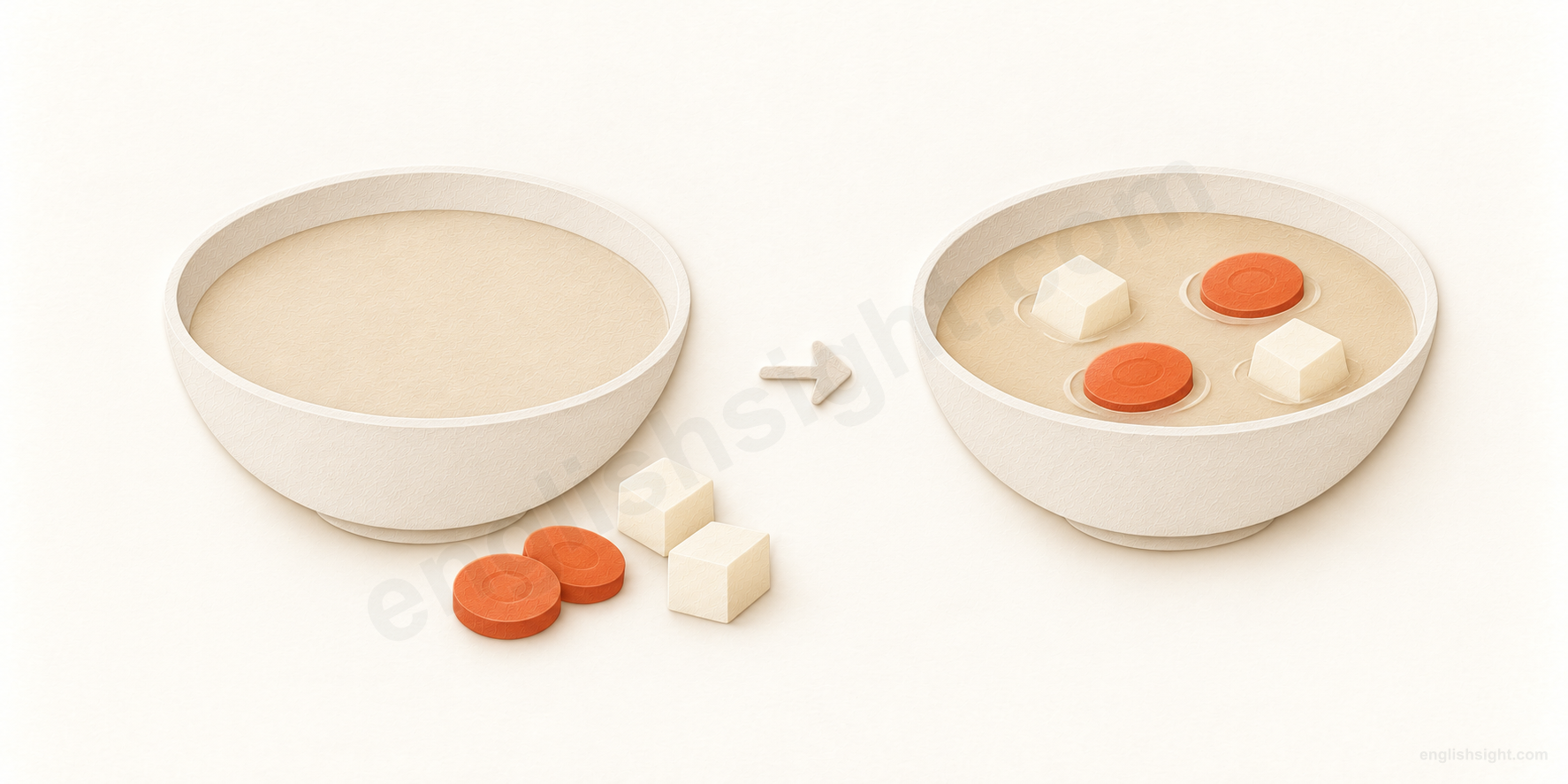
A liquid base and prepared food pieces are shown separately.
soup
The liquid surrounds the pieces in a bowl of soup.
The food pieces join the liquid to form one dish.
Liquid and ingredients form one dish. This version has pieces; smooth soup also fits.
Soup is a dish with a liquid base and food ingredients, blended smooth or left in pieces.
The sketch shows one soup with visible pieces. Smooth soups, cold soups, and different serving containers belong to the same food sense; the fixed expressions need separate explanations.
Start with soup as something you eat: ingredients form a dish with a liquid base. This simple connection supports food descriptions and some comparisons with mixtures.
It does not predict every expression. In the soup, from soup to nuts, and soup up have meanings to learn as complete units. The image is a teaching aid, not a claim about a picture shared by every English speaker.
01
Food, servings, and recipes
Start with the dish itself, then distinguish an amount, a serving, and a kind. The surrounding words specify ingredients, preparation, and the place of soup in a meal.
01
have / eat + soup; soup for + meal; soup as a starter
have soup for lunch
eat a liquid dish as part or all of a meal
Situation / starting point
You are choosing what to eat.
Meaning in context
You choose soup, with bread alongside it.
Soup names the food; have describes eating it in this meal.
Soup /suːp/ is a noun for a dish with a liquid base and food ingredients. Pieces may remain, or the ingredients may be blended smooth. Water is a common base, but the word does not require plain water or visible chunks.
Have soup and eat soup are both natural. Here have means eat, rather than own. For lunch gives the meal; soup as a starter gives its role before another course. Soup can also be a main dish.
The bowl illustrates a way of serving the food, not part of the definition. Soup can be served in a cup, and cold soup is still soup.
In a sentence
We had soup and bread for lunch.
Watch the difference Do not assume that soup must be hot, thin, or only the first course.
02
some / a little + soup; a bowl / cup of soup; two soups
some soup / two soups
refer to food as an amount or count separate servings
Situation / starting point
You are ordering for two people.
Meaning in context
The server brings two separate portions.
An uncountable food noun can have a countable serving use.
For an amount, say some soup, a little soup, or more soup. A bowl of soup counts the bowlful explicitly; two bowls of soup counts two portions. The noun soup stays singular in that phrase.
In an order, two soups can mean two servings. The situation supplies the serving unit: Two soups, please. A soup can likewise mean one order in a restaurant. Outside that setting, a bowl of soup is clearer.
Soups can also mean varieties, as in three different soups. Ask whether you are counting portions or kinds; the plural alone does not decide.
In a sentence
Could we have two soups and one salad, please?
Watch the difference For an unspecified amount, say some soup, not a soup; a soup is possible when one serving or kind is intended.
03
ingredient noun + soup; the soup of the day; canned / tinned soup
tomato soup / the soup of the day
name a soup by its ingredient or the day’s menu choice
Situation / starting point
You read the café menu.
Meaning in context
You ask which soup is being offered today.
A modifier or an of-phrase identifies the kind or menu choice.
In tomato soup, chicken soup, and vegetable soup, the first noun identifies an ingredient or style; soup is the head noun. These are noun combinations, not new verbs. The same grammar lets a menu offer several soups.
The soup of the day is the soup selected for that day’s menu. The phrase does not identify the ingredients, so asking What is the soup of the day? is useful. What’s today’s soup? is another natural way to ask about it.
Homemade soup describes preparation; canned soup describes packaging. British English also uses tinned soup and a tin of soup; American English commonly uses canned soup and a can of soup. The container does not change the food sense.
In a sentence
What is the soup of the day: tomato or vegetable?
Watch the difference A name such as vegetable soup does not by itself specify every ingredient or the cooking liquid.
04
make / serve / ladle out + soup; thick / thin / creamy soup; soup + utensil noun
make / serve thick soup
prepare the dish, give portions, or describe its consistency
Situation / starting point
You cook the ingredients in liquid.
Meaning in context
You serve the finished dish in bowls.
The verb supplies the action; thick describes the food’s consistency.
Make soup means prepare it. Serve soup means give it to people to eat; ladle out soup describes using a large serving spoon to transfer portions. These are ordinary verb–noun combinations, not phrasal verbs containing soup.
Thick soup has a substantial consistency; thin soup has a more fluid one. Creamy describes a texture or a cream-like quality, while watery often criticizes a soup for having too much water or too little flavor. These adjectives do not create separate noun senses.
In a soup bowl or soup spoon, soup modifies the name of a utensil. Contrast a bowl of soup, which refers to the container with its contents. An empty soup bowl is still a soup bowl.
In a sentence
I made a thick vegetable soup and served it in small bowls.
Watch the difference A soup bowl names a kind of bowl; a bowl of soup names a serving with soup in it.
02
Compounds and mixtures
Some combinations name a service or a particular soup. Others use the idea of ingredients mixed together to describe something quite different from food.
05
a soup kitchen; volunteer at a soup kitchen
a soup kitchen
a place that provides free meals to people in need
Situation / starting point
People need food but cannot afford a meal.
Meaning in context
A service offers meals without charging them.
This established compound names a charitable food service.
A soup kitchen provides free soup or other food to people who need it and cannot pay. It is not just any kitchen in which soup happens to be cooked.
Kitchen is the countable head: a soup kitchen, two soup kitchens. The service may offer a full meal rather than soup alone. The connection is to providing food, not to a special recipe.
In a sentence
She volunteers at a soup kitchen on Sundays.
Watch the difference Do not use soup kitchen as the ordinary name of a restaurant specializing in soup.
06
a soup of + components; primordial soup
a soup of chemicals
a liquid or dense mixture described by comparison with soup
Situation / starting point
Many substances are mixed together.
Meaning in context
A writer describes the mixture as a soup.
The extension borrows the idea of materials mixed in a liquid.
Outside food, soup can describe a mixture that resembles a soup in consistency or in containing many components. A soup of chemicals need not be edible. The of-phrase identifies the things mixed together.
Primordial soup names a proposed early mixture associated with the origin of life. Dense fog may also be described informally as soup. These comparisons do not turn the substances or weather into food.
Read the setting before interpreting the bowl image literally. This family is a resemblance-based extension; it does not explain the separate idioms in the next group.
In a sentence
The sample contained a soup of chemicals from several sources.
Watch the difference Soup is not a neutral replacement for mixture in every context; it suggests a liquid, density, or components mingled together.
07
alphabet soup; an alphabet soup of + plural noun
alphabet soup
letter-shaped pasta soup, or a confusing mix of abbreviations
Situation / starting point
A document uses many unfamiliar letter names.
Meaning in context
You find its mixture of abbreviations hard to follow.
The figurative expression treats abbreviations as letters mixed in soup.
Literally, alphabet soup contains pasta shaped like letters. The figurative use is informal: an alphabet soup of abbreviations, agencies, or technical terms is a confusing collection, especially of initials and shortened names. It can also describe a confusing mixture more generally.
The food image makes the connection memorable: many separate letters appear together. But the figurative phrase comments on confusing language or a mixed collection; it is not simply another name for the alphabet.
The expression is normally uncountable. An alphabet soup of agency names packages one particular collection; the article does not count individual letters.
In a sentence
The guide explains the alphabet soup of abbreviations used on the form.
Watch the difference Letter names in a technical document suggest the figurative meaning; pasta on a menu suggests the literal dish.
03
Expressions to recognize as a whole
These informal expressions have established meanings. Neither the bowl nor the separate words reliably predicts them; learn their context and regional limits.
08
be / get into / land someone in the soup
be in the soup
be in trouble
Situation / starting point
You miss an important deadline.
Meaning in context
You face consequences and a difficult situation.
In the soup is an informal idiom for trouble.
If someone is in the soup, they are in trouble. Be describes the state; get into the soup or land someone in the soup describes entering or causing that state. In the example, the missed deadline creates the difficulty.
Keep the in this fixed expression. Literal in the soup can instead locate an ingredient in food: There are beans in the soup. The subject and situation distinguish the two readings.
The idiom is informal. In trouble is a straightforward alternative when you want neutral wording. Its established meaning cannot be predicted just by looking at a bowl.
In a sentence
We’ll be in the soup if we miss the deadline again.
Watch the difference The idiom uses the soup; in soup without the is not its usual fixed form.
09
from soup to nuts
from soup to nuts
from the beginning through the end, including everything
Situation / starting point
A course covers the whole process.
Meaning in context
You can follow every stage from planning to completion.
The food sequence stands for complete coverage.
From soup to nuts means from beginning to end or in full detail. It is an informal North American expression. A guide can explain a process from soup to nuts without discussing any food.
The meal reference helps explain the expression: soup can begin a meal and nuts can end it. This is a memory aid for the established phrase, not a claim that all meals follow that order.
Use the whole sequence from soup to nuts. From start to finish is a neutral alternative, particularly when the idiom may be unfamiliar to the reader.
In a sentence
This workshop covers the project from soup to nuts.
Watch the difference Do not interpret nuts as a limit on ingredients when the topic is a project or process.
10
task / problem / opponent + be + duck soup
be duck soup
be easy to handle or defeat
Situation / starting point
You expect a task or opponent to be difficult.
Meaning in context
An experienced person judges it easy.
This North American informal expression is an evaluation, not a recipe.
Duck soup can describe an easy task or a problem that is easy to deal with. It can also describe an opponent who is easy to defeat. This is an informal North American use to recognize, rather than a neutral expression required everywhere.
For an ordinary description, say easy or an easy opponent. In a cooking context, duck soup can of course mean actual soup made with duck; context determines which reading fits.
In a sentence
After fixing the wiring, replacing the switch was duck soup.
Watch the difference The idiom does not mean the task involves ducks, soup, or cooking.
04
The separate verb expression soup up
Soup up is an informal phrasal verb about modification. It can concern actual power or a more exciting presentation, and has its own word order.
11
soup + object + up; soup up + noun; be souped up; a souped-up + noun
soup up an engine
modify something to make it more powerful
Situation / starting point
A vehicle has its original engine performance.
Meaning in context
Changes give the engine more power.
Soup up is a transitive, separable phrasal verb.
To soup up an engine, a car, or a computer is to modify it to increase power or performance. This informal verb expression is separate from the ordinary food noun; adding soup is not involved.
With a noun, soup up the engine and soup the engine up are both possible. With a pronoun, put it between the verb and particle: soup it up, not soup up it. The object is the thing modified.
Forms are soup, soups, souped, souping. A passive is possible: The engine has been souped up. Before a noun, the adjective is hyphenated: a souped-up engine. Do not spell the verb as suped up.
In a sentence
They souped up the engine before the race.
Watch the difference Say soup it up when the object is a pronoun.
12
soup up + presentation / music / version; soup it up
soup up a presentation
make something more exciting or impressive
Situation / starting point
A presentation is plain and unengaging.
Meaning in context
Added sound or visual effects give it more impact.
The same phrasal verb extends from power to presentation.
Soup up can also mean add features or effects that make music, writing, or a presentation more interesting or exciting. The object is something being enhanced, rather than an engine gaining horsepower.
The informal wording suggests an intensified or embellished version; it does not guarantee better substance. A souped-up version may have more impressive features while keeping the same basic material.
The particle and object order stay the same as in the engine use. This is a second established use of the whole expression, not a new meaning contributed by the food noun alone.
In a sentence
They souped up the presentation with animation and sound effects.
Watch the difference For neutral formal writing, enhance or make more engaging may fit the context better.
Keep the food, grammar, and fixed phrases distinct
Soup and stew overlap, but the names matter
Soup is a liquid dish. A stew is a dish of meat or vegetables cooked slowly in liquid, often in a covered container. A thick soup does not automatically become a stew; use the established name for the dish rather than a strict thickness test.
Count the intended thing
Some soup treats the food as an amount; two bowls of soup counts portions explicitly. Two soups may count orders or varieties. In a soup bowl, soup describes the utensil, so the bowl may be empty.
There is no general verb meaning eat soup
Use eat soup, have soup, or make soup for everyday actions. Soup up is the separate informal verb expression taught here. Ordinary noun phrases do not have tense, passive, or causative forms; those questions apply to the verb construction.
Scope and register
The food uses come first for daily communication. Regional informal idioms are included for recognition without a frequency ranking. Specialist slang for photographic developer or explosives, older dress terms, and individual regional recipes are outside this lesson.
Read the whole expression
Choose the meaning that fits the situation and grammar.
1. You order “two soups” at a café for yourself and a friend. What are you normally counting?
2. You take a clean, empty soup bowl from a shelf. Which statement is true?
3. “We lost the keys. We’re in the soup now.” What does the second sentence mean?
4. The computer needs more power. Which informal request uses the phrasal verb correctly?
5. A manual explains a repair “from soup to nuts.” What coverage does that promise?
Sources and teaching notes
Dictionary pages support the uses and register labels below. Explanations, example sentences, and the visual teaching model were written for this lesson.
The diagram helps explain the food sense; it is not a picture shared by every native speaker.