South: a direction, a region, and a few extensions.
Locate something opposite north, then let the construction specify the relationship.
Opposite north
Opposite north
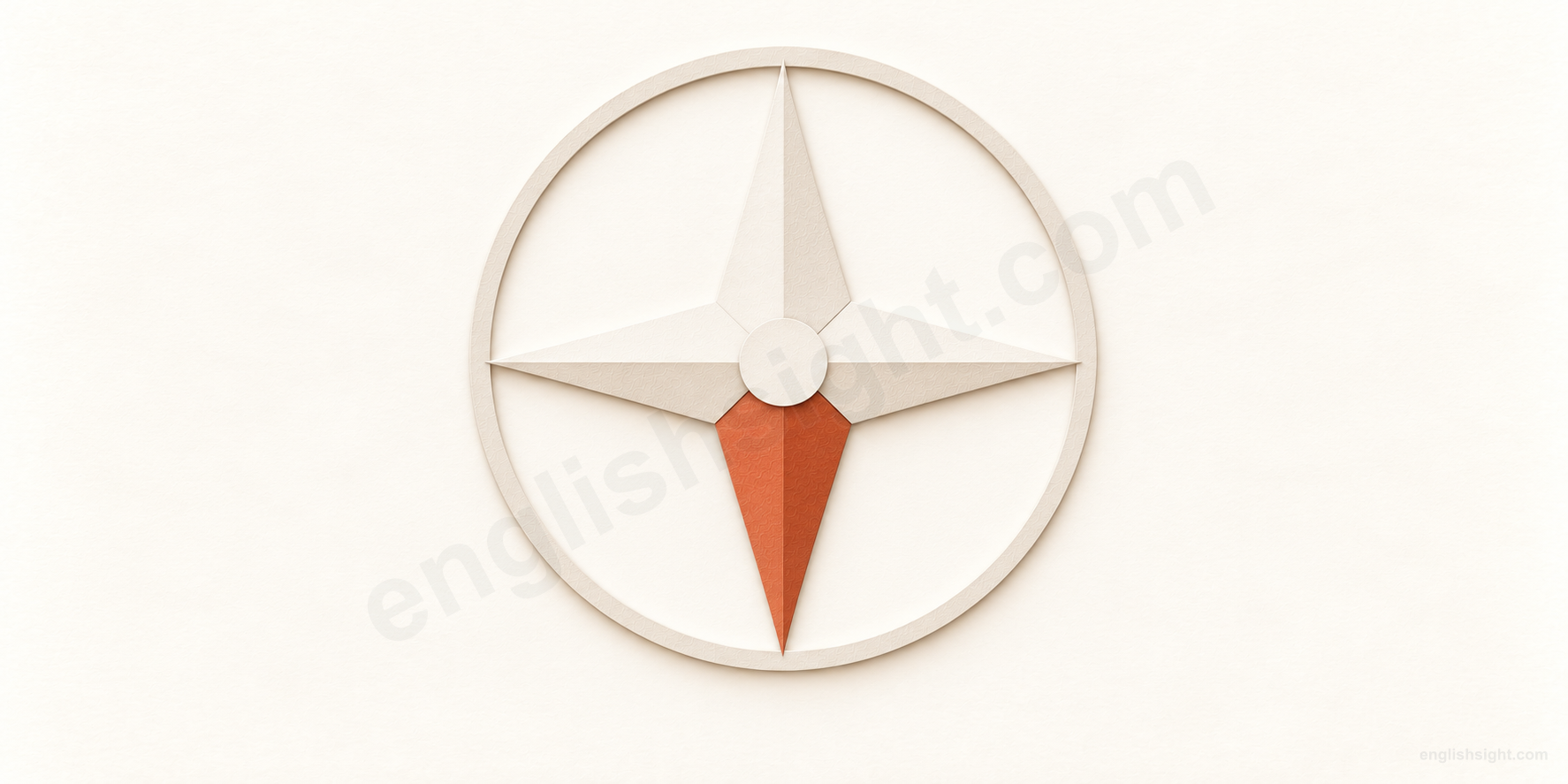
Use the upper arm as the north reference.
south
The orange lower arm marks south.
Find the opposite direction across the centre.
On this north-up compass diagram, orange marks south, opposite north.
South identifies the compass direction opposite north; a place can lie in that direction from a reference point.
The compass sketch highlights a direction, not a journey or a change of state. Its north-up layout is a map convention; regional labels and figurative expressions need their own explanations.
South gives a fixed geographical orientation. You can travel south, live south of a river, or live in the south of a country; those expressions describe different relationships.
This lesson connects the compass meaning with everyday descriptions and established expressions. The diagram is a teaching model, not a claim that all English speakers share one mental picture.
01
Find a direction or place
A compass direction stays fixed when you turn around. Use the surrounding words to distinguish movement, relative position, and an area within a larger place.
01
Which way is south?; the south; from / towards the south
Which way is south?
ask for the compass direction opposite north
Situation / reference
You need to orient a map.
Meaning in context
You identify the direction marked S.
South is a compass direction, independent of which way you face.
South /saʊθ/ names one of the four main compass directions; S is its usual map abbreviation. North and south are opposites, as east and west are. In Which way is south?, south names the direction without an article.
A phrase such as from the south names an origin; towards the south names a direction. On a north-up map, south is lower on the page. Rotate the map and the page position changes, while the compass direction remains the same.
In a sentence
Which way is south on this map?
Watch the difference South is not your right-hand side unless you are facing east.
02
go / drive / head / turn / face + south; due south
go / head / face south
move or look in a southerly direction
Situation / reference
You reach a road junction.
Meaning in context
Your route continues towards the south.
The verb supplies movement or orientation; south supplies direction.
Drive south and head south describe a route. Face south describes orientation without any travel: Our balcony faces south. South is an adverb in these patterns, so no to is needed directly before it.
Due south means exactly south rather than roughly that way: The island lies due south of us. Further south compares positions along this direction: We stopped further south. Neither phrase means a lower physical height.
In a sentence
At the junction, turn south and follow the river.
Watch the difference Say head south, not head to south. You can also say head towards the south.
03
be / lie + (distance) + south of + place; to the south of + place
south of / to the south of
locate one place on the southern side of another
Situation / reference
You know where the station is.
Meaning in context
You use it as a reference for the hotel.
Of introduces the reference place, not a destination.
South of compares two locations. The shorter form fits naturally after a distance. The hotel lies to the south of the station gives the same directional relationship without specifying a distance.
Just south of the station means nearby on its southern side. In the south of the city instead selects a part inside the city. A reference point can also be an area: a village south of the lake.
In a sentence
The hotel is two kilometres south of the station.
Watch the difference South of the city gives a relative position; it does not mean inside the city’s southern part.
04
in / from / to + the south + of + area; in the south
in the south of
identify the southern part of a larger area
Situation / reference
You divide an island into broad regions.
Meaning in context
You locate the village within its southern part.
The larger place contains the area being described.
The south can name a region rather than a single direction. In the south of the island describes location within that part; from the south describes origin, and to the south can describe a destination when the region is understood.
The context can supply the larger place: There will be rain in the south. Ordinary directional descriptions use lowercase south; established regional labels may use South. Follow the context and the publication’s capitalization style.
In a sentence
My grandparents live in the south of the island.
Watch the difference In south of the island is incomplete here: use in the south of the island.
05
live / work / stay / go + down south
down south
informally refer to being in or going to a country’s southern part
Situation / reference
You talk casually about where your cousin lives.
Meaning in context
You identify a broad southern region.
Down adds a familiar geographical framing, not a downhill route.
Down south is an informal way to refer to a southern region: She works down south describes location; She went down south describes movement. The verb tells you which is meant.
This established phrase needs neither in nor to before down: They live down south. Its downward framing fits a north-up map, not a claim about altitude. Which southern region is intended depends on the conversation.
In a sentence
My cousin moved down south last year.
Watch the difference Down south does not by itself name a particular town or guarantee warmer weather.
02
Describe a side, a wind, or a name
South can come before a noun. A south wind has a special directional convention, and established place names keep their own wording.
06
south + noun; south-facing + noun
the south side / coast
select the part or boundary oriented towards the south
Situation / reference
A building has several entrances.
Meaning in context
You identify the entrance on its southern side.
South modifies a noun; the noun names the feature.
The south entrance selects an entrance by position; the south coast selects a coast. South works before the noun, and it does not take -s for several features: the north and south gates.
A south-facing window looks towards the south. Position and orientation are related but different: a room on the south side of a building can still have a window facing east. The noun and construction make the relationship precise.
In a sentence
Please meet us at the south entrance of the museum.
Watch the difference For the direction an entrance faces, say The entrance faces south. The entrance is south of us instead describes its position.
07
a south wind; a wind from the south
a south wind
a wind arriving from the south
Situation / reference
Air arrives from the southern direction.
Meaning in context
You name the wind by where it comes from.
Wind directions name the source, not the destination.
With wind, south identifies the source. Compare The birds flew south, where south identifies the birds’ direction of travel. Reading the same direction word with a different noun changes the relationship.
Use from to make the origin explicit: The wind is blowing from the south. South alone does not tell you whether the air is warm, cold, gentle, or strong; that depends on the weather and location.
In a sentence
A south wind carried smoke towards the village.
Watch the difference A south wind comes from the south; it is not a wind travelling south.
08
South + geographical name
South Africa / South America
use South as part of an established geographical name
Situation / reference
You name a country or continent.
Meaning in context
The capital letter marks part of its name.
A place name is a fixed label, not a freely interchangeable description.
Keep the capital S in established names such as South Africa, South Korea, and South America. Learn the full name: replacing South with southern can change the reference, rather than merely changing the style.
Contrast South Africa with the south of Africa, which describes a part of the continent. Article choice follows the complete name: in South Africa, without the, but in the South Pacific. South alone does not determine the article.
In a sentence
Leila grew up in South Africa.
Watch the difference South Africa names a country; southern Africa describes a wider region.
09
south side / southern side; southern + regional description
south / southern
choose between a compass label and a broader regional adjective
Situation / reference
You want to describe where something is or what region it is associated with.
Meaning in context
You choose the form that fits the noun and intended reference.
There is overlap, but the forms are not interchangeable in every expression.
South and southern can both locate something: the south side and the southern side. Southern also describes regional associations, as in southern cooking or a southern accent. It is useful for broader descriptions, not just a compass point.
Keep ordinary combinations and proper names intact. Southern Spain describes a region within Spain. South Africa is the country name, not Southern Africa. Pronunciation changes too: south /saʊθ/, southern /ˈsʌðən/ in British English and /ˈsʌðərn/ in American English.
In a sentence
We explored southern Spain by train.
Watch the difference Southern is an adjective: say drive south, not drive southern.
03
Recognize named regions
The South can identify a conventional region. Geography alone does not tell you its boundaries or social meaning; the topic and location matter.
10
in / from / across + the South
the South
refer to a recognized southern region, especially the southern United States
Situation / reference
You are discussing regions of the United States.
Meaning in context
The South identifies a conventional regional area.
The capitalized regional label carries contextual and historical associations.
In a US context, the South commonly names the southern states as a region. If you hear She is from the South, the discussion helps establish which country is meant. Other countries can also have a region called the South.
The label can matter culturally and historically as well as geographically. Do not infer an exact list of states from the word alone. For a neutral relative location, use south of a named reference point.
In a sentence
Her research examines music in the American South.
Watch the difference The South is not a precise universal boundary or another name for every place south of you.
11
the Global South; countries in / of the Global South
the Global South
recognize a broad development term for countries generally described as developing or less economically wealthy
Situation / reference
An article compares economic and political relationships between groups of countries.
Meaning in context
You recognize a collective label, not a compass instruction.
This term groups countries in a development context.
The Global South, also called the South in this context, broadly refers to countries described as developing or as having less economic wealth and industrial development. The term appears in discussions of development and global inequality. It does not mean that all these countries have identical conditions.
The map model helps explain the geographical wording, but cannot define this social and economic grouping. The term is not simply equivalent to the Southern Hemisphere; check how a particular writer defines the group.
In a sentence
The report compares access to university education across the Global South.
Watch the difference Do not decide membership by drawing a line along the equator.
04
Understand the figurative expressions
Some expressions use the familiar lower position of south on a north-up map as a teaching link to a lower value or a worsening situation. Learn the complete expressions.
12
things / a plan / sales + go south; head south
go south
informally describe decline, failure, or a situation becoming worse
Situation / reference
A plan is working reasonably well.
Meaning in context
Problems make it start to fail.
The whole expression describes deterioration, not a compass route.
In this informal expression, a situation can go south when it deteriorates; a number such as sales can go south when it falls. Collins labels the expression US informal. It is useful in casual reports, but a precise word such as declined may suit a formal report better.
A downward graph can help you remember the numerical use. That is a teaching link, not a rule that south always means bad. Context also permits heading south for falling results; a vehicle heading south normally has the geographical meaning.
In a sentence
The launch went south when the booking system stopped working.
Watch the difference Compare They went south by train: a travel context usually gives the literal direction.
13
south of + number / amount; just south of + amount
south of a number
informally indicate a value lower than a stated amount
Situation / reference
You discuss a budget limit.
Meaning in context
The amount remains below that figure.
Of introduces a numerical reference value instead of a place.
In informal language, especially American or financial usage, south of a figure means less than that figure. Just south of $500 places the value slightly below $500. The number is a threshold; no travel is involved.
Contrast south of the station, a spatial relationship, with south of $500, a numerical one. North of a figure has the opposite comparison. For an unambiguous price limit, below $500 or less than $500 is a straightforward alternative.
In a sentence
We kept the total cost south of $500.
Watch the difference South of $500 means below $500; it does not mean a reduction of $500.
Keep the direction and the construction together
Three everyday word classes
South /saʊθ/ is a noun for a direction or region, an adjective before a noun, and an adverb giving direction or position. Ordinary direction uses do not need a verb form of south. Rare verb, astronomy, church-orientation, and card-game uses are outside this introductory lesson.
Choose the reference and the preposition
Go south gives a direction; come from the south gives an origin; south of the city compares locations; in the south of the city places something within a region. They are not interchangeable versions of one sentence.
Names and context
Capitalize South in established names and conventional regional labels; ordinary compass directions usually use lowercase. Neither a south-facing room nor down south guarantees sunshine or warm weather.
Limits of the picture
South is not inherently down, worse, or less. North-up maps offer a memory aid for established figurative expressions, but cannot predict the meanings of arbitrary combinations.
Read the relationship
Choose the expression or interpretation that matches the context.
1. The café is inside the city’s southern district. Which sentence makes that clear?
2. You want to tell someone to travel towards the south. Which instruction is natural?
3. A forecast mentions a south wind. Where does this wind come from?
4. “Our plan went south after the supplier cancelled.” What is the likely meaning?
5. A bill is “just south of $100.” Which amount fits?
6. You mean the country whose cities include Cape Town. Which form is its name?
Sources and teaching notes
The linked dictionary entries support the meanings and constructions. The explanations, examples, exercises, and compass sketch were created for this lesson. The diagram is a teaching interpretation.
The sketch explains a compass relationship; it does not represent a mental image shared by every speaker.