Use space for available room, separate places, intervals, freedom, and the world beyond Earth.
Room around and between things
Notice what occupies an area—and what remains available
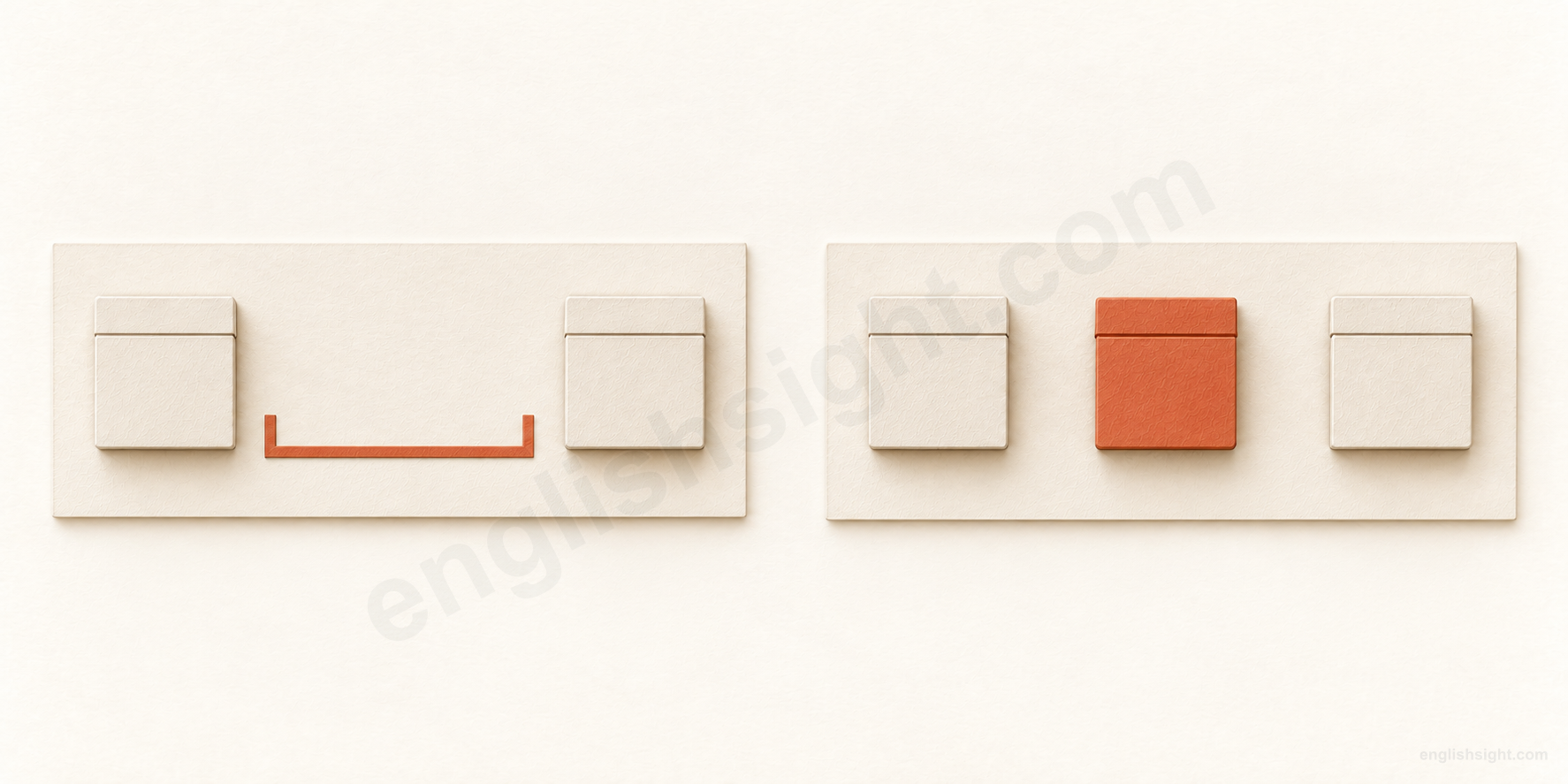
Two boxes leave room between them.
space
A third box occupies part of that space.
The marked gap is available for another box.
A gap provides room for another box; space need not stay empty.
Space is the extent around and between things that can be occupied, left open, or used.
The sketch highlights a usable gap on one surface. A space need not remain empty, and general space includes occupied positions. The freedom, time, and attention expressions need their own explanations.
Notice both the objects and what surrounds or separates them. Space can name room available for something, one usable area, or the wider extent in which things exist.
Time and freedom can also be described as space. Outer space and conversational expressions have established uses of their own. The physical model connects several branches; it does not mechanically explain every phrase.
01
Room, places, and gaps
Ask how much room is available, identify one usable place, or describe the distance left between things. Countability depends on what you are measuring or identifying.
01
space for + noun; space to + verb; space for + person + to + verb
enough space for / to…
a usable amount of room
Situation
You want to put another chair beside the table.
What space refers to
You assess whether the available area is large enough.
Uncountable space measures room; for names a thing or person, and to introduces an activity.
In There is enough space for a chair, space is an amount rather than one separate place. Some space, any space, much space, little space, no space, and plenty of space work this way. Ask How much space do we need?
Space for the children names who needs the room. Space to play names an activity, and space for the children to play combines both. Enough space does not say that the room is completely empty; it says enough remains available for the purpose.
Room often substitutes for space when you mean capacity: There is room for a chair. A room, however, normally means a separate part of a building. A place identifies a location rather than measuring available room.
In a sentence
Is there enough space for another chair?
Watch the difference Ask How much space? for an amount and How many spaces? for separate places or gaps.
02
a / the + space; two / several + spaces
a parking space / an empty space
one identifiable area or place
Situation
You reach a car park and look for somewhere to leave the car.
What space refers to
You identify one available parking place.
A space is one place; spaces counts several separate places.
A parking space is a single place for one vehicle. A parking lot or car park contains many such spaces. Empty spaces in a row, spaces in a cupboard, and a space on the sofa similarly identify particular areas.
Compare There is no space for the car with There are no parking spaces. The first measures available room; the second counts designated places. The physical situation may be similar, but the grammatical viewpoint changes.
Space does not always mean currently vacant. Our car occupies the last space still calls that marked place a space. Context can identify an area by its function even after it is filled.
In a sentence
We found a parking space beside the library.
Watch the difference Say a parking space, not a parking, when you mean one marked place.
03
make / clear + (some / a) space + for + noun
make / clear space for…
make room available for something
Situation
Boxes cover the surface you want to use.
What space refers to
Moving them leaves an area available.
Make or clear describes an action; space names the room that becomes available.
Make space for something means arrange things so that it can fit or be included. Clear a space often suggests removing objects from one particular area: Clear a space on the counter.
Make room for is a close everyday alternative. The usual expression is make space, without a, when the focus is the amount available; make a space is possible when one distinct gap is meant.
Space to work describes what the available area allows. In Make space for a guest, for introduces the intended user, not the person doing the moving.
In a sentence
Please move those boxes to make space for the printer.
Watch the difference Make space is a verb plus a noun object; it is not a phrasal verb of space.
04
take up / occupy / save / waste + space
take up / save / waste space
occupy or manage available room
Situation
A large item fills much of a small area.
What space refers to
Less room remains for other uses.
The accompanying verb says whether space is occupied, saved, or used poorly.
An item takes up space because its size or position uses part of the available area. Occupy space is a more formal alternative. The object need not be moving or actively doing anything.
Save space means use less room, for example by folding furniture or stacking containers. Waste space says the room is used inefficiently. A space-saving design describes a design intended to need less room.
The same capacity viewpoint applies to storage: a large file can take up space on a device. Do not assume that take up space always means physical furniture.
In a sentence
The folding table saves space when we are not using it.
Watch the difference Take up belongs to the verb take. Space is its noun object here.
05
space between + A + and + B; leave / create + space
leave space between…
keep an interval between people or things
Situation
Two objects or people could be too close together.
What space refers to
A gap separates them.
Between names the two sides of the gap; space names the separation available.
Leave space between A and B asks for a gap, not another object. Space between the boxes can be uncountable when its amount matters; a narrow space between them identifies one particular gap.
In transport, leaving space can provide a safety margin. In sport, a player in space has room away from opponents to receive the ball or move. Creating space means making that room available; it does not mean constructing a room.
Space and distance overlap, but distance measures how far apart things are. Space often emphasizes the usable or unoccupied area between them.
In a sentence
Leave some space between the desk and the wall.
Watch the difference Use between A and B, not between A to B.
06
purpose noun + space; a / an + describing word + space; a sense of space
office space / a shared space
an area used for a purpose
Situation
Several people need somewhere to work.
What space refers to
A building or part of it provides a working area.
The modifier names the use; space can mean an amount or a particular venue.
Office space, living space, floor space, and storage space usually discuss room available for those uses. Office space is expensive focuses on capacity or property, without counting separate rooms.
A shared space or an exhibition space identifies one usable area or venue. It may contain furniture and people. This sense is broader than a completely empty patch.
A feeling or sense of space describes an impression of openness. Mirrors or a simple layout can create that impression without increasing the actual floor area.
In a sentence
The ground floor includes a shared space for workshops.
Watch the difference Do not add an article automatically: We need more office space measures an amount.
07
open / green + space; open / green + spaces
open space / green spaces
outdoor land with few or no buildings
Situation
A neighbourhood has buildings and areas left undeveloped.
What space refers to
Residents can use parks or other open land.
Open and green select an outdoor land use, not the region beyond Earth.
Open space can refer to outdoor land kept free of buildings. Open spaces counts distinct areas. Wide open spaces emphasizes broad, relatively unobstructed land.
Green space usually means land with grass, trees, or other vegetation, especially in a town. Green spaces can be individual parks or planted areas. Open space need not all be green.
These expressions describe the character or use of land. They do not guarantee that nobody is present or that every part is accessible.
In a sentence
The plan protects green spaces near the school.
Watch the difference In open space may describe open land; in outer space has a different established meaning.
02
Writing, pages, and digital storage
A page has blank areas and limited room for content. A device has storage capacity. The surrounding words identify which kind of space matters.
08
write in / fill in + a space; a space between words
a blank space / spaces between words
an empty part of written or typed material
Situation
A form has an area reserved for an answer.
What space refers to
Writing can fill that blank area.
Count individual blanks or character gaps; use uncountable space for the total room available.
Write in the space provided directs you to a particular empty area. Fill in the blank spaces asks you to supply missing information. The page is the surface; a space is a portion of it.
A space between words separates them in writing. In typing, a space is also a blank character inserted with the space bar. A blank line is a whole empty line, so it is not always the same as one space.
White space in a layout is the area left without text or pictures. It can make a page easier to scan; it is not necessarily wasted room.
In a sentence
Type your name in the space below.
Watch the difference A space can be one blank character; space is also the amount of room on the whole page.
09
space for + content; advertising space
space for an article / advertising space
room allocated to content
Situation
A publication has limited pages or display area.
What space refers to
Only some material will fit.
The limitation is how much content can be included, not how many empty rooms exist.
We have no space for another article means the publication cannot allocate enough room for it. The available page or screen area is treated as a resource.
Advertising space is room offered for advertisements, for example on a website or in a magazine. Buying advertising space does not mean buying the physical newspaper or the website itself.
Compare a blank space in an article, which identifies a gap, with space for an article, which concerns the capacity to include the whole item.
In a sentence
There is not enough space for both photos on this page.
Watch the difference Space is usually uncountable when you discuss the amount allocated to content.
10
free / available + space; run out of / free up + space
free space / run out of space
available capacity for storing digital information
Situation
Your device already contains many files.
What space refers to
It may lack capacity for another download.
Free means available here; it does not mean that the device costs nothing.
Disk space, storage space, and memory space refer to capacity in a computer or other device. A file takes up space even though you cannot see it occupying a physical gap on the screen.
Free up space means make capacity available, often by removing unwanted files. Run out of space means have no usable capacity left; be short of space means have too little for the purpose.
Storage and working memory are different resources. The noun before space and the surrounding task tell you which capacity is being discussed.
In a sentence
My phone has run out of space for new videos.
Watch the difference Free space is available capacity; a free space can identify one particular vacant place.
03
People, freedom, and time
Physical distance can protect comfort. Space can also mean freedom from pressure or a period available for thinking, resting, or change.
11
need + space; give + person + space + to + verb
need space / give someone space
have freedom and time without pressure
Situation
Someone is being asked for an immediate decision.
What space refers to
They want time to think independently.
The person needs freedom from demands; extra floor area may be irrelevant.
I need some space can ask for privacy, emotional distance, or time without pressure. Give someone space means allow that freedom. The situation determines whether physical separation is also intended.
Space to think or space to develop names what the freedom is for. It is not an instruction to abandon the person permanently, and it does not by itself announce the end of a relationship.
Compare space for a chair, which concerns physical capacity. The freedom meaning is an established extension; a literal gap alone cannot tell you exactly what kind of support someone wants.
In a sentence
Please give me some space to decide what I want.
Watch the difference Say Give me some space, with the person before space; not Give space me.
12
someone’s personal space; invade / respect + personal space
respect someone’s personal space
avoid uncomfortable physical closeness
Situation
Another person stands closer than you are comfortable with.
What space refers to
You want them to leave more room around your body.
Personal space can concern physical comfort, not just being left alone to think.
Invade someone’s personal space means come too close in a way they find intrusive. The boundary is not a fixed distance shared by everyone; it varies with people, relationships, and circumstances.
Personal space can also refer to privacy and independence, as in I need my own personal space. Context distinguishes that sense from literal bodily distance.
Compare give me some space while a person is crowding you with the same request during an argument. The wording overlaps, but one may ask for a step back and the other for relief from pressure.
In a sentence
Could you step back a little and respect my personal space?
Watch the difference Do not assume that personal space means a privately owned room.
13
a safe space for + people; a safe space to + verb
a safe space
a setting where people can feel protected from harm or hostile judgment
Situation
People may be reluctant to discuss a difficult experience.
What space refers to
A supportive setting helps them speak more freely.
Safe describes the social conditions, not the size or emptiness of an area.
A safe space can be a place or organized setting intended to protect people from harm or criticism. In a support group, the phrase emphasizes how participants are treated.
It is countable: a safe space, several safe spaces. The meaning comes from the combination, rather than from space alone. A physically large hall is not automatically a safe space.
In a sentence
The group offers a safe space to talk about difficult experiences.
Watch the difference A safe space describes an intended environment; the phrase alone does not prove that every person will feel safe.
14
give / allow + person + (some / a) breathing space; space to breathe
some breathing space / space to breathe
a pause or relief from pressure
Situation
Tasks or problems leave almost no time to recover.
What space refers to
A delay provides time to rest or plan.
Breathing is a familiar metaphor for relief, rather than necessarily a problem with air.
Breathing space can mean time in which pressure eases and you can recover or prepare. Give us some breathing space and give us a breathing space are both possible; the first emphasizes the amount of relief.
Space to breathe can likewise mean a chance to recover during a difficult period. The expression does not promise that the underlying problem has been solved.
Breathing space can also mean enough physical room to move comfortably, for example in a crowded place. The situation, not breathing alone, selects the literal or figurative reading.
In a sentence
Moving the deadline gives us some breathing space.
Watch the difference A breathing space is temporary relief; it need not be a formal holiday or a complete solution.
15
in / within the space of + duration; in a short space of time; a space of + duration + between…
in / within the space of…
during a specified period
Situation
Several changes occur close together in time.
What space refers to
You state the short span containing them.
Of introduces the length of time; in or within places events inside that span.
In the space of a week presents a week as the period during which something happens. In a short space of time similarly emphasizes a relatively short duration.
Within the space of an hour means before the end of that hour-long span. The expression often highlights how much happens in limited time; it is not a physical location.
Leave a space of two days between meetings instead treats time as an interval separating events. Duration and separation are related viewpoints, but the surrounding construction decides which is intended.
In a sentence
We received three invitations in the space of an hour.
Watch the difference Say in the space of an hour or in an hour, not in space of an hour.
04
Outer space and wider domains
Space also names the region beyond Earth’s atmosphere and the extent in which things exist. Business speech sometimes uses it for a field of activity.
16
in / into / from + space; outer space; space + noun
in space / into outer space
the region beyond Earth’s atmosphere
Situation
You are discussing a satellite or space mission.
What space refers to
The location or destination is beyond the atmosphere.
In marks location and into marks movement; space usually has no article in this meaning.
In space describes where something is. Into space describes movement or sending something there. Outer space makes the astronomical meaning explicit, and from space gives a viewpoint or origin.
Space travel, space exploration, and a space station use space before another noun. In a space station, the article a belongs to station; it does not make astronomical space countable.
Compare in the space between two buildings, where the identifies a particular area. Outer space is a conventional meaning, and it is not literally free of all matter.
In a sentence
The satellite sends pictures of Earth from space.
Watch the difference Normally say an astronaut in space, not an astronaut in the space, for the general astronomical region.
17
space and time; three-dimensional space
space and time
the extent in which things exist and move
Situation
You are discussing position, dimensions, and events generally.
What space refers to
Space is treated as the setting for physical locations.
This sense includes occupied positions; it is broader than unused room.
In discussions of space and time, space is not just the gaps between objects. It is the extent in which objects have positions and movement is possible.
Three-dimensional space refers to dimensions such as height, width, and depth. Ordinary discussion does not require a claim that space is an absolutely empty container or an endless region.
This branch explains why space can be used even when emptiness is not the point. Technical theories and mathematical definitions need their own fuller treatment.
In a sentence
The model shows how objects move through three-dimensional space.
Watch the difference Do not define every use of space as complete emptiness.
18
in / within the + field name + space
the education space
a field of business activity
Situation
You are discussing what kind of market a company serves.
What space refers to
You locate its work in a business field.
The space is a domain of activity, rather than premises that the company rents.
In business conversation, the education space or the healthcare space can mean that industry or area of activity. This is informal business language.
Compare office space, which usually means physical working premises. A company in the education space might operate online and have very little office space.
For a general audience, the education sector or education industry may be clearer. This use is an established domain metaphor; an empty gap in a picture will not identify the industry.
In a sentence
The company develops software in the education space.
Watch the difference Recognize the business register; do not use space for every field when a simpler word is clearer.
05
Established conversational expressions
Learn these combinations with their situations and tone. Their meanings cannot all be predicted from a picture of an empty gap.
19
look / stare / gaze + into space
stare / gaze / look into space
look ahead without focusing on anything in particular
Situation
A person looks ahead while lost in thought.
What space refers to
Their gaze has no particular visible target.
Into space describes an unfocused gaze; it does not require looking at the sky.
Someone staring into space may be thinking, shocked, or simply not attending to the surroundings. The phrase describes the lack of a fixed target for the gaze, not a specific cause.
Stare, gaze, and look can occur in this expression. They retain their usual differences in manner, while into space supplies the idea that no particular object is being watched.
Compare stare at the screen, where at identifies a target. A person can stare into space while sitting indoors.
In a sentence
Maya sat by the window, staring into space.
Watch the difference This expression does not mean that Maya is watching planets or stars.
20
watch this space + (for + news / details)
Watch this space.
expect further news here
Situation
You can announce a plan but cannot give details yet.
What space refers to
You invite people to look for a later update.
The whole expression promises or suggests more information, rather than asking for a fixed stare.
Watch this space is an informal announcement that more news will follow. It suits notices, newsletters, websites, and playful conversation about a developing plan.
For details or for an announcement can specify what the audience should expect. This refers to a place for updates, but in conversation it can simply mean wait and see what happens.
In a sentence
We are planning a new evening class—watch this space for dates.
Watch the difference It is a fixed invitation to await news, not a literal instruction to keep watching an empty area.
21
be + a waste of space
a waste of space
a strongly negative judgment of usefulness
Situation
Someone is frustrated with an ineffective thing or person.
What space refers to
They dismiss it or them as useless.
The expression conveys contempt; it does not simply measure physical size.
Calling something a waste of space says you think it has little or no value. It may occupy very little room; the judgment is about usefulness.
Applied to a person, it is a harsh insult. Understanding the expression helps with reading or listening, but it is unsuitable for a neutral assessment.
Compare This arrangement wastes space, which can be a practical comment about layout. This machine is a waste of space dismisses the machine itself.
In a sentence
That broken dispenser is a waste of space.
Watch the difference Do not treat a waste of space as a polite synonym for a person who needs help.
06
The verb: arrange intervals or lose attention
Space things means arrange their separation in distance or time. Space out also has a separate informal meaning about attention; check whether it has an object.
22
space + objects + distance + apart; be spaced + evenly / at intervals; space + objects + out
space things apart / evenly
arrange the distance between objects
Situation
Several items must be placed along a surface or line.
What space refers to
You position them with chosen gaps.
The verb takes the arranged things as its object; apart or evenly describes their distribution.
Space the hooks evenly means choose positions with equal intervals. Space the hooks ten centimetres apart specifies the distance. Space by itself does not always require perfectly equal gaps; evenly adds that requirement.
Passive forms are common because the layout is the focus: The hooks are spaced ten centimetres apart. They can describe the resulting arrangement without naming who placed them.
Space the labels out can emphasize leaving gaps. With a noun, space out the labels and space the labels out are possible. With a pronoun, say space them out, not space out them.
In a sentence
Space the hooks twenty centimetres apart.
Watch the difference Use space as a transitive arranging verb here: space the hooks, not the hooks space apart.
23
space + events / payments + out + over + period; space out + noun; space + pronoun + out
space events / payments out over…
spread a series across a period
Situation
Several tasks would otherwise occur too close together.
What space refers to
You arrange intervals between them.
The gaps are in time; over introduces the whole period containing the series.
Space out the meetings means avoid putting them all close together in time. Space the meetings out over a month names the period across which you distribute them.
Space out payments means arrange them at intervals rather than making them all at once. This says how payments are distributed; it does not itself say they are cancelled or reduced in total.
The object can come before or after out when it is a noun. A pronoun goes between: space them out. The passive is natural too: The meetings are spaced out over a month.
In a sentence
We spaced the training sessions out over six weeks.
Watch the difference Space out a series concerns its arrangement; it does not mean that the whole series is simply postponed.
24
person + space out; be / feel / look + spaced out
space out / feel spaced out
stop attending to what is happening
Situation
Someone is talking, but your attention drifts.
What space refers to
You miss part of what they say.
Without an object, informal space out can describe losing attention; it is a separate established meaning.
I spaced out means I stopped paying attention or became mentally disconnected from the surroundings. The arranging meaning has an object: I spaced the chairs out. Do not use an arrow or a literal gap to predict this attention meaning.
Spaced out can be an informal adjective for a dazed or inattentive state: I felt spaced out. The expression can occur in contexts involving drugs, but the words alone do not establish a cause.
The progressive is possible for the activity: I was spacing out. Compare The chairs are spaced out, where the chairs are arranged with gaps. The subject and context distinguish the readings.
In a sentence
Sorry, I spaced out and missed the last question.
Watch the difference Space out them is not the pronoun pattern for arranging; I spaced out has no arranged object at all.
Choose the meaning from the construction
An amount or one place?
Space is uncountable for an amount of room, freedom, or the astronomical region. A space or spaces identifies one or more particular areas, gaps, or usable venues. Compare How much space? with How many parking spaces? The time sense is normally singular: a space of two days, the space of an hour, or a short space of time.
A useful connection, with limits
Available room and intervals support the physical model. A time span, freedom from pressure, a business field, and fixed expressions need their own contexts. This is a teaching model, rather than an account of every speaker’s mental picture or a proof of word history.
Read the verb and its object
Forms are space, spaces, spaced, spacing; drop the final e in spacing. Space things is transitive and often passive. Space out separates in the arranging sense: space them out. The informal attention meaning is intransitive: I spaced out.
Scope of this lesson
The lesson covers common modern noun uses, arranging in distance and time, selected compounds, and familiar idioms. Mathematical spaces, musical notation, printing hardware, and specialist physics require separate explanations. A large sense count is not a frequency ranking.
Which kind of space?
Use the situation, countability, and sentence structure to choose the meaning.
1. You want to know whether another suitcase will fit. Which question asks about the amount of available room?
2. You mean an astronaut is beyond Earth’s atmosphere. Which expression fits?
3. A friend says, “Give me some space to think.” What is the likely request?
4. You want three interviews distributed across a week. Replace interviews with a pronoun.
5. Someone says, “I spaced out and missed your question.” What happened?
6. Three messages arrived in the space of ten minutes. What does space identify?
Sources and teaching notes
Usage and constructions were checked against the publisher pages below. The explanations, examples, and compatibility sketch are original teaching material; the visual model is an interpretation.
The diagram highlights a useful relation; individual speakers may understand the word without picturing it.