Start with the digging tool, then separate the card meanings and fixed expressions.
A tool defined by the work its blade does
Cut into soil, then lift or turn it
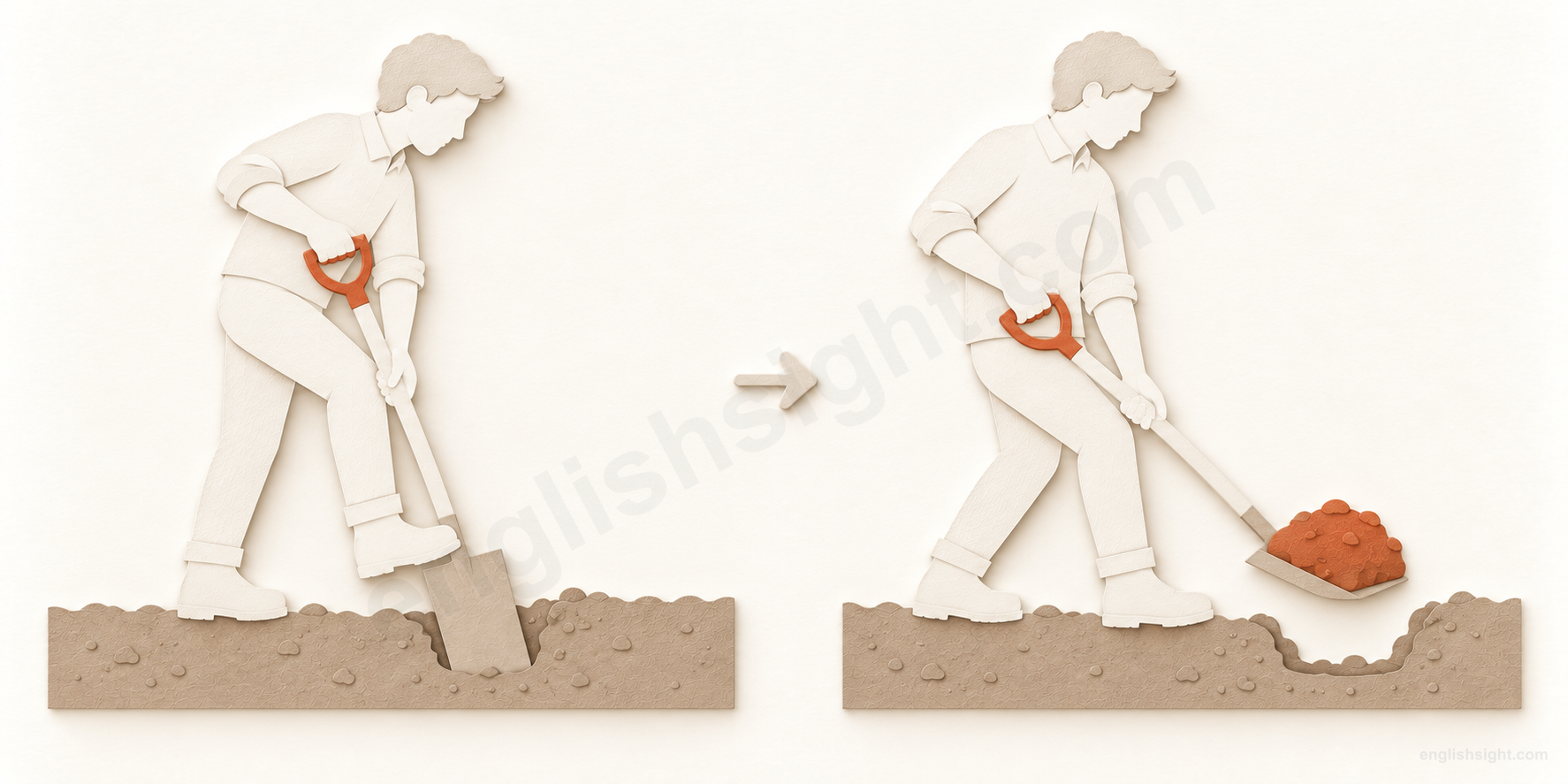
The gardener presses the spade blade into the soil.
spade
The tilted blade lifts the soil above the opening.
The blade cuts into the ground and supports a piece of soil.
A spade cuts into soil, then lifts a piece.
A spade is a broad-bladed tool made to cut into soil and lift or turn it.
This functional model anchors the tool noun and its related verb. The card branch and the fixed expressions are learned separately; the sketch is a teaching aid, not a universal mental image.
A spade is a tool whose blade can enter soil and lift or turn it. That working relationship explains the noun and the verb more usefully than memorizing only a picture of an object.
Pronounce spade /speɪd/, rhyming with made. The plural noun is spades. Card uses and two familiar idioms need their own explanations; they are not all versions of digging.
01
A tool and the work it does
Name a digging tool, ask for beach equipment, or describe preparing soil. The verb names an action performed with the tool.
01
a / the + spade; use a spade; dig + object + with a spade; a spadeful of + material
a garden spade
a long-handled tool for cutting into and turning soil
Situation / starting point
You want to make a planting hole in firm soil.
Meaning / result
You choose a tool with a broad blade that can enter the ground.
Spade names the tool; with a spade names what you use.
A spade has a handle and a broad, fairly flat blade. You can press the blade into the ground, often with a foot, and lift or turn a piece of soil. This function is the anchor for the diagram.
The tool noun is countable: a spade, the spade, two spades. Garden and digging can identify the kind: a garden spade, a digging spade. In dig a hole with a spade, the hole is what you make and the spade is the instrument.
A useful practical contrast is cutting or turning ground with a spade versus scooping and moving loose material with a shovel. Tool shapes and everyday names overlap; this is a typical distinction, not a rule that every shop or speaker follows.
A spadeful of soil means the amount carried on one spade. The ending -ful supplies the amount meaning; a spade itself is the implement.
In a sentence
I used a spade to dig a hole for the young tree.
Watch the difference Spade is a noun here: say I need a spade, with an article. Dig is the general action word and does not specify this tool.
02
a bucket and spade; buckets and spades (especially British English)
a bucket and spade
a container and small digging tool for playing in sand
Situation / starting point
A child is packing things for the beach.
Meaning / result
The child has equipment to dig and build in the sand.
The same tool name applies to a small beach version.
In British English, a bucket and spade is a familiar pair of beach toys. The spade may be small and plastic; it does not have to be a full-sized metal garden tool.
For several children you may speak of buckets and spades. North American English often uses pail and shovel for this equipment. These are differences in conventional naming, not different ways to play.
The combination is an ordinary noun phrase, not a phrasal verb or a new abstract meaning of spade. Context tells you that this is sand play rather than gardening.
In a sentence
Ella packed a bucket and spade for our day at the beach.
Watch the difference A toy spade need not match the material or size of a garden spade. In North America, shovel is often the natural beach word.
03
spade + soil / ground / bed; spade (something) up; spade it up
spade the soil / spade it up
dig or turn ground using a spade
Situation / starting point
A vegetable bed needs digging before planting.
Meaning / result
The ground has been dug and turned.
As a verb, spade makes the tool’s use into the action.
In spade the soil, the subject is the worker and the object is the ground being worked. You can also use the verb without an object when the task is understood: We spent the morning spading.
Spade up the bed emphasizes digging it up or turning it over. With a noun object both spade up the bed and spade the bed up are possible; with a pronoun use spade it up. Up contributes to the expression for digging or turning the ground; it does not describe upward travel by the worker.
Forms are spade, spades, spaded, spading: drop the final e before -ing. A passive is possible when the prepared ground matters: The bed was spaded yesterday. In everyday conversation, dig the soil or dig over the bed may be an easier choice.
In a sentence
We spaded up the vegetable bed before planting the beans.
Watch the difference The verb describes digging with the tool. It does not mean playing a card from the suit of spades.
02
The symbol, the suit, and a single card
In card talk, spades names a suit and a spade names one of its cards. Treat this as a separate vocabulary branch.
04
the + rank + of spades; spades as a suit / as cards
the ace of spades
a card identified by its rank and the black spade suit
Situation / starting point
You need to identify which ace someone is holding.
Meaning / result
The suit name distinguishes it from the other aces.
In rank of spades, spades names the suit, not several digging tools.
The black symbol ♠ identifies one of the four playing-card suits. Spades is the suit name; the same word can refer to its symbols. The pointed design is recognizable independently of any garden tool.
Use the rank followed by of spades: the two of spades, the queen of spades, the ace of spades. Keep the plural form spades even when you mean one card. Of links the card’s rank to its suit.
When spades means the suit as a category, singular agreement is possible: Spades is the trump suit. When it refers to individual cards, use a plural: My spades are all low cards. Trump status and rank depend on the game; spades does not mean automatic victory.
In a sentence
The ace of spades was lying face up on the table.
Watch the difference Say the ace of spades, not the ace of spade. One suit name can have a plural ending.
05
a spade; number + spades; have / play / lead + a spade
play a spade
put down one card belonging to the spade suit
Situation / starting point
You choose a card from your hand.
Meaning / result
One card from the spade suit is on the table.
A spade is one card; spades can be several such cards.
In card conversation a spade is a countable card: I have a spade means I have at least one card of that suit. Three spades means three cards, without specifying their ranks.
Play a spade names the act of putting down such a card in the game. Play spades can instead refer to playing the card game called Spades, so keep a when your meaning is one card.
This is an ordinary object of play, not a special phrasal verb. The card meaning is an established branch with its own history; the digging diagram is not a claim that a garden tool produced the suit name.
In a sentence
I had three spades, but I chose to play a heart.
Watch the difference In a card game, a spade may be any rank in that suit. It does not specifically mean the ace.
03
Two established expressions
One expression describes direct speech; the other adds emphasis. Learn the whole expressions rather than guessing from digging.
06
call a spade a spade; calling a spade a spade
call a spade a spade
speak plainly and directly, including about unpleasant facts
Situation / starting point
People are avoiding a direct description of a problem.
Meaning / result
Someone names the problem plainly.
The whole expression means directness, not a gardening task.
Use this idiom when someone says openly what they think instead of choosing a softer or less clear description. It can praise honesty, but the directness may also sound blunt.
Call has the pattern call + object + description: call a spade a spade. Both occurrences retain a in the fixed expression. You can vary call for grammar: She calls a spade a spade; I prefer calling a spade a spade.
For memory, imagine naming a familiar tool by its ordinary name. That is a teaching connection, not a method for predicting every idiom. In a sensitive conversation, speak plainly is a simple alternative. Direct wording does not itself prove that a speaker’s judgment is correct.
In a sentence
Let’s call a spade a spade: this deadline is impossible.
Watch the difference Learn the complete expression. Call someone a spade does not have this meaning and can be a racial insult.
07
have + quality + in spades; verb phrase + in spades (informal)
have something in spades
have a quality in great abundance or to a marked degree
Situation / starting point
You want to emphasize how much patience someone has.
Meaning / result
The listener understands that the person has a great deal of it.
In spades adds degree; it does not identify a container or tool.
The informal expression in spades strengthens what you say. Have patience in spades means have plenty of patience. The emphasis belongs to the whole fixed phrase, not to the ordinary preposition in alone.
It can follow more than have: The extra effort paid off in spades means it produced a very strong result. The expression can describe welcome or unwelcome things, so it does not mean good by itself.
Keep the plural in spades and no article. Learn it as an established degree expression associated with the card branch; you do not need to imagine digging tools, or know the rules of a particular card game, to understand it.
In a sentence
Teaching young children takes patience, and Mina has it in spades.
Watch the difference In this idiom, in spades means very much or abundantly. It does not mean with a spade, and in a spade is not the expression.
Keep the branches and grammar clear
Tool, action, suit, or card?
A spade is countable as a tool or a card. Spade can also be a verb. Spades names the suit even when one card is being identified: the king of spades. Context and construction do the sorting.
A serious usage restriction
The noun also has an offensive racial use. Do not use it as a label for a person. This lesson teaches the tool, cards, and established expressions, without practicing the insult.
Coverage boundary
Specialist equipment, historical senses, and dialect forms are outside this beginner lesson. Related words such as spadework have their own entries; they are not additional meanings automatically created by the diagram.
Choose the meaning that fits
Use the situation and the whole expression, including articles and plural forms.
1. You need to make a hole in firm garden soil. Which request names the tool?
2. You want to name one ace belonging to the black spade suit. Which form is standard?
3. The team is avoiding an unpleasant fact. Someone says, “Let’s call a spade a spade.” What do they want?
4. “Sam has energy in spades.” What does this tell you?
Sources and teaching notes
Dictionary entries below were consulted for meanings, constructions, regional wording, and usage restrictions. Explanations and examples are original. The digging model is a teaching interpretation with a stated boundary.
The diagram explains the tool’s working relationship; it does not represent every speaker’s mental image.