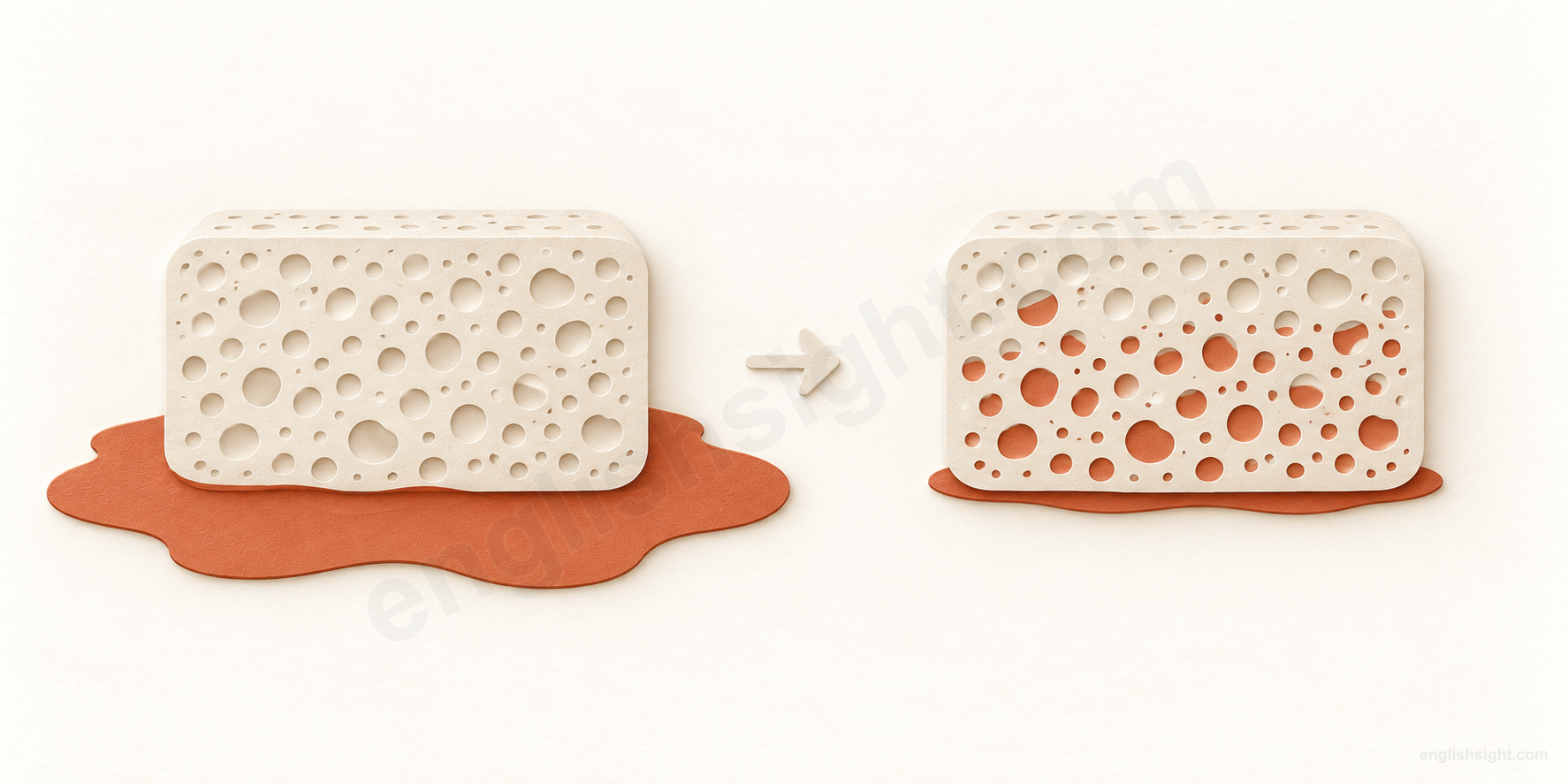
Meet the cleaning tool, then follow its texture, actions, and established expressions.
Liquid enters small spaces
Take in and hold liquid
A sponge touches a broad spill.
sponge
More liquid inside, less left outside.
Liquid enters and stays in the sponge’s small spaces.
The spill shrinks as the sponge takes liquid in.
A sponge has many small spaces that let it take in and hold liquid.
Porous texture connects the object, its material, and comparisons about taking in information. Cleaning verbs add an action; cake and fixed social expressions require their own explanations.
Picture a sponge touching a spill: liquid enters its many small spaces and can remain there. This gives us a useful starting point for absorption and cleaning.
Other branches need their own context: a sea sponge is a living animal, sponge cake is food, and sponging off a person is a criticism. A teaching picture connects some uses without predicting every phrase.
01
Tools, materials, animals, and food
The noun names a cleaning object, its material, a sea animal, or a particular kind of cake. Context and countability help you choose.
01
a / the + sponge; clean / wipe something with a sponge
a damp sponge
a small absorbent object used for cleaning
Starting situation
There are crumbs and a sticky patch on the counter.
Meaning in context
You wipe the counter with a cleaning sponge.
A sponge is the tool; with introduces the tool you use.
Here sponge is countable: one sponge, two sponges. A kitchen sponge or bath sponge can be manufactured; the word does not imply that it came from the sea.
Damp means slightly wet. Wet and dry also describe sponges. You can squeeze out a sponge to remove water; squeeze out describes your action, not a special meaning of sponge.
Example in context
Use a damp sponge to wipe the counter.
Watch the difference Say with a sponge when naming the instrument. Sponge is not another name for every cleaning cloth.
02
be made of sponge; a piece of sponge; sponge rubber
made of sponge
the soft cellular material rather than one cleaning tool
Starting situation
A cushion needs a soft filling.
Meaning in context
The maker fills it with sponge.
Material sponge is uncountable; a sponge usually identifies an object.
When sponge names material, use some sponge or a piece of sponge. This differs from counting individual cleaning sponges.
Sponge rubber names a rubber material with a cellular structure. It helps explain the connection through texture, but does not mean every foam product is a kitchen sponge.
Example in context
The seat is padded with a thick piece of sponge.
Watch the difference Do not add an article simply because sponge is a noun: made of sponge describes material.
03
a sea sponge; sponges
a sea sponge
a simple aquatic animal with a porous body
Starting situation
A diver notices an attached organism on a rock.
Meaning in context
It is identified as a sponge.
The living sponge is an animal, not a loose household cleaning pad.
A sea sponge is countable, with plural sponges. The name of the natural cleaning material is linked to these animals.
Keep the animal and the manufactured tool distinct. Seeing sponge on a kitchen packet does not establish that the product is a sea animal.
Example in context
The guide pointed out several sea sponges on the rock.
Watch the difference Do not call a sponge a plant just because it remains attached in one place.
04
a sponge cake; some sponge cake; a chocolate sponge
sponge cake / a chocolate sponge
a light cake; also a related dessert in British usage
Starting situation
You look at a bakery menu.
Meaning in context
Sponge refers to food rather than cleaning material.
The cake name suggests a light, airy texture.
Sponge cake names a type of cake. In British English it can be shortened to sponge, as in a chocolate sponge or Victoria sponge. Sponge can also name a light hot dessert; sponge pudding is a related British food name.
You can count whole cakes or use the noun for an amount: a sponge cake, two sponge cakes, some sponge cake. This branch is linked by texture; it does not say that cake has the same cleaning function.
Example in context
We shared a slice of lemon sponge cake.
Watch the difference For an international audience, sponge cake makes the food meaning clearer than sponge alone.
02
Cleaning, removing, and absorbing
Check the object: are you washing a surface, removing a mark, or taking up a spill? The following word helps specify the result.
05
sponge + person / body part / surface; sponge something with water
sponge a surface
wipe or wet something using a sponge or wet cloth
Starting situation
The painted surface needs a gentle clean.
Meaning in context
Someone wipes it with a damp cleaning tool.
The direct object is the thing being cleaned.
Sponge is also a verb. In sponge the wall, the wall receives the action; the instrument is understood or added with with.
The action can be in progress: I am sponging the wall. A passive is possible when the surface matters: The wall was sponged with clean water. The verb describes a method, not a guarantee that every stain disappears.
Example in context
Mina sponged the painted wall with clean water.
Watch the difference Sponge the wall names the surface. Sponge a mark off the wall names what you remove.
06
sponge something down; sponge down something; sponge it down
sponge something down
wash or wipe over a person or surface
Starting situation
The garden chair is dusty.
Meaning in context
You wipe over it with a wet sponge.
Down belongs to the cleaning expression; it need not mean movement toward the floor.
Sponge down extends the washing use. The object can be a person, an animal, or a suitable surface; the action involves wiping with a wet sponge or cloth.
A noun can go between the verb and down or after down: sponge the chair down / sponge down the chair. Put an object pronoun in the middle: sponge it down.
Example in context
I sponged the garden chair down before bringing it inside.
Watch the difference Sponge down is not the disapproving expression sponge off someone. Read the whole complement.
07
sponge something off a surface; sponge something out of fabric
sponge a mark off / out
remove something by wet wiping
Starting situation
There is mud on a sleeve.
Meaning in context
You try to lift the mud from the fabric.
The object now names the unwanted substance, not the surface.
In sponge mud off a sleeve, mud is what you remove and off a sleeve identifies its source. Compare sponge the sleeve: there the sleeve itself is the object being cleaned.
Off commonly presents removal from a surface; out can present removal from within fabric, as in sponge a stain out of a shirt. With a pronoun use sponge it off or sponge it out. These result words do not guarantee that a difficult stain can be removed.
Example in context
She sponged the mud off her sleeve.
Watch the difference Sponge it off can mean remove a mark. Sponge off him names a person being exploited and means something else.
08
sponge up + liquid; sponge + liquid + up; sponge it up
sponge up a spill
take up liquid with an absorbent object
Starting situation
A small puddle lies on the table.
Meaning in context
Liquid moves into the sponge and the puddle shrinks.
Up marks the taking-up result; the liquid need not move a long distance upward.
The object of sponge up is the liquid being collected. It differs from washing a surface with a sponge: the focus is absorption of the spill.
Say sponge up the water or sponge the water up. With a pronoun, say sponge it up. Soak up also describes absorption and does not require a sponge as the tool.
Example in context
He sponged up the water beside the sink.
Watch the difference Sponging up water is not the same as squeezing water out: the liquid moves into the sponge rather than out of it.
03
Taking in ideas or taking from people
Absorption provides a useful comparison for learning. Getting support unfairly is a separate, established social use with a critical tone.
09
someone’s mind is like a sponge; someone’s mind is a sponge
a mind like a sponge
a mind that readily takes in information
Starting situation
A learner encounters new words and ideas.
Meaning in context
The learner picks up a great deal.
Information is compared with liquid being absorbed.
Her mind is like a sponge is a simile: a mind is compared with an absorbent object. Her mind is a sponge makes the comparison more directly as a metaphor.
The comparison highlights a capacity to take in information. It does not promise perfect recall, understanding without practice, or a scientific account of how learning works.
Example in context
Her mind is like a sponge when she listens to stories.
Watch the difference Like a sponge can be positive about learning; calling someone a sponge in a money dispute is usually criticism.
10
sponge off + person; sponge on + person; be a sponge (disapproving person noun)
sponge off / on somebody
rely unfairly on someone else for money, food, or support
Starting situation
A roommate repeatedly lets others pay and contributes nothing.
Meaning in context
The others criticize the arrangement.
The speaker presents the support as taking advantage, not simply receiving help.
Sponge off someone and sponge on someone are informal, disapproving expressions. The person after off or on is the source of support, not an object being washed.
He is sponging off us describes continuing behavior. Keep the person after the preposition: sponge off them, not sponge them off for this meaning. Receiving necessary help does not by itself deserve this label; the expression adds a negative judgment.
As a countable noun, a sponge can also mean a person who takes advantage of others for support: He is a sponge. This is an insulting judgment, not a neutral description of someone who needs help.
Example in context
The roommates accused Dan of sponging off them and never paying for food.
Watch the difference This is a critical accusation. Use rely on or receive support from when you want neutral wording.
11
sponge + meal / money + off / from + person
sponge a meal off somebody
obtain something by taking advantage of another person’s generosity
Starting situation
A guest expects a friend to pay again.
Meaning in context
The guest gets a free meal at the friend’s expense.
This transitive pattern names the benefit as well as the person providing it.
Sponge a meal off someone and sponge meals from someone put the benefit directly after sponge. The expression is informal and critical, like the intransitive dependence use.
Compare sponge off a friend, which focuses on dependence, with sponge a meal off a friend, which names what is obtained. Neither is a neutral synonym for accepting an offered meal.
Example in context
He tried to sponge another meal off his neighbor.
Watch the difference Do not confuse this with sponge a mark off a sleeve: the object and context select a different meaning.
04
Useful compounds and an idiom to recognize
Learn these complete names and expressions. Their meanings cannot always be predicted from the cleaning tool alone.
12
give someone a sponge bath; have a sponge bath
a sponge bath
washing someone’s body with a wet sponge or cloth instead of immersing them
Starting situation
A patient cannot get out of bed to wash.
Meaning in context
A carer helps the patient wash in bed.
Bath names the washing activity, not a bathtub full of sponges.
Sponge bath is a compound noun, especially North American English. It often appears in care settings when a person cannot use a normal bath or shower.
Use give someone a sponge bath or have a sponge bath. Here sponge specifies the washing method; the compound is countable because one washing occasion is being named.
Example in context
The carer helped him have a sponge bath in bed.
Watch the difference A bath sponge is the cleaning object; a sponge bath is an act of washing. Word order changes the head noun.
13
a sponge bag; put toiletries in a sponge bag
a sponge bag
a bag for toiletries, especially in British English
Starting situation
You pack your toothbrush and soap for a trip.
Meaning in context
They go into a small washbag.
Sponge bag is an established name for a travel container.
A sponge bag holds personal washing items. British English also uses washbag; North American English uses toiletry bag.
The bag need not contain a sponge and is not necessarily made of sponge. Learn the complete compound rather than guessing its material from the first noun.
Example in context
I packed my toothbrush in my sponge bag.
Watch the difference A sponge bag is a bag for washing items, not automatically a bag made from absorbent foam.
14
throw in the sponge
throw in the sponge
stop trying and admit defeat
Starting situation
A team has struggled with a difficult task.
Meaning in context
Someone considers abandoning the attempt.
The whole idiom expresses surrender; sponge alone does not mean give up.
Throw in the sponge is an established informal idiom to recognize. Outside a literal cleaning context, it can mean abandoning an effort after difficulty.
The absorption picture does not predict this meaning. Keep the complete expression, including the, and let context distinguish surrender from literally throwing a cleaning object somewhere.
Example in context
After three failed attempts, we still refused to throw in the sponge.
Watch the difference Do not replace sponge with any cleaning object and expect the same established idiom.
Let the object and construction guide you
Count an object; name a material
Use a sponge / two sponges for tools and animals, but some sponge / made of sponge for material. Sponge cake can refer to a whole cake or an amount of food.
Forms and sentence roles
Say sponge, sponges, sponged, sponging; drop the final e before -ing. The pronunciation is /spʌndʒ/. Cleaning and absorbing allow ordinary progressive and passive forms. No special causative meaning is needed: have the wall sponged is the general have + object + past participle construction.
One off, different relations
In sponge dirt off a wall, dirt is removed from a surface. In sponge off a friend, the friend supplies support and the speaker disapproves. The preposition alone does not supply the whole meaning.
Scope of this lesson
This is a practical selection, not a frequency ranking. Specialized surgical pads, contraceptive devices, metal sponge, bread-making sponge, crab eggs, commercial sponge gathering, and dated drinking-related uses are outside the lesson. Spongy and sponger are related words, not extra inflections of sponge.
Choose by object and situation
Decide what sponge names or what the whole expression does.
1. The label describes a cushion’s filling, not one cleaning tool. Which phrase fits?
2. There is water on the table. You want it to move into a sponge. Which instruction fits?
3. In “He keeps sponging off his roommates,” what is the speaker saying?
4. You mean an act of washing someone in bed. Which expression names the activity?
5. In “She sponged the mud off her sleeve,” what does the direct object name?
Sources and teaching notes
Dictionary entries support the usage distinctions below. The explanations, examples, and visual model were created for this lesson.
The picture is a teaching aid, not a claim that every speaker has the same mental image.