From a familiar utensil to portions, cooking actions, and expressions you learn as a whole.
A bowl that supports a portion
Hold a portion, then move it
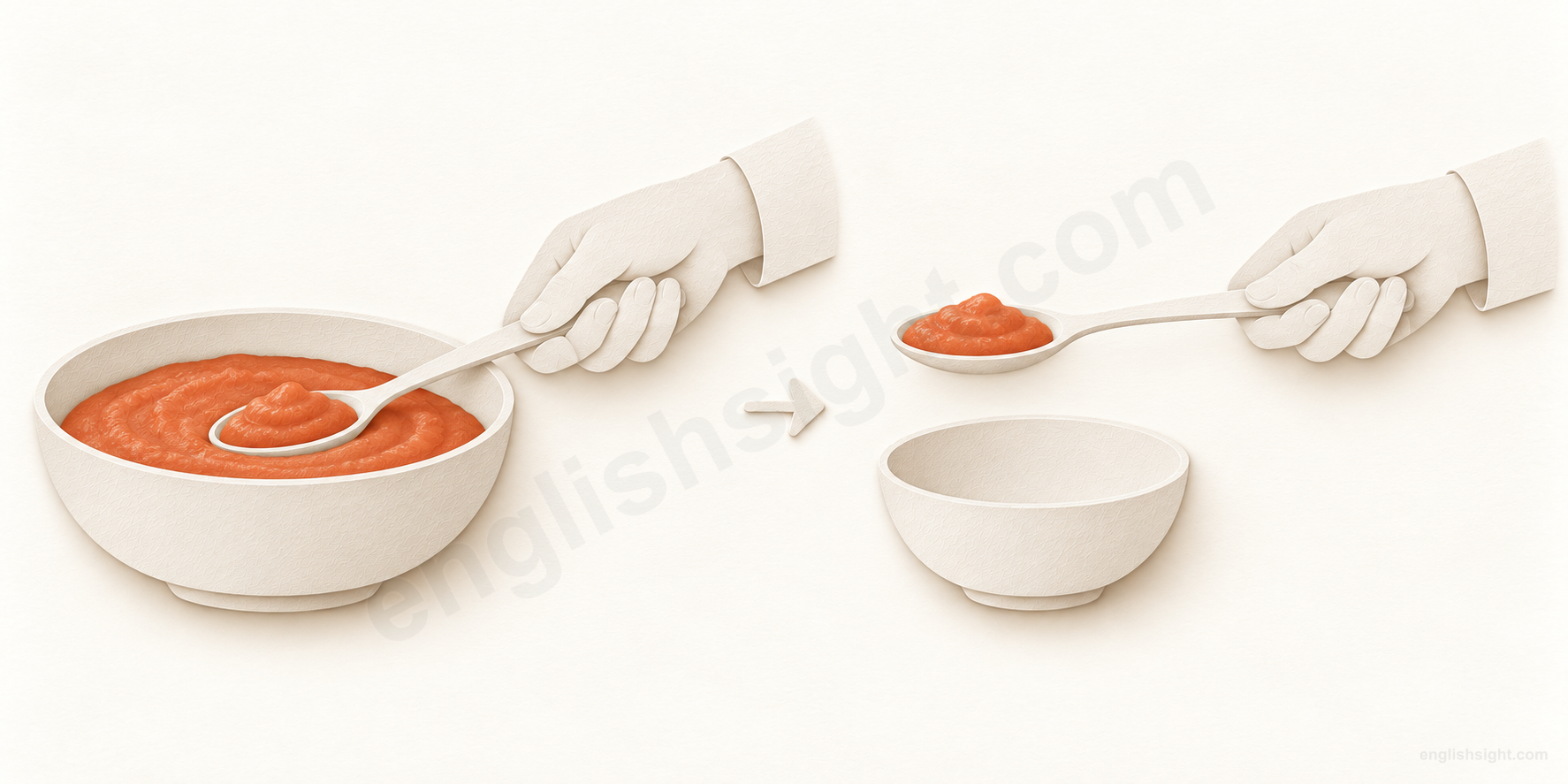
A spoon scoops a small portion from the large bowl.
spoon
The portion stays supported above a smaller bowl, ready to transfer.
A hand grips the handle and lifts the loaded spoon.
The shallow bowl supports food; the handle lets a person carry the portion.
A spoon’s shallow bowl supports a small portion of food, while its handle lets someone hold and move it.
This model connects the utensil, its capacity, and transferring food with it. It does not predict the meanings of complete sayings or every use of spooning.
A spoon has a shallow bowl that supports a small amount of food and a handle you can hold. This concrete shape helps connect the utensil, a spoonful, and the cooking verb spoon.
Other uses need their own context: spooning can describe two people lying close, while a silver spoon or a greasy spoon may occur in an established expression. The picture is a teaching aid, not a claim about every speaker’s mental image.
01
The tool, its types, and the amount it holds
Name a utensil, ask for the right kind, or describe a quantity. The surrounding words tell us whether spoon names an object or its contents.
01
a / the + spoon; eat / stir + with a spoon
a spoon; with a spoon
a utensil with a handle and a shallow bowl
Situation
You have yogurt but no utensil.
What is meant
You ask for a spoon to eat it.
The bowl holds food; the handle gives you somewhere to grip.
Spoon is a countable noun: a spoon, the spoon, two spoons. Its shallow bowl can hold soft food or liquid. You can eat with it, serve food with it, or stir with it.
In eat with a spoon and stir with a spoon, with names the instrument. In Pass me a spoon, the spoon itself is the thing being passed. Compare a fork, with prongs, and a knife, with a cutting edge: the tool’s shape helps explain its usual job.
In a sentence
Could I have a spoon for my yogurt, please?
Watch the difference Use a determiner for one ordinary countable object: I need a spoon, not I need spoon.
02
a + soup / serving / slotted / wooden + spoon
soup spoon; serving spoon; slotted spoon
identify a spoon by its purpose or construction
Situation
You need to lift peas from cooking water.
What is meant
You choose a slotted spoon so water can drain.
A modifier tells you what kind of spoon is needed.
A soup spoon is used for eating soup; a serving spoon transfers food to plates. These purpose words identify kinds of the same utensil. A wooden spoon describes its material and is useful for mixing food in a pan.
A slotted spoon has openings that let liquid pass through while it holds pieces of food. Choose it for draining peas, rather than for carrying a portion of broth. Ask for a clean spoon to specify its condition, not a different utensil type.
In a sentence
Lift the peas out with a slotted spoon.
Watch the difference Slotted does not mean a spoon with a special place in a drawer; it describes openings in the spoon.
03
a spoon / spoonful of + substance; number + spoons / spoonfuls of + substance
a spoon of…; a spoonful of…
the quantity held by a spoon
Situation
You want a little honey in your yogurt.
What is meant
You add one spoonful.
The utensil’s capacity stands for an amount of food.
A spoon of honey and a spoonful of honey describe an amount, rather than just naming the utensil. Of introduces the substance. Two spoons may mean two utensils; two spoons of honey normally means two portions measured with a spoon.
The ordinary plural is spoonfuls: three spoonfuls of yogurt. A spoonful does not specify a universal volume, because spoons differ in size. A heaped spoonful rises above the edge; a level spoonful is even with the edge. Use those descriptions when the amount matters.
In a sentence
I mixed a spoonful of honey into the yogurt.
Watch the difference Do not confuse a spoon of sugar with a sugar spoon: the first names an amount, the second a utensil used for sugar.
04
a teaspoon / tablespoon of + ingredient; a measuring spoon; tsp / tbsp
teaspoon; tablespoon; measuring spoon
distinguish a named spoon from a recipe measure
Situation
A recipe asks for a teaspoon of an ingredient.
What is meant
You use the matching measuring spoon.
A general spoonful is less specific than a named recipe measure.
A teaspoon is a small spoon associated with drinks; a tablespoon is a larger spoon associated with serving. Both words also name quantities: a teaspoon of sugar, a tablespoon of oil. In recipes, tsp and tbsp are abbreviations you need to distinguish.
A measuring spoon is intended to measure a stated quantity. When following a recipe, use its specified measure rather than assuming any spoon in a drawer will do. In two tablespoons of oil, the plural belongs to tablespoon, while oil remains the substance.
In a sentence
The recipe needs one teaspoon of sugar and one tablespoon of oil.
Watch the difference Teaspoon and tablespoon are different measures; do not treat tsp and tbsp as interchangeable abbreviations.
02
Moving food, feeding, and lying close
The cooking verb names an action done with a spoon. Spoon-feed is a separate compound; spooning also has a different use involving two people.
05
spoon + food + into / onto / over + destination; spoon + food + out of + source
spoon something into / onto / over / out of…
lift and move food using a spoon
Situation
The fruit mixture is in a saucepan.
What is meant
You move portions into small bowls with a spoon.
Spoon tells us the method; the following words locate the food.
As a cooking verb, spoon takes the food as its object: spoon the mixture into bowls. Into gives the destination inside a container; onto places it on a surface; over describes distributing it across the top. Spoon the sauce over the vegetables does not mean stir it.
Out of names the source: spoon the flesh out of the melon. With the source understood, spoon it out is natural; spoon out the mixture is possible too. Keep a pronoun before the particle in spoon it out. These are ordinary spatial uses, not unrelated idioms.
Forms are spoon, spoons, spooned, spooning. A recipe often uses an imperative without naming you. The food can become a passive subject: The mixture is spooned into small bowls. Compare pour, which describes a flowing transfer, and stir, which mixes food already in a container.
In a sentence
Spoon the warm fruit mixture into four small bowls.
Watch the difference Use spoon it out, not spoon out it. With an into destination, keep the food before the destination: spoon it into the bowl.
06
spoon-feed + person; be spoon-fed
spoon-feed someone
give someone food using a spoon
Situation
A baby cannot yet use a spoon independently.
What is meant
An adult brings small portions to the baby’s mouth.
The person being fed is the object of spoon-feed.
Spoon-feed combines the instrument with feed: the person receives food from someone else’s spoon. The ordinary past and past participle are spoon-fed, following feed → fed, not spoon-feeded.
Compare spoon some yogurt into a bowl, where the object is food and the destination is a bowl. In spoon-feed the baby, the object is the person receiving food. A passive is possible too: The baby was spoon-fed.
In a sentence
He spoon-fed the baby while she held her toy.
Watch the difference Write spoon-fed for the past form; spooned is the past of the separate verb spoon.
07
spoon-feed + person + information; spoon-feed + information + to + person; spoon-feed + person + with + information; be spoon-fed
spoon-feed information; be spoon-fed
give ready-made information with too little independent effort required
Situation
Learners are asked to work out an answer.
What is meant
Instead, someone supplies every answer for them.
The food-feeding image becomes a criticism of excessive help.
Figurative spoon-feed often criticizes teaching or communication that does too much for the receiver. Food becomes information, and independent eating becomes independent thinking. It is the established compound that carries this evaluation.
You can spoon-feed someone information or spoon-feed information to someone. Spoon-feed someone with information is another pattern: The students were spoon-fed with facts instead of being asked to investigate. Be spoon-fed is useful when the receiver is the focus. Explaining a difficult idea clearly is not automatically spoon-feeding: the criticism is that too little thinking or effort is left to the learner.
More broadly, someone who is spoon-fed may receive excessive help instead of making an effort. With ideas or beliefs, the criticism can be that the receiver is expected to accept them without questioning them: They were spoon-fed political slogans and discouraged from asking questions. Context tells you whether the problem is lack of effort, lack of critical thought, or both.
In a sentence
Our tutor gives us clues but refuses to spoon-feed us the answers.
Watch the difference The figurative sense is usually disapproving; it is not a neutral synonym for teach or explain.
08
two people + spoon; be spooning
spoon; spooning
lie close on your sides with one person behind the other
Situation
Two partners lie on their sides facing the same way.
What is meant
They settle close together, one against the other’s back.
Here spoon is an intransitive verb about body position.
In this use, two people fit close together somewhat like nested spoons. They spoon, or they are spooning; no food object is involved. The shape comparison is a memory aid for this distinct meaning.
This is an intimate, informal context. Spoon is more specific than cuddle: cuddling can involve other positions, while spooning describes one person lying close behind the other. Dictionaries also record a broader sense of affectionate kissing and caressing, marked old or old-fashioned in Collins; that broader sense is not the focus here.
In a sentence
They fell asleep spooning on the sofa.
Watch the difference Do not interpret spooning here as cooking; the people and their position determine the sense.
03
Recognize the whole expression
These expressions refer to wealth, last place, a cheap restaurant, or a children’s race. Learn their established meanings and settings rather than guessing from spoon alone.
09
be born with a silver spoon in + possessive + mouth
be born with a silver spoon in your mouth
come from a wealthy family
Situation
Someone has financial advantages from childhood.
What is meant
A speaker points out that the advantages came from family wealth.
The full saying concerns inherited privilege, not eating equipment.
Be born with a silver spoon in your mouth says that someone’s parents were rich. Silver suggests expensive possessions, but the established saying gives the family-background meaning; no actual spoon needs to have been present.
The possessive follows the person: she was born with a silver spoon in her mouth; I wasn’t born with a silver spoon in my mouth. The saying may criticize privilege, but it does not by itself prove that the person has never worked hard.
In a sentence
She was born with a silver spoon in her mouth, but she still works hard.
Watch the difference Do not use this saying merely because someone became rich later; it concerns their background at birth.
10
get / win / receive + the wooden spoon
get / win the wooden spoon
finish last in a competition
Situation
A team has the lowest score in a quiz.
What is meant
Someone jokes about its last-place result.
The figurative wooden spoon is a humorous last-place prize.
A wooden spoon can literally be a cooking utensil. In British informal competition language, the wooden spoon is a supposed prize for coming last. The phrase can be used even when no physical spoon is awarded.
You may get or win the wooden spoon. Although win usually suggests success, this expression refers to the bottom position. The competition context distinguishes it from buying a wooden spoon for the kitchen.
In a sentence
Our team got the wooden spoon in the village quiz.
Watch the difference The wooden spoon is last place, not second place or a general prize for taking part.
11
eat at / go to + a greasy spoon
a greasy spoon
a cheap, basic cafe or restaurant associated with fried food
Situation
You want an inexpensive cooked breakfast.
What is meant
A friend suggests a small, basic local cafe.
The whole compound names a place, not an oily utensil.
In the informal expression a greasy spoon, spoon helps name a restaurant. Greasy suggests the fried food associated with it. It can sound dismissive, so a neutral phrase such as a small cafe may be better when you do not intend that judgment.
Context matters: We ate at a greasy spoon names a place; Wash that greasy spoon can simply describe a dirty utensil. The preposition at and the action ate make the restaurant reading clear.
In a sentence
We had breakfast at a greasy spoon near the station.
Watch the difference Do not call every affordable restaurant a greasy spoon; the phrase carries an informal image and can be unflattering.
12
take part in / run / win + an egg-and-spoon race
an egg-and-spoon race
a race run while balancing an egg on a spoon
Situation
Children line up with eggs resting on spoons.
What is meant
They race while trying to keep the eggs balanced.
The compound names a game with a literal spoon.
An egg-and-spoon race is associated with children’s sports days, especially in British English. The challenge is to move along the course while keeping an egg balanced on the spoon.
Race is the head noun: one egg-and-spoon race, two egg-and-spoon races. Egg-and-spoon describes the kind of race. This is a named activity, rather than another meaning of the utensil noun.
In a sentence
The children took part in an egg-and-spoon race after lunch.
Watch the difference The plural goes on races, not on egg or spoon inside the compound.
Keep the object, amount, and expression distinct
Pronunciation and forms
Spoon is pronounced /spuːn/: the vowel is long, as in moon. The noun plural is spoons. The cooking verb has the regular forms spoon, spoons, spooned, spooning; the compound spoon-feed follows feed and has spoon-fed as its past form.
An instrument is not an amount
With a spoon names a tool. A spoonful of soup names a quantity. A soup spoon names a type of utensil. The different word order and prepositions do meaningful work.
Do not force every use into the cooking picture
The close-fitting shape helps explain the comparison in spooning, but the wealth, last-place, and cafe expressions must be learned as established language. They are not automatic rules for creating new phrases.
Scope of this lesson
This selection covers everyday utensils, quantities, cooking, familiar compounds and sayings, plus the modern intimate-position use. Specialist fishing lures, old golf-club names, rowing blades, technical objects, regional insults, and sporting strokes are not developed here.
Choose from the context
Decide whether the sentence concerns a tool, a quantity, an action, or an established expression.
1. You want the amount of honey held by one spoon, not a new utensil. Which phrase fits?
2. A recipe asks you to use a spoon to move yogurt from a large tub into dessert bowls. Which instruction fits?
3. A teacher says, “I will help, but I won’t spoon-feed you the answers.” What is the teacher asking you to do?
4. In a British quiz report, a team “got the wooden spoon.” What happened?
5. Someone became wealthy after many years of work, having grown up poor. Does “born with a silver spoon in their mouth” describe that background?
Sources and teaching notes
The sources below were read to check meanings, constructions, and register. The lesson’s explanations and examples are original; the shape-based connection is a teaching model.
The diagram explains a useful connection; speakers do not all share one mental image.