A sudden move, a fresh beginning—and distinct everyday things.
Read the noun or construction to tell a season, a water source, a rebound, and a sudden appearance apart.
From compression to a sudden return
From a held position to a sudden return
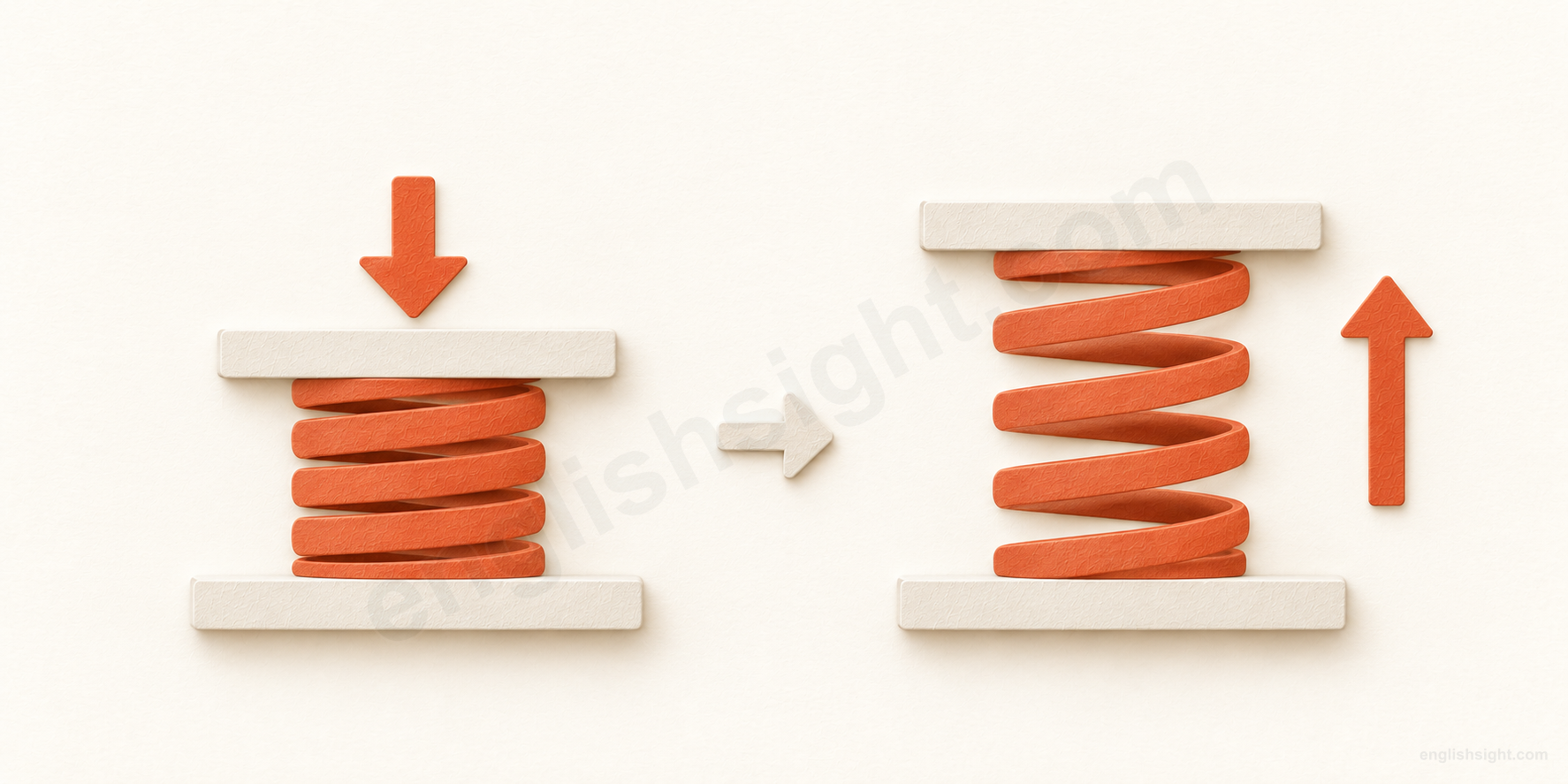
Pressure holds the spring compressed and the top plate low.
spring
The same spring is taller and the top plate is higher.
Removing the pressure lets the spring rebound upward.
A compressed spring rebounds when released. This illustrates elastic return, not every meaning of spring.
In the movement family, spring highlights a quick, sudden move. Here, removing pressure lets a compressed spring return upward and lift a plate. Other uses extend to sudden appearance or activity; some remain separate branches.
This is a model of rebound, not a universal definition. A jump need not involve a metal coil; spring from a cause need not be sudden. Learn the season, the water source, and fixed idioms with their own contexts.
Spring has several useful noun meanings and an energetic verb family. In the verb family, something often moves, appears, or becomes active suddenly. In a source construction, it may instead originate in a cause.
A compressed spring returning after release offers one concrete teaching connection. It does not define the season, predict every idiom, or represent an image that all English speakers share.
01
Seasons, water, and elastic things
First identify what spring names. A season, a water source, and an elastic device are distinct noun meanings; the surrounding words tell you which one you need.
01
in (the) spring; early / late spring; next / last / this spring; a + adjective + spring
in spring / next spring
the season after winter and before summer
Starting situation
You are choosing a season for planting.
What changes or is meant
You plan for the period when many plants resume growth.
Spring names a season, not a sudden action.
Use in spring or in the spring for a seasonal setting. Early spring and late spring locate a time within that season. In the spring of 2024 identifies one particular year’s spring.
Next spring, last spring, and this spring normally act as time expressions without in: We will move next spring. A cold spring treats one year’s season as a countable instance.
Spring weather and spring flowers put the season before another noun. The seasonal meaning is useful in its own right; a metal spring is not a definition of it.
Springtime is another name for this season. Spring is in the air suggests that you can notice its arrival in the weather or surroundings; it is not a claim that the season is a physical substance.
In a sentence
We plan to plant the young trees next spring.
Watch the difference Say next spring, not in next spring. The season does not fall in the same months everywhere.
02
on / during spring break
spring break
a school or college vacation during spring
Starting situation
Students have a gap in their class schedule.
What changes or is meant
They spend the spring vacation away from classes.
Break names the vacation; spring locates it in the year.
Spring break is particularly associated with North American schools and colleges. On spring break describes the students’ vacation status; during spring break places another event within that vacation.
This is a compound noun. It does not mean that a metal spring has broken, and it is not the name of the entire spring season.
In a sentence
My cousins are visiting us during spring break.
Watch the difference A broken spring is damaged equipment; spring break is time away from classes.
03
do some / the spring cleaning
do some spring cleaning
clean a home thoroughly, including neglected parts
Starting situation
Routine cleaning has left cupboards and high shelves untouched.
What changes or is meant
You give the home a more complete clean.
The established compound describes a thorough cleaning task.
Spring cleaning includes places or jobs that ordinary cleaning may miss. Use do some spring cleaning or do the spring cleaning. The phrase is connected with a seasonal household habit, but it names the kind of job.
Cleaning here is an activity noun, not a verb after spring. This expression therefore has a different structure from The door sprang open.
In a sentence
We did some spring cleaning and emptied the cupboard above the fridge.
Watch the difference Do not use spring cleaning for every quick wipe of a surface.
04
a mountain / natural spring; hot / mineral springs; spring water
a spring / spring water / hot springs
a natural place where underground water reaches the surface
Starting situation
Water is underground on a hillside.
What changes or is meant
It emerges naturally at a water source.
A spring is a natural water outlet; spring water is the water from it.
A mountain spring names a water source. Hot springs names naturally heated sources; the plural is common when describing a bathing area with several outlets.
In spring water, spring specifies the source of the water. A well is a hole made to reach water; a spring is a natural emergence. Neither the word spring nor an attractive source guarantees that untreated water is safe to drink.
In a sentence
A small spring feeds the pond below the hill.
Watch the difference Keep the countable source distinct from uncountable water: a spring, but some spring water.
05
a spring; the springs in + object; like a coiled spring
a spring / a coiled spring
an elastic device that returns toward its original shape
Starting situation
A force compresses or stretches a resilient device.
What changes or is meant
Removing the force lets it return and push or pull.
The object stores energy through deformation and can release it as movement.
The countable noun names a component in such things as a mattress, a mechanism, or a suspension. A coil of wire is a familiar shape, though not every spring is a coil.
The diagram shows one compression spring before and after release. A coiled spring can also suggest a person ready for an energetic response: He waited like a coiled spring. The comparison describes readiness, not actual wire inside a person.
In a sentence
A tiny spring pushes the button back when you let go.
Watch the difference One device is a spring; several devices are springs. Damaged springs may no longer return normally.
06
have spring; lose its / their spring
lose its spring
lose the ability to bounce or recover shape
Starting situation
A cushion used to recover after being pressed.
What changes or is meant
It now stays flatter and feels less resilient.
Uncountable spring is a quality, not a count of components.
A cushion can have spring or lose its spring even when you are discussing its overall bounce rather than identifying a metal part. Spring in this sense is uncountable.
Compare The cushion has lost its spring with Two springs have broken. The first describes diminished resilience; the second counts damaged components.
In a sentence
After years of use, the seat cushions have lost their spring.
Watch the difference Lost their spring need not mean that any metal parts fell out.
07
with a spring in + possessive + step
a spring in your step
a lively, buoyant way of walking
Starting situation
Someone receives encouraging news.
What changes or is meant
Their walk looks more energetic and cheerful.
The bounce of movement becomes a description of someone’s manner.
With a spring in her step describes a lively walk, often suggesting good spirits or renewed energy. Spring is singular in this familiar phrase.
It does not mean a person is literally hopping or has a spring attached to a shoe. The connection with physical bounce is a helpful comparison, not a mechanical explanation of emotion.
In a sentence
He left the interview with a spring in his step.
Watch the difference The expression suggests a manner or mood; it does not establish why the person feels that way.
02
Move suddenly or respond quickly
With the verb, notice what moves, where it goes, and what state it reaches. Spring adds suddenness or energy; the following words supply the direction or result.
08
spring + direction; a spring; make a spring
spring into the air / make a spring
jump suddenly and energetically
Starting situation
An animal is on the ground.
What changes or is meant
It pushes off in a quick leap.
The verb presents an energetic movement; a spring can name that leap.
Spring can stand alone when the direction is understood, or take a direction phrase: spring forward, spring back, spring over a low wall. The moving person or animal is the subject.
In The rabbit made a spring, the noun a spring names one jump. Jump is a broader everyday word; spring often makes the quick push-off more vivid. It does not always mean repeated bouncing.
In a sentence
The dog sprang into the air to catch the toy.
Watch the difference Sprang is a past form; after has or had use sprung. A spring is a noun, not a past-tense verb.
09
spring out of bed; spring to + possessive + feet; spring to attention
spring out of bed / to your feet / to attention
stand up suddenly or quickly adopt an alert posture
Starting situation
A seated person hears an urgent knock.
What changes or is meant
They stand immediately.
To introduces the resulting position, not a recipient.
Spring out of bed describes getting out of bed with a quick, energetic movement. Out of names the starting location. Spring to your feet means stand up quickly; the possessive follows the person: I sprang to my feet; they sprang to their feet.
Spring to attention means quickly take an upright, formally attentive posture, as a guard might. The person may already be standing. Spring supplies sudden movement, while to your feet or to attention specifies the result.
In a sentence
At the sound of the alarm, Maya sprang to her feet.
Watch the difference Use to her feet for Maya, not to my feet. To attention does not simply mean become interested.
10
object + spring + open / shut
spring open / spring shut
move suddenly into an open or closed state
Starting situation
A lid is held closed by a catch.
What changes or is meant
Releasing the catch lets it open abruptly.
The object moves; open or shut names the resulting state.
The lid sprang open describes the lid’s sudden movement. Open is an adjective complement, so the expression is not a separable verb plus object. Spring shut likewise describes a sudden closing.
The intransitive subject is the lid, door, or similar object. For the person’s action, I released the catch is often clearer than trying to turn every spring + adjective expression into a causative command.
In a sentence
When I released the catch, the lid sprang open.
Watch the difference Sprang open is active and intransitive; it does not need was as though open were a past participle.
11
spring back; spring back into + position / shape
spring back
return quickly, often through elastic force
Starting situation
A flexible branch has been bent aside.
What changes or is meant
It moves back when released.
Back adds return to the sudden movement expressed by spring.
A bent branch or a compressed component can spring back. The diagram shows this return after compression. Back gives the movement a relation to an earlier position.
Spring back does not mean every moving object will recover perfectly. Its suitability depends on the material and event; come back is the broader expression when no quick rebound is intended.
In a sentence
The flexible strip sprang back into shape as soon as I let go.
Watch the difference Do not confuse spring back, a returning movement, with spring up, which can describe new things appearing.
12
spring to + someone’s + defence / defense / assistance
spring to someone’s defence / assistance
act quickly to defend or help someone
Starting situation
A colleague is unfairly blamed.
What changes or is meant
Another person immediately speaks in support.
The quick response may be verbal rather than a physical jump.
Spring to her defence presents an immediate response on her behalf. Spring to his assistance describes promptly helping him. The noun after to identifies the kind of response.
This is a figurative extension of quick movement. The person does not have to stand up or move across the room; a timely objection or phone call can qualify. American spelling uses defense.
In a sentence
When the coach blamed Lina, her teammates sprang to her defence.
Watch the difference To here does not introduce an infinitive. Keep the possessive noun phrase: to her defence.
03
Appear, begin, or come from a source
The movement connection extends to new activity, appearances, and thoughts. A source construction can instead explain a cause without claiming that the result happened instantly.
13
spring into action; spring to / into life
spring into action / spring to life
suddenly become active, start working, or come into existence
Starting situation
A team is waiting for the signal.
What changes or is meant
The team begins its work immediately.
The change is from inactivity to activity, not necessarily from nonexistence to existence.
People spring into action when they begin doing something promptly. A machine can spring into life when it starts, and a place can spring to life when it becomes busy.
Spring into life is also used. Life in these expressions is a metaphor: a town or engine has not literally become a living organism. In other contexts, spring into life can describe something newly coming into existence: A new industry sprang into life around the port. Context distinguishes formation from renewed activity.
In a sentence
As soon as the doors opened, the volunteers sprang into action.
Watch the difference An engine springing to life has started; the expression does not say it has just been invented.
14
something + spring + to / from / out of + place
tears spring to your eyes
appear suddenly in a place
Starting situation
Someone reads an unexpectedly moving message.
What changes or is meant
Tears appear in their eyes.
Something comes into view quickly; it need not be jumping.
Tears sprang to her eyes describes a sudden emotional response. Words can spring to someone’s lips when they are on the point of being said. The following phrase names where the thing appears.
This appearance use connects with sudden movement without requiring a literal leap. It is vivid narrative wording; Tears appeared in her eyes is a more neutral alternative.
In a sentence
Tears sprang to his eyes when he read his daughter’s letter.
Watch the difference The tears are the subject. Do not turn the sentence into He sprang tears to his eyes.
15
something + spring up; be springing up
spring up
appear or develop quickly
Starting situation
A neighborhood has few places to eat.
What changes or is meant
Several new cafés open in a short time.
Up marks emergence here, rather than a literal upward path.
Shops, groups, and problems can spring up. The expression emphasizes their relatively quick appearance or development. It need not mean that a building was physically completed in a second.
This phrasal verb is intransitive in this sense: New cafés sprang up, not Someone sprang new cafés up. The progressive is natural when the development is continuing: New cafés are springing up.
A breeze or wind can also spring up: A cool breeze sprang up after sunset. Here the wind begins to blow; no new shop or organization is involved. The shared point is a relatively sudden beginning.
In a sentence
New cafés have sprung up around the station since it reopened.
Watch the difference A cat springing up onto a wall makes a physical movement; cafés springing up are coming into existence.
16
result / idea / feeling + spring from + source / cause
spring from a cause
originate in, or be caused by, something
Starting situation
A shared difficulty prompts an idea.
What changes or is meant
The difficulty is identified as the idea’s source.
From marks origin; the process need not be sudden.
An idea can spring from an experience, and a disagreement can spring from a misunderstanding. This source meaning is often relatively formal; come from is a useful neutral alternative.
Unlike physical spring from the ground, the object after from can be an abstract cause. The causal construction does not require a burst of energy or an immediate change. Read the entire sentence before importing suddenness from the movement sense.
In a sentence
The plan sprang from a conversation about our daily commute.
Watch the difference The plan springs from the conversation, not the conversation springs the plan. From takes a source, not a direct object of spring.
17
where + did + person + spring from?
Where did you spring from?
appear unexpectedly from somewhere
Starting situation
A friend suddenly appears beside you.
What changes or is meant
You express surprise at their arrival.
The question concerns an unexpected appearance, not ancestry.
Where did you spring from? is an informal, sometimes playful question when someone appears unexpectedly. It is not necessarily a literal question about jumping out of a place.
Compare The idea sprang from a conversation: that construction names a cause. A physical sentence such as The rabbit sprang from behind the hedge instead describes an actual quick movement from a location.
In a sentence
“Where did you spring from? I thought you were still at work!”
Watch the difference After did use spring, not sprang. This informal question can sound abrupt without a friendly context.
18
something + spring to mind; nothing / no one springs to mind
spring to mind
come into your thoughts suddenly
Starting situation
You consider who could help with a task.
What changes or is meant
You suddenly think of one suitable person.
The idea or name is the subject; mind is where it appears.
A name, memory, solution, or question can spring to mind. The expression emphasizes the thought’s arrival, often without a deliberate search.
Come to mind is a broader alternative. In Nothing springs to mind, no suitable idea occurs to you at that moment; this does not prove that no answer exists.
In a sentence
When you mentioned a quiet beach, one place immediately sprang to mind.
Watch the difference Say A name sprang to mind, not I sprang a name to mind.
04
Learn the whole expression
Some combinations have established meanings and special grammar. Surprise, a leak, payment, and age cannot all be predicted from a picture of a metal spring.
19
spring + something + on + someone; spring it on someone; something is sprung on someone
spring something on someone
present something without warning
Starting situation
Your colleague has no warning of a request.
What changes or is meant
You abruptly introduce it and surprise them.
The direct object is the news, request, or surprise; on identifies the affected person.
Spring a question, a new rule, or a surprise on someone draws attention to their lack of preparation. The surprise may be pleasant or unwelcome; spring does not decide that for you.
With a pronoun, use spring it on me. The news can also be the subject of a passive: The change was sprung on us. This is a real transitive construction, unlike The lid sprang open.
Spring a surprise can appear without on when the affected people are understood. Do not treat on as a direction that can simply be exchanged for to.
In a sentence
Please don’t spring a major deadline change on the team at the last minute.
Watch the difference Keep on before the person: spring it on us, not spring us it or spring it to us.
20
boat / tank / container + spring a leak
spring a leak
develop an opening through which liquid passes
Starting situation
A container or boat is intact.
What changes or is meant
An opening develops and liquid begins to pass through it.
The boat or container is the subject; a leak names the new fault.
A boat may spring a leak and take water in. A tank may spring a leak and let liquid out. The expression identifies the development of the fault, rather than simply the existence of a wet surface.
The container has sprung a leak uses the past participle after has. Compare The container leaks, which can describe its present condition without highlighting when the problem began.
In a sentence
The old water tank has sprung a leak near its base.
Watch the difference Keep a: spring a leak. The subject need not be a boat, and the liquid need not always move inward.
21
spring a trap; a trap is sprung
spring a trap
trigger a trap, or put a prepared trick into effect
Starting situation
A trap or deceptive plan has been prepared.
What changes or is meant
An action activates it or brings the trick into play.
Spring concerns activation; setting a trap is the earlier preparation.
Literally, spring a trap means make its catching mechanism operate. The grammatical subject can trigger it accidentally; it need not be the person who set the trap.
Figuratively, someone may spring a trap by using a prepared trick to catch another person in a mistake or admission. The trap may involve questions rather than equipment. Context tells you who is arranging the trick and who gets caught.
In a sentence
The interviewer sprang a trap by asking about a detail the guest had denied knowing.
Watch the difference Setting a trap prepares it; springing it activates it. A figurative trap need not be a physical device.
22
spring for + purchase / meal / treat; spring for it
spring for something
pay for something, often as a treat for others
Starting situation
Friends are deciding how to pay for a treat.
What changes or is meant
One person volunteers to cover the cost.
This informal North American use concerns payment, not jumping toward an item.
I’ll spring for dessert means I will pay for it, often treating the other people too. It suits a friendly, informal offer more than an invoice or formal financial agreement.
For keeps its following noun or pronoun: I’ll spring for it. The expression is not separable, so it does not become spring it for. It is a conventional use to learn as a whole.
In a sentence
You bought the tickets, so I’ll spring for dinner.
Watch the difference The payer is the subject. This meaning is especially North American and informal.
23
spring + person + (from + confinement); person + be sprung + from + confinement
spring someone from jail
get someone out of confinement
Starting situation
A person is confined.
What changes or is meant
Someone secures or helps bring about their release or escape.
This informal transitive use has a person as its object.
In an escape story, spring someone can mean help that person escape. American usage can also describe getting someone released from custody, for example through bail. The surrounding details establish how it happens.
He was sprung from jail is a possible passive. This informal sense should not replace precise wording such as was released on bail in a formal report when the legal distinction matters.
In a sentence
In the film, two friends try to spring the prisoner before dawn.
Watch the difference Do not assume spring always means a lawful release, or always an escape: the story supplies that distinction.
24
be no spring chicken
be no spring chicken
be no longer young
Starting situation
Someone comments humorously on their own age.
What changes or is meant
They acknowledge that they are no longer young.
The whole negative idiom concerns age.
I’m no spring chicken is a humorous way to say that you are no longer young. It does not specify an age, and it does not automatically imply poor health or inability.
The negative form is the familiar idiom to learn. Comments on someone else’s age can sound unkind, so the friendly or self-directed context matters.
In a sentence
I’m no spring chicken, but I still enjoy a long walk.
Watch the difference This idiom is not about the season, and it does not mean that someone is cowardly.
25
be / seem + full of the joys of spring
full of the joys of spring
very cheerful
Starting situation
A friend arrives in a noticeably happy mood.
What changes or is meant
You describe their exuberant cheerfulness.
Spring contributes a familiar association with freshness and renewed life.
Full of the joys of spring is a colorful established expression for great cheerfulness. The person need not be happy because it is actually spring.
The whole phrase carries the meaning. Full of joy is a plainer alternative; replacing spring with another season does not preserve the same established idiom.
In a sentence
After hearing the good news, Ravi arrived full of the joys of spring.
Watch the difference This is descriptive wording, not a claim about the date or weather.
26
hope springs eternal
hope springs eternal
people keep hoping despite discouragement
Starting situation
Repeated disappointment has not ended someone’s hopes.
What changes or is meant
They continue to expect a better outcome.
The saying presents hope as continually arising again.
Hope springs eternal is a saying about the persistence of hope. A speaker may use it warmly or with gentle irony when someone remains optimistic despite poor prospects.
Eternal is part of the fixed wording. The saying is not evidence that the hoped-for event will happen; it describes the human tendency to go on hoping.
In a sentence
“Perhaps our team will win next year.” “Well, hope springs eternal.”
Watch the difference Learn the familiar saying as a unit; do not use it as a grammar model for replacing every adverb with an adjective.
Choose the meaning and then follow the grammar
Forms and pronunciation
The headword is pronounced /sprɪŋ/. Forms are spring, springs, sprang, sprung, springing. Sprang is the usual simple past; sprung also occurs as a simple past, especially in North American English. After has, have, or had, use sprung: has sprung up. The ordinary past is not springed.
Movement and transitive uses behave differently
The cat sprang and The lid sprang open have no direct object. We sprang a surprise on them has an object and can be passive: A surprise was sprung on them. A possible pattern for one sense does not automatically transfer to every other sense. The springing form is natural for an ongoing process: New shops are springing up.
A noun can modify another noun
Spring flowers, spring water, and a spring mechanism use different noun meanings before another noun. The position before a noun does not by itself settle the meaning. Dictionaries may classify some of these modifiers differently; identify the relationship rather than assuming a new action sense.
A useful connection has limits
Suddenness links many verb uses, but origin in spring from need not be sudden. The season and water-source nouns have their own meanings. This lesson selects modern everyday uses and a few recognizable sayings; it does not cover all botanical, architectural, nautical, hunting, mechanical, historical, or regional terms.
Read the situation and the whole pattern
Choose the sentence or interpretation that matches the intended meaning.
1. You will visit during the spring that follows this winter. Which time expression fits?
2. The cushion no longer bounces back well. You are describing a quality, not counting broken components. Which fits?
3. The idea sprang from a long discussion. What does this establish?
4. Someone announced a change without warning you. Which sentence has the correct pattern?
5. Several new clubs have appeared recently. Which sentence uses the participle correctly?
6. Your friend says, “I’ll spring for lunch.” What are they offering?
Sources and teaching notes
Noun senses, verb patterns, and expressions were checked against the dictionaries below. The explanations and examples are original; the visual connection is a teaching model, not a dictionary definition of every use.
The diagram explains one connection; it is not a mental picture shared by every English speaker.