Start with the shape, then learn the patterns for area, alignment, agreement, and familiar expressions.
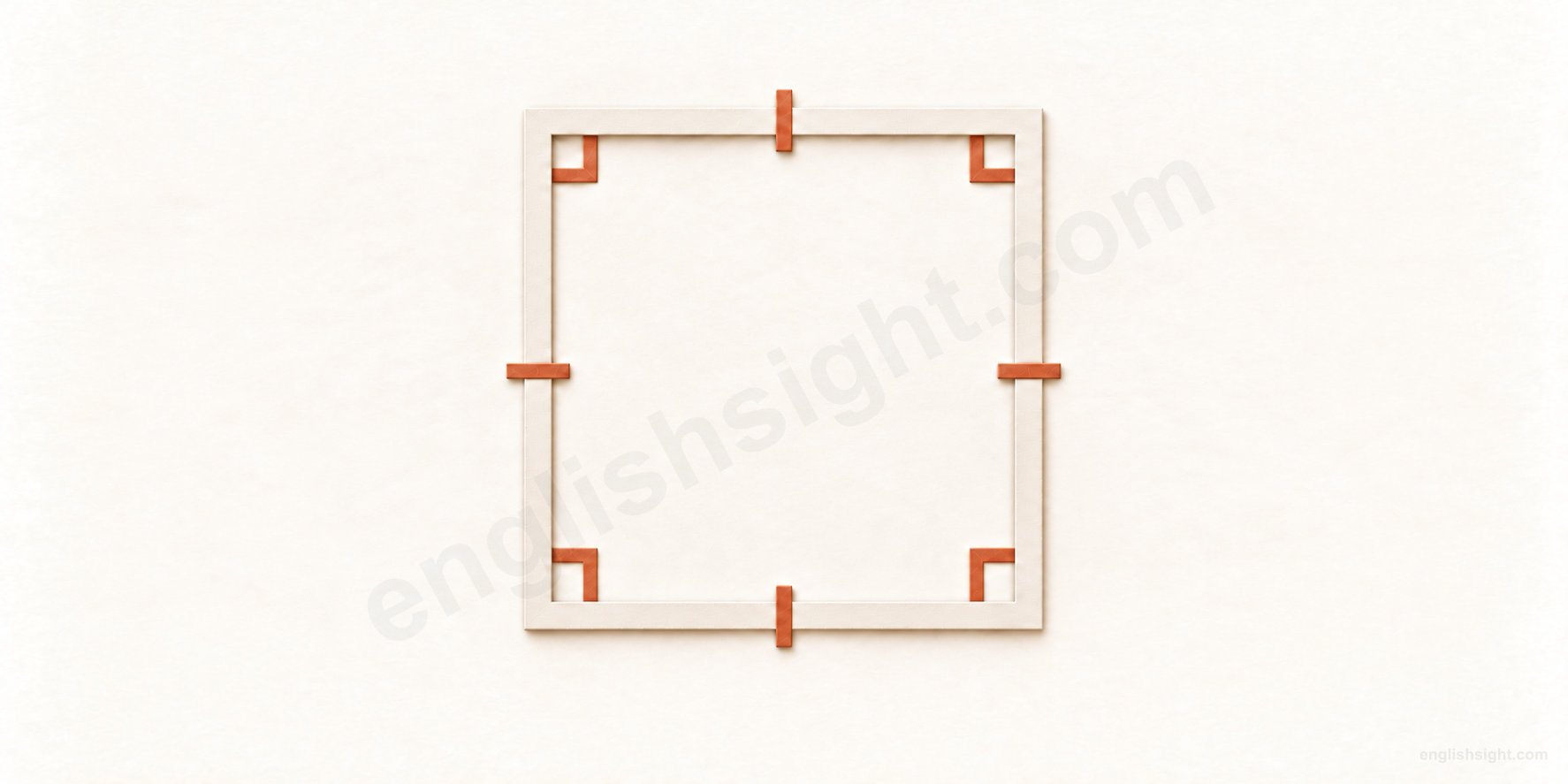
Equal sides meeting at right angles
Equal sides meeting at right angles
Four straight sides of equal length.
square
Together, they form a square.
Each neighboring pair meets at a right angle.
Four equal sides meet at four right angles.
In its geometric use, square combines four equal straight sides with four right-angle corners.
The sketch shows the defining relationship within a square. Alignment and evenness offer useful connections for some later uses, but the diagram does not predict the meanings of every phrase.
Square can name a figure, describe an outline, or tell us what someone does. A useful starting point is a shape whose four equal sides meet at right angles.
Several uses concern things being straight, even, or made to agree. Other combinations have established meanings that need their own explanation. Read the grammar and the situation rather than forcing every use into the same picture.
01
Shapes, places, and written marks
Begin with the geometric shape, then distinguish objects, public places, body descriptions, and names for tools or marks.
01
a square; square + noun; a square of + material; cut something into squares
a square; a square table
name a shape or describe something with that shape
Situation / starting point
You compare the length of each side and examine the corners.
Meaning / result
The four sides are equal, and every corner is a right angle.
Equal sides and right angles together define the geometric square.
As a countable noun, square names the figure: Draw a square. As an adjective, it describes another noun: a square tile. A rotated square is still a square; its orientation does not change its sides or angles.
A square is a special rectangle. A rectangle can have unequal neighboring sides, so rectangular is broader. Everyday descriptions such as a square table may allow small rounding at the edges.
The noun also names a square-shaped piece or space: a square of chocolate, squares of fabric, or a square on a game board. Cut something into squares describes the resulting pieces; into supplies the result pattern.
In a sentence
Cut the fabric into squares before you sew the cover.
Watch the difference Four equal sides alone are not enough: a slanted rhombus need not have right angles. Square describes shape, not automatically a three-dimensional cube.
02
in / across / near the square; town / market square; [name] Square
the town square
refer to a public open space in a town
Situation / starting point
Several streets and buildings surround an open meeting place.
Meaning / result
You identify the place where the market is held.
Square names a kind of urban place, not a guarantee of exact geometry.
People can meet in the square, cross the square, or live near the square. Town square and market square identify the setting or its usual activity. The space need not be a mathematically perfect square.
Square also appears in place names and addresses. Keep the capital in a name such as Cedar Square, but use lower case in the descriptive phrase the main square. In the square locates you in the open area; at Cedar Square can identify a meeting location.
In a sentence
There is a small market in the town square on Fridays.
Watch the difference A city square is not the same as a city block: a block normally refers to an area bounded by streets, often containing buildings.
03
square + corner / edge; a square; check something with a square
square corners; a carpenter’s square
describe or check right-angle corners
Situation / starting point
You check the angle where two edges meet.
Meaning / result
The corner is, or is being made, a right angle.
A square corner is a right angle even when the whole object is not a square.
Square can describe a corner rather than a complete outline: a long rectangular frame can have four square corners. Rounded corners instead curve where the edges meet.
A square is also a tool for checking or drawing right angles. A carpenter’s square may have an L-shaped outline; the tool’s name does not mean that the tool itself has four equal sides. It tests the angle between edges.
In a sentence
Use a square to check the corners of the frame.
Watch the difference The tool and the shape share a connection with right angles, but they are different referents of the noun.
04
a square jaw; square shoulders; of square build
a square jaw / build
describe a broad, solid-looking outline
Situation / starting point
You describe a person’s broad, angular features.
Meaning / result
Your listener imagines a solid rather than a narrow or rounded outline.
A physical description uses resemblance, not a measurement of four equal sides.
A square jaw has a broad, angular outline. A person of square build has a broad, solid-looking body. These are conventional descriptive combinations, not claims that a face or body is a geometric square.
Compare square shoulders, a description of their outline or position, with square your shoulders, an action of straightening yourself. The verb construction adds a change of posture.
In a sentence
The drawing shows a man with a square jaw and a narrow nose.
Watch the difference Do not treat square as a general synonym for strong with every noun: square coffee does not mean strong coffee.
05
in square brackets; an opening / closing square bracket
square brackets
name the written marks [ and ]
Situation / starting point
A note contains extra words inside [these marks].
Meaning / result
You can identify the marks by their angular shape.
Square describes the corners of the marks, not a closed four-sided figure.
Square brackets are [ ]. They can enclose extra information, including an editor’s addition. The phrase often appears in the plural because the marks normally work as a pair.
American English commonly uses brackets for [ ], without square. Saying square brackets makes the shape explicit when you need to distinguish them from round brackets, ( ).
In a sentence
Put your explanatory note in square brackets.
Watch the difference Do not swap [ ] and ( ) when a form, editor, or mathematical instruction specifies which marks to use.
02
Area, side length, and multiplication
The position of square matters. Area units, equal side lengths, and the operation of multiplying a number by itself are related but different.
06
number + square metres / feet / miles; a six-square-metre room
six square metres
give a measurement of area
Situation / starting point
A floor is three metres long and two metres wide.
Meaning / result
Its area is six square metres.
Square before the unit names an area unit; it does not require the measured object to be square.
One square metre is the area of a square one metre on each side. An area of six square metres may belong to a rectangle, a circle, or an irregular shape. The unit measures how much surface there is.
For a rectangular floor, multiply length by width: 3 m × 2 m = 6 m². Read m² as square metres. A six-square-metre room uses a singular unit in the compound adjective before room.
In a sentence
The storage room has an area of six square metres.
Watch the difference Six metres measures length. Six square metres measures area. Six cubic metres would measure volume.
07
number + unit of length + square; six metres by six metres
six metres square
give the length of each side of a square object
Situation / starting point
A square courtyard has sides of equal length.
Meaning / result
You specify that every side is six metres long.
Square after the length expression gives equal side lengths, not the total area.
A courtyard six metres square is six metres long and six metres wide, giving 36 square metres of area. The word order differs from six square metres, which gives only the area.
For clarity in practical instructions, you can say six metres by six metres or a square with sides six metres long. This avoids a potentially expensive misunderstanding when ordering flooring or fabric.
In a sentence
The courtyard is six metres square, so we need thirty-six square metres of paving.
Watch the difference Six metres square and six square metres are not interchangeable.
08
square + number; number + squared; the square of + number; a square number
square a number; the square of a number
multiply a number by itself and name the result
Situation / starting point
You start with the number five.
Meaning / result
You calculate five times five, giving twenty-five.
The operation uses the same number as both factors.
Square is a transitive verb in Square five. Five squared is the conventional way to read 5². The square of five names the result, 25. Squaring means multiplying by itself, not simply doubling.
A square number is the result of a whole number multiplied by itself: 0, 1, 4, 9, 16, 25, and so on. A five-by-five grid contains 25 unit squares; this connects the calculation with square area.
The forms are square, squares, squared, squaring. We drop the final e before -ing. A sentence such as The number is squared uses a passive construction; the number is the thing being multiplied.
In a sentence
Five squared is twenty-five, but five doubled is ten.
Watch the difference Squared does not mean multiplied by two. Compare 5² with 5 × 2.
09
the square root of + number; √36
the square root of…
work back from a square to its factor
Situation / starting point
You know the squared result is thirty-six.
Meaning / result
You identify six as its nonnegative square root.
The operation asks which number multiplied by itself gives the stated value.
The square root of thirty-six is six because 6 × 6 = 36. This reverses the calculation in six squared. In ordinary arithmetic, the square-root symbol √ asks for the nonnegative value.
Although both 6² and (−6)² equal 36, √36 is 6. Solving x² = 36 is a different instruction and has two real solutions, 6 and −6. Keep the wording of the problem in view.
In a sentence
The square root of thirty-six is six.
Watch the difference The square of six is thirty-six; the square root of thirty-six is six. Do not reverse the two phrases.
03
Straight edges, alignment, and direct contact
These uses focus on how something is positioned or shaped. An object can be aligned correctly without having four equal sides.
10
be / set something square with + reference; check that something is square
be square with the wall
be correctly aligned with a reference
Situation / starting point
A desk stands at an awkward angle to the wall.
Meaning / result
You position its edge parallel to the wall.
Square can concern alignment rather than the object’s overall shape.
A desk square with the wall is positioned evenly in relation to it. In this setting, its back edge can run parallel to the wall. The desk itself may be a long rectangle.
In construction, square also concerns correct right-angle alignment. The reference and context matter: check that a frame is square asks about its corners; align the desk square with the wall concerns its position in the room.
In a sentence
Set the desk square with the wall before you measure the gap.
Watch the difference Square with the wall need not mean that the desk’s back edge is perpendicular to the wall. Identify the edge and relation being discussed.
11
square + object; square off + object; square + object + off
square something (off)
give something straight edges or square corners
Situation / starting point
A piece of wood has an uneven end.
Meaning / result
You trim it to a straight end with right-angle corners.
The object receives a shape change; off can emphasize finishing the end or edge.
Square the end of the board and square off the end of the board describe making that part straight and properly angled. The whole board need not become a square: the object can remain long and narrow.
With the particle off, a noun object can occur before or after it: square the end off or square off the end. Put a pronoun between them: square it off. A squared-off end describes the resulting outline.
In a sentence
The carpenter squared off the end of the long board.
Watch the difference Square off an edge concerns shape. Two people square off against each other in a confrontation; that is a separate use.
12
square + possessive + shoulders; square yourself
square your shoulders
straighten your posture, often showing determination
Situation / starting point
Your shoulders are slumped before a difficult conversation.
Meaning / result
You straighten up and prepare to speak.
The person changes their own posture; readiness comes from the situation.
Square your shoulders describes bringing them into a straighter, firmer position. In a story, the action often signals that someone is gathering courage or preparing to face difficulty.
The possessive identifies whose shoulders move: She squared her shoulders. Square yourself can similarly describe straightening or positioning your body. This is an action, unlike the description She has square shoulders.
In a sentence
Maya squared her shoulders and knocked on the manager’s door.
Watch the difference The phrase does not say the shoulders form a literal square or that the person is about to fight.
13
look + person + square in the eye; hit + person + square on + body part
look someone square in the eye
look or make contact directly
Situation / starting point
A person avoids your gaze, then turns to face you.
Meaning / result
They look directly into your eyes.
Here square is an adverb describing directness.
Look someone square in the eye describes a direct look. The same adverb occurs with contact: The ball hit him square on the chest. It tells you how directly the action reaches its target.
Squarely can also express directness. Keep the construction together: square in the eye, square on the chest. This use does not describe the shape of an eye, chest, or ball.
In a sentence
She looked me square in the eye and asked for an honest answer.
Watch the difference Use square after the verb in these combinations. It is not a freely interchangeable substitute for every use of directly.
04
Matching facts and arranging matters
Read what follows with: facts can be consistent, a plan can need someone’s approval, and unfinished details can be put in order.
14
A squares with B; square A with B; A is squared with B; A is square with B
square with; square something with something
be consistent, or make two things fit together
Situation / starting point
You compare a statement with the evidence.
Meaning / result
You decide whether both can fit the same account.
With names the fact, principle, or account used for comparison.
Her account squares with the timetable means the two are consistent. Square is intransitive here: her account is the subject and the timetable follows with. It does not say that the timetable approves anything.
How do you square that decision with your promise? adds a direct object, that decision. The speaker asks how the decision can be reconciled with the promise. This pattern often challenges an apparent contradiction.
The ideas can be compared to matching edges as a memory aid, but no physical adjustment is required. A passive is possible: The new policy must be squared with existing rules.
The adjective also occurs after be: That claim is not square with the evidence means the claim is not in agreement with it. Compare the verb The claim does not square with the evidence. Here be square with expresses a relationship; it does not describe a passive action.
In a sentence
How do you square the extra charges with your promise of a fixed price?
Watch the difference Keep the object of the preposition after with: square it with the facts, not square with it the facts.
15
square + plan / it + with + person
square it with someone
check that a plan is acceptable to someone
Situation / starting point
You want to change a shift that affects your supervisor.
Meaning / result
You check for agreement before changing it.
With a person, this construction can concern approval rather than factual consistency.
Square the change with your supervisor means make sure the supervisor accepts it. The thing being arranged is the direct object, and the person whose approval matters follows with. A pronoun stays before with: square it with her.
This is conversational wording. In a formal request, obtain approval for the change is more explicit. Compare Your story squares with hers: there, two accounts agree; neither person is necessarily being asked for permission.
In a sentence
I can swap shifts once I’ve squared it with my supervisor.
Watch the difference Do not confuse square it with her, checking approval, with square up with her, settling a payment.
16
square + object + away; square away + noun; be squared away; get + object + squared away
get something squared away
put details in order or finish dealing with them
Situation / starting point
Travel arrangements still need attention.
Meaning / result
The outstanding details are organized and settled.
The particle away belongs to an established completion expression.
Get the booking squared away means deal with the remaining work so it is in order. This informal expression is especially associated with North American English and often appears as be or get squared away.
The active form is separable: square the details away or square away the details. With a pronoun, say square them away. Away does not say the details have physically moved somewhere.
In a sentence
Let’s get the travel arrangements squared away before Friday.
Watch the difference Squared away concerns being organized or finished. It does not necessarily mean a bill has been paid.
05
Debts, scores, and fair treatment
Square can describe an even or settled position. Fairness is another established branch, expressed especially in familiar combinations.
17
be square; be square with + person
Now we’re square.
say that neither person owes the other money
Situation / starting point
You borrowed twelve dollars and have not repaid it.
Meaning / result
You return the twelve dollars, leaving no debt.
Be square describes the settled position after repayment.
Now we’re square is an informal way to acknowledge that the debt between us is settled. The people are the subject; square is an adjective after be.
The expression is useful when returning borrowed money or balancing shared expenses. It reports the resulting relationship; square up describes the act of paying what is owed.
In a sentence
Here’s the twelve dollars I borrowed; now we’re square.
Watch the difference We’re square does not mean we each paid the same amount today. Earlier borrowing or shared costs may explain the final balance.
18
square up; square up with + person; square up + bill / account
square up (with someone)
pay the money you owe
Situation / starting point
A friend has paid for your lunch.
Meaning / result
You give the friend your share.
Up marks part of the established payment expression, and with identifies the person to be paid.
I’ll square up with you tonight means I will pay what I owe you tonight. Square up can stand without a following phrase when the bill or debt is already clear.
An object is also possible, as in square up the bill or square the bill up. A pronoun goes between the verb and particle: square it up. Settle up is a useful alternative in the same situation.
In a sentence
You paid for both tickets, so I’ll square up with you after work.
Watch the difference With introduces the payment partner. Square up to someone has a different meaning involving confrontation.
19
be all square; square the score / match / game
all square; square the score
describe equal scores or make the scores equal
Situation / starting point
One team is behind by one goal.
Meaning / result
A goal makes the score two–two.
Be square describes equality; square the score describes bringing it about.
The teams are all square means their scores are equal. All adds emphasis; it does not mean every possible aspect of their performance is the same.
In sports reporting, especially British usage, a goal can square the match or square the score. This makes the scores level; it does not necessarily win the match. Tied and level provide clear alternatives.
In a sentence
The late goal squared the score at two–two.
Watch the difference The teams can be all square while still having more time to play.
20
give / get + a square deal; be square with + person
a square deal
fair treatment in an agreement
Situation / starting point
A customer worries that a contract favors the seller.
Meaning / result
The customer asks for fair terms.
Square has an established fairness sense in this combination.
Give someone a square deal means treat them fairly in the arrangement. The deal is the agreement or treatment, not a geometrically shaped object.
The phrase has a somewhat traditional tone. A fair deal is a straightforward alternative. The adjective also occurs in be square with someone, meaning be honest with them; context distinguishes this from the money-owed sense.
In a sentence
All we want is a square deal on the repair costs.
Watch the difference A square deal promises fairness, not necessarily a low price or a special discount.
21
win / beat someone + fair and square; hit + target + fair and square
win fair and square
win honestly, following the rules
Situation / starting point
Someone questions how the winning team succeeded.
Meaning / result
You stress that they won without cheating.
Fair and square is a fixed expression describing the manner of winning.
Win fair and square and be beaten fair and square focus on a legitimate result. The phrase works after the verb even though fair and square look like adjectives.
A different use, especially British, describes an accurate direct hit: The ball struck the target fair and square. There the issue is contact with the intended place, rather than whether a contest was honest.
In a sentence
We checked every answer, and Leila won the quiz fair and square.
Watch the difference Do not interpret fair and square as saying the competitors finished with equal scores.
06
Facing others and familiar expressions
Learn these whole expressions in context. Their meanings are not instructions to imagine a literal geometric square.
22
square up to + person / difficulty
square up to someone / something
face a person or difficulty with determination
Situation / starting point
A difficult task has been avoided.
Meaning / result
Someone decides to face it directly.
To introduces the person or problem being faced.
Square up to a problem means confront it in a determined way. With a person, square up to can describe facing them as if ready to fight: The angry player squared up to his opponent, but the referee stepped between them. This describes a threatening stance; it does not say that a fight actually took place.
In this use, there is no direct object between square and up. The person or problem comes after to: square up to it. Compare square up with someone, which normally concerns paying a debt.
In a sentence
We need to square up to the problem instead of delaying a decision.
Watch the difference Square up to a person can sound confrontational. It is not a neutral way to say greet someone.
23
A and B square off; square off against + opponent
square off against someone
prepare to compete or confront an opponent
Situation / starting point
Two competitors prepare for a debate.
Meaning / result
They meet as opposing sides.
Off belongs to a confrontation expression here, not to trimming an edge.
Two people or groups can square off, or one can square off against another. This use is especially North American and appears in reports of contests, debates, and confrontations as well as physical fights.
Against identifies the opponent: The clubs square off against each other. The expression establishes the opposing sides; it does not tell you who wins or that anyone is injured.
In a sentence
The two finalists square off in a televised debate tonight.
Watch the difference Do not insert the opponent as a direct object: square off against them, not square them off, for this meaning.
24
have / eat / get + a square meal
a square meal
a substantial meal that satisfies hunger
Situation / starting point
You have eaten only small snacks during a long journey.
Meaning / result
You sit down to a proper, filling meal.
The whole combination describes a satisfying meal; it says nothing about shape.
Have a square meal means eat a substantial meal rather than merely snack. A bowl of soup with bread could form part of one; the plate and food do not need to have square outlines.
This established expression should be learned with meal. Square is not a general replacement for filling or nutritious before all food words, and the phrase does not specify a medical or nutritional standard.
In informal American English, a square can also mean a substantial meal. You may hear three squares a day, meaning three proper meals each day. This shortened noun use is useful to recognize.
In a sentence
After a day of crackers and fruit, we finally had a square meal.
Watch the difference Square meal is a fixed food expression, not a promise of four courses.
25
be / go back to square one; send someone back to square one
back to square one
return to the beginning after an unsuccessful attempt
Situation / starting point
Your proposed solution fails during testing.
Meaning / result
You need to start the task again.
Square one stands for the starting point in the established expression.
Be back to square one describes losing the progress you hoped you had made. Send someone back to square one describes a setback causing that return.
The expression suits failed plans, repairs, and investigations. It need not mean that every fact learned has disappeared; it emphasizes having to begin the practical attempt again.
In a sentence
The replacement part did not fit, so we were back to square one.
Watch the difference Use the fixed phrase square one without an article: back to square one, not back to the square one.
26
be / feel like + a square peg in a round hole
a square peg in a round hole
a person poorly suited to a role or situation
Situation / starting point
Someone’s abilities and interests do not suit their assigned job.
Meaning / result
They feel out of place in that role.
The familiar shape contrast represents a mismatch between a person and their setting.
Feel like a square peg in a round hole describes a poor fit with a job, group, or situation. The problem is the relationship between the person and the setting, not necessarily a lack of ability.
The physical image is a memory aid for the mismatch. Do not turn it into a mathematical claim about what sizes of peg could fit inside which hole; the idiom assumes an unsuitable fit.
In a sentence
In a job with no creative work, Nina felt like a square peg in a round hole.
Watch the difference This expression describes unsuitability in a context, not the person’s body shape.
27
try to square the circle; square the circle of + conflicting aims
square the circle
try to reconcile demands that seem impossible to combine
Situation / starting point
A service must improve while its budget is being sharply reduced.
Meaning / result
Someone tries to satisfy both conflicting demands.
The idiom highlights an apparently impossible problem or reconciliation.
Square the circle is used figuratively when two aims seem impossible to achieve together. It can describe an attempt or, in context, an apparent success in combining them.
A demand to provide more help while employing far fewer staff can create that tension. The expression draws on a geometric problem, but ordinary conversation uses it to assess difficulty, not to request a drawing.
In a sentence
They are trying to square the circle of faster service with a much smaller budget.
Watch the difference The idiom expresses how the problem is viewed; it is not proof that every possible solution is logically impossible.
28
be square; a square
be square; a square
describe someone as unfashionable or overly conventional
Situation / starting point
Someone judges another person’s tastes against current fashions.
Meaning / result
They dismiss those tastes as boring or old-fashioned.
This is an informal, dated judgment about a person, not a shape description.
You may hear You’re so square in an older film or as a playful insult. The adjective labels someone’s tastes or behavior as conventional or unfashionable. A square uses the same idea as a countable noun.
The tone is often disapproving and can be teasing or rude. Recognize the expression, but choose a more precise description when speaking about someone respectfully.
In a sentence
In the old film, the teenagers call their cautious uncle a square.
Watch the difference Square is not a neutral description of a quiet or careful person. The speaker’s judgment is part of this use.
Keep shape, grammar, and fixed meanings distinct
A teaching connection has limits
The equal sides and right angles in the sketch define the geometric figure. Straightness, balance, and agreement connect some other uses, but these are learning connections, not a claim that every expression has one literal meaning or that every speaker visualizes the word identically.
Check where square appears
A square is a noun; a square tile uses an adjective; square the number uses a verb; look square in the eye uses an adverb. The verb forms are square, squares, squared, squaring. Active, passive, and progressive forms are possible when the action allows them: The carpenter is squaring the end of the board.
Objects and particles change the construction
Square it off and square them away put a pronoun before the particle. Square it with her puts the direct object before the with phrase. Square up to her and square off against her put the opponent after a preposition. Do not classify all these patterns as one freely interchangeable particle verb.
Scope of this lesson
This selection covers everyday shapes, measures, settings, and familiar modern expressions, with the dated personal label included for recognition. Specialized cricket, rowing, sailing, astrology, military formations, roofing units, cotton buds, and obsolete uses are not developed here. It is a practical selection, not a frequency ranking.
Read the relationship and the pattern
Choose the expression or interpretation that fits the situation.
1. A rectangular room is three metres by two metres. Which description gives its area?
2. What does seven squared mean?
3. Your friend bought your ticket. You promise to repay her tonight. Which sentence fits?
4. The times in a report contradict the recorded timetable. Which sentence expresses that problem?
5. A repair fails and you need to begin finding a solution again. Which expression fits?
6. A long rectangular frame has four right-angle corners. Must all its sides be equal to say the corners are square?
Sources and teaching notes
The sources below support the meanings and constructions. Explanations and examples were written for this lesson; the diagram is a teaching aid for the geometric starting point.
The sketch shows equal sides meeting at right angles.