Connect printing, forceful footsteps, and distinctive marks without treating them as one interchangeable meaning.
From contact to a distinct impression
Contact leaves an impression
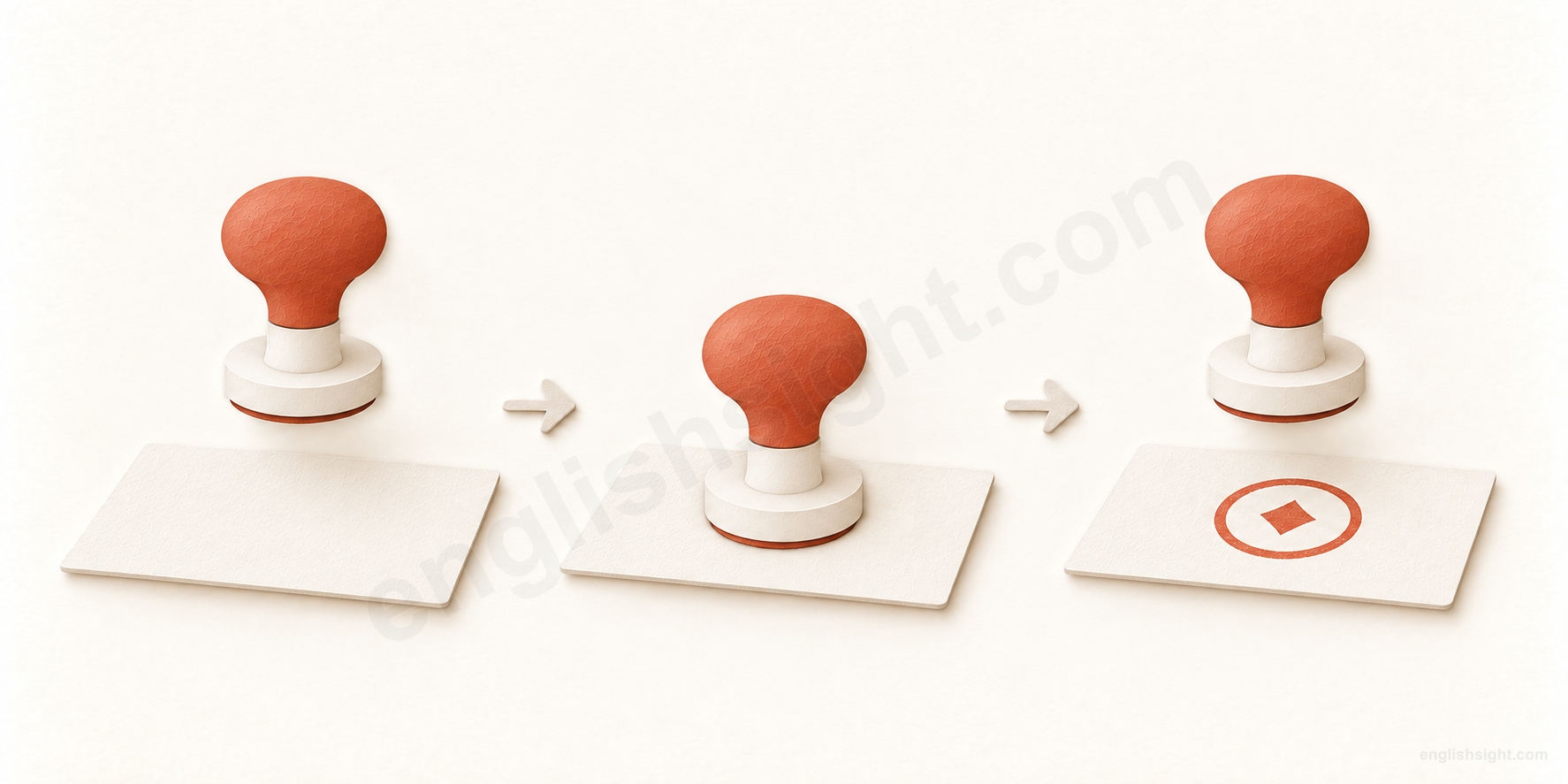
The stamp is raised above a blank card.
stamp
The tool lifts away, leaving a ring-and-diamond impression.
Its printing base presses firmly onto the card.
The tool lifts away; its printed impression remains.
Press a tool firmly onto a surface so that its design leaves a distinct impression.
This picture explains the printing branch directly. Heavy footsteps emphasize contact and force, while figurative marks and fixed phrases extend or depart from that physical scene.
A stamp may be the tool you press down, the mark it leaves, or a postage label. As a verb, stamp can describe printing a mark or bringing a foot down heavily. The object and the words that follow tell you which use is intended.
A useful teaching connection is firm contact with a surface, sometimes leaving a clear impression. Foot stamping need not leave a mark, and established expressions such as stamp out bullying need their own explanation. This is a learning model, not a claim about a picture shared by every English speaker.
01
Postage and preparing mail
A stamp can be a label used to pay for mailing; stamp can also mean attach that label.
01
a stamp; buy / collect stamps; put / stick a stamp on + envelope
a postage stamp
a small official label used to pay for sending mail
Situation / starting point
A letter needs postage before it is sent.
Result / intended meaning
A stamp is attached to the envelope.
Here stamp names the label, not the action of pressing a tool.
A stamp is countable: one stamp, two stamps. In a mailing context, stamp usually means postage stamp. You buy stamps, put or stick a stamp on an envelope, and send the letter. Postage is the charge for carrying the mail; it is not the little label itself.
A book or sheet of stamps contains several stamps. A stamp collector keeps stamps as a hobby; stamp collecting names the activity, and a stamp album holds the collection. These noun combinations keep the postage meaning rather than introducing a new verb sense.
The picture of an impression helps connect the printed label with other kinds of stamp, but using a self-adhesive stamp does not require a striking or stamping action.
In a sentence
I bought a book of stamps and put one on the envelope.
Watch the difference Say a stamp or some stamps. Postage is normally uncountable: How much is the postage?
02
stamp + envelope / letter; a stamped addressed envelope
stamp an envelope
put a postage stamp on an envelope
Situation / starting point
The envelope has an address but no postage stamp.
Result / intended meaning
The envelope has been stamped and is ready for mailing.
The object is the envelope receiving the label.
In a mailing context, stamp an envelope means attach a postage stamp to it. The same verb with a passport normally means print an official mark instead. The object and the situation select the action; stamp does not always describe the same physical process.
Stamped is common in a passive sentence or before a noun: The envelope is already stamped; a stamped envelope. A British stamped addressed envelope, often abbreviated sae, has your address and a stamp so that the recipient can send a reply to you.
Putting a stamp on an envelope does not itself mean posting it. You still need to send it. An envelope stamped with a company logo, by contrast, has had a design printed on it.
In a sentence
Please stamp the return envelope before you enclose it.
Watch the difference A stamped envelope has postage attached in this context; it has not necessarily been posted.
02
Tools, impressions, and shaped parts
A tool meets a surface. Follow which object receives the mark, what is printed, and what remains afterward.
03
a rubber / date stamp; a stamp in + passport; a stamp on + document
a rubber stamp / a passport stamp
the printing tool, or the impression it produces
Situation / starting point
A stamp is held above a blank surface.
Result / intended meaning
The surface carries a stamp made by that tool.
The same countable noun can name the instrument and its result.
A rubber stamp is a small tool whose printing surface carries letters or a design. A date stamp prints a date; an ink pad supplies ink. In Pass me the stamp, stamp names the tool. In There is a stamp in my passport, it names the printed mark.
A mark may record an official check, but not every stamp is official: a child can use a decorative stamp on a card. Passport stamp and postage stamp are different objects, even though both may be found on paper.
The diagram shows this tool-to-impression relationship. The original tool can be lifted away while its mark stays on the surface.
In a sentence
She lifted the rubber stamp, leaving a clear stamp on the card.
Watch the difference Check whether stamp names the tool, its printed mark, or a postage label.
04
stamp A with B; stamp B on A; have + object + stamped
stamp a form with a date
print a mark onto a surface using a tool
Situation / starting point
A form has no date mark.
Result / intended meaning
A date is printed on the form.
Name either the marked object or the mark as the direct object.
Stamp the form with a date and stamp a date on the form describe the same relationship. In the first pattern the direct object is the surface receiving the mark; in the second it is the information printed there. With introduces the mark, while on introduces its location.
The passive is especially useful when the mark matters more than the operator: The form was stamped with a date; A date was stamped on the form. A bill can be stamped “PAID”, where the quoted word gives the text of the mark.
Have your passport stamped means arrange for an official to mark it. Have + object + past participle supplies the arrangement meaning; stamp alone does not mean persuade someone to do something. Stamping is one way of printing, using a stamp or similar tool, rather than a general word for every printer operation.
In a sentence
The clerk stamped the form with today’s date.
Watch the difference Use with before the mark and on before the surface: stamp the date on the form, not with the form.
05
stamp + object + out of / from + material
stamp shapes out of metal
cut or shape material with a die or pressing tool
Situation / starting point
A sheet of metal has not been cut into parts.
Result / intended meaning
A press produces shaped parts from the sheet.
Here pressure creates a shape rather than an ink mark.
In manufacturing, a tool can stamp a part out of a sheet of material. Stamp connects the shaped result with pressure from a tool. Out of or from names the material used, as in stamp discs out of metal.
The passive is natural when describing a process: The parts are stamped from sheet metal. You can say stamp discs out of metal or stamp discs from metal. Keep out of together in the first pattern; from alone introduces the material in the second. This production use is different from stamp out a bad practice, which means eliminate it.
This is a useful recognition sense in descriptions of how things are made. It does not make stamp a general substitute for cut, carve, or build.
In a sentence
The machine stamps small discs out of thin metal sheets.
Watch the difference Stamp out metal parts means produce them; stamp out fraud means stop it.
03
Forceful steps, movement, and stopping things
Foot uses emphasize firm downward contact. Direction phrases and established particles then distinguish walking, extinguishing, elimination, and suppression.
The forceful contact matters; a visible mark is not required.
Stamp your foot can describe a forceful downward movement, for example in anger or impatience. Stamp your feet can describe repeated movements to keep warm. The emotion or purpose comes from the situation, not from stamp alone.
The verb can also stand without a direct object: The children stamped and cheered. In stamp the snow off your boots, the forceful movements remove snow; off names the result and your boots name its original location.
Stomp overlaps with stamp in foot and heavy-walking uses. It does not replace stamp for a postage label or for printing a document. Step is more neutral about force and noise.
The noun can also name the act or sound: A sudden stamp of the foot broke the silence. This is usually singular and refers to the movement or its noise, not to a postage label.
In a sentence
We stamped our feet while we waited outside in the cold.
Watch the difference Stamp does not always mean angry, and stamping need not leave a footprint.
07
stamp on + object / person’s foot; stamp on it
stamp on something
put a foot down forcefully onto something
Situation / starting point
An object is beneath a raised foot.
Result / intended meaning
The foot strikes the object with force.
On introduces what receives the downward force.
Stamp on a can means hit it hard with your foot, often flattening it. You can also stamp on someone’s toe accidentally. The verb describes the forceful contact; harm, damage, or intention must be understood from the full sentence.
On has its ordinary contact relationship in this physical use. Keep the object after on, including a pronoun: stamp on it. Stamp it on would suggest a different construction, such as applying a mark to something.
Compare step on a can, which can simply mean place your foot on it. Stamp on makes the force much more prominent.
In a sentence
He stamped on the empty can and flattened it.
Watch the difference Stamp on it has a different structure from stamp it out.
08
stamp + out of / into / across / down + place; stamp off / away
stamp out of the room
leave a room with heavy, noisy steps
Situation / starting point
A person is inside a room.
Result / intended meaning
The person leaves with forceful footsteps.
Stamp describes the manner of walking; out of supplies the route.
She stamped out of the room says how she walked as she left. It often suggests anger or irritation, although the surrounding context still matters. Stamp off and stamp away can similarly describe leaving with heavy steps.
Other directions are possible: stamp down the stairs or stamp across the floor. These are combinations of a manner-of-walking verb with direction phrases, not a separate memorized phrasal verb for every route.
In He stamped out of the office, out of the office describes the route from inside the office to outside it; there is no thing being eliminated. In He stamped out the problem, the problem is the object of a different expression.
In a sentence
After the argument, Leo stamped out of the kitchen.
Watch the difference Stamp out of a room means leave it noisily, not destroy the room.
09
stamp out + flame / fire; stamp + object + out; stamp it out
stamp out a flame
extinguish something by bringing a foot down on it
Situation / starting point
A small flame is burning.
Result / intended meaning
Repeated forceful contact puts it out.
Out supplies the extinguished result.
Stamp out can describe a physical action that extinguishes a flame, using the downward force of a foot. Unlike simple stamp on, it includes the result of putting the fire out.
With a noun, both stamp out the flame and stamp the flame out are possible. A personal pronoun goes between the verb and the particle: stamp it out. This is a separable particle construction.
This literal result helps make the expression stamp out bullying memorable, but that abstract use involves policies or other efforts rather than feet.
In a sentence
Maya stamped out a tiny flame beside the path.
Watch the difference With a pronoun say stamp it out, not stamp out it.
10
stamp out + harmful practice; stamp it out; be stamped out
stamp out bullying
take strong action to eliminate something harmful
Situation / starting point
A harmful practice is occurring.
Result / intended meaning
People act to stop it completely.
The established expression presents an unwanted practice as something to eliminate.
Stamp out bullying means work to remove it, not physically step on people. Typical objects include racism, corruption, fraud, and other problems treated as harmful. The expression emphasizes determined action toward elimination.
The grammar is the same as in the literal extinguishing use: stamp out bullying, stamp bullying out, stamp it out. A passive is possible: Corruption must be stamped out.
Try to, aim to, and a campaign to describe an effort or goal; they do not prove success. Compare reduce, which allows the problem to remain at a lower level, with stamp out, whose target is its elimination.
In a sentence
The school introduced new measures to stamp out bullying.
Watch the difference The aim to stamp something out is not evidence that it has already disappeared.
11
stamp on + idea / criticism / activity; stamp on it; be stamped on
stamp on an idea
use authority or force to stop something developing
Situation / starting point
Someone begins raising a suggestion or criticism.
Result / intended meaning
An authority moves to suppress it.
This figurative on construction concerns forceful opposition.
In stamp on an idea or stamp on criticism, there is no literal foot. A person uses authority or pressure to stop the activity or prevent it from developing. Depending on context, this can describe controlling something harmful or unfairly suppressing discussion.
Keep the object after on: stamp on it. A passive keeps the preposition: The suggestion was stamped on. This differs from the separable stamp it out.
Stamp out often emphasizes removing a harmful practice altogether; stamp on can emphasize crushing a particular attempt or development. Their meanings overlap, so this is a useful tendency rather than a rule that forbids other objects.
In a sentence
The manager stamped on every suggestion for changing the schedule.
Watch the difference Stamp on a suggestion suppresses it; stamp a date on a form prints information.
04
Distinctive qualities and lasting impressions
A visible mark provides a useful metaphor for a recognizable style, a clearly revealed quality, or a vivid memory. These uses are often more formal or descriptive.
12
bear / carry / have the stamp of + quality / person
bear the stamp of something
clearly show a particular quality or influence
Situation / starting point
You look at something’s features.
Result / intended meaning
Those features reveal a distinctive quality or source.
A figurative stamp is a recognizable sign, not an ink mark.
A work that bears the stamp of originality clearly shows originality. Bear, carry, and have can introduce this figurative stamp. Of names the quality or the person whose influence is recognizable.
This is relatively formal language, useful in reviews and evaluations. The singular noun often comes with the or a description such as unmistakable. The impression model connects a visible mark with a quality that seems clearly expressed.
The formal phrase people of a different stamp uses stamp to mean kind or character. It does not mean that they collect different postage labels. Recognize it in writing; kind or type is usually a simpler everyday choice.
In a sentence
The short film bears the stamp of an original mind.
Watch the difference Here bear means show or carry a characteristic, not tolerate it.
13
put / leave your stamp on + work; stamp your style on + work
put your stamp on something
give something a recognizable personal character
Situation / starting point
A project does not yet reflect someone’s own approach.
Result / intended meaning
Their choices give it a distinctive character.
The person’s influence is compared to an impression left by a tool.
Put your stamp on a project means shape it so that your approach or style is recognizable. Leave your stamp on emphasizes the influence that remains. The stamp is figurative; no official printing tool is required.
The related verb construction is stamp your personality or style on something. Here the direct object is the quality being impressed, and on introduces the work or situation that receives the influence.
This is different from give a project your stamp of approval. Putting your stamp on it concerns its character; approving it concerns accepting or endorsing it.
In a sentence
The new director put her stamp on the festival with a bold choice of films.
Watch the difference A personal stamp is an influence or style; a stamp of approval is an endorsement.
14
something stamps + person + as + noun phrase; be stamped as + description
stamp someone as something
show clearly that someone belongs to a particular type or has a quality
Situation / starting point
A person’s quality is not yet clear to others.
Result / intended meaning
A revealing action makes that quality apparent.
As introduces the identity or description revealed by the evidence.
An achievement can stamp someone as a talented player or a serious contender. The subject is often the achievement or feature that reveals the quality; the object is the person being characterized. This is relatively formal, emphatic wording.
It can be positive or negative, depending on the description after as. It does not inherently mean blame. A passive is also possible: She was stamped as a potential leader by her performance.
Unlike call someone a leader, the construction emphasizes evidence that marks the person out. The result is a characterization, not a physical stamp on their body.
In a sentence
Her calm response to the crisis stamped her as a natural leader.
Watch the difference Keep as before the identifying description: stamped her as a leader.
15
feeling + be stamped across / on + face; face + be stamped with + feeling; have + quality + stamped all over + it
fear was stamped across her face
a feeling was very clearly visible
Situation / starting point
A person experiences a strong feeling.
Result / intended meaning
Their expression makes the feeling unmistakable.
The passive likens a visible feeling to a clearly printed mark.
Fear was stamped across her face is vivid descriptive language: her expression clearly showed fear. Alternatively, Her face was stamped with fear makes the face the subject. Neither wording describes a literal printing operation.
Stamped all over can also present a quality as obvious: The plan had haste stamped all over it suggests clear signs of rushed preparation. It is an emphatic assessment, not a claim that words were physically printed there.
These expressions fit storytelling or strong commentary more readily than neutral everyday reporting. She looked frightened and the plan looked rushed are simpler alternatives.
In a sentence
Relief was stamped across his face when he heard the good news.
Watch the difference Read the surrounding subject and context before assuming stamped refers to printed words.
16
image / event + be stamped on / in + someone’s memory
be stamped on your memory
remain very clearly fixed in your memory
Situation / starting point
A striking event is experienced.
Result / intended meaning
Its details remain strongly remembered.
The lasting impression is mental rather than physical.
An image stamped on your memory is difficult to forget. The metaphor compares a vivid recollection with a mark pressed onto a surface. Indelibly can emphasize that it seems impossible to erase.
In and on both occur with memory in this use. The passive is natural because the remembered image or event is in focus: The moment was stamped on my memory.
This is vivid, relatively literary wording. Remember clearly is the more neutral everyday alternative. The expression does not mean that an official recording was made.
In a sentence
The sight of the empty station was stamped on my memory.
Watch the difference A mental stamp is a lasting recollection, not necessarily a traumatic one.
05
Approval and established compounds
Learn these complete expressions with their own meanings and contexts; the physical picture alone does not predict them.
17
give + thing + your stamp of approval; put your stamp of approval on + thing
give something your stamp of approval
express acceptance or endorsement
Situation / starting point
A proposal is waiting for someone’s decision.
Result / intended meaning
That person or organization endorses it.
An official-looking mark serves as a metaphor for acceptance.
Give a plan your stamp of approval means say that you accept it or think it is good enough. An institution can give its stamp of approval, and an individual can give theirs. No physical stamp is necessary.
You can also say put your stamp of approval on something or something has your stamp of approval. Seal of approval is a closely related expression. These phrases identify whose endorsement matters in the context.
The phrase does not by itself prove that every legal step is complete or every risk is removed. In everyday use it can simply express a person’s positive judgment.
In a sentence
The club gave the revised plan its stamp of approval.
Watch the difference Keep approval in the phrase: put your stamp on a plan usually concerns influence or style.
18
rubber-stamp + decision / agreement; be a rubber stamp for + decisions
rubber-stamp a decision
approve a decision without giving it proper consideration
Situation / starting point
Another person or body has already made the decision.
Result / intended meaning
The approving body accepts it with little real scrutiny.
The criticism is about automatic approval, not the physical use of rubber.
To rubber-stamp a decision is to approve it, especially without examining it carefully or exercising independent judgment. The verb often expresses disapproval. It is not a neutral synonym for any official approval.
A committee can be called a rubber stamp for decisions made elsewhere. In that figurative noun use, the committee is compared with a tool that merely repeats an approval. A literal rubber stamp is simply a printing tool and need not imply careless work.
The noun is normally written as two words, rubber stamp; the verb is commonly hyphenated, rubber-stamp. It takes a direct object: rubber-stamp the agreement. It is a compound verb, not stamp followed by a particle.
In a sentence
The committee refused to rubber-stamp the agreement without reading it.
Watch the difference Using a physical rubber stamp does not by itself prove that approval was careless.
19
someone’s (old) stamping ground; North American also stomping ground
your old stamping ground
a familiar place where you used to spend time
Situation / starting point
A place has been part of someone’s regular life.
Result / intended meaning
They refer to it as a familiar haunt.
The whole informal expression names a place of repeated activity.
Your stamping ground is a place you like and often visit. Old stamping ground commonly refers to somewhere you used to spend time. It may be a neighborhood, a café, or another familiar area; it need not be a literal patch of ground.
North American English also uses stomping ground. A person can have several old stamping grounds. The possessive usually helps identify whose familiar place is meant.
Repeated footsteps offer a memory connection, but the whole noun phrase is established. It does not mean a place where people must stamp their feet or collect postage stamps.
In a sentence
We went back to my old stamping ground near the university.
Watch the difference Ground here names a familiar place, not necessarily soil or a sports field.
20
receive / use food stamps; buy food with food stamps
receive food stamps
receive government assistance for buying food in the US
Situation / starting point
A text discusses help with buying food.
Result / intended meaning
Food stamps identifies a particular kind of assistance.
This fixed compound concerns food support, not postage.
In US English, food stamps refers to government help that people with low incomes can use to buy food. The term is usually plural. Dictionaries describe the vouchers associated with this name; in a sentence about receiving food stamps, the focus is the food assistance.
Treat food stamps as a complete noun expression: receive food stamps or buy food with food stamps. It does not mean postage stamps with pictures of food, and it does not describe an action of stamping food.
This lesson explains the expression for reading and conversation. It does not set out benefit rules or tell you how any particular payment system works.
In a sentence
The article describes a family that receives food stamps.
Watch the difference Understand the compound as food assistance rather than interpreting stamp in isolation.
21
pay stamp duty; stamp duty on + transaction
pay stamp duty
pay a tax associated with certain legal documents or transactions
Situation / starting point
A text discusses the taxes connected with a legal transaction.
Result / intended meaning
Stamp duty identifies a tax rather than a postal charge.
The fixed compound belongs to legal and financial vocabulary.
Stamp duty is the name of a tax associated with certain legal documents or transactions, familiar in British usage. Duty here means a tax, not a personal responsibility. The connection is with official evidence of payment, rather than with sending mail.
The expression is normally uncountable: pay stamp duty, not pay a stamp duty when simply naming the tax. A physical revenue stamp on a document is countable; stamp duty names the tax itself.
Learn the expression for recognition in a document or news report. Which transactions are taxed and how much is payable belong to the relevant tax system, not to the meaning of the word stamp.
In a sentence
The report discusses stamp duty on property purchases.
Watch the difference Stamp duty is a tax; postage is the charge for sending mail.
Keep the object and the construction in view
Forms and pronunciation
The noun and verb are commonly pronounced /stæmp/. The forms are stamp, stamps, stamped, stamping; stamped ends in /t/, as /stæmpt/. Do not double the p in stamping or stamped. The ordinary concrete noun is countable; stamp duty is an uncountable compound.
Stamp, step, stomp, and print
Step does not specify force. Stamp and stomp overlap for forceful foot movements and heavy walking, but stomp does not replace postage stamp or stamp a passport. Print is broader than making an impression with a stamp.
On and out do different jobs
Stamp a date on a form prints a mark; stamp on a can makes forceful contact; stamp on an idea suppresses it. Stamp out of a room describes a route, stamp out a problem means eliminate it, and stamp parts out of metal means produce them. Similar words do not guarantee the same grammatical structure.
Action, passive, and arrangement
An ongoing action can use the progressive: The clerk is stamping the forms. Marking and manufacturing uses readily take passives: The boxes are stamped with a code. Have a document stamped arranges the action through have + object + past participle; there is no ordinary stamp someone to do something causative pattern.
Scope of the lesson
The lesson covers modern everyday senses and selected expressions useful for reading, with formal and specialist uses labeled. Historical mining machinery, detailed tax and welfare rules, and every technical compound are outside its scope. The entries are grouped for learning, not ranked by measured frequency.
Read the object and the result
Choose the sentence that matches the situation. Small words can change both grammar and meaning.
1. A clerk prints a date on a form. Which sentence names the form as the direct object?
2. After an argument, someone leaves a room noisily. Which sentence fits?
3. Bullying is the problem, and you replace it with it. Which form fits the elimination meaning?
4. A committee accepts a plan but does not change its style. Which expression describes its acceptance?
5. A press cuts matching metal discs from a sheet. What does stamped out mean here?
6. A council is criticized for approving decisions automatically. Which wording conveys the criticism?
Sources and teaching notes
The sources below were read to check meanings, constructions, and usage labels. The explanations and examples are original. The physical connection is a teaching model, not a dictionary claim that every use follows from one image.
The diagram illustrates a useful connection; English speakers do not all share one mental picture.