Use start for entering an activity, locating its beginning, and describing how that beginning goes.
From not under way to under way
From not under way to under way
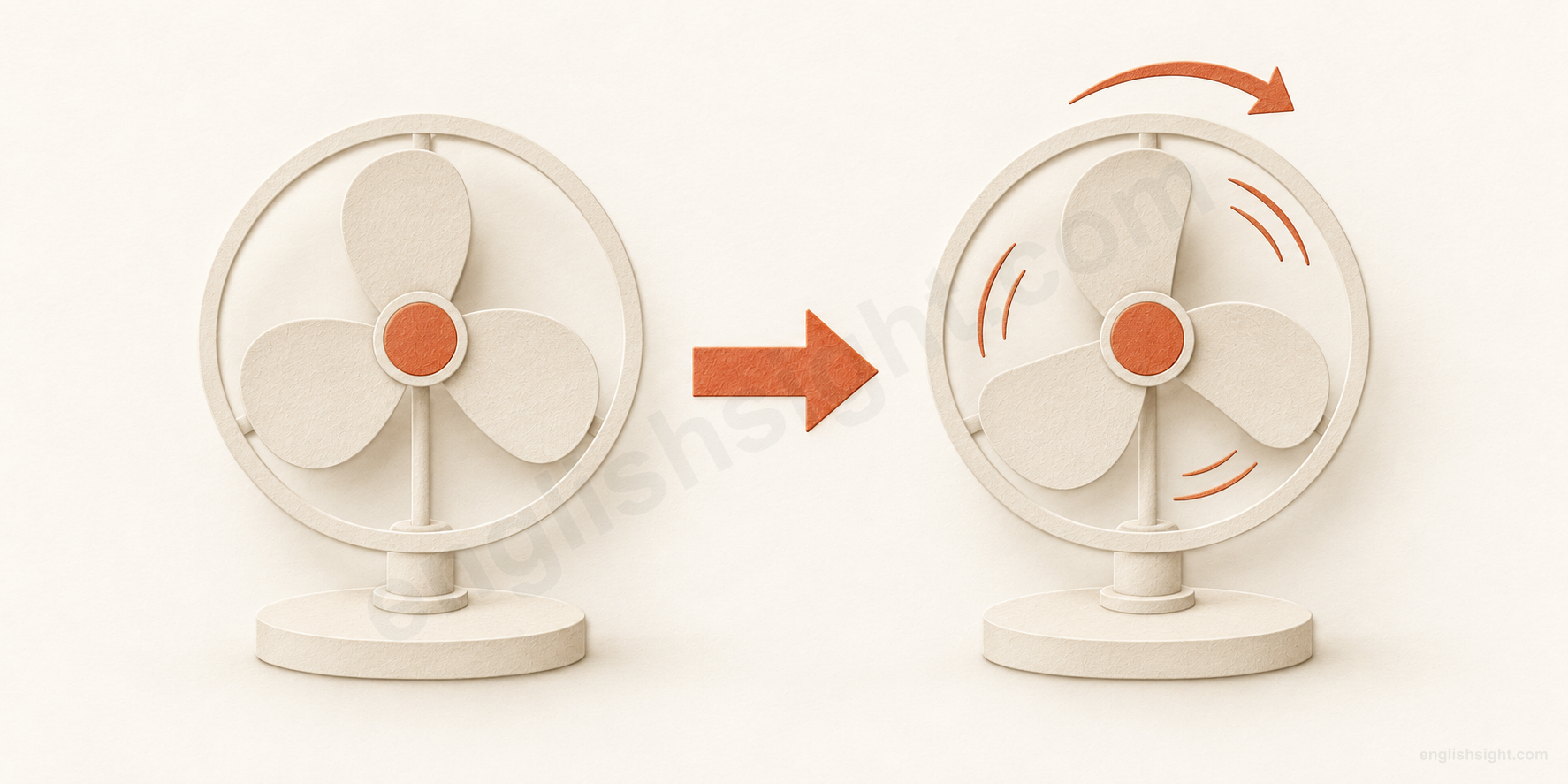
Not operating
start
Operating now
The fan starts.
The same fan goes from still to turning. Start marks entry into operation, not completion.
An activity, event, or operation begins: it was not happening, and now it is under way.
The fan illustrates entry into operation, including a restart. Start does not imply completion, success, or a long duration. Static origins, established phrases, and the surprise branch need their own explanations.
A useful connection is the boundary between not yet doing something and doing it. People start work, rain starts, and a motor starts. Other patterns locate the beginning of a route, price range, or career.
The connection helps organize the word; it does not predict every fixed expression. The sudden movement of surprise is taught as a separate branch. No single picture is shared by all English speakers.
01
An activity comes into progress
Identify what begins, who begins it, and whether someone causes another person or thing to become active.
01
start + -ing; start + to-infinitive
start doing / start to do
enter an activity or developing state
Situation before
Mina is silent while she waits.
Beginning / interpretation
Mina begins speaking.
Start focuses on entry into the activity, not on finishing it.
Mina started talking and Mina started to talk both describe the beginning of talking. The following verb tells us which activity begins; start alone does not mean moving fast.
With many ordinary activities either form works. In I’m starting to understand, understanding is developing now; the progressive is on start. Starting to feel is a useful natural pattern, without a rule that all -ing complements are wrong.
In a sentence
Mina started talking when the others sat down.
Watch the difference Say started talking or started to talk, not started talk. Starting an activity does not say that it was completed.
02
start + activity noun / object
start work / school / a new book
begin a task, a stage of life, or using something
Situation before
Your new job has been arranged.
Beginning / interpretation
Your first working day arrives.
The noun and context supply the activity that begins.
Start a job can mean begin working in it; start school can mean enter school as a pupil. Start work may describe the beginning of a working day or the beginning of employment.
I started the novel last night can mean began reading it or began writing it: the situation decides. Start a new jar means begin using its contents. These objects are not all things you create.
In a sentence
I start my new job on Thursday.
Watch the difference Start a book does not by itself distinguish reading from writing. Add reading or writing when the context is unclear.
03
event + start; person + start + event; be started + by
The meeting starts / start a meeting
begin happening or cause an event to begin
Situation before
Everyone is waiting for the discussion.
Beginning / interpretation
The chair opens the discussion.
The event can be the subject, or a person can cause its beginning.
The meeting started at ten reports when the event began. Priya started the meeting at ten names the person who initiated it. Starting a fire or an argument similarly names what someone caused to happen.
A passive is possible when something is initiated by an agent: The campaign was started by local parents. Contrast that with The campaign started in April, which simply locates its beginning.
In a sentence
Priya started the meeting with a question.
Watch the difference The meeting started is not missing a passive auxiliary. Use was started when presenting it as something initiated by someone.
04
start + machine; machine + start; will not + start
start the engine / It won’t start
begin operating or make a machine operate
Situation before
A fan is switched off and its blades are still.
Beginning / interpretation
The motor runs and the blades turn.
The machine enters operation; it need not travel anywhere.
Start the engine presents someone bringing it into operation. The engine started presents the machine’s change. This is the concrete example used in our diagram.
The car won’t start commonly reports a failure to function when you try it. Won’t here need not mean that a car has a will or refuses deliberately. Begin the engine is not the ordinary substitute for start the engine.
In a sentence
The van won’t start this morning.
Watch the difference Starting the engine is different from starting to drive: the vehicle may still be parked.
05
start + organization; start a family
start a business / a family
bring an organization into existence or begin having children
Situation before
Two friends have a plan but no company.
Beginning / interpretation
They establish a repair business.
Something new begins to exist; the object determines the kind of beginning.
Start a business, a club, or a blog can mean establish it, rather than merely begin today’s work. The business started in 2020 locates its origin without naming its founders.
Start a family conventionally means begin having children. It does not simply mean share an apartment, get married, or invite relatives to a meal. Learn that meaning with the whole collocation.
In a sentence
They started a bicycle repair business together.
Watch the difference Start a family and start a company share the idea of a beginning, but their specific activities are supplied by established usage.
06
start + person / thing + -ing
start someone thinking
cause a person or process to begin an activity
Situation before
You have not been considering a move.
Beginning / interpretation
A message makes you begin considering one.
The object after start is the participant in the following activity.
In The message started me thinking, me is the person who thinks; the message triggers the thinking. This pattern can describe feelings and responses as well as deliberate actions.
The -ing clause explains what starts. Compare I started thinking, where I am the subject and there is no separate object naming an affected participant.
In a sentence
Her message started me thinking about moving closer to home.
Watch the difference Use started me thinking for this pattern. Get me to think and make me think use different verb constructions.
07
get started (on / with something); get + object + started
get started / get someone started
begin, or help someone or something begin
Situation before
The team has its materials but has done no work yet.
Beginning / interpretation
The team takes the first practical step.
Get started emphasizes moving from readiness into action.
Let’s get started is a normal invitation to begin. Get started on the report names the task; get started with a short outline names an initial tool or step.
I’ll get you started can offer initial help rather than a promise to finish the task for you. Get the motor started means make it run. Started here is a participle, not a new past-tense verb after get.
In a sentence
I’ll get you started, and then you can finish the form yourself.
Watch the difference Let’s get started does not mean Let’s get someone else to do it. Read whether get has an object.
02
The first step, place, amount, or role
Following words locate a beginning. A beginning can be a point in a sequence or a range, without anything physically moving.
08
start by + -ing; start with + noun; start + object + with + noun
start by doing / start with something
choose the first action or item in a sequence
Situation before
You have several jobs to do in the kitchen.
Beginning / interpretation
You choose washing vegetables as the first step.
By introduces an initial action; with introduces an initial item or component.
Start by washing the vegetables says what to do first. Start with the vegetables chooses the first thing to deal with. Neither phrase says that nothing else will follow.
Start the day with a walk puts a walk at the beginning of the day. A word starts with a particular letter describes its first component, rather than a person carrying out a task.
In a sentence
Start by checking the names, then print the list.
Watch the difference Use by checking, not by check. Start with a question differs grammatically from the fixed sentence adverb To start with, ….
09
start at / from / in + place, point, or situation
start at / from / in
locate an origin or initial position
Situation before
You want to identify the beginning of a route.
Beginning / interpretation
You locate its first point at a bridge.
A beginning can be a location, not an event happening now.
The trail starts at the bridge describes the trail’s layout. The trail does not travel from the bridge. We started from the bridge instead describes people beginning a journey there.
Start from the assumption that… names the reasoning you take as an initial basis. Start in a difficult position describes initial circumstances. The choice of preposition depends on the intended relationship, not one universal rule.
In a sentence
The trail starts at the old bridge.
Watch the difference Start for the bridge means begin moving toward it; start at the bridge identifies a starting point.
The number is a lower starting level, not the price of every option.
Rooms start at $90 means the range begins at that amount; other rooms can cost more. Starting at $90 is a shorter phrase often used in advertisements.
The same beginning model can locate a scale or range. No buyer, machine, or physical movement is implied by the verb itself.
In a sentence
Room rates start at $90 a night.
Watch the difference Do not infer that all rooms cost $90 or that the price is rising over time.
11
start (out / off) as + role; start life as + noun
start as / start out as
describe an initial role or form before later development
Situation before
An editor’s first job was in customer support.
Beginning / interpretation
You contrast that early role with her later career.
As names the initial identity or function.
Start as an assistant and start out as an assistant both locate an early career stage. Out can highlight a longer course of development; off is also possible. The sentence often leads to a contrast with what happened later.
A project can start out as a hobby, and a building can start life as a school. Start life as is an established way to describe an original function; it does not imply that a building is literally alive.
Start young describes the age at which someone begins; start small describes the initial scale. In these patterns the following word describes the participant or beginning, rather than naming an object that is created.
In a sentence
Nora started out as an assistant and now edits the magazine.
Watch the difference Use as for the role: started as an assistant. Start an assistant would give assistant a different grammatical role.
12
start (out / off); start for / toward + destination
start out / start for home
begin a journey or begin moving toward a destination
Situation before
You are packed but still at the campsite.
Beginning / interpretation
You set off toward home.
This beginning is the departure, not the arrival.
We started out before sunrise means we began our journey then. Start off can also describe setting off. Where the journey begins can be added with from.
She started for the exit means she began moving toward it. For marks the intended destination; it does not guarantee that she reached it. In a career context, starting out can instead mean taking one’s first steps in work or life.
In a sentence
We started out before sunrise to avoid the afternoon heat.
Watch the difference Started for home does not mean arrived home. Use arrived or reached for arrival.
03
Read the whole combination
Off, up, over, and on contribute different patterns. Some combinations remain close to beginning; others have established social meanings.
13
start off + adverb / adjective; start off by + -ing; start off with + noun
start off well / quiet / by…
describe how something is at its beginning
Situation before
A discussion has only just begun.
Beginning / interpretation
Its early tone is friendly, whatever happens later.
Off can foreground the initial phase and how it develops.
The meeting started off well evaluates its beginning. The room started off quiet describes an initial condition; an adjective can follow when it describes the subject.
Start off by asking a question and start off with a question select an opening action or item. These patterns do not require literal movement away from a place.
In a sentence
The meeting started off well, but we soon ran out of time.
Watch the difference Started off quiet describes the subject’s condition; started off quietly describes the manner of beginning.
14
start + noun + off; start off + thing; start + person + off + -ing / on + noun
start something / someone off
initiate an event, trigger a response, or provide initial help
Situation before
A group is silent before a funny remark.
Beginning / interpretation
One remark triggers their laughter.
The object is what is set going, not what moves off into the distance.
Start the discussion off means initiate it. Start someone off laughing means cause laughter to begin; start someone off on the piano can mean help them begin learning.
Don’t start her off again can warn that a comment will trigger another angry speech or emotional response. The context supplies that response. With a pronoun say start it off, not start off it.
In a sentence
That joke started us all off laughing.
Watch the difference Start someone off can trigger a reaction or help them begin; it does not always describe a supportive action.
15
machine / business + start up; start up + noun; start + noun / pronoun + up
start up / start something up
begin operating or establish a new enterprise
Situation before
The machine is inactive.
Beginning / interpretation
It comes into operation.
Up forms an established combination about activation or establishment.
Start up the engine and start the engine up both mean bring it into operation. A business can start up, and people can start one up. Up does not add a literal upward direction.
With an object pronoun, use start it up. The noun a start-up names a recently established business, while start-up costs are the costs of setting something up. These hyphenated forms are not past tenses or extra verbs.
In a sentence
We checked the machine before starting it up.
Watch the difference Use start it up, not start up it. Compare the two-word verb start up with the noun a start-up.
return to a beginning or begin without a prepared base
Situation before
Your first version contains a basic mistake.
Beginning / interpretation
You begin a new version from the beginning.
Over signals another attempt from the beginning, not continuation halfway through.
Start over is especially associated with American English; start again is also widely understood and is the usual British equivalent. Start it over puts the object pronoun before over.
Start from scratch emphasizes having no prepared work or resources to build on. It can describe a first attempt as well as a replacement attempt. Starting again does not always mean discarding every earlier idea.
In a sentence
The recording was full of noise, so we started it over.
Watch the difference Resume means continue after a pause; start over means go back to the beginning. From scratch is not simply a synonym for after a short break.
17
start on + task / food / drink; start in; start in on + task
start on a task / a meal
begin working on or consuming something
Situation before
The letters are ready to be sorted.
Beginning / interpretation
You begin dealing with the letters.
On identifies the thing you begin to work on or use up.
Start on the report means begin work on it. Start the report often works too, but start on makes the task being tackled explicit. After finishing one task, you can start on the next.
Start on a sandwich means begin eating it; start on a bottle of juice means begin drinking its contents. The activity is supplied by the object and context, not by a general meaning of on as above.
Chiefly US informal start in means begin an activity; start in on the report means begin dealing with it. Compare start in on a person, which can mean criticize them rather than tackle a task.
In a sentence
I’ve finished the forms, so I’ll start on the letters now.
Watch the difference Keep the object after on: start on it, not start it on, for this task pattern.
18
start on + person; start in on + person (about + topic)
start on someone
begin attacking or criticizing a person
Situation before
A customer has been speaking to someone else.
Beginning / interpretation
The customer turns his anger toward you.
With a person as object, this can be an attack rather than a task.
In an angry exchange, He started on me means he began attacking me with words, or in some contexts physically. This person-directed use is especially British and informal. It is not the neutral meaning of beginning work on an object.
The person follows on directly, including pronouns: started on him. Oxford marks this person-directed construction as not having a passive.
Chiefly US informal start in on someone can mean begin criticizing them: She started in on me about my untidy desk. Do not automatically give this variant the physical-attack meaning.
In a sentence
When the clerk left, the angry customer started on me.
Watch the difference Start on me does not mean help me begin. Start me off can have that helpful meaning in the right context.
19
start on at + person + about + noun / -ing; start on about + topic
start on at someone / start on about something
begin complaining or criticizing
Situation before
A subject has caused repeated complaints.
Beginning / interpretation
Someone brings up that complaint again.
The pattern identifies the target of criticism or its topic.
Start on at me about the dishes means begin criticizing or nagging me about them. Start on about the dishes leaves the person being addressed unstated.
These are informal complaint patterns. About introduces the topic and can be followed by an -ing clause. They are different from neutral start on the dishes, which can mean begin washing them.
In a sentence
He started on at me again about leaving the lights on.
Watch the difference The at after on belongs to this complaint pattern. Do not use it when you simply mean begin a task.
04
Talk about beginnings as things
The noun names a beginning, an opportunity, an advantage, or an attempt. Fixed expressions add judgments about how that beginning goes.
20
the start of + event; at / from the start; from start to finish
the start of / at the start / from the start
name the beginning point or opening period
Situation before
You need to locate a problem within a course.
Beginning / interpretation
You say it was present from the beginning.
The noun turns the beginning into a point or phase we can refer to.
At the start of the course locates something in the opening part. From the start treats that beginning as the point from which a situation applies. From start to finish covers the whole duration.
The start can also be the place where a race begins: Meet me at the start. This is a location sense of the noun, not a command to begin running.
In a sentence
The instructions were unclear from the start.
Watch the difference Compare at the start, a time reference, with from the start, a starting boundary for what follows. In from start to finish, no the is needed.
21
make a start (on something); get an early start; it’s a start
make a start / get an early start
do the first part or begin early
Situation before
The full job is still too large to finish today.
Beginning / interpretation
You complete the first small part.
A start can be a useful first contribution without being a finished result.
Make a start on the packing means begin it, even if little is done. It’s a start acknowledges useful progress while recognizing that more remains.
Get an early start means begin early, often for a journey or a day’s work. It can help you gain time, but it does not by itself describe an advantage over a particular competitor.
In a sentence
We can make a start on the packing tonight.
Watch the difference Use make a start, with a. Do not confuse a useful first step with completion of the whole task.
22
make / have a fresh / new start; give + person + a fresh / new start
make a fresh start
begin again with a chance to change earlier circumstances
Situation before
An earlier arrangement has been difficult.
Beginning / interpretation
You begin a new stage with a chance to do things differently.
Fresh adds the idea of renewed possibility, not just an earlier clock time.
A fresh start can involve a new job, a move, or a changed approach after difficulties. Make a fresh start focuses on taking that opportunity; give someone a fresh start focuses on providing it.
The expression does not promise that all earlier consequences disappear. It describes a new beginning and its possibilities, rather than a guaranteed happy ending.
In a sentence
After the move, she wanted to make a fresh start.
Watch the difference An early start is about timing; a fresh start is about beginning anew.
23
get one’s start in + field / as + role; give + person + a start in + field
get your start / give someone a start
receive or provide a first opening in a field
Situation before
A new writer has not yet had professional work.
Beginning / interpretation
A small magazine gives her a first opportunity.
The noun can name the opportunity that allows a career to begin.
Get your start in journalism means find your initial opening in that field. It does not mean receive a physical object called a start.
A good start in life similarly concerns early conditions and support. Give someone a start in a career is about enabling a beginning; a head start additionally highlights an advantage over others.
In a sentence
She got her start in radio at a local station.
Watch the difference In got her start, her is a possessive; get a start in a field is also possible. These noun patterns differ from got started, which simply means began.
24
get off to a good / bad / flying start; start off on the right / wrong foot
get off to a good / bad / flying start
have a successful or unsuccessful beginning
Situation before
The first week of a project has just passed.
Beginning / interpretation
You evaluate how its early stage went.
The judgment is about the opening, not a prediction of the final result.
Get off to a good start means do well initially; a bad start means the opening goes poorly. A flying start is a very successful beginning, without literal flight.
Start off on the right or wrong foot describes beginning a relationship well or badly. It is a related fixed expression about first interactions, not advice about which foot should move.
In a sentence
The project got off to a bad start when the first delivery went missing.
Watch the difference Keep to a in get off to a good start. A strong beginning does not guarantee overall success.
25
a head start on / over + competitor; a head start in + field; give + person + a head start
have / get / give a head start
have an initial advantage over others
Situation before
One learner has practised the material before the course.
Beginning / interpretation
That learner begins with an advantage.
The beginning is unequal: one participant is already ahead.
A head start can be literal extra time or distance in a race, or a figurative advantage from preparation, resources, or experience. It need not mean moving before an official signal.
You can give someone a head start by letting them begin earlier. A five-minute start on the others is another way to specify an initial time advantage.
In a sentence
Knowing some Spanish gave me a head start in the class.
Watch the difference A head start is an advantage; a false start is an invalid or unsuccessful beginning. Neither expression guarantees who wins.
26
make a false start; after + false starts
a false start
an invalid race beginning or an unsuccessful attempt to begin
Situation before
The racers have not yet received the signal.
Beginning / interpretation
One racer moves too early and the start is invalid.
False modifies the validity or success of a beginning, not whether movement occurred.
In a race, a false start happens when a competitor begins before the proper signal. This differs from a permitted head start.
Outside sport, a false start is an unsuccessful early attempt, such as an opening to a speech that you abandon and try again. It is not a general name for every late setback in a long project.
In a sentence
After two false starts, I finally recorded a clear introduction.
Watch the difference An early start can be sensible planning. A false start is premature, invalid, or unsuccessful in its context.
27
in / by fits and starts; in stops and starts
in fits and starts
with repeated bursts and pauses rather than continuously
Situation before
You can only work in short periods between interruptions.
Beginning / interpretation
The work advances irregularly, with repeated stops.
Repeated beginnings form a broken pattern of activity.
In fits and starts describes uneven progress: some work, a pause, then another burst. By fits and starts is also used, and in stops and starts makes the stopping especially explicit.
This is an idiom. Fits here does not mean that clothes are the right size, and starts is a plural noun rather than the present-tense verb after he or she.
In a sentence
With constant interruptions, the report progressed in fits and starts.
Watch the difference This means intermittently, not rapidly from beginning to end and not necessarily with no progress at all.
28
player + start; coach + start + player; a player’s + number + starts
start a match / three starts
be chosen to play from the beginning; count appearances as a starter
Situation before
The coach chooses the initial team.
Beginning / interpretation
A player takes part from the opening rather than entering later.
In team sport, a start can count an appearance in the initial lineup.
A player who starts is in the team from the beginning; a coach can start that player. Three starts can mean three games in which the player was in the initial lineup, rather than three goals.
In racing, starts can instead count occasions of competing. This is a useful recognition sense in sports reports, without needing the detailed terminology of every sport.
In a sentence
She scored twice in her first three starts for the team.
Watch the difference Starts does not mean victories. A substitute can play in a match without making a start.
05
Organize a conversation or manage trouble
These expressions can order reasons, describe an initial situation, or refer to an argument. Their meanings belong to the complete wording.
29
to start with, + clause; clause + to start with
to start with: initially
describe the earliest stage, often before a change
Situation before
The first lessons felt difficult.
Beginning / interpretation
You distinguish that initial feeling from later improvement.
The phrase locates a situation in the early stage.
To start with can mean at first. A later contrast often makes this clear: it was difficult to start with, but became easier.
This fixed phrase can sit apart from the verb of the clause. Compare We started with an easy lesson, where started is the main verb and with has its own noun object.
In a sentence
The instructions seemed confusing to start with, but the examples helped.
Watch the difference Do not assume that to start with always introduces a first reason. Here it describes time.
30
for a start, + clause; to start with, + clause
for a start / to start with: first reason
introduce a first point or reason
Situation before
Someone asks why you reject a plan.
Beginning / interpretation
You give the first of your objections.
The starting point belongs to your explanation, not necessarily to a timeline.
For a start and to start with can introduce the first of several points you could make. The speaker may stop after one, leaving others implied.
For a start is often conversational and emphatic. It does not ordinarily replace initially when describing how a situation felt before it changed.
In a sentence
We can’t hold the picnic here. For a start, there’s no shade.
Watch the difference For a start, it costs too much gives a reason. It cost less to start with describes an earlier price.
31
don’t (you) start; person + started it; start something
Don’t start! / You started it!
discourage complaints or blame someone for a quarrel
Situation before
A familiar complaint or argument is about to resume.
Beginning / interpretation
You warn against it or argue about who began it.
What starts is an understood complaint or conflict.
Don’t start! can mean do not begin complaining or criticizing. It can sound impatient or confrontational; it is not a neutral invitation to wait before a task.
You started it! blames the other person for beginning the fight. Start something can mean cause trouble when the context is conflict: Are you trying to start something? That informal meaning differs from neutral start something useful.
In a sentence
“Stop arguing.” “But he started it!”
Watch the difference The it in started it refers to the argument. These expressions do not tell us who is right or excuse continuing the fight.
32
don’t get + person + started (on + topic)
Don’t get me started (on…)
warn that a topic will trigger your complaints or strong reaction
Situation before
Someone mentions a recurring problem that irritates you.
Beginning / interpretation
You signal how strongly you feel about that subject.
The speaker is the person who would be set off talking or complaining.
Don’t get me started on the delays! is an informal reaction to an irritating topic. The speaker suggests that bringing it up will set off complaints, rather than asking for help to begin a practical task.
Compare Don’t start!, which tells the other person not to complain, with Don’t get me started!, which focuses on the speaker’s own reaction. The topic can follow on; when it is already clear, the phrase can stand alone.
In a sentence
Don’t get me started on the delays—we waited an hour for one bus.
Watch the difference This conversational warning is different from I’ll get you started on the form, which can offer practical help.
33
start / get / set the ball rolling
start the ball rolling
take an action that sets an activity in motion
Situation before
Nobody has yet taken a practical first step.
Beginning / interpretation
Your first contribution prompts the process to begin.
A rolling ball is a conventional metaphor for activity under way.
Start the ball rolling means do something that gets an activity or discussion going, such as making the first suggestion or contribution. A real ball is not required.
Keep the ball rolling shifts the focus to maintaining progress after the beginning. The metaphor helps memory, but it does not make every phrase containing ball a start expression.
In a sentence
I’ll start the ball rolling by suggesting a date.
Watch the difference Start the ball rolling means initiate activity; keep the ball rolling means maintain it.
06
A separate branch: a sudden bodily reaction
Start can also describe an involuntary movement caused by surprise. Keep this distinct from deliberately beginning a task.
34
person + start (at + stimulus); give a start; wake with a start
start / give a start / with a start
make a sudden involuntary movement from surprise or fear
Situation before
You are absorbed in a book.
Beginning / interpretation
A sudden crash makes your body jerk.
This branch describes a brief startled movement, not the opening of a planned activity.
She started at the noise means she moved suddenly because the noise surprised her. The noun appears in give a start and wake with a start. This use is common enough in narrative to recognize, though jump is often more conversational.
You gave me a start means you startled me. Compare You gave me a start in publishing, where the extra career context points to an opportunity instead. Keep the surprise branch separate from our fan illustration.
In a sentence
A tray crashed behind me, and I gave a start.
Watch the difference I started at the noise does not mean I began making the noise. With a start describes a startled movement, not a planned start time.
Choose the construction, then the meaning
Start and begin overlap, with limits
Start doing and begin doing often express the same beginning. For activating a machine, start the engine is the ordinary choice. Start is also a noun, but begin is not: use the start or the beginning.
Forms and the passive
Forms are start, starts, started, started, starting. Started ends with an extra /ɪd/ syllable. A project can be started by someone; an event can also simply start without an agent in the sentence. These are different grammatical presentations.
The following word does real work
By takes an -ing action, with can introduce an item, as a role, and at an amount or point. These are not all interchangeable phrasal verbs. Keep a pronoun inside start it up/off/over, but after the preposition in start on it.
A beginning is not a guarantee
A project may start and fail soon afterwards. A price that starts at $90 is the lower end of a range. A head start is an advantage, while a false start is invalid or unsuccessful. Read the whole expression rather than treating all of them as simple synonyms.
Scope and the visual model
This lesson covers common modern verb and noun uses, plus selected recognizable sports and narrative expressions. Historical loosening, flowing, bulging-eye, hunting, and specialized agricultural senses are outside the course.
Read what begins
Choose the expression that matches the situation and the whole construction.
1. You turn the key, but the engine does not run. What describes the problem?
2. The names must be checked before the list is printed. Which instruction gives that first action?
3. You must record the whole introduction again from the beginning. Which expression fits?
4. You reject a venue and give the lack of shade as your first reason. Which sentence fits?
5. Earlier study gives one learner an initial advantage in a new course. What does that learner have?
6. A crash makes you jerk involuntarily. Which sentence expresses that reaction?
Sources and teaching notes
The sources below were read to check meanings, patterns, and usage. The explanations and examples are original. The before-and-after model is a teaching aid, not a dictionary definition or a universal mental picture.
The diagram illustrates one semantic connection; it does not represent a picture shared by every native speaker.