Hot water becomes vapor. Power becomes a useful picture.
Follow steam from a kettle to cooking, movement, momentum, and feelings.
Heated water, vapor, and mist
From heated water to escaping vapor
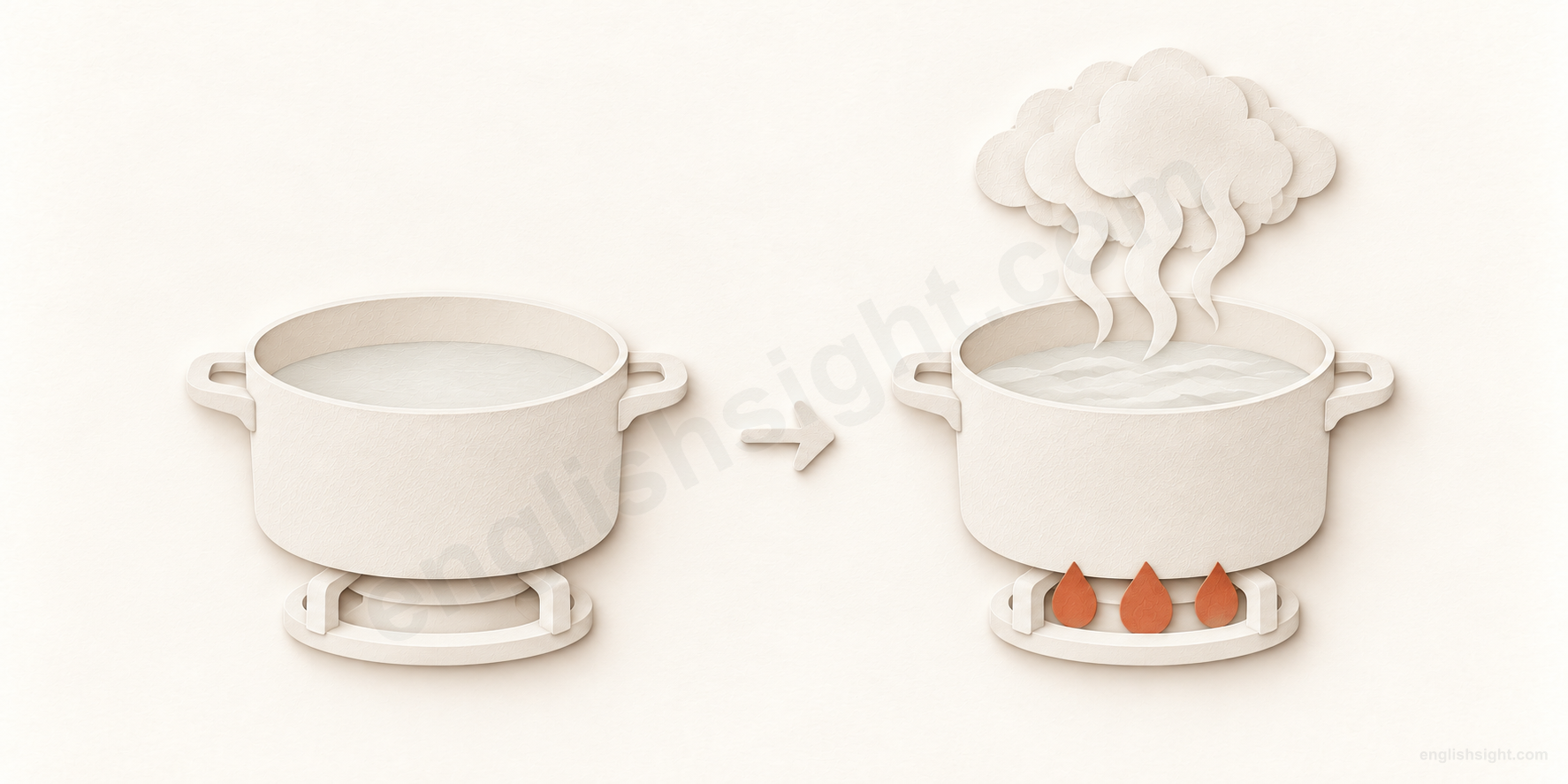
The pot contains still water above an unlit burner.
steam
Above the heated pot, pale curls rise into a cloud of mist.
Heating the water produces vapor, which forms visible mist as it cools.
Heat produces water vapor; the visible white mist is tiny liquid droplets.
Heating water produces water vapor; steam names this vapor and, in everyday speech, the mist it forms as it cools.
Steam can transfer heat and, under pressure, supply power. Those facts help connect several uses, but they do not mechanically predict fixed idioms or every emotional meaning.
Steam first names water vapor and the mist associated with it. As a verb, it can describe giving off vapor or using it to do something. Familiar expressions extend steam to energy and strong feelings.
Begin with the physical relationship, then learn each construction. The diagram is a teaching model, not evidence that all English speakers share one mental picture.
01
Water, heat, and power
Begin with the substance, the power it supplies, and the verb for giving it off. The visible cloud and the invisible vapor are related but physically different.
01
steam + rise / escape; a cloud / jet of steam
steam rises / a cloud of steam
water vapor, or the visible mist formed as it cools
Situation before
Water is heated in a kettle.
What changes or results
Vapor escapes; a pale cloud becomes visible as it cools.
Steam is a substance name, not a count of separate objects.
In ordinary descriptions, steam can mean the vapor from hot water or the white mist above it. Strictly, water vapor itself is invisible; the visible cloud consists of tiny liquid droplets. The noun can also name condensation on a cold surface: I wiped the steam off the bathroom mirror. Here it means the moisture on the glass, not gas trapped inside it.
Steam is normally uncountable: some steam, a little steam, a cloud of steam, or a jet of steam. The countable noun is cloud or jet. Steam rises describes movement; the noun alone does not mean rising.
Example in context
A cloud of steam rose when I lifted the lid.
Watch the difference For this substance, say some steam, not a steam or three steams. Smoke comes from burning material; steam does not imply burning.
02
run on steam; be powered by steam; steam + noun
steam power / a steam engine
steam used as a source of power
Situation before
A boiler produces pressurized steam.
What changes or results
The steam supplies power to machinery.
Pressure makes steam useful for doing mechanical work.
Steam can name the power obtained from pressurized water vapor. A machine can run on steam or be powered by steam. The noun may therefore refer to the substance or to its use as power.
Before another noun, steam describes a connection: a steam engine uses steam for power; a steam pipe carries it; a steam iron uses it to press fabric. The second noun determines the exact connection. These are not all separate meanings of steam.
Example in context
The museum’s engine is powered by steam.
Watch the difference A steam room contains hot moist air; it is not a room that moves like an engine. Read the whole compound.
03
something steams; be steaming; steaming + noun
a steaming bowl / the bowl is steaming
give off steam or visible warm mist
Situation before
Soup has just been served.
What changes or results
Mist rises above its surface.
The subject gives off steam; nobody needs to be cooking it now.
As an intransitive verb, steam can describe something giving off vapor. A steaming bowl of soup is a bowl whose hot contents are sending up mist; the bowl itself is not turning into gas.
Compare steaming soup with steamed vegetables. Steaming describes the visible activity or hot appearance. Steamed describes food cooked using steam. Forms are steam, steams, steamed, steaming; the noun and verb are pronounced /stiːm/.
Example in context
Two bowls of soup were steaming on the table.
Watch the difference Steaming does not by itself identify a cooking method: fried food can also be steaming when served hot.
02
Cooking, treating, and changing a surface
Here steam is the means of doing something. Objects and following words tell you what is cooked, softened, removed, opened, or covered with mist.
04
steam + food; food steams; food is steamed
steam the vegetables
cook food with steam
Situation before
Vegetables sit in a basket above boiling water.
What changes or results
Steam heats and cooks them.
The cook can be the subject, or the food can be the subject.
Steam the vegetables makes the food the object. The vegetables are steaming can describe them cooking in steam; the cooking context distinguishes this from merely giving off mist.
The passive is useful in recipes: The dumplings are steamed, not fried. Steamed vegetables also uses the past participle to describe the preparation. Boil the vegetables instead normally puts them in boiling liquid.
Example in context
Steam the broccoli until it is just tender.
Watch the difference Do not replace steam with boil if the food is held above the water; these describe different methods.
05
steam + material / garment; steam-clean + object
steam a shirt / steam-clean a carpet
apply steam to treat a material
Situation before
A shirt has creases.
What changes or results
A garment steamer treats the fabric.
Steam names the treatment; the object supplies its purpose.
Outside cooking, steam can mean applying steam to something, for example to press fabric or soften material. The object is what receives the treatment: steam a shirt; the shirt was steamed.
Steam-clean makes cleaning explicit: We had the carpet steam-cleaned. Steam alone does not always mean clean, and steam a shirt is not the same as washing it. The heat-and-moisture connection is literal here.
Example in context
I steamed the shirt before the interview.
Watch the difference A steamed shirt is a treated object, not a shirt that has been cooked as food. Context chooses the purpose.
Up marks the misted condition, not movement toward the ceiling.
The mirror steamed up has no object: the mirror became covered with condensation. The shower steamed the mirror up names a cause and an affected object. Glasses, windows, and mirrors are typical subjects.
This use is separable: steam the window up or steam up the window. With a pronoun, use steam it up. The surface may be steamed up even after the shower stops. Compare steam rising from water: here the focus is a clouded surface. The verb sometimes appears without up: Their warm breath steamed the window. It still describes making the glass misty.
Example in context
The hot shower steamed up the bathroom mirror.
Watch the difference Do not confuse physical steamed-up glass with a person getting steamed up: the person may be angry.
07
steam + object + off (+ surface); steam + pronoun + off
steam a label off
remove an attached layer by softening its glue with steam
Situation before
A paper label is stuck to a jar.
What changes or results
Steam softens the glue so the label can come away.
Off gives the removal result; steam gives the method.
The object is the piece being removed, not the surface underneath it. Steam the label off the jar names both. Steam the label off omits the source when it is already understood.
With a pronoun, say steam it off, not steam off it. A passive is also possible: The old labels were steamed off. This literal removal construction differs from let off steam, where steam is the noun object in a fixed expression.
Example in context
We steamed the paper labels off the empty jars.
Watch the difference Steam the label off removes the label. It does not mean that the label itself travels away under engine power.
08
steam + envelope / pronoun + open
steam an envelope open
use steam to soften a seal and open an envelope
Situation before
An envelope is sealed with glue.
What changes or results
The glue softens and the flap can open.
Open describes the result of the steam treatment.
In steam an envelope open, the envelope is the object and open describes its resulting state. Steam says how the seal is loosened. An ordinary box opened by hand is not steamed open.
Keep the object before open: steam it open. The passive is The envelope was steamed open. Compare steam a stamp off an envelope: off describes removal, while open describes a change in the envelope’s state.
Example in context
In the story, the detective steamed the envelope open.
Watch the difference Say steam it open, not steam open it. The construction requires steam as the means, not simply any way of opening.
03
Moving and making progress
A steam-powered journey provides a useful connection to energetic movement and progress. The figurative expressions do not require a real engine.
09
vessel / train + steam + direction
a boat steams across the lake
travel using steam power
Situation before
A steam-powered boat leaves the pier.
What changes or results
It travels across the water.
The vessel moves; a direction phrase supplies its route.
Steam can be an intransitive travel verb for a steam-powered boat or train. Across the lake, into the harbor, or away tells us where it goes. The vessel is the subject; no direct object is needed.
The link to steam power is literal in this use. Compare The boat steamed across the lake with Steam rose above the lake: the first moves a boat; the second moves vapor.
Example in context
The old boat steamed slowly across the lake.
Watch the difference Steam does not always mean fast: a steam-powered vessel can steam slowly. Speed must come from context.
10
person + steam + directional phrase
steam into / out of a room
move somewhere with energy or force
Situation before
Someone approaches in a determined hurry.
What changes or results
They move quickly into the room.
The movement is real, but a human subject does not need a steam engine.
Informally, a person can steam down a corridor or steam out of a room. The verb presents energetic, forceful movement. Anger may explain the movement, but the direction phrase describes an actual route.
Compare She was steaming about the delay, which describes anger without saying she went anywhere. Into, out of, and down retain their normal directional meanings; they do not all create separate idioms.
Example in context
Mara steamed into the office carrying the missing files.
Watch the difference Do not assume every use describes anger. Energetic movement can be determined or excited as well.
11
steam ahead; steam ahead with + plan / project
steam ahead with a plan
make energetic progress or become more successful
Situation before
A project is ready to advance.
What changes or results
Work moves ahead strongly.
Ahead turns the movement picture toward progress.
Steam ahead can describe an economy or company growing stronger, or people pressing forward with work. In steam ahead with a plan, with introduces the project being pursued, not a passenger or an instrument.
This figurative use does not require physical travel. Full steam ahead is a related fixed expression meaning very energetic progress; steam ahead itself need not include the word full.
Example in context
The team is steaming ahead with its new app.
Watch the difference Say steam ahead with the plan, not steam the plan ahead as an ordinary equivalent.
04
Energy, momentum, and independence
These established noun phrases describe gaining energy, losing it, working intensely, or acting without help. Learn the whole phrase.
12
pick up / gain / gather / get up + steam
pick up / gain / gather steam
become more active, powerful, or successful
Situation before
A campaign starts with little support.
What changes or results
More people join and its momentum grows.
The whole expression describes increasing momentum.
A project, trend, or campaign can pick up steam as it develops. Gain steam and gather steam express the same broad increase in momentum. The image of increasing engine power helps explain the connection, but the collocation is conventional.
Oxford also records get up steam and a vehicle picking up steam as it gathers speed. In pick up steam, steam is the noun object of pick up. This is different from the verb phrase steam up, which can describe misted glass.
Example in context
The recycling campaign picked up steam after the school joined.
Watch the difference A campaign picking up steam is developing strength; it is not becoming covered with condensation.
13
build up / gather + a head of steam
build up a head of steam
accumulate pressure, momentum, or strong feeling
Situation before
An effort begins gradually.
What changes or results
Its momentum becomes strong enough to sustain progress.
A head of steam is a built-up supply of pressure, literally or figuratively.
In an engine, a head of steam is pressure available to produce force. Figuratively, a campaign or team builds up a head of steam as activity or success gathers. The article belongs to the whole phrase: a head of steam.
With a person and an emotional context, the same expression can describe anger, anxiety, or excitement building up: He was building up a head of steam over the repeated delays. Context distinguishes growing momentum from growing emotion.
Example in context
The local campaign has built up a head of steam.
Watch the difference Head here is not a body part or the leader of a group. Do not reduce the phrase to build a steam.
14
person / project + run out of steam
run out of steam
lose the energy or enthusiasm needed to continue
Situation before
You begin sorting photos enthusiastically.
What changes or results
You become tired and stop before finishing.
The energy for continuing is treated like a limited supply.
People run out of steam when their energy or enthusiasm is used up. A project can also run out of steam when its drive fades. It may stop completely or simply become less effective.
Run out of is followed by the noun steam. The verb changes tense: ran out of steam yesterday, is running out of steam now. This informal expression does not mean that the room has become too cold or dry.
Example in context
I sorted three boxes of photos, then ran out of steam.
Watch the difference Running out of time concerns the available time. Running out of steam concerns energy, enthusiasm, or momentum.
15
go full steam ahead (with + project); work / operate at full steam
full steam ahead / at full steam
continue with great energy or at full capacity
Situation before
Preparations are complete.
What changes or results
The team commits its full effort to the work.
Full describes the level of power or effort, not a quantity of water.
Full steam ahead is a fixed expression for moving forward quickly and energetically. Go full steam ahead with a project is useful when work proceeds vigorously. It can also stand alone as an announcement: Full steam ahead!
At full steam focuses on intensity or capacity: The workshop is operating at full steam. Unlike pick up steam, it does not describe a gradual increase; the emphasis is the high level already reached.
Example in context
We are going full steam ahead with the exhibition.
Watch the difference Do not add an article to the fixed expression: full steam ahead, not a full steam ahead. It does not guarantee the project will succeed.
16
get somewhere / do something + under + possessive + own steam
under your own steam
by your own effort or without help
Situation before
Friends offer you a lift.
What changes or results
You make your own way to the event.
The power is your own: the expression emphasizes independence.
Get somewhere under your own steam means arrange or manage the journey without other people’s help. You might walk, drive, or use public transport; walking is not required.
The expression can also describe doing something independently. Change the possessive to match the person: under my own steam, under her own steam, under their own steam. It is informal and contains a noun, not the verb steam.
Example in context
Thanks for the offer, but I’ll get there under my own steam.
Watch the difference Under my own steam does not necessarily mean alone, on foot, or in a steam-powered vehicle. The central point is independence.
05
Pressure as a picture for feelings
Informal expressions compare strong feelings with heat and pressure. Read the person and the situation, rather than looking for literal steam.
17
let off / blow off + (some) steam
let off / blow off steam
release energy, anger, or emotional tension
Situation before
A difficult day leaves you tense.
What changes or results
An activity gives those feelings an outlet.
The pressure-release connection is a teaching analogy for an established idiom.
Let off steam and blow off steam are informal expressions for releasing strong feelings or excess energy. An active game, a run, or a noisy conversation may provide the outlet. The phrase describes the release, not necessarily a solution to the original problem.
Here steam is the noun object: let off some steam is also possible. Compare a valve letting off real steam with a person letting off steam after work. Context distinguishes a physical release from emotional release.
Example in context
After the argument, I went for a run to blow off steam.
Watch the difference Do not confuse let off steam with steam a label off: the first releases energy or vapor; the second removes an object using steam.
18
be steaming about / over + issue; be / get (all) steamed up about / over + issue
be steaming / get steamed up
be angry or become emotionally worked up
Situation before
Repeated delays upset someone.
What changes or results
The person becomes very annoyed.
Heat and pressure provide a metaphor; no visible vapor is required.
Informal She was steaming about the delay means she was angry. Be or get (all) steamed up about or over something means be or become very angry or excited. Get highlights the change; be describes the state.
North American English also uses be steamed about something without up. The following topic phrase identifies the cause. This is an emotional use of the whole expression, not a claim that the person has literally been treated with steam.
Example in context
He got all steamed up about the missing invitation.
Watch the difference A steamed-up mirror is misty. A steamed-up person is emotionally worked up. The subject and situation determine the interpretation.
19
have + steam + coming out of + possessive + ears
have steam coming out of your ears
be extremely angry
Situation before
Someone hears a particularly insulting remark.
What changes or results
Their anger is obvious.
This is an exaggerated image of anger escaping like hot steam.
Have steam coming out of your ears is a colorful informal expression for being very angry. The possessive changes with the person: He had steam coming out of his ears.
It does not state that the person is shouting or behaving violently; it expresses the degree of anger. Unlike let off steam, it does not say the feeling is being relieved. These expressions emphasize different parts of an emotional situation.
Example in context
When she saw the damaged bike, she had steam coming out of her ears.
Watch the difference The ears are part of a conventional exaggeration. Do not interpret the phrase as a physical description or a medical symptom.
Choose the noun, the verb, and the whole phrase
Vapor, mist, and smoke
Everyday steam includes visible mist. In a precise physical description, vapor is gas and the visible cloud is condensed droplets. Smoke involves burning material. These words are not freely interchangeable.
Grammar follows the use
The substance noun steam is normally uncountable. The verb has regular forms: steam, steams, steamed, steaming. It can be intransitive for giving off vapor or moving, and transitive for cooking or treating an object. Ordinary passives belong to transitive uses: The fish was steamed; the labels were steamed off.
Read the words in their order
Steam up the glass and pick up steam have different verbs and different structures. Steam a label off and let off steam also differ. Learn the complete pattern instead of treating every nearby small word as the same kind of phrasal verb.
Scope of this lesson
This selection covers modern general uses and familiar expressions, not a frequency ranking or every technical compound. The education abbreviation STEAM and the software brand Steam have separate identities; regional slang and historical senses are outside this lesson.
Find the intended meaning
Use the subject, the object, and the complete expression as clues.
1. The vegetables sit above boiling water, rather than in it. Which instruction names the method?
2. Warm moist air makes your cold glasses misty. Which sentence describes that change?
3. A campaign is gaining support and becoming more active. Which expression fits?
4. You say you will get there under your own steam. What have you said?
5. A friend plays a vigorous game after a tense day to release frustration. Which expression fits?
6. The soup was boiled in a pan and is now giving off mist in the bowl. Which wording describes what you see?
Sources and teaching notes
Dictionary entries and linked expressions were checked for meanings, grammar, and usage. Explanations and examples are original; the visual relationship is a teaching interpretation.
The diagram offers a learning connection; it is not a shared mental picture of every native speaker.