Follow steel from an iron-based metal to courage, cold firmness, and mental preparation.
Strength that bears pressure
Strength that bears pressure
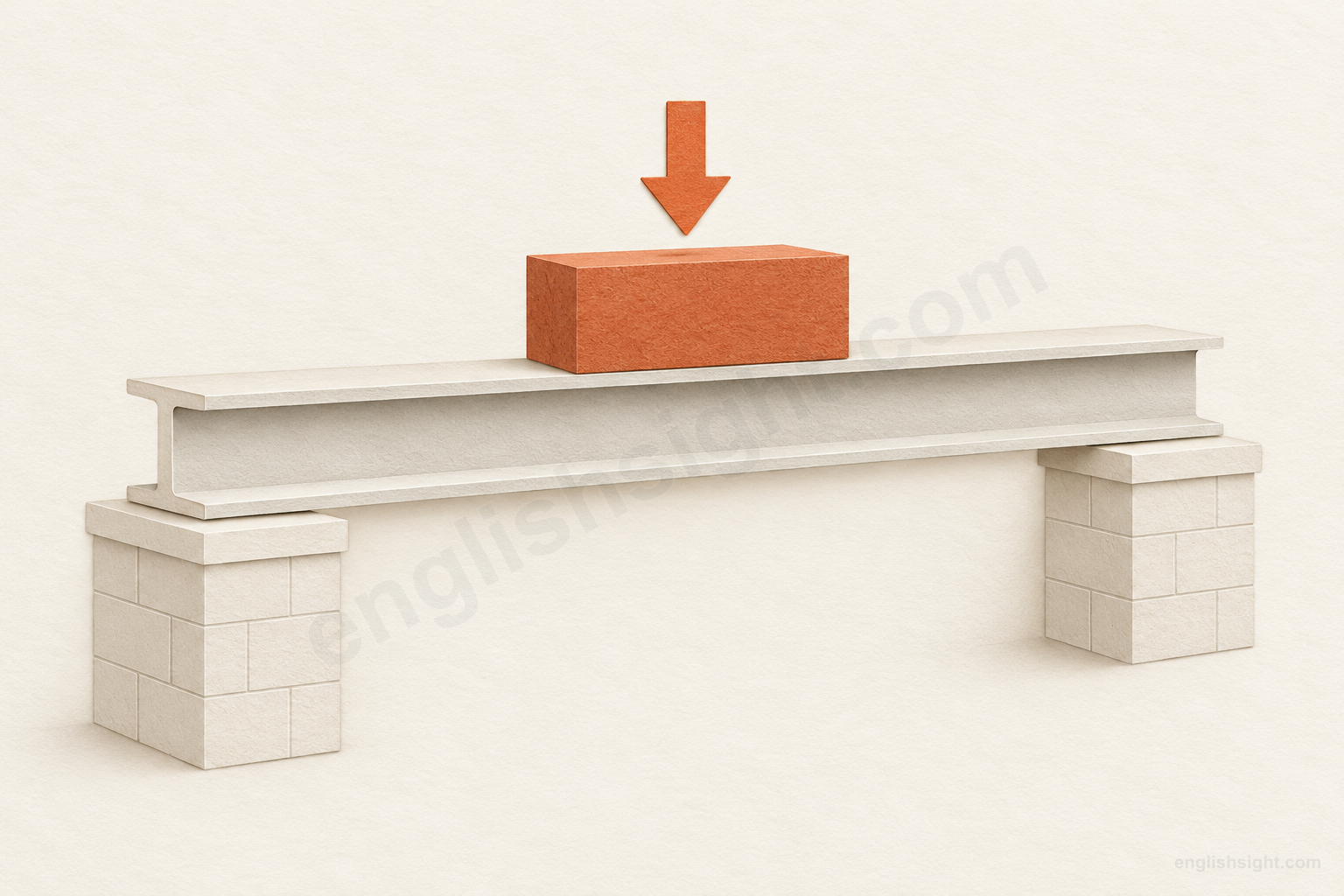
A load presses down on a steel beam.
steel
The beam remains in place under the load.
The beam carries the load between two supports.
The steel beam bears the load: a limited comparison for firmness under pressure.
A steel beam bears a load; its physical strength offers a limited comparison for firmness under pressure.
Steel is a family of materials whose properties vary. The image highlights strength without claiming that every steel object is rigid, unbreakable, or rustproof. Mental preparation is a figurative use, not a physical transformation.
Steel first names a material used in frames, tools, and countless other objects. English also compares a person’s strength or determination with qualities of that material.
This lesson separates literal materials, established object names, figurative qualities, and the verb steel. These connections are teaching aids, not a shared mental picture claimed for every speaker.
01
The material and its manufacture
Start with the substance, then distinguish an object’s material, its form, a named type, and the industry that produces it.
01
be made of / from steel; some steel; a piece of steel
made of steel
identify an iron-based material
Situation
You ask what the frame is made of.
Meaning in context
The answer names a material, not an individual object.
Steel is the substance in the frame.
Steel contains iron and carbon, and may contain other elements. It is a kind of metal, not a separate name for all metal or for pure iron.
In ordinary material talk, steel is uncountable: some steel, a piece of steel, or two tonnes of steel. Say The steel is heavy. Specialists can use steels for different types; that does not make two ordinary steel objects two steels.
In a sentence
The bicycle frame is made of steel.
Watch the difference Count the objects or quantities: two steel bars, not two steels when you mean two bars.
02
steel + object noun; sheet steel
steel beams; sheet steel
describe a material or the form in which it is supplied
Situation
You compare beams, wire, and flat sheets.
Meaning in context
The noun pattern tells you which is the object or form.
A steel beam is a beam; sheet steel is steel supplied in sheets.
Put steel before an object name to say what it is made of: steel beams, steel wire, steel doors. The final noun carries the ordinary plural: one steel beam, several steel beams.
Sheet steel reverses the relationship: sheet tells you the form of the material. Dictionaries may treat steel before a noun as a noun modifier or an adjective. The usable pattern is the same. A colour description such as steel grey refers to resemblance, not proof of actual steel.
In a sentence
The workshop ordered steel wire and two sheets of steel.
Watch the difference Steel is not a verb meaning make in steel doors; doors is the main noun.
03
stainless steel; a stainless steel + object noun
stainless steel
name a type chosen for its resistance to rust
Situation
You compare the materials listed for kitchen equipment.
Meaning in context
One label identifies stainless steel.
Stainless steel is a named type, not a claim about all steel.
Stainless steel names a type of steel associated with resistance to rust. You often meet it in descriptions of sinks, knives, and appliances.
The full material name is uncountable: some stainless steel. Before an object noun, the same words describe the material: a stainless steel sink. Do not assume that ordinary steel has the same resistance just because the word steel occurs in both names.
In a sentence
We chose a stainless steel sink for the kitchen.
Watch the difference A stainless steel sink is countable because sink is countable; the material name itself is not.
04
work in steel; the steel industry; steel + industry noun
work in steel; the steel industry
refer to the business that makes steel
Situation
Someone asks which industry employs you.
Meaning in context
Your answer identifies steel production.
The material name can stand for the industry.
In She works in steel, steel refers to an industry rather than a substance surrounding her. Steel production, steel mills, and steel workers belong to this business context.
The steel industry is a fuller, clearer expression for a beginner. A steel town is a town associated with that industry, not a town literally built entirely of steel. This is an established extension from a product to its production.
In a sentence
My uncle works in steel, at a mill outside town.
Watch the difference A steel worker is a person working with or producing steel; worker is the main noun.
02
Named objects made from steel
Some complete expressions name particular tools or products. Their meanings depend on the whole expression, not just the material.
05
some steel wool; a steel wool pad
steel wool
name a mass of fine metal strands used for cleaning or smoothing
Situation
A product looks like tangled fine fibres.
Meaning in context
The label identifies a metal cleaning material.
Wool describes the fibrous form; the strands are steel.
Steel wool consists of fine steel strands used for cleaning or smoothing surfaces. British English also uses wire wool. This is a product name, not wool from an animal.
Use some steel wool for the material, or a steel wool pad for one formed piece. The word pad lets you count individual pads. Recognizing the compound helps you distinguish it from both soft textile wool and an ordinary thick steel wire.
In a sentence
There was a packet of steel wool beside the cleaning brushes.
Watch the difference Say two steel wool pads if you mean two pads, not two steel wools.
06
a / the + steel; two steels
a steel
name a rod used for maintaining a knife’s edge
Situation
A cook has a knife and a handled metal rod.
Meaning in context
The rod is called a steel.
Here steel names one particular implement.
In a kitchen, a steel can mean the long metal rod on which a knife is rubbed to maintain its edge. The context and the article a distinguish this tool from steel as a substance.
This is a countable use: a steel, the steel, or two steels when you really mean two such tools. It does not allow you to call every object made of steel a steel. A steel spoon remains a spoon.
In a sentence
The chef kept a steel in the drawer with the knives.
Watch the difference A steel is a tool in this context; made of steel names a material.
07
play a steel drum / steel pan
a steel drum / steel pan
name a musical instrument with different pitched areas
Situation
A musician strikes different parts of a shaped metal surface.
Meaning in context
The instrument produces different notes.
This compound names an instrument, not just any metal container.
In music, a steel drum, also called a steel pan, is an instrument whose surface is struck in different places to play different notes. Learn the full name as a unit.
A literal steel drum can also be a drum-shaped container made of steel. The surrounding scene decides: someone playing notes suggests the instrument; a container holding oil suggests the ordinary material-plus-object description. The material alone does not supply the musical meaning.
In a sentence
At the concert, Maya played a melody on a steel pan.
Watch the difference The word pan in steel pan names the instrument here, not a cooking task.
03
Strength and firmness in people
Physical strength supplies a comparison for courage, a powerful hold, or a cold and determined manner. Context decides which quality matters.
08
have + nerves of steel
have nerves of steel
remain remarkably calm and brave under pressure
Situation
A difficult performance could make someone panic.
Meaning in context
The person stays composed.
The comparison concerns emotional steadiness.
If someone has nerves of steel, they can face danger or intense pressure without becoming visibly frightened or upset. The expression praises exceptional steadiness.
Of steel does not identify a physical material in this idiom. Compare a cable made of steel, where the same material word is literal. Having nerves of steel describes a quality; steeling yourself describes an effort to prepare. A nervous person can still steel themselves.
In a sentence
You need nerves of steel to land a plane in a storm.
Watch the difference The fixed expression uses plural nerves: nerves of steel, not a nerve of steel.
09
steel in + voice / manner; a grip / hand of steel
steel in someone’s voice; a grip of steel
describe firmness, coldness, or physical strength
Situation
Someone speaks firmly or holds something very tightly.
Meaning in context
The quality is compared with steel.
Context selects mental hardness, physical strength, or both.
Steel in her voice suggests a firm, cold, or unyielding manner. A grip of steel emphasizes a very strong hold. These are comparisons, not reports that a body contains metal.
The quality is not always friendly or admirable. A voice with steel in it can sound threatening, while nerves of steel usually emphasizes courage. Read the noun and situation before deciding what strength means.
In a sentence
There was steel in her voice when she refused.
Watch the difference Do not treat every steel comparison as fearlessness; a powerful grip concerns physical force.
04
Making yourself ready for difficulty
The verb commonly takes a reflexive object. It describes a person gathering determination before something unwelcome; the following construction identifies the challenge.
10
steel + reflexive pronoun + for / against + noun phrase
steel yourself for / against something
gather determination to face or resist something unpleasant
Situation
You expect an unwelcome result.
Meaning in context
You make a mental effort to be ready.
The subject and the reflexive object are the same person.
I steeled myself for the result means I prepared mentally for it. For identifies what lies ahead. Against emphasizes what you intend to resist or withstand: She steeled herself against their criticism.
Choose the reflexive to match the subject: I steel myself; he steels himself; they steel themselves. The action is preparation, so it does not promise success or remove all fear. Brace yourself is a close everyday alternative, though it can also concern physical impact.
In a sentence
I steeled myself for the interview panel’s toughest questions.
Watch the difference Do not omit myself in I steeled myself for it. This is a verb with an object and a prepositional phrase, not a separable particle verb.
11
steel + reflexive pronoun + to-infinitive
steel yourself to do something
prepare mentally to carry out an unwelcome action
Situation
You have to admit an uncomfortable truth.
Meaning in context
You gather the resolve to speak.
The infinitive names the action you are preparing to do.
In I steeled myself to admit the mistake, I am the person preparing and the person who will admit it. To introduces a verb, unlike for, which introduces the expected situation.
The forms are steel, steels, steeled, and steeling. Was steeling herself can show preparation in progress. Compare steel yourself for the conversation with steel yourself to start the conversation: the second explicitly names your action. Neither sentence guarantees that the conversation actually takes place.
In a sentence
He steeled himself to tell his team about the delay.
Watch the difference Say to tell, not to telling; after for use a noun phrase, as in for a difficult conversation.
12
something steels someone; be steeled by something; steel one’s heart against something
steel someone; steel your heart
make a person or their feelings more determined or less yielding
Situation
Pressure or a decision could weaken someone’s resolve.
Meaning in context
Experience or effort makes them more resistant.
The object can be a person or an aspect of their emotional response.
More descriptive writing can say that experience steeled someone: it made them tougher or more determined. A passive is possible too: She was steeled by years of difficult work. The cause need not be the same person as the object.
Steel your heart against an appeal suggests making yourself less open to pity or persuasion. It can sound emotionally cold. This is a marked extension of hardening, not the neutral everyday pattern for all kinds of preparation. For ordinary plans, prepare is usually enough.
In a sentence
Years of criticism had steeled her for the debate.
Watch the difference Steel is not interchangeable with prepare in prepare dinner or prepare a report; it concerns resolve here.
Keep material, metaphor, and grammar apart
One sound, two spellings
Steel and steal are pronounced /stiːl/. Steal means take without permission and has the forms stole and stolen. The verb steel has steeled and steeling. A steel frame and a stolen frame describe different things.
Material strength has limits
A steel wire can bend and ordinary steel can rust. Strong does not mean indestructible. The teaching diagram selects load-bearing strength; it does not predict every physical property or every compound.
What this lesson leaves aside
Literary steel for weapons, specialist steel grades, financial steels for shares, and the technical verb meaning cover or edge with steel are outside the main practical lesson. Mild steel and steel guitar are separate compound topics. No everyday particle-verb family is being implied.
Choose the meaning and construction
Use the object, article, and following words to decide whether the meaning is literal or figurative.
1. You are buying three individual bars made from steel. Which wording counts the objects?
2. You are anxious but gather courage before giving bad news. Which sentence describes that effort?
3. A pilot remains calm in a dangerous situation. What does She has nerves of steel mean?
4. A cook says Pass me the steel while holding a knife. What does steel most likely name?
Sources and teaching notes
The sources below support the meanings and constructions. Explanations and examples are original; the load-bearing comparison is a teaching model.
The diagram is a teaching aid, not a picture shared by every native speaker.