A supporting part, a source, or a check on a flow.
Use the noun, then let the construction distinguish origin from restraint.
A connecting support
A connecting support
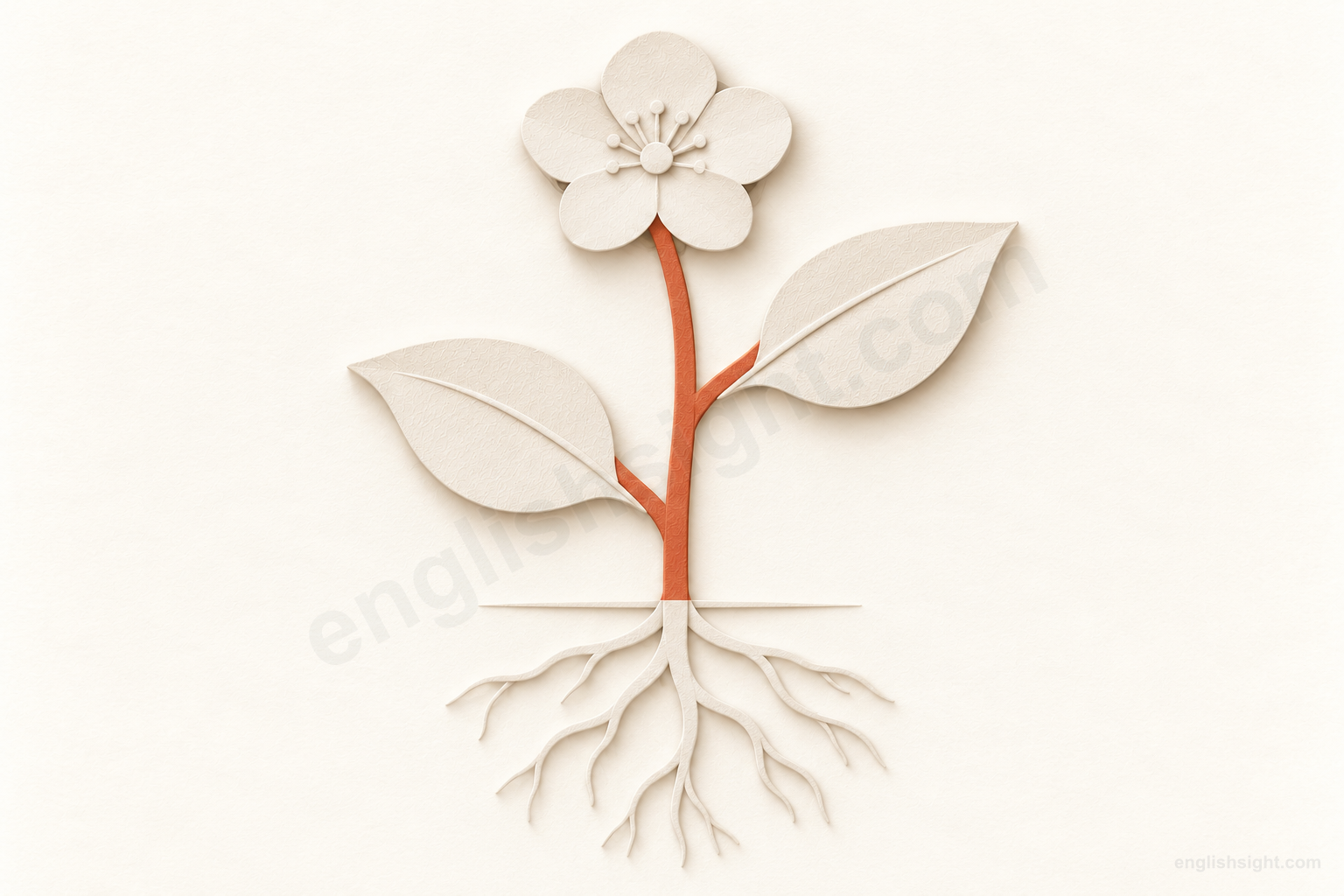
A flowering plant with two leaves.
stem
The flower and leaves are borne on the highlighted stem.
The stem connects and supports them.
The orange stem connects and supports the cream leaves and flower; the pale roots are a different plant part.
A plant stem forms an axis that supports and connects leaves and flowers to the rest of the plant.
The picture focuses on the noun. Tracing something to a source can help you remember stem from, but restraining a flow is a separate sense; neither action is shown as plant growth.
A plant stem gives a useful starting picture: an axis that bears other parts. Similar shapes help explain glass stems and some specialist nouns. Stem from describes an origin, while stem something can mean hold it back or remove its stalk.
These are connected learning routes with important boundaries, not one rule that generates every meaning. The support picture is a teaching aid, not a claim that all English speakers imagine the same scene.
01
Plant parts and slender supports
Start with a plant, then notice similar shapes in familiar objects. The noun usually names a countable part, not an action.
01
a / the stem of + plant or flower; leaves on a stem
a plant stem
the part that bears leaves, flowers, or fruit
Situation or object
You examine a flowering plant.
What the expression identifies
You identify its supporting axis and the parts attached to it.
The stem is a plant part; leaves and flowers grow from it.
Use a stem for one supporting part and stems for several. On the stem describes where leaves are attached; the stem of a flower identifies the part belonging to that flower.
In everyday gardening, stem and stalk can overlap. Trunk is the usual name for the thick main woody part of a tree. Root normally names the part that anchors a plant and takes in water; it is not simply another name for stem.
The drawing highlights the support and connection, not a rule that every stem must be straight or upright. Climbing and trailing plants have stems too.
In a sentence
The bean plant has three leaves on its main stem.
Watch the difference Say the leaves grow on the stem; a leaf is not itself the whole stem.
02
the stem of a glass; hold a glass by its stem
the stem of a glass
the narrow support joining a drinking glass’s bowl and base
Situation or object
You look at a wine glass.
What the expression identifies
You distinguish the bowl, the narrow support, and the base.
The glass stem connects two parts; it is not the rim or the bowl.
A stemmed glass has a narrow supporting section below its bowl. The shape resembles a plant support, although no growth or transport of food is involved.
The same part can be mentioned when carrying, cleaning, or describing a glass. The rim is its top edge; the base is the part resting on the table. Some drinking glasses have no stem.
In a sentence
Nora lifted the empty glass by its stem.
Watch the difference Stem does not mean the whole glass in ordinary learner usage.
03
a pipe stem; the stem of a tobacco pipe
a pipe stem
the narrow tube leading from a tobacco pipe’s bowl
Situation or object
You identify parts of an old tobacco pipe in a display.
What the expression identifies
You locate the tube between the bowl and the mouth end.
The tube’s shape links this noun use to other slender parts.
Here pipe means a tobacco pipe. Its stem is the long narrow section, not the bowl that contains tobacco.
This is an object label, not an instruction to smoke. A household water pipe is itself a tube; do not assume every water pipe has a part ordinarily called its stem.
In a sentence
The museum label describes the pipe’s carved wooden stem.
Watch the difference The surrounding object determines the meaning: a pipe stem is not a plant part.
04
long- / short- / slender-stemmed + noun
a long-stemmed rose
having a stem of a described kind
Situation or object
You compare two kinds of cut flower.
What the expression identifies
You choose the one with a long supporting stalk.
An adjective ending in -stemmed describes the stem a thing has.
Long-stemmed and short-stemmed describe the length of the stem. The same pattern works for objects: a slender-stemmed glass has a slender supporting section.
Before a noun, keep the compound together with a hyphen: a long-stemmed rose. This adjective describes a feature. In a cooking instruction, stemmed cherries instead means cherries whose stems have been removed.
In a sentence
She put a single long-stemmed rose in the tall vase.
Watch the difference Stemmed in a descriptive compound need not mean that someone removed anything.
02
Parts of words and written notes
In grammar and music, stem is a specialist name for a structural part. These uses are useful when a teacher explains how something is built.
05
the stem of + word; add an ending to a stem
the stem of a word
the form to which grammatical endings attach
Situation or object
You compare the forms play, plays, and played.
What the expression identifies
You separate the shared form play from the endings.
A word stem can remain while its grammatical ending changes.
For these examples, play is the stem and -s or -ed is an added ending. This helps a learner notice how related grammatical forms are built.
Stem and root are related technical terms, but they are not always interchangeable: a stem may already contain an affix. Do not turn the simple example into a rule that removing the final letter of any word reveals its stem.
In a sentence
In “plays” and “played”, “play” is the stem.
Watch the difference A stem is a linguistic unit, not necessarily a syllable or the first few letters of a word.
06
a note’s stem; the stem of a musical note
the stem of a musical note
the line attached to the head of certain written notes
Situation or object
A music teacher points to a written note.
What the expression identifies
You distinguish its head from its attached line.
The note stem is a line in notation, not a sound or an instrument.
Some written notes have a straight stem attached to their head. This is another shape-based use of the noun; it labels part of a symbol.
A note does not always have a stem, and its stem may point up or down. If a teacher asks you to draw the stem, you add the line to the symbol, rather than drawing a plant.
In a sentence
Draw the stem upward from this note head.
Watch the difference This specialist use describes notation. It does not mean the tune or pitch.
03
Tracing something to its source
Stem from puts the outcome first and its origin second. The plant offers a memory link for origin, but the sentence normally explains a cause rather than physical growth.
07
result + stem(s) / stemmed from + source or -ing form
stem from something
have a particular cause or origin
Situation or object
Deliveries are late, and you investigate why.
What the expression identifies
You connect the delays with a shortage of drivers.
The result is the subject; from introduces its source.
In The delays stem from a shortage, delays is the result and shortage is the explanation. From is essential to this pattern. You can picture tracing growth back to a supporting source, but that connection is a teaching analogy, not a claim about literal plants.
From can be followed by a noun phrase or an -ing form: The error stems from using an old address. It can introduce a positive origin too: Her confidence stems from years of practice.
Keep from before a pronoun: The shortage explains the delays; they stem from it. Do not move the pronoun between stem and from. Oxford lists this under phrasal verbs; grammatically from introduces the source rather than acting as a movable particle.
For an existing cause-and-result relationship, use the simple form: The problem stems from poor planning. The past is stemmed from. In this sense, prefer these forms to is stemming from; the separate action sense can be progressive.
In a sentence
The delivery delays stem from a shortage of drivers.
Watch the difference Reverse the sentence carefully: A shortage causes delays; delays stem from a shortage. Not delays are stemmed from a shortage.
04
Holding something back or removing a part
Read the object carefully: stemming a flow restrains it, while stemming fruit removes its stalk. These actions cannot be predicted from one plant picture.
08
stem + flow / bleeding; stem the flow of + noun
stem the flow
hold back something that is flowing or spreading
Situation or object
Water is entering a room through a gap.
What the expression identifies
A barrier limits the incoming flow.
Here stem takes the thing being restrained as its direct object.
Stem the flow uses stem as a transitive verb: the flow is what someone tries to restrain. The same action sense occurs in stem the bleeding. In reports, the flow may also be information or money rather than a literal liquid.
This sense does not mean originate. Compare The leak stems from a damaged seal with We need to stem the flow. The first explains the source; the second describes intervention.
The action may be ongoing or passive: Workers are stemming the flow; the flow was stemmed. Trying to stem a flow does not by itself prove it has stopped. The verb is more formal than stop or hold back.
In a sentence
They used a barrier to stem the flow of water into the hall.
Watch the difference Use a direct object: stem the flow, not stem from the flow when you mean hold it back.
09
stem the tide of + events; stem the rise in + noun
stem the tide of something
check a growing wave of events, often unwanted ones
Situation or object
More local shops are closing.
What the expression identifies
People try to prevent further closures.
Tide turns a series of events into a figurative incoming wave.
In stem the tide of closures, tide presents many events as a spreading wave. Stem describes holding that wave back. The objects need not be connected with water.
This is a familiar reporting expression. Stem the rise in prices has a related meaning without the tide image. An attempt to stem a trend can fail: aim to stem describes a goal, while fail to stem says that the restraint did not succeed.
Learn the whole collocation. Turn the tide describes changing the course of events, while stem the tide emphasizes restraining their advance.
In a sentence
The new grants aim to stem the tide of village shop closures.
Watch the difference The tide is figurative here. It is the growing series of closures, not a real sea tide.
10
stem + fruit; stemmed + fruit
stem the cherries
remove the stems from fruit or a similar item
Situation or object
The cherries still have their stalks.
What the expression identifies
The stalks are removed before cooking.
The fruit is the object; stem names the part to remove.
In recipe language, stem can mean take the stems off something. Stem the cherries tells you to remove their stalks. This is a different action from holding back a flow.
A past participle can describe the prepared fruit: washed and stemmed cherries. Removing the stem is not the same as removing the stone or pit; a recipe may ask for both.
Remove the stems from the cherries is a clearer alternative when a reader may not know this cooking use.
In a sentence
Wash and stem the cherries before making the sauce.
Watch the difference The fruit remains: stemming cherries removes their stems, not the cherries themselves.
05
Whole expressions and capital letters
Learn the boat expression, the biological compound, and the educational abbreviation as complete items. Capitalization can change what you are talking about.
11
verb + from stem to stern
from stem to stern
from the front of a ship to its back; throughout
Situation or object
A crew inspects a boat.
What the expression identifies
The inspection covers its whole length.
The two boat ends frame the full extent of the inspection.
Stem here is the front of a boat; stern is the back. The fixed expression means all the way along the vessel, as in checking or cleaning it completely.
The expression can extend figuratively to a whole place or thing, though from end to end is usually a simpler everyday alternative. It is an established phrase, not the cause pattern stem from.
In a sentence
The crew inspected the boat from stem to stern.
Watch the difference Keep the order stem to stern. Do not confuse stern, the back of a boat, with a plant stem.
12
a stem cell; stem cells; stem cell + research
stem cell
a cell able to divide and develop into specialized cell types
Situation or object
You read an article about biological research.
What the expression identifies
You recognize a technical name for a kind of cell.
Stem cell is a biological compound, not a cell in a plant stalk.
A stem cell can divide and develop into cells with particular functions. Learn stem cell as the complete biological term; the plant drawing cannot supply its scientific meaning.
Stem cells is the plural. In stem cell research, the compound names the subject of the research. This lesson explains the expression; it does not describe treatments or claim that every stem cell can become every kind of cell.
In a sentence
The article explains why scientists study stem cells.
Watch the difference Stem is lowercase in the biological term. Stem cell is not the educational abbreviation STEM.
13
STEM + subjects / courses / jobs
STEM subjects
science, technology, engineering, and mathematics as a group
Situation or object
A school lists courses in several technical fields.
What the expression identifies
It groups those fields under the label STEM.
Capital letters signal an abbreviation, pronounced like stem.
STEM groups science, technology, engineering, and mathematics in education and careers. You may read about STEM subjects, STEM courses, or STEM jobs.
The letters come from the four field names. This is an abbreviation rather than a new botanical meaning. A STEM course concerns that group of subjects; it need not be about plant stems or stem cells.
In a sentence
The college offers a weekend programme in STEM subjects.
Watch the difference Use uppercase STEM for the educational label; lowercase stem normally refers to the ordinary word.
Let grammar separate the meanings
Forms and spelling
The noun is countable: a stem, several stems. Pronunciation is /stem/. Verb forms are stem, stems, stemmed, stemming: double the final m before -ed and -ing. A long-stemmed flower describes a feature; stemmed fruit can describe preparation.
Cause versus control
The shortage stems from a planning error explains the shortage’s origin. The team stemmed the losses describes restraint and has a direct object. Use stemming for an ongoing restraining action, but normally use simple stems from for a continuing causal relationship. That source construction has no ordinary passive.
What the support model cannot do
The hold-back verb has a different historical origin from the plant noun, as the dictionaries’ etymologies show. Treat the plant picture as a useful connection for some uses, not a proof that all senses share one origin. The cooking verb, boat idiom, biological compound, and uppercase abbreviation need their own explanations.
Scope
This course selects common uses and useful reading vocabulary, not a frequency ranking. It includes basic grammar and music labels, but does not teach specialist skiing, ship construction, engineering mechanisms, family-line terminology, or historical uses. A plant stem is not defined by being above ground in every botanical case.
Choose by structure and context
Look at what follows stem, and decide what relationship the sentence expresses.
1. An old address caused the delivery error. Which sentence gives that cause?
2. A barrier is intended to hold back incoming water. Which use fits?
3. Which part joins the bowl of a wine glass to its base?
4. A recipe asks for washed and stemmed cherries. What has been removed?
5. A college advertises STEM courses. What are these courses grouped around?
Sources and teaching notes
Dictionary meanings and constructions were checked against the linked publisher entries. Explanations and example sentences are original; visual links are teaching interpretations.
The support picture explains one useful connection; it is not a shared mental image for every speaker.