From a single placement of the foot to stages, actions, and changes of involvement.
A separate move, a new placement
A separate move, a new placement
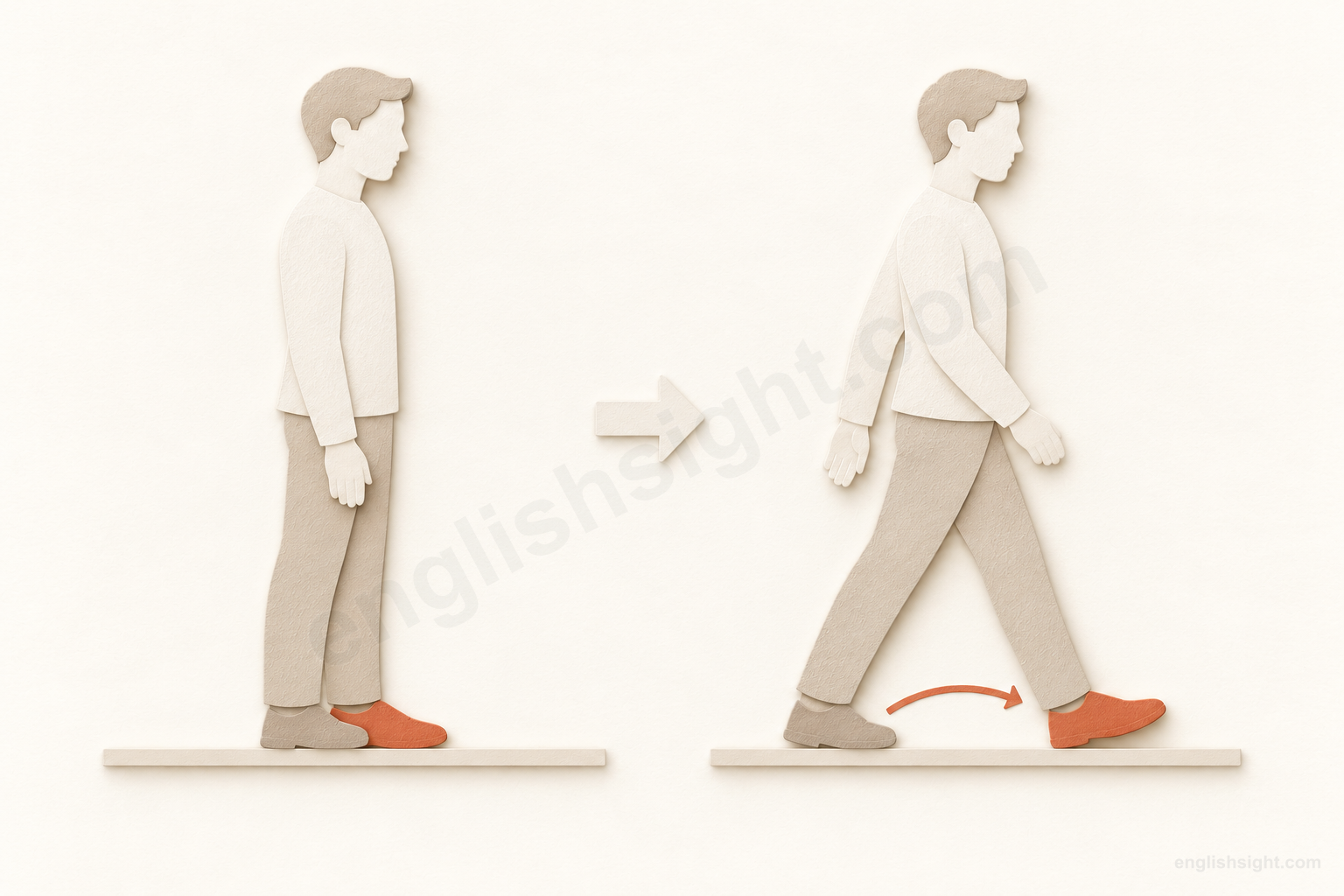
The person stands with the orange shoe beside the taupe shoe.
step
The orange shoe is placed farther forward, with the taupe shoe behind.
One foot lifts and moves to a new position.
One foot changes placement; separate moves offer a model for stages of action.
Lift a foot and put it down in another position; repeated placements make a course of movement.
The diagram isolates one ordinary forward step. A real step can also go sideways, backward, up, or down. Abstract stages and established idioms connect with this model in different ways; they are not mechanically predictable from it.
A physical step lifts a foot and puts it down in another place. The noun can name this movement, its sound or distance, and a surface that supports it. In plans and processes, a step is one part of a larger course of action.
This connection is a teaching model, not a universal picture in every English speaker’s mind. Fixed combinations such as step down and step on someone’s toes need their own context and grammar.
01
Feet, direction, and surfaces
A physical step moves a foot to another place. The noun can name that movement, its distance or sound, a walking style, or a surface for the foot.
01
take + a / number + step(s)
take a step
make one movement of the foot
Starting situation
You stand near the wall.
What changes or is described
You move one foot and put it down elsewhere.
A step is a unit of movement, not necessarily movement forward.
Use take with the countable movement: take a step, take two steps. The phrase a baby’s first steps refers to the beginning of walking independently.
Walk describes the activity more generally; step picks out a small movement or placement. You can take a step sideways or backward without going for a walk.
In a sentence
I took two steps sideways to make room for the box.
Watch the difference Take a step is the usual everyday collocation for a foot movement; do not treat step as a synonym for an entire walk.
02
a few steps + away / from; hear + steps
a few steps away; hear steps
measure a short distance or refer to footfalls
Starting situation
Someone walks along a nearby corridor.
What changes or is described
You describe how far away they are or hear their footfalls.
Context distinguishes distance from the sound of walking.
In The kitchen is a few steps away, steps measures a short walking distance. Step length varies, so this is not a precise unit like a metre.
In I heard steps behind me, steps names sounds. Footsteps makes that interpretation explicit. Neither wording says you saw the person.
In a sentence
The lift was only a few steps away, and I could hear steps behind me.
Watch the difference A distance and a sound are different readings of the noun; the surrounding words identify which one you mean.
03
with a + adjective + step; a spring in + possessive + step; dance steps
a spring in your step; dance steps
describe a walking style or a dance movement
Starting situation
You notice how someone moves their feet.
What changes or is described
You describe their manner or learn a movement pattern.
A walking manner and a dance unit are related but distinct noun uses.
A quick, light step describes someone’s way of walking. A spring in your step suggests lively, cheerful energy; it need not mean literal jumping.
Dance steps are learned movements or sequences. In We practised the steps, the plural names the parts of the dance, rather than the stairs in the room.
In a sentence
After the good news, Maya walked home with a spring in her step.
Watch the difference Learn the dance steps refers to movements; learn to step is not an ordinary replacement for learn to dance.
04
step + direction; step + direction + from / onto / to + place
step forward / back / aside
move a short distance in a specified direction
Starting situation
You are standing in someone’s path.
What changes or is described
You change position so they can pass.
The direction word tells us where the foot movement takes you.
Forward, back, aside, away, up, and down can describe actual movement: Step back from the edge; step up onto the platform. Step this way is a polite direction to follow the speaker.
These literal combinations need no special idiom reading. Stepping aside to let a trolley pass does not mean resigning, though step aside also has that established meaning.
Stepping back in time is a figurative description of an experience that feels like entering an earlier period: Visiting that preserved village felt like stepping back in time. It does not mean either actual time travel or calmly reassessing a problem.
In a sentence
Please step aside so the trolley can get through.
Watch the difference Step back can be physical; only the context tells you whether it means withdraw mentally and reassess.
05
step + on / in / onto + noun or pronoun
step on / in / onto something
place a foot on a surface or in a substance or space
Starting situation
A cable lies across the floor.
What changes or is described
Your foot comes down on it.
On marks contact; in marks a location or substance; onto emphasizes movement to a surface.
Step on a cable or someone’s foot means put your foot on it, often accidentally. Step in a puddle places the foot in the water; step onto a platform emphasizes reaching its surface.
The thing after on is the object of the preposition: I stepped on it. The verb itself has no ordinary direct object in this pattern.
Step on can also mean press with your foot to operate something: She stepped on the brake to slow the car. This use is intentional; stepping on a surface is not always accidental.
In a sentence
I stepped on the loose cable as I reached for the door.
Watch the difference Say stepped on it, not stepped it on, for physical contact.
06
step over + obstacle; step into / out of + place; step inside / outside
step over; step into / out of
cross an obstacle or enter or leave a space on foot
Starting situation
A low rope separates you from the garden.
What changes or is described
You lift a foot across it and enter the garden.
The preposition describes a route, not just a vague direction.
Step over a rope means move a foot across it without stepping on it. Step into a room and step out of a room mark crossing a boundary; step inside and step outside can omit the named place.
A host’s Please step inside invites a short movement indoors. Into names a destination; in can describe foot placement in something, as in step in mud.
Step in can also describe a brief informal visit: I stepped in to say hello on my way home. Here to say hello gives the purpose of the visit. This differs from stepping in to resolve an argument, where step in means intervene.
In a sentence
We stepped over the rope and into the garden.
Watch the difference Step over it avoids contact; step on it describes contact. Keep out of together before a named place.
07
a / the + step; a flight of steps; up / down the steps
a step; a flight of steps
name a foot-supporting surface or a series of them
Starting situation
The entrance is above ground level.
What changes or is described
You use raised surfaces to reach it.
A step can be an object you stand on, rather than the movement itself.
One step is a single raised surface. Steps can mean a series, and a flight of steps is a connected set. The front step can be the surface immediately outside a door.
Stairs normally names a stairway or set of indoor stairs; steps is also natural for outdoor approaches and single changes of level. Mind the step warns of a physical change in height.
In a sentence
There are three stone steps between the path and the front door.
Watch the difference One movement can cross more than one stair, so count physical steps and foot movements separately.
08
the steps; a pair of steps
a pair of steps
refer to a portable stepladder in British English
Starting situation
The top shelf is beyond reach.
What changes or is described
You bring a small ladder that stands by itself.
Here steps is a plural noun naming a piece of equipment.
In British English, the steps or a pair of steps can mean a stepladder. The context is equipment you bring, open, and stand on, rather than a permanent staircase.
A stepladder is a clearer choice for an international audience. The words a pair do not mean that the ladder has exactly two treads.
In a sentence
Could you bring the steps so I can reach the top shelf?
Watch the difference This equipment use is British; do not assume every occurrence of steps refers to a ladder.
09
retrace + possessive + steps
retrace your steps
go back along your earlier route
Starting situation
You reach the station without your gloves.
What changes or is described
You go back the way you came to look for them.
Steps can stand for the route made by earlier movements.
Retrace your steps means return along the path you previously took. The possessive refers to the person whose route is followed.
When looking for a missing object, the phrase suggests checking places along that route. It is not the same as follow in someone’s footsteps, which can mean choosing a similar career or life.
In a sentence
I retraced my steps to the café and found my gloves under the table.
Watch the difference The normal phrase is retrace my steps; reverse my steps is not the usual fixed expression for this search.
02
Actions, stages, and progress
A task can be understood as a sequence of separate moves. A step may advance a plan, repeat a stage, or take you backward; progress is not guaranteed.
10
a step in + process; the next step is to + verb
the next step
identify a stage of a process
Starting situation
One part of the application is complete.
What changes or is described
You identify what comes next.
The noun divides a larger procedure into manageable parts.
A step in a process is one stage or operation. The next step is to… states what to do next. Follow the steps means carry out the procedure in its intended order.
A step need not be a physical action: checking a fact or deciding a budget can be part of the sequence. The diagram’s separate placements are a memory aid for separate stages.
In a sentence
The next step is to check that all the names are correct.
Watch the difference A step in the process names a component; a step towards a goal emphasizes its intended contribution.
11
take steps to + verb; take the step of + -ing
take steps to do something
act in order to achieve or prevent something
Starting situation
Repeated errors have caused delays.
What changes or is described
The team introduces practical measures.
Steps names actions; the infinitive gives their purpose.
Take steps to prevent something or to improve something is a common way to say that measures are being taken. It sounds more formal than simply do something about the problem.
The steps may be different actions, not literally numbered instructions. The phrase reports action toward a result, rather than proving the result has already happened.
In a sentence
The team has taken steps to prevent the same error from happening again.
Watch the difference Use take steps to improve, not take steps for improve. The step of changing suppliers names the action itself.
12
a step toward(s) + noun / -ing; a step in the right direction
a step towards; a step in the right direction
evaluate an action as movement toward a goal
Starting situation
The service still has problems.
What changes or is described
One change brings an improvement.
One useful action can matter without completing the job.
A step towards a goal connects an action with what it may help achieve. Toward is also standard, especially in American English. A step in the right direction evaluates a development positively while leaving more to do.
A big step can be an important decision: moving abroad is a big step. Its size is about significance, not how far a foot travels.
In a sentence
The new evening class is a step towards making training more accessible.
Watch the difference Towards takes a noun or -ing form here: towards improving access, not towards improve access.
13
a step forward / back; a backward step; one step forward, two steps back
a step forward / backward
describe progress or a setback
Starting situation
You compare the project’s earlier and current condition.
What changes or is described
You judge whether it has improved or worsened.
Figurative direction expresses evaluation, not physical location.
A step forward describes progress; a step back or backward step describes a setback. A change can be large or small, helpful or harmful.
One step forward, two steps back is a saying for progress repeatedly outweighed by setbacks. The numbers express frustration; they do not require exact measurements.
In a sentence
Losing the new data would be a serious step backward for the project.
Watch the difference Step alone does not promise improvement. Forward and backward supply the positive or negative direction.
14
take + object + a step further; a step up / down from + noun
take something a step further; a step up
extend an idea or move to a different level
Starting situation
You have a basic plan or an existing role.
What changes or is described
You develop the plan or compare a new role.
A step can mark an additional degree on a scale.
Take an idea a step further means develop it beyond its current point. Further marks extra development; it does not say the development is wise.
A step up from something is a move to a higher level or better position; a step down can mark a lower level. These are noun phrases, unlike the verb phrase step up your efforts.
In a sentence
This job is a step up from my last one, with more responsibility.
Watch the difference A step up can describe a career change without saying the person physically climbed anything.
15
do something step by step; take it one step at a time; a step-by-step + noun
step by step; one step at a time
proceed through stages without rushing
Starting situation
The task feels too large to handle at once.
What changes or is described
You work through manageable stages.
The expression organizes effort into separate moves.
Step by step means gradually, moving through a sequence. One step at a time often reassures someone to focus on the current part rather than tackle everything at once.
Before a noun, the compound adjective is normally hyphenated: a step-by-step guide. After the verb, write I explained it step by step.
Baby steps are small actions, especially at the beginning of a difficult process: I’m taking baby steps towards speaking in meetings. The speaker can be an adult; baby describes the small scale of the progress.
In a sentence
We will set up your account step by step, starting with your email address.
Watch the difference Gradual does not mean every stage is easy or that the result is guaranteed.
16
every step of the way
every step of the way
refer to all stages of a journey or process
Starting situation
Someone faces a long recovery.
What changes or is described
You promise support throughout it.
Way supplies the larger course; every step includes its stages.
Every step of the way emphasizes continuity throughout a process. It can describe support, supervision, or difficulty; the surrounding verb tells you what happens throughout.
I helped her every step of the way is about sustained involvement. It need not mean literally walking beside her.
In a sentence
The adviser supported us every step of the way, from the first form to the final interview.
Watch the difference Every takes singular step: every step of the way, not every steps of the way.
17
be / stay / keep + a / one step ahead of + noun
one step ahead of
keep a small advantage or anticipate another’s move
Starting situation
A competitor is preparing a new service.
What changes or is described
You anticipate it and act sooner.
Ahead compares positions or readiness, rather than measuring a real stride.
Stay one step ahead of someone means remain better prepared or achieve something before they do. It can describe avoiding trouble as well as competition.
One step behind suggests being less advanced or slower to react. In a literal queue or walk, the same words can describe physical positions.
In a sentence
We check customer feedback each week to stay one step ahead of our competitors.
Watch the difference Use ahead of someone; one step does not mean an exact amount of time or a fixed margin.
03
Entering, leaving, and changing involvement
These established expressions describe taking part, replacing someone, giving up a position, or changing effort. Read the whole expression and its grammar.
18
step in; step in to + verb
step in
become involved to help or take control
Starting situation
An argument is getting worse.
What changes or is described
Another person intervenes.
In marks entry into an affair, without requiring entry into a room.
Step in means intervene when a situation needs help or control. A manager, mediator, or public authority may step in; it need not involve a bodily movement.
To stop the argument in stepped in to stop the argument gives the purpose. Contrast stepped in the mud, where in introduces a physical location.
In a sentence
The supervisor stepped in when the two customers began shouting.
Watch the difference Do not say stepped the argument in. The intervening use is intransitive.
19
step in for + person; step in to + verb
step in for someone
act as a substitute
Starting situation
The usual presenter is ill.
What changes or is described
A colleague handles the presentation instead.
For names the person being replaced.
Step in for someone means take their place, often for a limited period or at short notice. You can also state the task: step in to lead the meeting.
The replacement use overlaps with helping out, but the for phrase specifies whose role you cover. Step in for me does not mean physically enter my body or stand inside my space.
In a sentence
Could you step in for me at tomorrow’s briefing?
Watch the difference For me names the person being covered; to brief the team names the action.
20
step into + possessive + shoes
step into someone’s shoes
take over the work or position of another person
Starting situation
A long-serving director retires.
What changes or is described
Someone continues the director’s work.
The shoes represent an established role to be filled.
Step into someone’s shoes means take over their job or function. The image helps connect the people through the same role, but no footwear needs to change hands.
Contrast put yourself in someone’s shoes, which asks you to imagine their experience or viewpoint rather than replace them at work.
In a sentence
When Lena retired, Omar stepped into her shoes as director.
Watch the difference The possessive names the previous role holder, not the new person taking over.
21
step into the breach
step into the breach
cover an unexpected gap in work or responsibility
Starting situation
The event leader suddenly cannot attend.
What changes or is described
Someone else takes over the urgent work.
The breach is a figurative gap that needs filling.
Step into the breach describes doing work that someone unexpectedly cannot do. It often presents the substitute’s action as helpful in an urgent situation.
This is a fixed idiom, somewhat more vivid than step in for someone. Keep the definite article in the breach; you are not describing a real hole in a wall.
In a sentence
When the organiser fell ill, two volunteers stepped into the breach.
Watch the difference Stepping into the breach need not be a permanent promotion or appointment.
22
step down as + role; step down from + post; step aside
step down / aside
give up an important post
Starting situation
A chair has decided to leave the position.
What changes or is described
Another person can take over.
Leaving a role is an established meaning of the whole combination.
Step down as chair names the post being given up; step down from a position names it with from. Step aside can similarly emphasize making room for a successor.
These phrases do not necessarily mean retiring from all work. Compare literal step down from the platform and step aside to let someone pass.
In a sentence
Ravi will step down as chair in June but stay on the committee.
Watch the difference Say step down as chair, not step down the chair. The role is not a direct object.
23
step back (from + situation); step back and + verb
step back from a situation
pause direct involvement to gain perspective
Starting situation
The details of a dispute are overwhelming you.
What changes or is described
You consider the broader situation more calmly.
Back creates mental distance in this established figurative use.
Step back and look at the whole problem suggests a pause from immediate reactions. Step back from the situation adds what you are distancing yourself from.
It can be a temporary change of perspective. Step down usually means giving up a position; stepping back to reassess does not necessarily mean resignation.
In a sentence
Let’s step back from the argument and look at what we actually agree on.
Watch the difference You can step back mentally while remaining in the same room and keeping the same job.
24
step out; step out for + time / purpose
step out for a moment
leave briefly
Starting situation
A caller asks for someone who has left the office.
What changes or is described
You explain a short absence.
Out can describe going away for a short time, especially in North American English.
She has just stepped out often explains that a person is temporarily unavailable. For a moment or for lunch supplies the expected duration or purpose; out alone does not state an exact return time.
The phrase is especially familiar in North American English. Do not confuse stepping out briefly with resigning from a role.
In a sentence
Nina has stepped out for lunch; can I take a message?
Watch the difference For lunch explains why she went out. It does not identify a person she is replacing, as for Nina would after step in.
25
step out of + role / situation
step out of a role
leave a role or situation
Starting situation
Someone can no longer continue a particular role.
What changes or is described
They stop occupying that role.
Out of marks departure from an abstract situation.
Step out of a role can describe leaving it, rather than briefly leaving a building. The noun after out of is essential to this reading: a role, a position, or a situation.
Step down is especially associated with leaving a senior post. Step out of places attention on leaving the named role; it does not itself specify who replaces the person.
In a sentence
She stepped out of the role of spokesperson to focus on research.
Watch the difference She stepped out does not by itself mean she resigned. The role phrase makes that meaning clear.
26
step up + noun; step + noun / pronoun + up; be stepped up; step + noun / pronoun + down
step something up; step something down
increase an activity, or gradually reduce it with down
Starting situation
Demand is rising.
What changes or is described
The factory increases output.
Up marks an increase; down can mark a gradual reduction. Neither requires a physical change of location.
Step up production, step up security, and step up your efforts all mean increase or intensify them. This is a transitive particle verb: step up production or step production up.
A pronoun goes between the verb and particle: step it up. The passive is natural: Security has been stepped up. It reports greater intensity, not a foot movement.
By contrast, step production down means reduce it gradually: The factory is stepping production down as demand falls. A pronoun again goes in the middle: step it down. This has an object, unlike a director stepping down from a post.
In a sentence
We need to step up production before the holiday orders arrive.
Watch the difference With a pronoun use step it up, not step up it. This object pattern differs from intransitive step up and help.
27
step up and + verb; step up to the plate
step up; step up to the plate
start taking necessary responsibility
Starting situation
A difficult job needs someone to lead.
What changes or is described
Someone accepts the challenge and acts.
Here step up can stand alone, without an object being increased.
Step up and help calls on someone to contribute or accept responsibility. Context supplies the task. It is different from step up the training, which has an object and means increase it.
Step up to the plate is a related idiom, especially North American, for responding actively to an opportunity or difficult demand. Plate belongs to the conventional baseball expression; it is not a dinner plate.
In a sentence
When the team needed a new leader, Jo stepped up and organised the work.
Watch the difference Stepping up need not involve promotion; it can mean taking responsibility for a single urgent task.
28
step forward; step forward to + verb; step forward with + information
step forward
offer help or information
Starting situation
An appeal asks witnesses to contact the police.
What changes or is described
Someone volunteers what they know.
Forward can signal making yourself available, without literal forward walking.
Step forward can mean offer assistance or information. It commonly occurs with volunteers and witnesses. To help, to give evidence, or with information can explain the contribution.
Contrast a teacher’s physical instruction to step forward for a photograph. The figurative reading depends on the appeal and what the person offers.
In a sentence
Several witnesses stepped forward with details of the missing bicycle.
Watch the difference A person can step forward by contacting someone online; a visible bodily step is not required.
29
step into + role / situation; step outside + possessive + comfort zone
step into a role; step outside your comfort zone
enter a new situation or try something beyond familiar limits
Starting situation
You are used to a familiar set of tasks.
What changes or is described
You take on an unfamiliar role or challenge.
A situation is treated as a place you can enter or leave.
Step into a new role describes entering it, sometimes with an impression of an easy or immediate transition. Someone may be replacing another person, but the general role expression does not require that.
Step outside your comfort zone means try an activity beyond what feels familiar and safe. This is a figurative boundary, not a physical place. Outside emphasizes going beyond a limit; into emphasizes entering a situation.
In a sentence
Teaching an evening class meant stepping outside my comfort zone.
Watch the difference Entering a new role does not necessarily mean promotion, and leaving your comfort zone does not guarantee a good result.
04
Coordination, caution, and social boundaries
Walking offers useful comparisons for timing and behavior. These familiar expressions have conventional meanings that a picture alone cannot predict.
30
in / out of step with + person / music; keep in step; fall into step; break step
in / out of step; keep / fall into step
coordinate foot movements or fail to do so
Starting situation
Two people are walking together.
What changes or is described
Their footfalls match, or they do not.
Step can be a shared rhythm.
In step means moving with the same rhythm; out of step means not matching it. Keep in step means maintain that coordination. Fall into step with someone means begin matching their walking rhythm.
Break step means interrupt the shared marching or walking rhythm. With names the person, group, or music that provides the reference.
In a sentence
I slowed down and fell into step with my sister.
Watch the difference Fall into step does not mean fall over. It describes starting to move in coordination.
31
be in / out of step with + views / needs / times
in / out of step with ideas or expectations
match or fail to match other people’s views or current practice
Starting situation
A policy reflects outdated assumptions.
What changes or is described
People judge it inconsistent with current needs.
A shared rhythm becomes a comparison for social agreement.
A policy out of step with public opinion does not fit people’s views. In step with changing needs suggests keeping aligned with them.
This is a figurative comparison, not a claim about walking. Being out of step can be good or bad depending on the speaker’s judgment; it does not automatically mean objectively wrong.
In a sentence
The old opening hours are out of step with the needs of working parents.
Watch the difference Keep with before the reference: out of step with public opinion.
32
watch / mind + possessive + step; mind the step
watch / mind your step
walk carefully or be careful about behavior
Starting situation
The floor is uneven, or a social situation is risky.
What changes or is described
Someone warns you to act carefully.
The warning can concern feet or conduct.
Watch your step near loose stones is a literal safety warning. Watch your step with that client warns you to be careful about what you say or do.
Mind your step also gives a warning, and Mind the step can point to a particular raised surface. Tone matters: a warning about behavior can sound stern or threatening.
In a sentence
Watch your step with the new client; she was upset by yesterday’s delay.
Watch the difference A possessive changes with the person: I need to watch my step. Step stays singular in the fixed warning.
33
step on + possessive + toes
step on someone’s toes
offend someone, especially by intruding on their responsibility
Starting situation
You are considering changing a colleague’s plan.
What changes or is described
You worry that acting without asking may annoy them.
A physical intrusion supplies a memorable comparison for a social one.
Figuratively, stepping on someone’s toes means offending or annoying them, especially by taking over something they regard as their responsibility. No physical contact is needed.
Tread on someone’s toes is especially British; step on someone’s toes is usual in North American English. The literal meaning is also possible, so use the surrounding situation to decide.
In a sentence
I asked the designer first because I didn’t want to step on her toes.
Watch the difference Interference with someone’s work is a typical context, but the idiom can also refer more generally to offending or annoying someone. A disagreement is not automatically offensive.
34
Step on it!
step on it
tell someone to go faster
Starting situation
The journey is taking too long.
What changes or is described
A passenger urges the driver to speed up.
It belongs to a fixed informal expression.
Step on it! is an informal command to hurry, especially to drive faster. The driving context makes a pedal connection easy to remember, but learn the expression as a whole.
In Step on the mat, the object names a real surface. In the idiom, it need not refer to an object already mentioned.
In a sentence
“We’re going to miss the start,” Eli said. “Step on it!”
Watch the difference This is a forceful informal request. It does not automatically fit polite or professional instructions.
35
step out of line
step out of line
break rules or behave unacceptably
Starting situation
A group has clear behavior rules.
What changes or is described
Someone crosses an accepted limit.
Line represents a boundary of acceptable conduct.
Step out of line means behave badly or break the rules. It often appears in warnings and can suggest strict authority: the speaker decides what conduct is acceptable.
It is different from out of step with an opinion, which describes a mismatch in views. A person can disagree while still following the rules.
In a sentence
The coach warned that anyone who stepped out of line would leave the training session.
Watch the difference The fixed phrase is out of line, not out from line. It need not describe leaving a physical queue.
Keep the noun, the verb, and the whole phrase distinct
Forms and objects
The verb forms are step, steps, stepped, and stepping, with doubled p before -ed and -ing. Physical movement is usually intransitive plus a direction or preposition: step back, step on it. Productive transitive step something up has a direct object and permits the passive. Do not extend that object pattern to every combination.
A stage is not guaranteed success
A step can go forward or backward. Taking steps to fix a problem reports action toward a goal, not proof that the problem is fixed. Walk describes movement more broadly; a step picks out a placement or unit.
Related-looking words and specialist uses
The family combining form step- in stepmother and stepbrother is a separate item and does not mean walking or stages. Musical half steps and whole steps, step aerobics, engineering levels, nautical mast supports, and measuring land by pacing are outside this everyday lesson.
The picture has a limited job
The picture shows one foot changing placement. Think of separate placements when learning stages of a process, but read each fixed phrase in its own context. A drawing cannot tell you that step down means resign or that stepping on toes can mean unwanted interference.
Choose the meaning and pattern
Use the situation and the entire expression to decide.
1. A rope lies on the ground. You want to cross it without putting your foot on it. Which instruction fits?
2. The team has acted to reduce errors, but the result is not certain. Which wording fits?
3. Training needs to become more intensive. Replace training with a pronoun.
4. Your colleague is ill. You will do her job for one meeting. Which expression fits?
5. You want the group to pause and consider the dispute calmly, while everyone keeps their role. Which suggestion fits?
6. You ask a colleague before changing her project because you do not want to intrude on her responsibility. Which phrase fits?
Sources and teaching notes
Modern uses and grammar were checked against the dictionary pages listed below. The explanations, situations, examples, and diagram are original teaching material. The visual connection is a memory aid, not evidence for a universal mental image.
This diagram helps explain a connection; it is not a picture shared by every native speaker.