Learn the noun, then follow attachment, fixed position, persistence, and the whole expression.
A thin object; contact that holds
Put into contact; remain held
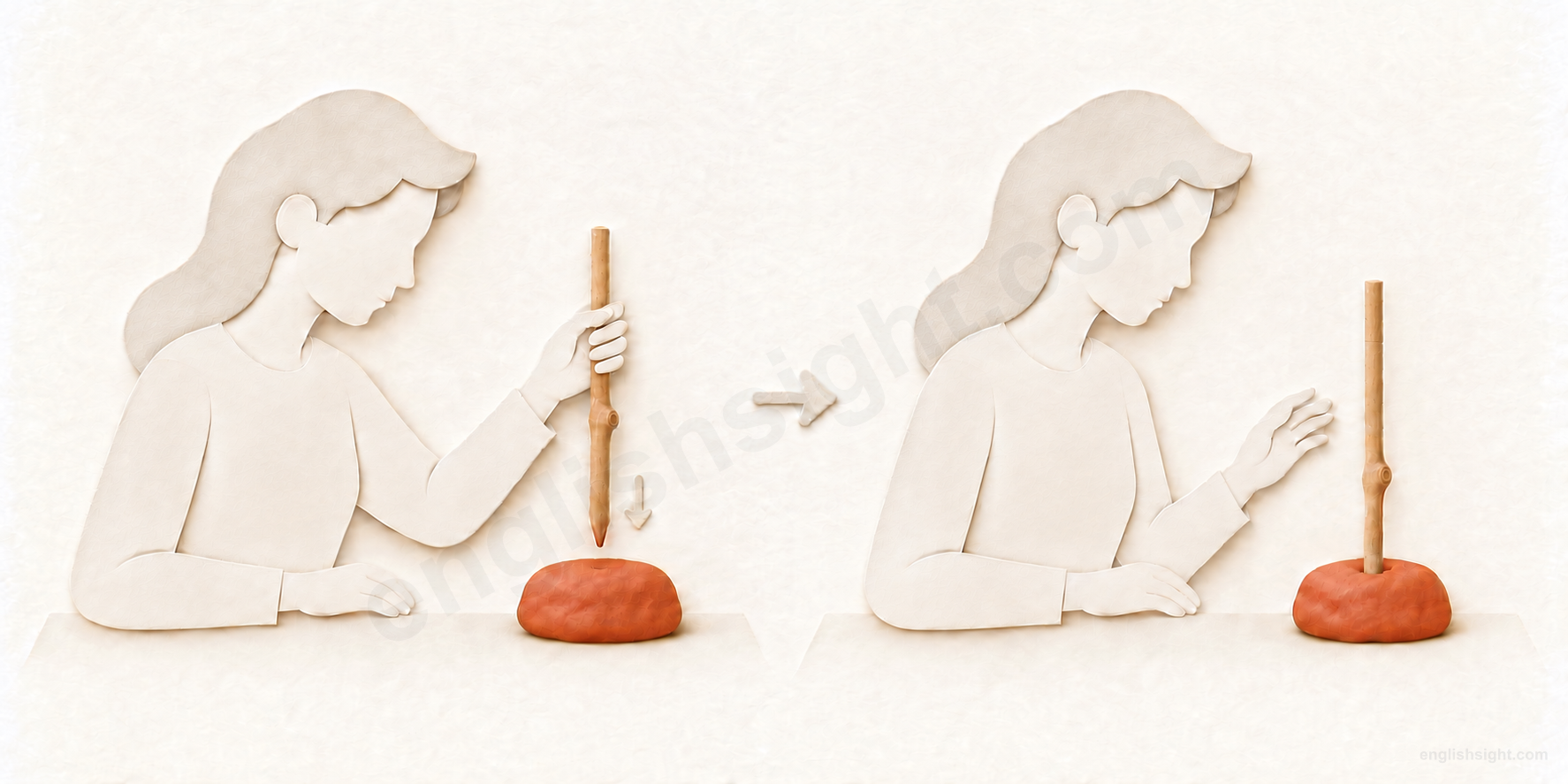
A woman holds a slender wooden stick just above soft clay.
stick
The clay holds the stick upright without her hand supporting it.
She pushes its lower end into the clay, then lets go.
A stick goes in; the clay holds it upright.
For many verb uses, something becomes or remains fixed to something else or in a position. In the sketch, a thin wooden stick is pushed into soft clay, which then holds it in place.
The noun names the thin wooden object; the verb describes inserting it and its resulting fixed position. Adhesion, obstruction, memory, and commitment share useful connections with remaining, but casual put and many idioms are separate learned uses. The picture does not claim a single origin for every meaning.
A stick can be a thin piece of wood. As a verb, stick often describes something becoming or remaining fixed to a surface or in a position. Compare a stick in your hand, stick it into clay, and it has stuck there.
This connection helps organize many uses, but it is not a universal formula. Casual placing, projection, social loyalty, and established idioms still need their own constructions and contexts. The sketch is a teaching model, not a shared picture in every English speaker’s mind.
01
A long, thin object
Start with the countable noun: a piece of wood, a tool, or something with a similar shape. Context gives a stick its purpose.
01
a stick; two sticks; a bundle of sticks
a stick / sticks
a long, thin piece of wood
Situation / starting point
A branch has broken into small pieces.
Result / interpretation
You can pick up and count the pieces.
The noun names an object, not an action.
A stick is usually a narrow piece of wood, often from a tree. It may be straight or irregular; it does not have to be a perfectly manufactured rod.
Use a stick for one piece and sticks for several. Wood names the material without counting pieces: some wood, but three sticks. A branch can still be attached to a tree; a stick is commonly a separate piece.
In a sentence
The children collected dry sticks beside the path.
Watch the difference Count the pieces with sticks; do not use three woods for this meaning.
02
a walking / hockey / measuring / selfie stick; drumsticks; the conductor’s stick
a walking stick / a hockey stick
a thin tool whose purpose is specified
Situation / starting point
Someone needs support or equipment.
Result / interpretation
A particular kind of stick serves that purpose.
The modifying word identifies the tool.
A walking stick supports a person while walking; a hockey stick controls or strikes the ball or puck. These are established names, not instructions to stick something somewhere.
Other familiar names include a measuring stick and a selfie stick. Drumsticks are used to play drums. In an orchestra, the conductor’s stick is the baton used to direct the players. These tools may be wood, plastic, or another material: stick does not guarantee wood in every compound.
In a sentence
Maya left her hockey stick beside the sports bag.
Watch the difference The noun does not mean that all sports equipment is called a stick; tennis uses a racket.
03
a stick of + substance; material + sticks; a glue stick
a stick of butter / a glue stick
a narrow piece or a product in stick form
Situation / starting point
A substance is presented as a shaped piece.
Result / interpretation
You name the piece or its familiar product form.
Shape and packaging extend the noun beyond wood.
A stick of celery or a stick of gum is a narrow piece of that substance. Carrot sticks and cinnamon sticks use the material before stick. A stick of butter is a familiar North American package or portion; it is not a universal measure for every country.
A glue stick contains solid glue that can be exposed and rubbed on a surface. The noun names the product, whereas stick the paper down describes what you do with it.
In a sentence
Cut the carrots into sticks and put them beside the dip.
Watch the difference Do not treat a stick as a fixed length, weight, or volume without knowing the product.
04
the control stick; the stick; a stick shift
the stick / a stick shift
a control handle or a manual vehicle
Situation / starting point
A pilot or driver operates a vehicle.
Result / interpretation
A handle changes its movement or gears.
A specialized object name depends on the vehicle context.
The stick can mean an aircraft control handle or, especially in North American informal speech, a vehicle’s gear lever. It is not a broken branch in these settings.
A stick shift can name the gear lever or a vehicle with manual gears. British English commonly uses gear lever or gearstick for the handle and a manual for the vehicle.
In a sentence
This rental car is a stick shift, so we need a driver who can use manual gears.
Watch the difference A stick shift can refer to the car, but a control stick in an aircraft is not a gearbox.
05
give + person + stick; get / take + stick + for + noun / -ing
give someone stick / get stick
criticize or receive criticism and teasing
Situation / starting point
People object to a mistake or choice.
Result / interpretation
Someone receives harsh comments.
This British informal noun is uncountable.
In British informal speech, give someone stick means criticize or tease them, often strongly. Get or take stick describes receiving it. The tone may range from joking among friends to unpleasant criticism.
Some stick and a lot of stick refer to comments, not wooden objects. Do not infer physical violence simply from this expression.
In a sentence
I got some stick from my friends for arriving in the wrong costume.
Watch the difference For criticism, say some stick, not a stick. A stick normally names a countable object.
06
live / stay + (out) in the sticks
out in the sticks
in a remote rural place
Situation / starting point
A home is far from major towns.
Result / interpretation
The speaker emphasizes how remote it feels.
The fixed plural has a conversational, often dismissive tone.
The sticks is an informal expression for countryside far from cities. It often suggests inconvenience, isolation, or the speaker’s dismissive attitude; it is not a neutral official name for every rural area.
Keep the plural and the: in the sticks or out in the sticks. This meaning is not the same as a pile of actual wooden sticks.
In a sentence
Their cottage is out in the sticks, with no bus stop nearby.
Watch the difference Use country or rural area when you want a more neutral description.
02
Attach, insert, put, and project
These verbs describe contact or position. The object and the words after stick tell you whether something is glued, pushed in, placed, or projecting out.
07
stick + object + on / onto / to + surface; stick + objects + together; stick it down / up
stick a label on / stick things together
fasten one thing to another
Situation / starting point
A label and a jar are separate.
Result / interpretation
The label is attached to the jar.
The subject causes attachment; the object is what gets attached.
In stick a label on the jar, a person attaches the label, usually with an adhesive. On names the surface; to stresses the connection. Stick the pieces together names a connection between pieces.
Stick it on and stick it down put a pronoun before the particle. Stick down the loose edge can mean fasten it flat; stick up a poster can mean attach it for display. These physical uses differ from writing a name down or robbing a shop.
In a sentence
Stick the label on the jar before you fill it.
Watch the difference Attach something to something; do not reverse the label and its supporting surface.
08
something + sticks + to + something; things + stick together; something won’t stick
stick to / stick together
become or remain attached without naming an agent
Situation / starting point
A wet surface touches another surface.
Result / interpretation
The surfaces resist separating.
The thing attached can itself be the subject.
The rice sticks to the pan describes the rice becoming attached. No object follows stick directly: to the pan identifies the other surface. Glue or moisture may cause the contact.
The pages are sticking together describes their unwanted attachment. Compare I stuck the pages together, where I caused it. The glue won’t stick means it fails to hold, not that it refuses voluntarily.
In a sentence
The wet shirt was sticking to my back.
Watch the difference Physical stick to does not mean follow a rule; choose the meaning from the subject and context.
09
stick + object + in / into / through + something; something + is sticking + in + something
stick a pin into / stick in
push something into a place or material
Situation / starting point
A pointed object is outside a material.
Result / interpretation
Part of it goes in and may remain there.
Into marks entry; in can describe the resulting position.
Stick a pin into the cushion means push it in. A pin is sticking in the cushion describes its position afterward. The first sentence has an agent and object; the second makes the pin the subject.
This pattern also works with non-sharp body parts: stick a finger into the sand. It need not mean stab violently, and inserting something does not guarantee that it will be impossible to remove.
In a sentence
She stuck a wooden stick into the soft clay, and it stayed upright.
Watch the difference Stick it in is the pronoun order; do not say stick in it when it means insert that object.
10
stick + object + place / direction
stick something somewhere
put something somewhere casually or quickly
Situation / starting point
You need a temporary place for an object.
Result / interpretation
You put it in a convenient location.
Informal placing does not require glue or a sharp point.
Stick your bag under the seat is an informal way to say put it there. The place is usually stated. The bag need not become trapped or attached.
Stick your hands in your pockets and stick your head around the door similarly describe positioning body parts. The words after the object supply the location or direction; stick alone does not mean every possible movement.
In a sentence
Just stick the spare keys in that drawer for now.
Watch the difference Use put for a neutral instruction; stick can sound casual, especially in careful formal directions.
11
something + sticks out of / up from + something; stick + object + out / up
stick out / stick up
project beyond a surface or point upward
Situation / starting point
Part of an object is inside a space.
Result / interpretation
Another part extends beyond its edge.
Out and up describe position as well as movement.
A pencil sticking out of a pocket has a visible part beyond the pocket. Hair that sticks up points upward. These can describe an ongoing position, not a newly completed action.
You can also cause projection: stick your tongue out or stick out your tongue. With a pronoun, use stick it out. That same word order can have a separate endurance meaning, so read the whole situation.
In a sentence
A ruler was sticking out of the top of his bag.
Watch the difference A thing can stick out without being loose, unusual, or stuck so tightly that it cannot move.
12
something + sticks out; stick out like a sore thumb; stick out a mile
stick out
be especially noticeable
Situation / starting point
Most signs look alike.
Result / interpretation
One sign draws attention.
Physical prominence extends to being easy to notice.
A mistake, color, or detail can stick out because it attracts attention. Nothing has to project physically from a surface. Stand out is often a suitable alternative.
Stick out like a sore thumb usually adds that something looks conspicuously different or out of place. Stick out a mile means be very obvious; it does not describe a measured distance.
In a sentence
The spelling mistake really sticks out in such a short title.
Watch the difference Noticeable does not automatically mean good: the context may emphasize an awkward difference.
13
something + sticks; something + stuck + in + place; get + object + stuck
the drawer sticks
become difficult or impossible to move
Situation / starting point
A drawer should slide freely.
Result / interpretation
It catches and will not slide normally.
The subject is the thing whose movement is obstructed.
This drawer sticks describes a recurring mechanical problem. The key stuck in the lock describes a particular event. Neither sentence needs an agent who glued something.
Be stuck describes the condition; get stuck emphasizes entering it. I got the key stuck means my action left the key unable to move, not that I necessarily intended the result.
In a sentence
The bottom drawer sticks whenever the weather is damp.
Watch the difference Use stuck for the ordinary past: the drawer stuck, not the drawer sticked.
03
Unable to move or make progress
Stuck often describes a resulting condition. Physical obstruction extends to a problem, an unwanted duty, or a situation you cannot leave.
14
be / get stuck + in / at + place or situation
be / get stuck in traffic
be unable to leave or move on
Situation / starting point
You want to reach another place.
Result / interpretation
An obstruction or situation keeps you where you are.
Stuck presents unwanted lack of movement or freedom.
We are stuck in traffic describes our present condition; we got stuck describes how it began. The delay might be traffic, snow, or a cancelled journey, not adhesive contact.
Stuck at home and stuck in a job extend the same lack of freedom to places and circumstances. A person may still move around locally while being unable to leave the wider situation.
In a sentence
We got stuck in traffic and missed the first ten minutes.
Watch the difference I am stuck describes a state. I stuck normally needs a different pattern and does not mean I am unable to leave.
15
be / get stuck on + problem; be stuck for + words / ideas / something to do; be / get stuck at + level
stuck on a question / stuck for words / stuck at a level
unable to make progress or find what is needed
Situation / starting point
You reach a question or need an answer.
Result / interpretation
You cannot take the next step.
On identifies the difficulty; for identifies what you lack; at identifies an unchanged level.
I’m stuck on question five means I cannot answer it or make progress with it. I’m stuck for words means I cannot find anything suitable to say.
These are ordinary uses of the adjective stuck after be or get. Compare stick at the task, which means keep working at it: lack of progress and determined effort are different ideas.
A process or amount can also be stuck at a level: the progress bar is stuck at 80 percent means it is not advancing beyond that point. At names the unchanged level, rather than the question causing difficulty or the words you cannot find.
In a sentence
I’m stuck on the last question; can you give me a hint?
Watch the difference Do not replace on with to in stuck on a question. Attached to a surface uses a different relation.
16
be / get stuck with + person / thing; stick + person + with + burden
be stuck with / stick someone with
have or impose an unwanted responsibility
Situation / starting point
A bill or duty needs an owner.
Result / interpretation
Someone is left unable to avoid it.
With names the burden; the active form can name who imposes it.
I’m stuck with the bill means I have to deal with paying it and cannot easily pass it on. Stick someone with the bill is an informal active expression for making that person bear the unwanted cost.
Compare stick with the job, which means choose to continue it, with be stuck with the job, which stresses lack of a welcome alternative. The small verb be changes the grammatical structure and the viewpoint.
In a sentence
Everyone else left early and stuck me with the cleaning.
Watch the difference Stick with someone can mean stay close to them; stick someone with something imposes something on them.
17
get stuck in; get stuck into + task / food
get stuck in / get stuck into
begin energetically
Situation / starting point
A task or meal is ready.
Result / interpretation
You start with enthusiasm.
This British informal idiom reverses the expectation of being blocked.
Get stuck in is an encouragement to begin doing something enthusiastically, often eating or working. Get stuck into the work names the activity directly.
Contrast get stuck in traffic, where traffic blocks movement. Get stuck into this puzzle invites effort; get stuck on this puzzle reports difficulty. The full pattern and context decide the meaning.
In a sentence
The food is ready—come and get stuck in!
Watch the difference Do not interpret this established invitation as a warning that you will become trapped.
04
What remains in place
A memory can remain, a name can become established, and an accusation can hold up. These are different from literally using glue.
18
something + sticks / has stuck + in + someone’s mind / head
stick in your mind / head
remain easy to remember
Situation / starting point
You hear or experience something.
Result / interpretation
It stays in your memory.
What remains is a memory, not a physical object.
A sentence or image that sticks in your mind is remembered for a long time. A tune can stick in your head, sometimes even when you would prefer to stop hearing it mentally.
The remembered thing is the subject: that tune has stuck in my head. In or in my mind supplies the mental location; the construction does not say you deliberately memorized it.
In a sentence
Her advice has stuck in my mind ever since that conversation.
Watch the difference Stick in my mind means remain memorable; stick to my opinion means continue holding an opinion.
19
a name + sticks; make + charge / accusation + stick
the name stuck / make a charge stick
become established or hold up as a claim
Situation / starting point
Someone proposes a name or makes an allegation.
Result / interpretation
The name remains in use, or the allegation is established.
Social acceptance and evidential support are separate applications.
The nickname stuck means people continued using it. It was not merely proposed once. The name itself is the subject, with no direct object.
Make the charges stick means establish them successfully, typically through evidence in a legal setting. Make takes an object followed by the bare verb stick: they could not make the charge stick. This is stronger than saying that people repeated a rumor.
In a sentence
We called the room “the nest” as a joke, but the name stuck.
Watch the difference The name stuck does not mean the name is legally registered; a charge sticking is a different, evidential context.
20
can’t / couldn’t stick + noun / pronoun / -ing
can’t stick it / can’t stick doing something
be unable to tolerate a person or situation
Situation / starting point
A noise or situation is unpleasant.
Result / interpretation
You say you cannot bear it.
British informal stick can take the disliked thing as its object.
I can’t stick that noise means I cannot stand or tolerate it. This use is British and informal, especially in negatives and questions. It is not a statement about failing to attach the noise to a surface.
An -ing form can name the experience: I can’t stick waiting indoors all day. Compare I’ll stick it out, which promises to endure to the end instead of saying you cannot bear it.
In a sentence
I can’t stick waiting in this freezing corridor any longer.
Watch the difference For a neutral expression across varieties, use can’t stand or can’t bear.
05
Stay, continue, and support
Learn the complete combinations. To, at, with, by, around, together, and up for organize different kinds of staying or commitment.
21
stick around; stick around + for + duration; stick around + after + event
stick around
stay rather than leave
Situation / starting point
An event has finished but help may be needed.
Result / interpretation
You remain nearby for a while.
Around contributes staying in the area, often while waiting.
Stick around is informal: remain here or nearby, often because something may happen or someone will arrive. It does not require standing still in one exact spot.
There is no direct object in Stick around for a minute. For a minute gives a duration. Stick around after the meeting gives a time, not a surface to which you attach yourself.
In a sentence
Can you stick around after the talk? I’d like to ask you something.
Watch the difference Stay is more neutral in formal instructions. Stick around is conversational.
22
stick to + path / road / area
stick to the path
keep to a route or stay close to something
Situation / starting point
Several routes are possible.
Result / interpretation
You remain on the chosen route.
The route limits where you go.
Stick to the marked path means keep using that path instead of wandering elsewhere. Stick to well-lit streets similarly selects a kind of route.
To is a preposition followed by the route or area. This is different from mud sticking to your shoes: here the person controls the route, rather than material adhering to a surface.
In a sentence
When you cross the park at night, stick to the lit paths.
Watch the difference Keep to a route does not mean the traveler is physically glued in place.
23
stick to + plan / rules / word / story / -ing
stick to the plan / rules / your word
keep following a chosen course or obligation
Situation / starting point
A plan, standard, or promise already exists.
Result / interpretation
You continue to follow it.
To connects the action to a continuing guide or commitment.
Stick to the plan means continue following it rather than switch. Stick to the rules means obey them. Stick to your word means do what you promised, while stick to your story means keep giving the same account.
In stick to practicing every day, to is a preposition, so use practicing rather than practice. These expressions can suggest determination, but they do not prove the plan or account is wise or true.
In a sentence
We agreed on a spending limit, and we need to stick to it.
Watch the difference Keep a pronoun after to: stick to it, not stick it to, for following a plan.
24
stick to + the point / subject / facts
stick to the point / facts
limit your discussion to the relevant subject
Situation / starting point
A discussion is drifting toward unrelated opinions.
Result / interpretation
You keep it on the agreed subject.
The topic is a boundary for what you say.
Stick to the point asks someone to stay relevant. Stick to the facts asks them to give factual information rather than speculation or extra stories.
This is a restriction on the content of speech, not necessarily a promise to continue speaking for a long time. It belongs with following a selected course but serves a distinct conversational purpose.
In a sentence
Please stick to the facts when you describe what happened.
Watch the difference Stick to the facts can sound firm or corrective; it is not always a friendly suggestion.
25
stick at + task / -ing; stick at it
stick at it
keep working with determination
Situation / starting point
A skill is difficult at first.
Result / interpretation
You continue practicing it.
At presents the activity as work you keep applying yourself to.
Stick at a task means keep working seriously even when progress is slow. Stick at it often encourages someone who is tempted to give up.
Compare I’m stuck on it, which reports inability to solve it. Sticking at it describes continued effort and does not guarantee success or an immediate improvement.
In a sentence
Learning the rhythm took weeks, but she stuck at it.
Watch the difference At is followed by the activity: stick at learning, not stick at to learn.
26
stick with + person / thing; stick with it
stick with someone / something
stay close or continue with a choice
Situation / starting point
A guide or a workable method is available.
Result / interpretation
You stay with that person or method.
With keeps a companion or chosen approach in your activity.
Stick with me can mean stay close so I can guide or help you. Stick with this method means keep using it instead of changing. The person or thing follows with.
With a plan, stick with and stick to often overlap. With a person, stick with may emphasize staying alongside them; stick by more specifically emphasizes loyalty through difficulty.
In a sentence
The new software feels strange, but stick with it for a few days.
Watch the difference Stick with it emphasizes continuing, which may be a choice or something circumstances require. Be stuck with it specifically stresses an unwanted lack of alternatives.
27
stick by + person / decision / promise
stick by someone / a decision
remain loyal or keep a commitment
Situation / starting point
A friend faces difficulty or a decision is challenged.
Result / interpretation
You continue supporting them or honoring the decision.
By suggests standing alongside an existing commitment.
Stick by someone emphasizes support when it would be easy to abandon them. The support may be emotional or practical; it need not mean agreeing that every action was right.
Stick by your decision means keep to what you decided. Compare stick up for someone, which highlights actively defending them from criticism or unfair treatment.
In a sentence
Her sister stuck by her throughout the difficult year.
Watch the difference Keep the person after by: stuck by her, not stuck her by, for loyalty.
28
people + stick together; let’s stick together
stick together
remain together and support one another
Situation / starting point
A group faces uncertainty or pressure.
Result / interpretation
Its members remain united.
The relation is mutual among the group members.
In informal English, when people stick together, they stay as a group or support one another. At a crowded station, it may chiefly mean do not get separated; during a disagreement, it may mean remain united.
Compare wet pages sticking together, which is physical attachment. With people, together usually describes social or practical unity, not literal glue.
In a sentence
The new students stuck together during their first week.
Watch the difference Stick together describes the group; stick by someone singles out the person receiving support.
29
stick up for + person / yourself / belief
stick up for someone / yourself
defend a person or belief
Situation / starting point
Someone is criticized or treated unfairly.
Result / interpretation
You speak or act in their defense.
The whole up for combination contributes defense.
In informal English, stick up for a colleague means defend or support them, often by saying that criticism or treatment is unfair. Stick up for yourself means defend your own interests or rights.
Up alone does not mean defend: hair sticks up describes direction. For introduces the person or cause defended, and the phrase is normally active: she stuck up for him.
In a sentence
When the others blamed Amir unfairly, Jo stuck up for him.
Watch the difference Do not omit for: stick up him does not mean defend him.
30
stick it / something out
stick it out
endure until the end
Situation / starting point
A course or task is unpleasant.
Result / interpretation
You continue until the relevant endpoint.
Out adds completion of the difficult period.
Stick it out is informal and means continue to the end despite difficulty or boredom. It usually refers back to the situation already discussed.
Compare stick at it, which focuses on sustained effort, and stick it out, which stresses lasting through the period. Pronoun position matters: stick it out, not stick out it.
In a sentence
The training was exhausting, but I decided to stick it out until Friday.
Watch the difference She stuck her tongue out describes projection; she stuck it out during training can describe endurance.
31
stick out for + demand / desired result
stick out for something
insist until you get what you want
Situation / starting point
An offer falls short of your demand.
Result / interpretation
You refuse to settle for less.
For introduces the result being demanded.
Stick out for a better offer means keep insisting instead of accepting less. It is an informal expression used in negotiation or other disagreements about what someone should receive.
Compare stick it out, where the object is a difficulty you endure. In stick out for a refund, the refund is the desired outcome, not the unpleasant period.
In a sentence
The passengers are sticking out for a full refund.
Watch the difference For is essential to this demand pattern; sticking out alone may simply mean being noticeable.
06
Established expressions and special meanings
Some combinations have meanings or tones that cannot be calculated from the sketch. Notice object position, regional labels, and the situation.
32
stick + name / detail + down; stick it down
stick your name down
write a name or detail on a list
Situation / starting point
A list has space for volunteers.
Result / interpretation
Your name is entered on it.
This informal use concerns recording information.
Stick your name down means write or enter it on a list, commonly to volunteer or register interest. There is no need for a sticker or glue.
Compare stick the edge down, which fastens it flat. In the writing pattern, the kind of object—a name, number, or detail—and the list supply the interpretation.
In a sentence
If you can help on Saturday, stick your name down on this list.
Watch the difference With a pronoun, use stick it down; down does not move in front of it.
33
stick up + shop / person; stick + pronoun + up; a stick-up
stick up a shop / a stick-up
rob, especially with a gun
Situation / starting point
A report describes an armed robbery.
Result / interpretation
A robber has taken money through a threat.
This mainly American slang meaning is distinct from up as direction.
In crime stories, stick up a store means rob it, especially at gunpoint. A stick-up is the related noun for the robbery. These are informal or slang expressions, not neutral instructions.
Compare stick up a poster, which may mean display it, and stick up for a cashier, which means defend that person. The object and the presence of for completely change the reading.
In a sentence
The news report said that two people had stuck up a petrol station.
Watch the difference Use rob or robbery for a clearer neutral account; a stick-up is not a person defending someone.
34
someone + can stick + object; tell someone where to stick it
You can stick it!
rudely reject something offered or demanded
Situation / starting point
Someone offers a job or makes a demand you resent.
Result / interpretation
You reject it angrily.
The rejection is an established rude use, not a permission to attach something.
You can stick your job is an angry, rude way to say you do not want the job. Tell someone where to stick it is another rude rejection. Recognizing the tone matters when hearing an argument or reading dialogue.
Compare I can’t stick this job, which says you cannot tolerate it. You can stick this job addresses the other person and rejects it. A neutral refusal is I don’t want the job or I’m not accepting that offer.
In a sentence
Angry at the new conditions, he said, “You can stick your job!”
Watch the difference This is confrontational, not a friendly substitute for No, thank you.
35
stick it to + person / group
stick it to someone
attack, punish, or retaliate against someone
Situation / starting point
Someone wants to hurt or get back at an opponent.
Result / interpretation
They act harshly against that person or group.
The fixed it to pattern differs from following a plan.
In American slang, stick it to someone means criticize, punish, or retaliate against them harshly. In a dispute, a speaker may use it to frame an action as hitting back at an opponent.
Compare stick to it, meaning continue a task or commitment. In stick it to them, it belongs to the idiom and them names the target after to. In stick to it, it is the task after the preposition.
In a sentence
The manager raised the fee just to stick it to his former partners.
Watch the difference Stick it to them is hostile slang; stick to it is an encouragement to continue.
36
stick + possessive + neck + out; stick your neck out for + person
stick your neck out
take a personal risk by acting or speaking
Situation / starting point
It would be safer to stay silent.
Result / interpretation
You make a claim or take action despite possible trouble.
The idiom presents exposure to risk, not a literal body movement.
The informal expression stick your neck out often describes giving an opinion, prediction, or support when being wrong or opposed could cause trouble. Someone may stick their neck out for another person.
The risk belongs to the social situation. It does not require danger to your neck or prove that the prediction will be correct.
In a sentence
I’ll stick my neck out and predict that the smaller team will win.
Watch the difference Use the possessive for the person taking the risk: she stuck her neck out means she took the risk herself.
37
stick / poke + possessive + nose + into + someone’s business
stick your nose into something
interfere in another person’s private business
Situation / starting point
A matter does not concern you.
Result / interpretation
You try to become involved anyway.
The idiom usually expresses disapproval of unwanted involvement.
Stick your nose into someone’s business means interfere, often by asking questions or offering unwanted advice. Poke your nose into is a familiar alternative.
This differs from literal sticking your head through a doorway. The private matter after into is what makes involvement inappropriate in the idiomatic use.
In a sentence
Please stop sticking your nose into my private messages.
Watch the difference This can sound annoyed or rude; mind your own business is also direct, not a polite neutral request.
38
stick to + possessive + guns
stick to your guns
refuse to change your position under pressure
Situation / starting point
Others urge you to change a decision.
Result / interpretation
You maintain it.
The fixed expression stresses firmness despite opposition.
The informal expression stick to your guns means keep your opinion or decision even when others pressure you to change. It can sound approving of courage or critical of stubbornness, depending on the situation.
Learn guns as part of this idiom. It need not involve weapons, and it does not mean the person must be right.
In a sentence
Although the client pushed for a lower fee, she stuck to her guns.
Watch the difference Stick to a plan is a general continuation; stick to your guns particularly highlights opposition.
39
words / a situation + stick(s) + in + someone’s throat
stick in your throat
be hard to say or accept
Situation / starting point
An apology is needed, or a situation feels unfair.
Result / interpretation
Speaking or accepting it feels emotionally difficult.
There are two figurative meanings as well as literal obstruction.
In informal figurative use, the words stuck in my throat can mean I could not bring myself to say them. In another figurative use, an unfair privilege sticks in my throat because I find it unacceptable or upsetting.
The subject distinguishes a blocked utterance from an objectionable situation. Literal food stuck in someone’s throat is a physical problem; do not assume every use is figurative.
In a sentence
I wanted to apologize, but the words stuck in my throat.
Watch the difference This idiom is about difficulty saying or accepting something, not simply forgetting the words.
40
mud sticks; some of the mud has stuck
mud sticks
bad allegations can damage a reputation even after correction
Situation / starting point
A false accusation is circulated.
Result / interpretation
Some people continue believing it after it is disproved.
Mud metaphorically represents harmful claims that remain associated with a person.
Mud sticks is a saying, especially associated with British usage, about persistent reputational damage. It warns that people may remember or believe an accusation even after learning it was false.
Compare make a charge stick, which concerns establishing an allegation. Mud sticks can describe belief persisting without proper evidence; the saying does not endorse that belief.
In a sentence
The rumor was disproved, but mud sticks, and some neighbors still repeat it.
Watch the difference Do not confuse a lingering rumor with a charge proved to be true.
41
the carrot and stick; a carrot-and-stick approach; a stick to beat someone with
the carrot and stick
rewards and punishments used to influence behavior
Situation / starting point
An organization wants people to change their behavior.
Result / interpretation
It combines incentives with penalties.
The noun stick can represent pressure rather than attachment.
A carrot-and-stick approach combines rewards for compliance with punishments for refusal. The carrot represents an incentive and the stick a penalty; neither has to be a real object.
The big stick emphasizes force or its threat. A stick to beat someone with is a fact or argument repeatedly used to blame or punish them. These noun expressions do not come from adhesive glue.
In a sentence
The policy uses a carrot-and-stick approach: discounts for early payment and fees for late payment.
Watch the difference Keep the reward and penalty distinct; carrot-and-stick does not mean reward alone.
42
get / have got + the wrong end of the stick
get the wrong end of the stick
misunderstand what someone means
Situation / starting point
You hear part of a conversation.
Result / interpretation
You form an incorrect interpretation.
The whole noun idiom describes misunderstanding.
Get the wrong end of the stick is an informal expression, particularly familiar in British English, for misunderstanding a message or situation. It is not about choosing the less favorable deal.
You may use it to correct a misunderstanding: You’ve got the wrong end of the stick—we are moving the meeting, not cancelling it. The expression reports an interpretation error, not necessarily carelessness or bad hearing.
In a sentence
You’ve got the wrong end of the stick: I invited your sister too.
Watch the difference The wrong end concerns misunderstanding; the short end concerns a disadvantage.
43
get + the short end of the stick
get the short end of the stick
receive the worse share or an unpleasant task
Situation / starting point
Work or benefits are divided unequally.
Result / interpretation
One person receives the less favorable outcome.
This especially North American idiom concerns disadvantage.
Get the short end of the stick means come off worse in an arrangement. It can describe receiving an unfair share of benefits or being left with an unpleasant duty.
It does not mean you misunderstood the arrangement. The unfair outcome can be perfectly clear to you. Compare the wrong end of the stick, where the problem is interpretation.
In a sentence
We paid the same, but I got the tiny room—I got the short end of the stick.
Watch the difference Short and wrong are not interchangeable in these idioms.
Check the form, object, and small words
Forms and pronunciation
The ordinary verb is stick /stɪk/, sticks, sticking, stuck /stʌk/, stuck. The noun is a stick, plural sticks. Use stuck for the everyday past and past participle; a rare separate gardening verb can have sticked, but that is outside this lesson.
Action, state, and passive
I stuck the label on describes an action. The label was stuck on by hand can be passive; the label is stuck to the jar can simply describe its attached state. I am stuck often means unable to move or progress, not that someone deliberately trapped me. The drawer is sticking and the rice is sticking are ordinary progressive uses.
Object position
Physical particle constructions allow stick the label down / stick down the label, but a pronoun goes in the middle: stick it down. Prepositional expressions keep their complement after the preposition: stick to it, stick with me, stick by her, stick up for him. Their meanings are not interchangeable.
Useful contrasts
Sticky is an adjective meaning tending to adhere; stuck describes something already attached, blocked, or unable to progress. A sticky label may attach easily; a stuck drawer cannot move freely. Stuck-up is a separate informal adjective for an unfriendly, self-important attitude, not the past tense of defend.
Scope and tone
This lesson covers modern everyday noun and verb families and selected established expressions. Regional and informal uses are labeled. Rare historical senses, specialist printing, nautical and military terms, and a full catalog of compounds are outside the lesson.
Choose the meaning from the whole pattern
Read the situation, then check whether stick names an object, an action, a state, or an established expression.
1. You need several narrow pieces of carrot for a dip. Which phrase fits?
2. A friend says, “Just stick your bag under the chair.” What is the instruction?
3. You dislike an old computer, but you cannot replace it. Which sentence stresses lack of alternatives?
4. Someone cannot solve a puzzle yet. You want to encourage continued effort. Which fits?
5. A colleague is unfairly criticized. Which expression means defend the colleague?
6. You plan to finish an unpleasant course. Which expresses enduring until the end?
7. A British host points to the food and says, “Get stuck in!” What does the host mean?
8. You paid as much as everyone else but received much less. Which idiom describes the disadvantage?
Sources and teaching notes
The listed dictionary pages were read to check meanings, constructions, and usage labels. Explanations and examples are original; the visual connection is a teaching interpretation.
The sketch illustrates a useful connection; English speakers do not all share one mental picture.