From clinging surfaces to humid heat and awkward situations.
Contact resists separation
Contact resists separation
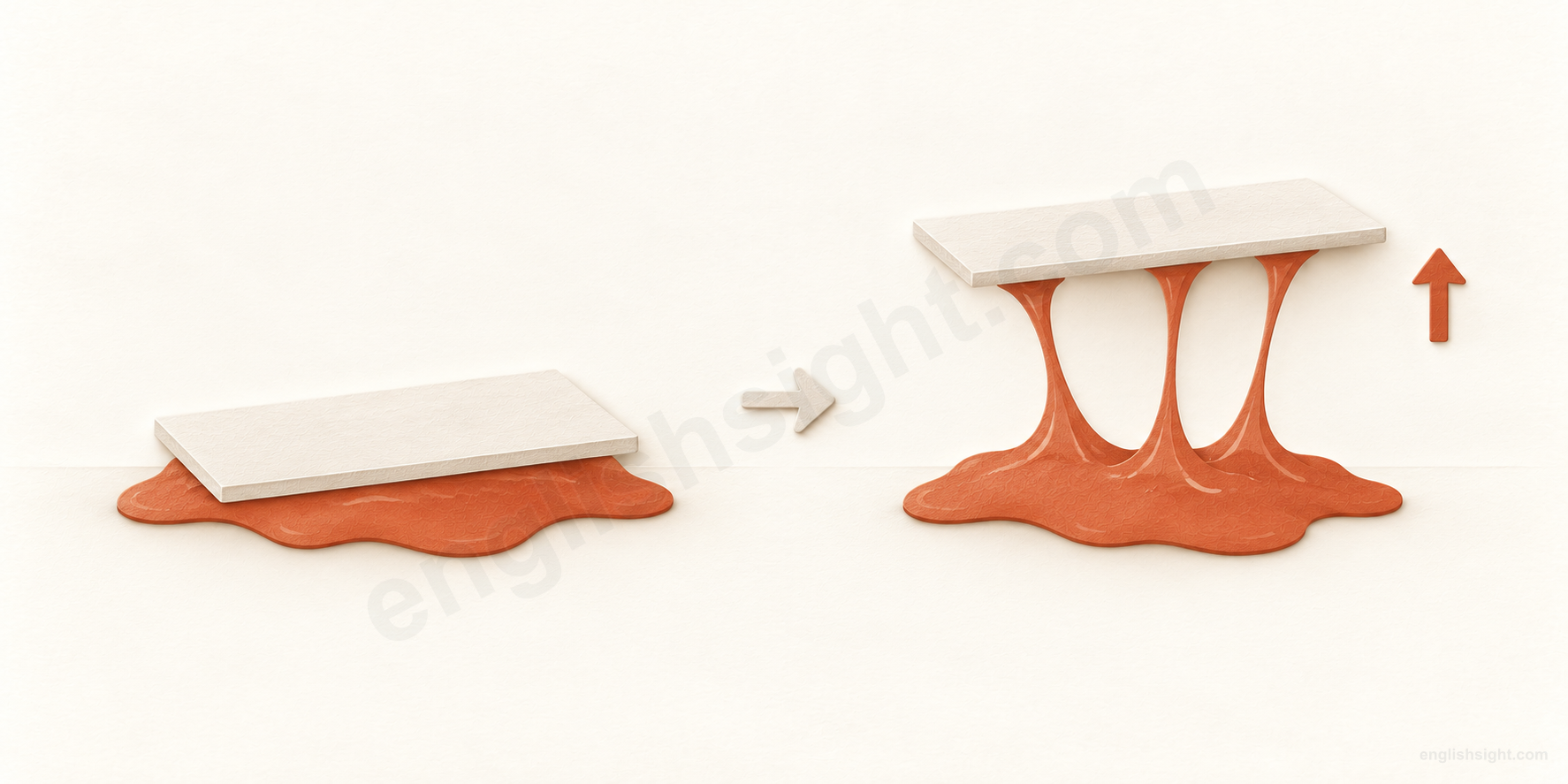
An ivory tab rests on a patch of sticky material.
sticky
Three strands still connect the raised tab to the patch below.
The tab is lifted, but the material keeps clinging.
The tab rises, but the sticky material still clings. The strands show adhesion; real sticky surfaces need not form strands.
A sticky material tends to hold onto something it touches, so the two do not separate cleanly or easily.
The sketch illustrates physical clinging. A mechanism that catches offers a related idea of resistance; humid weather and established idioms must be learned in their own contexts. Visible threads are only a way to show adhesion in a drawing.
Sticky often describes something that clings when it touches another surface. It can describe the material itself, something coated in it, or a moving part that catches.
English also uses sticky for humid warmth and for awkward problems. Fixed expressions need their own explanations: a sticky end is not a kind of glue. The sketch is a teaching model, not a picture every speaker necessarily imagines.
01
Material, surfaces, and movement
Describe what clings, what has a coating, and what does not move freely. Notice whether sticky describes a material, an object, or a mechanism.
01
sticky + material / food; material + be / feel + sticky
sticky glue / dough
able to cling to things it touches
Starting situation
You touch a little glue or soft dough.
What happens or is understood
Some of the material holds onto your finger.
Sticky describes the tendency to cling; something need not already be attached.
Use sticky before a noun or after be, feel, or become: sticky glue; the dough is sticky. The adjective describes a property or condition. It does not itself describe someone applying glue.
Food can be sticky too. Rice grains may cling to one another, while a sweet coating on a bun may cling to your fingers. The relevant contact differs with the food.
Thick concerns how easily a liquid flows. Sticky concerns clinging at contact. A thick mixture is not necessarily sticky, and sweetness alone does not make a food sticky.
In a sentence
The dough is too sticky to shape by hand.
Watch the difference Sticky is an adjective: The dough is sticky. Stick is a verb: The dough sticks to my hands.
02
surface / body part + be / feel + sticky (with + substance)
sticky with juice
having a surface covered in something that clings
Starting situation
Fruit juice has dried on a surface.
What happens or is understood
The surface feels tacky when you touch it.
The table itself need not be made from an adhesive material.
Sticky hands, a sticky floor, and a sticky table can all have a coating or residue. Here the thing being described carries the sticky material rather than being that material.
With can identify the substance responsible: Her fingers were sticky with jam. It introduces what coats the fingers, not a tool used to make them sticky.
Compare a sticky label with a sticky table: the label is designed to attach; the table usually needs cleaning. The noun and context guide the interpretation.
In a sentence
The table was sticky with spilled juice.
Watch the difference Sticky does not simply mean dirty. A dusty surface may be dirty without feeling sticky.
03
a sticky note; sticky notes
a sticky note
a small paper reminder with an adhesive area
Starting situation
You have a short reminder on a small piece of paper.
What happens or is understood
You attach the paper where you will see it.
The adhesive area lets the paper attach and usually be removed again.
A sticky note is a countable object: one sticky note, several sticky notes. The compound names a familiar kind of paper, rather than any note that happens to feel tacky.
Use a sticky note to leave a reminder or mark a page. Here sticky still has a physical explanation: part of the back attaches to a surface. It does not mean the reminder is difficult.
In a sentence
I left a sticky note on the fridge to remind us to buy milk.
Watch the difference Keep the noun: a sticky note. This lesson does not use the informal noun a sticky as a general substitute.
04
some / a piece of / a roll of sticky tape
sticky tape
adhesive tape used to fasten things
Starting situation
A paper wrapping has loose edges.
What happens or is understood
A strip of tape holds the edges together.
The tape attaches surfaces to one another.
Sticky tape is a British expression for adhesive tape, especially the clear kind used with paper. In American English, tape, clear tape, or the familiar brand name Scotch tape may be used.
Tape is normally uncountable when naming the material: some sticky tape or a piece of sticky tape. Count rolls or pieces when you need a number.
Sticky describes the tape. In stick the paper together, stick is instead a verb describing what you do with it.
In a sentence
Could you pass me a piece of sticky tape for this wrapping paper?
Watch the difference Say a piece of sticky tape, rather than a sticky tape, when you mean a strip of the material.
05
a sticky + moving part; moving part + be + sticky
a sticky window / key
not moving or working freely
Starting situation
You try to move a window or press a key.
What happens or is understood
It catches instead of moving smoothly.
A mechanism can stick even when its surface is not tacky.
A sticky window may be hard to slide open; a sticky key may catch when pressed or released. The adjective describes resistance during normal movement.
This connects with the verb stick meaning fail to move freely. It does not diagnose the cause: paint, a poor fit, or dirt might be responsible.
Compare The window is stuck: it is currently unable to move. The window is sticky can describe a recurring tendency to catch even if it still opens with effort.
In a sentence
The space bar is sticky, so it sometimes stays down when I press it.
Watch the difference Do not assume sticky always means covered in glue. With a mechanism it can describe how it moves.
02
Warm air and uncomfortable skin
Sticky can describe humid weather or how your skin feels in it. These uses concern warmth and moisture, rather than actual glue.
06
sticky weather / a sticky day; it + be + hot and sticky
hot and sticky
uncomfortably warm and humid
Starting situation
The air is warm and contains a lot of moisture.
What happens or is understood
The heat feels close and uncomfortable.
Sticky weather concerns humid warmth rather than rain alone.
A sticky day or sticky weather suggests uncomfortable warmth with moisture in the air. Hot and sticky makes both features explicit.
Weather is the subject in The weather is sticky. In It is sticky today, it refers generally to the conditions; no object is being coated in adhesive.
Damp weather can be cool, and hot weather can be dry. Sticky is useful when you want the uncomfortable combination associated with humid heat.
In a sentence
It was hot and sticky even after sunset.
Watch the difference Sticky weather does not require rainfall. Humidity is moisture in the air.
07
person + feel / be + (hot and) sticky
feel hot and sticky
feel unpleasantly damp on your skin
Starting situation
You have been walking in warm weather.
What happens or is understood
Your skin feels moist and uncomfortable.
With a person as subject, sticky can describe a bodily sensation.
After exercise or a humid journey, I feel sticky can describe uncomfortable dampness on the skin. No syrup or glue is needed in this context.
Feel takes an adjective describing your condition: I feel sticky. Compare My hands feel sticky after eating jam: the same adjective can instead refer to a coating, so use the situation to decide.
Clammy also describes unpleasantly damp skin and may suggest coolness. Hot and sticky explicitly keeps the feeling connected with heat.
In a sentence
After the crowded bus ride, I felt hot and sticky.
Watch the difference Do not replace feel sticky with feel stickily. Here the word describes your condition.
03
Problems, difficult periods, and reluctance
Sticky can describe a matter that needs careful handling, a difficult phase, or someone who is reluctant to cooperate. The subject and the words that follow distinguish these uses.
08
a sticky + situation / problem / question; be in a sticky situation
a sticky situation / problem
a difficult or awkward matter requiring care
Starting situation
You face a problem with no easy response.
What happens or is understood
You need to handle the matter carefully.
The difficulty may be practical or social; it is not physical glue.
Sticky is informal when it describes a problem, question, or situation. It can suggest complications, embarrassment, or a risk of upsetting someone.
Use in a sticky situation for the position someone is in. A sticky question names the issue they must answer. The noun supplies the type of difficulty.
The contact-and-resistance sketch provides a memory link: progress is not smooth. This is a teaching comparison, not a rule that every difficult thing can naturally be called sticky.
In a sentence
I am in a sticky situation: both friends expect me to support them.
Watch the difference A hard exam question may simply require knowledge. A sticky question often suggests complications or sensitive handling.
09
have / go through + a sticky patch
go through a sticky patch
experience a difficult period
Starting situation
Work or a relationship begins to run into trouble.
What happens or is understood
The difficulties continue for a stretch of time.
Patch picks out a period rather than a single problem.
A sticky patch is an informal way to describe a difficult phase, especially in British English. Go through a sticky patch presents someone as experiencing that phase.
Our team is having a sticky patch can concern results, finances, or working relationships. The phrase does not identify the cause, and it does not guarantee that things will improve.
Compare a sticky situation, which names a predicament. Patch gives the difficulty a time span; going through contributes the experience of that period.
In a sentence
Our team went through a sticky patch when two key members left.
Watch the difference Sticky patch is a figurative noun phrase. Go through is a separate verb construction, not part of an adjective phrasal verb.
10
person + be + sticky about + -ing
be sticky about doing something
be reluctant to agree or cooperate
Starting situation
You ask someone to agree to a request.
What happens or is understood
They hesitate or resist instead of readily agreeing.
Sticky describes someone’s attitude toward a particular request.
In informal usage, someone who is sticky about doing something is reluctant to agree or cooperate. It describes resistance to a request, rather than a physically clinging person.
Use about followed by an -ing form to name the action at issue: sticky about approving the plan. The person described is the one reluctant to approve; about does not introduce the person making the request.
Compare The request puts me in a sticky situation with The manager is sticky about approving it. The first describes a difficult predicament; the second describes someone’s reluctance. Reluctant to approve is a more neutral alternative.
In a sentence
The manager was sticky about letting us leave early.
Watch the difference Say sticky about letting us leave, not sticky to let us leave, for this established use. It need not mean that permission is finally refused.
04
Expressions to learn as a whole
These established phrases have meanings beyond physical adhesion. Read the whole expression and the situation before choosing an interpretation.
11
have / have got + sticky fingers
have sticky fingers
have a tendency to steal
Starting situation
Small belongings keep disappearing around someone.
What happens or is understood
Someone accuses that person of taking them.
The idiom concerns stealing; the literal phrase may simply concern jam.
In informal speech, someone who has sticky fingers is said to steal. It may sound playful in some contexts, but it still makes an accusation, so use it carefully.
The fixed plural fingers is part of the idiom. You cannot infer this meaning from every description of a sticky hand or finger.
Compare The child has sticky fingers after eating jam: that context is literal. In a story about missing money, sticky fingers is likely to describe theft.
In a sentence
The missing coins made everyone suspect that someone in the house had sticky fingers.
Watch the difference This phrase expresses a tendency or accusation; it is not evidence that someone actually stole something.
12
be / be batting + on a sticky wicket
be on a sticky wicket
be in a difficult or disadvantageous position
Starting situation
You must defend a claim with little support.
What happens or is understood
Your position is difficult to maintain.
The whole phrase describes an awkward position, not an adhesive object.
Be on a sticky wicket is a British informal expression for being in a difficult position. You may hear bat or be batting on a sticky wicket too.
The phrase uses cricket vocabulary, but ordinary figurative use does not require a cricket match. Learn on a sticky wicket as the established wording.
The disadvantage belongs to the whole idiom. Sticky alone does not mean cricket, and wicket cannot freely be replaced with another object while keeping this meaning.
In a sentence
Without any records to support his claim, he is on a sticky wicket.
Watch the difference Use on a sticky wicket. In a sticky situation is a different expression with a different preposition.
13
come to + a sticky end; meet + a sticky end
come to / meet a sticky end
suffer a very bad fate, sometimes an unpleasant death
Starting situation
A story moves toward a character’s final fate.
What happens or is understood
Something very bad happens to that character.
End names an outcome; the expression does not mean merely getting delayed.
To come to a sticky end or meet a sticky end is a British informal expression for an unpleasant fate, often a bad death. It is common in comments about a story’s characters.
The expression can sound darkly humorous or judgmental. It is not a considerate neutral way to describe a real person’s death.
Come to and meet are alternative constructions here: came to a sticky end; met a sticky end. Keep the whole phrase rather than translating each word literally.
In a sentence
In the final chapter, the cruel king meets a sticky end.
Watch the difference A sticky situation is a problem someone faces; a sticky end is the bad outcome itself.
Read the noun and the whole expression
An adjective, not a past form of stick
Sticky /ˈstɪki/ is normally an adjective in these uses. Stickier and stickiest compare degrees of the quality. Stuck is the past form and past participle of stick: the label stuck to the box; the window is stuck. Sticky describes a tendency or condition and does not always mean something is completely stuck.
Grammar supplies the change or cause
The surface is sticky describes a state; it gets sticky describes becoming so; the syrup makes it sticky names a cause. In too sticky to handle, too marks a degree that prevents comfortable handling. These are ordinary adjective constructions, not special senses of sticky.
A useful connection has limits
Think of clinging or resistance as a memory aid for the physical uses. Do not predict an idiom by replacing its nouns, or call every difficult person sticky. Learn established combinations and their register.
Scope of this lesson
This lesson covers the everyday adjective and selected familiar compounds and idioms. Specialist descriptions of prices, customer retention, or software behavior, an uncommon sentimental sense, regional nouns, and a rare verb are outside the main lesson. It is a selection of useful modern uses, not a frequency ranking.
Choose from the situation
Decide whether the sentence concerns a material, a mechanism, a feeling, or an established expression.
1. A clean window catches when you slide it. Which explanation fits “a sticky window” here?
2. You want to say that a label is already attached to a box. Which sentence states that attachment?
3. Someone says “It is hot and sticky today.” What are they describing?
4. A child has just eaten jam and says “My fingers are sticky.” What is the natural reading?
5. A team has struggled for several months. Which phrase highlights a difficult period?
Sources and teaching notes
The linked publisher entries were used to check meanings, forms, and expressions. The explanations and examples are original; connections in the sketch are teaching interpretations.
The sketch is a teaching aid, not a shared mental picture for every English speaker.