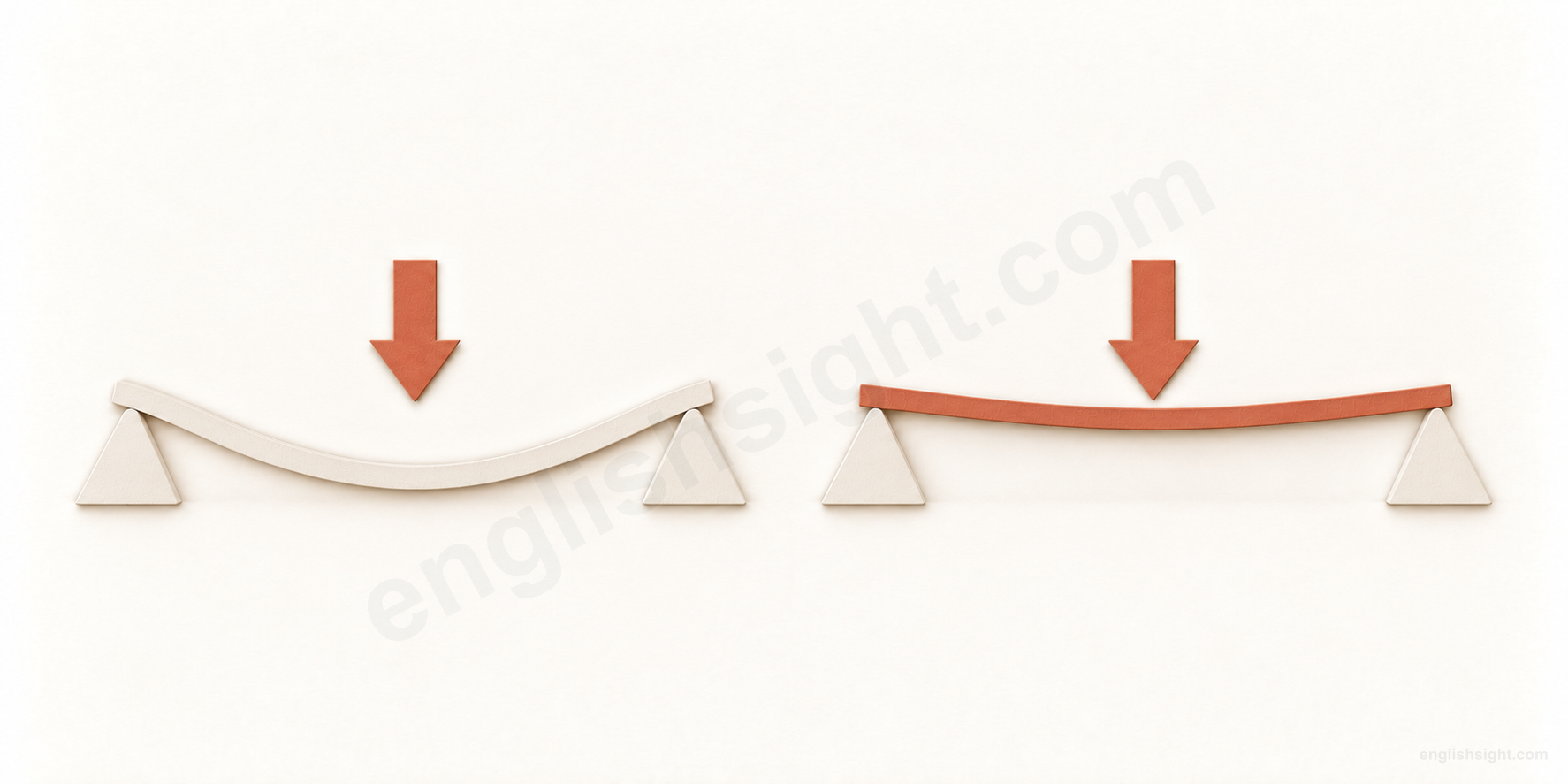
Two different strips under comparable forces: the stiffer one gives way less readily. This is a comparison, not a change over time.
In the central physical use, something stiff resists bending or changing shape under a bending force. It may bend a little; stiffness is a matter of degree.
The comparison explains physical flexibility. It can support an analogy with constrained behavior or difficult resistance, but it does not mechanically explain strong drinks, high prices, intensifiers, or slang nouns and verbs.
A stiff strip resists bending. A stiff joint or handle does not move freely. These physical uses provide a useful starting point for understanding a lack of flexibility or ease.
Other meanings belong to particular nouns and whole expressions: stiff competition, a stiff drink, bored stiff. Learn their established meanings and limits rather than translating every use as rigid. The picture is a teaching comparison, not a shared mental image claimed for every English speaker.
01
Materials, movement, and the body
Begin with resistance to bending or movement. The object tells you whether firmness is useful, inconvenient, or uncomfortable.
01
stiff + material / object; be / feel stiff; stiffer than; as stiff as a board
stiff cardboard / a stiff brush
not easy to bend or flex
Situation
You need a card that will stand upright.
What stiff adds
The firm material keeps its shape.
Stiff concerns resistance to bending, rather than weight or surface hardness.
Stiff cardboard, stiff leather, and a stiff collar do not bend readily. A stiff brush has bristles that resist bending; that may make it useful for scrubbing. Stiff is not automatically a criticism.
A material can be stiffer than another without being completely rigid. Hard often concerns a surface resisting pressure or damage; stiff focuses on bending or flexibility. A thin metal strip can have a hard surface yet bend easily.
The comparison as stiff as a board emphasizes rigidity, including an unusually rigid body or posture. It does not mean that the person is literally made of wood.
Example
Use stiff card so the sign will stand up on its own.
Watch the difference Do not use stiff as a general synonym for heavy or solid.
02
stiff + mechanism; be stiff to + verb; too stiff (for someone) to + verb
a stiff lock / stiff to turn
hard to move or operate smoothly
Situation
You put the key into an old lock.
What stiff adds
Turning it takes more effort than expected.
The moving part resists operation; it need not bend.
A stiff lock, handle, door, or drawer does not move as freely as it should. The adjective can describe the whole mechanism although only one part actually moves.
The lock is stiff to turn explains the difficult operation. The handle is too stiff for me to turn adds a degree that prevents this person from managing it. Stiff alone does not mean completely stuck: something stiff may still move with effort.
Example
The window handle is stiff to turn, but it still works.
Watch the difference Stuck usually means unable to move; stiff can mean difficult but possible to move.
03
be / feel / get / go stiff; a stiff + body part; stiff from / with + cause
a stiff neck / feel stiff
have muscles or joints that do not move freely, often with discomfort
Situation
You sit in one position for a long journey.
What stiff adds
Your legs feel uncomfortable when you stand.
A person or body part has limited, uncomfortable movement.
I feel stiff describes a bodily condition. A stiff neck and stiff shoulders locate it. I feel stiff all over means the discomfort affects much of your body. It is different from simply feeling tired or lacking energy.
Get stiff or go stiff describes becoming stiff, rather than just being in that condition. In stiff from sitting, from identifies the cause; stiff after a long trip gives the time or occasion. Fingers stiff with cold identifies cold as the cause or accompanying condition.
The same with pattern can explain material stiffness: boots stiff with dried mud have been made inflexible by the mud. The preposition supplies that relationship; stiff itself names the condition.
Example
My knees felt stiff after the long bus journey.
Watch the difference Stiff does not by itself identify an illness, and it is not interchangeable with tired.
thick or firm enough to resist flowing or stirring
Situation
You beat egg whites for a cake.
What stiff adds
The foam holds pointed shapes when the whisk is lifted.
In cooking, stiff describes consistency and the ability to hold shape.
A stiff dough or mixture is firm and not runny. Egg whites beaten until stiff hold their shape; stiff peaks is the familiar recipe expression for pointed peaks that remain upright when the whisk is lifted.
In beat the egg whites until stiff, until introduces the target state: until they are stiff. In beat them into stiff peaks, into introduces the resulting form. This is an ordinary adjective describing the food, not a separate verb stiff.
Example
Beat the egg whites until they form stiff peaks.
Watch the difference Stiff describes firmness here, not necessarily dryness or hardness.
02
When behavior does not feel relaxed
A physical lack of flexibility can help you remember a social lack of ease, but the social meaning is an established use.
Social stiffness is a lack of relaxed, natural expression.
A stiff manner, stiff greeting, or stiff smile can seem overly formal, awkward, or unfriendly. The description does not prove that the person intends to be rude: nervousness can also make behavior stiff.
A stiff style of writing or stiff dialogue lacks conversational ease or grace. The connection with physical stiffness is a useful teaching comparison, not a claim that a conversation literally bends.
Stiffly describes how someone behaves: She answered stiffly. Stiffness names the condition or quality. Use these ordinary derived forms rather than making stiff a general manner adverb.
Example
His stiff welcome made the visitors feel uneasy.
Watch the difference A stiff smile is not necessarily an angry smile; it may be forced or awkward.
03
Difficult, severe, expensive, or strong
Read the noun with stiff. Competition is hard to beat, a penalty is harsh, and a drink contains plenty of alcohol; these are distinct collocations.
06
face stiff competition (from + rival)
face stiff competition
compete against strong rivals who are difficult to beat
Situation
Several excellent applicants want the same job.
What stiff adds
Winning the position will be difficult.
Stiff describes the strength of the competition, not a physical barrier.
Face stiff competition means have strong rivals. A company, athlete, applicant, or product can face it. From introduces the rival: competition from larger companies.
Competition is normally uncountable when it means rivalry: stiff competition, without a. A competition can instead be a particular contest. Tough competition is a close alternative in this sense.
Example
Our small bakery faces stiff competition from two large chains.
Watch the difference Do not write a stiff competition when you mean the general pressure from rivals.
07
meet with / face stiff opposition; offer / put up stiff resistance
meet with stiff opposition / resistance
encounter strong efforts to prevent or oppose something
Situation
A proposal is put to the committee.
What stiff adds
Several members oppose it firmly.
Opposition resists a proposal; competition involves rivals seeking success.
Meet with stiff opposition means encounter strong disagreement or attempts to block a plan. The plan meets with opposition; the opponents offer or put up resistance. With belongs to meet with, not to a special phrase stiff with.
Stiff resistance can be physical or nonphysical. It highlights determined opposition that is difficult to overcome. It does not tell you whether that opposition is justified.
Example
The proposal met with stiff opposition from local residents.
Watch the difference Use competition for strong rivals and opposition for people resisting a plan or action.
08
a stiff + climb / test / challenge
a stiff climb / a stiff test
a task that requires considerable effort or ability
Situation
The path rises sharply toward the ridge.
What stiff adds
Reaching the top takes hard work.
The task is demanding; the hill or test is not physically inflexible.
A stiff climb is hard work. A stiff test or challenge makes serious demands on ability or resources. This sense often appears before a noun in descriptions of sport, journeys, or difficult tasks.
The connection is the effort needed to deal with something resistant or demanding. Learn the collocations; stiff is not a natural replacement for difficult before every noun. A difficult question is generally a clearer everyday choice than a stiff question.
Example
The final hill was a stiff test for the tired cyclists.
Watch the difference Do not replace difficult with stiff in every context.
09
a stiff + fine / penalty / sentence; face stiff penalties
a stiff fine / penalty / sentence
a punishment that is unusually severe
Situation
A business breaks the regulations.
What stiff adds
It must pay a large punitive fine.
The consequence is harsh, rather than hard to move.
A stiff fine is a large monetary punishment; a stiff prison sentence is a severe term of imprisonment. Here sentence means a legal punishment, not a group of words.
The noun supplies the kind of penalty. Stiff evaluates its severity. It does not establish whether the punishment is fair. The punishment seemed stiff can also place the adjective after a linking verb.
Example
The company received a stiff fine for breaking the rules.
Watch the difference A stiff fine punishes an offence; a stiff fee is simply expensive.
10
a stiff + price / fee / charge; the price is stiff
a stiff price / fee
a charge that seems high or excessive
Situation
You check the cost of a short visit.
What stiff adds
The entrance charge seems more than you expected.
The price is hard to accept because it is high.
A stiff price, charge, or fee is expensive, often more than the speaker thinks reasonable. This evaluation is informal and depends on expectations.
That price is a bit stiff is a possible informal comment. It concerns the amount charged, not a price that refuses to change. Price and punishment overlap in financial impact, but a fee is not automatically a fine.
Example
That is a stiff fee for a ten-minute consultation.
Watch the difference Stiff usually evaluates a high amount here, not whether negotiation is possible.
11
a stiff + breeze / wind
a stiff breeze / wind
a wind that blows strongly
Situation
You step onto an exposed path.
What stiff adds
Strong moving air pushes against you.
With wind, stiff means forceful rather than rigid.
A stiff breeze is noticeably strong, although breeze alone may suggest gentler wind. The combination is established, so do not interpret it as air that cannot bend.
This is a descriptive expression rather than a precise weather measurement. A stiff wind does not specify a single exact speed.
Example
A stiff breeze blew across the open field.
Watch the difference Stiff wind does not mean still air or a wind that never changes direction.
12
a stiff + drink / whisky / brandy
a stiff drink
a strong alcoholic drink
Situation
A character pours a generous measure of spirits.
What stiff adds
The drink contains plenty of alcohol.
The strength concerns alcohol, not the physical thickness of a liquid.
A stiff drink, stiff whisky, or stiff brandy refers to a strong alcoholic serving, often a generous or relatively undiluted one. It is not a drink that has become solid.
This meaning normally comes before the drink noun. Learn a stiff drink as a collocation. Strong coffee is ordinary English; stiff coffee is not the general equivalent. In a story, someone wanting a stiff drink may be reacting to a shock, but stiff itself means alcoholic strength.
Example
In the novel, the detective pours himself a stiff whisky.
Watch the difference Do not use stiff drink for any thick drink or for strong coffee.
04
Whole expressions and result states
Some patterns intensify feelings, some describe an actual rigid result, and one familiar idiom concerns hiding distress.
13
be scared / worried / bored stiff; scare / worry / bore + person + stiff
scared stiff / bored stiff
extremely frightened, bored, or worried
Situation
A child is terrified before a performance; a listener loses interest in a long talk.
What stiff adds
One is scared stiff; the other is bored stiff.
In these fixed combinations, stiff intensifies the feeling.
Scared stiff means extremely frightened. Worried stiff means extremely worried. The bodily image of becoming unable to move may help you remember fear, but the expression does not require actual paralysis.
Bored stiff means extremely bored, not necessarily physically motionless. That lecture bored me stiff uses bore as the verb, me as its object, and stiff as an intensifying complement. The full pattern expresses the effect on the listener.
Dictionaries differ in analyzing these uses as adverbial intensification or an adjective complement. For practical use, learn the complete informal patterns. Stiff is not a freely usable replacement for very: very happy does not become happy stiff.
Example
I was scared stiff before my first solo performance.
Watch the difference Keep stiff after the feeling word: scared stiff, not stiff scared.
14
be / get frozen stiff
frozen stiff
made rigid by freezing, or extremely cold in informal speech
Situation
Wet fabric is left outside in freezing weather.
What stiff adds
It becomes rigid rather than hanging loosely.
This can describe a physical result, unlike purely emotional intensification.
Clothes frozen stiff have become rigid because they froze. The fabric cannot move freely. Here stiff names the resulting rigid condition, not merely a high degree of emotion.
I was frozen stiff after waiting outside may be informal exaggeration for feeling extremely cold. People need not be literally frozen solid. Decide from the subject and situation whether the phrase describes an actual rigid object or an exaggerated human experience.
Example
The wet towel was frozen stiff by morning.
Watch the difference Do not assume every frozen stiff describes a person or is only figurative.
15
keep / maintain a stiff upper lip
keep a stiff upper lip
stay outwardly composed and hide distress during difficulty
Situation
A person is upset by bad news.
What stiff adds
They try not to let their distress show.
The idiom concerns outward control, not absence of feeling.
Keep a stiff upper lip means remain calm and avoid showing pain, fear, or distress. It does not say the person feels nothing. The whole phrase is idiomatic; simply describing a lip as stiff does not necessarily express this meaning.
The phrase is often associated with a traditional British ideal of not showing distress, though it is understood more widely. It can express admiration, criticism, or humor depending on context. It describes a style of response, not a rule about how people ought to handle emotion.
Example
She tried to keep a stiff upper lip while saying goodbye.
Watch the difference Do not interpret the idiom as proof that someone is happy or untroubled.
05
Recognizing informal nouns and a verb
These uses are useful for understanding conversation and stories. Their meanings and tone must be learned separately from the adjective.
16
stiff + person (on + payment); be / get stiffed
stiff someone / stiff someone on a bill
cheat someone by failing to pay or tip them
Situation
A freelancer finishes the agreed work.
What stiff adds
The client refuses to pay the bill.
This informal verb names failure to pay, not physical rigidity.
In informal American English, stiff someone can mean refuse to pay money owed or fail to leave an expected tip. The client stiffed me on the bill concerns nonpayment; the diners stiffed the waiter concerns a tip. Context supplies the financial expectation.
The verb is regular: stiff, stiffs, stiffed, stiffing. Its direct object is the person denied payment; a passive is possible: I got stiffed. These are ordinary verb patterns, not phrasal verbs. The on phrase identifies the payment involved.
To make something rigid, normally use stiffen or make it stiff. The slang verb stiff is not the ordinary verb for making cardboard or muscles less flexible.
Example
The client stiffed the designer on the final payment.
Watch the difference This verb is slang and accusatory; did not pay is more neutral in a formal report.
17
a working stiff; a lucky stiff; working stiffs
a working stiff / a lucky stiff
an ordinary worker, or informally a person of a particular kind
Situation
Someone talks casually about ordinary wage earners.
What stiff adds
They use working stiff as a familiar social label.
As a count noun, stiff can label a person; tone depends on the phrase.
A working stiff is an informal American expression for an ordinary working person, often someone earning wages through practical or routine work. It can sound sympathetic or self-deprecating, especially when speakers include themselves.
You lucky stiff! informally addresses someone who has been fortunate. The adjective lucky supplies the favorable meaning. These labels do not mean that the person has stiff joints, and stiff is not a neutral substitute for person in every sentence.
Example
I am just a working stiff trying to pay the rent.
Watch the difference Use these familiar labels with attention to tone; worker or person is safer in neutral formal writing.
18
a stiff; two stiffs
a stiff
a dead body, in slang
Situation
A crime story uses blunt slang for a body.
What stiff adds
The reader understands that someone is dead.
This count noun has a distinct slang meaning.
A stiff can mean a corpse in slang, especially in crime stories or blunt conversation. The association with a dead body becoming rigid can help with recognition, but the noun is a conventional label.
It is different from He is stiff, which ordinarily describes rigidity, discomfort, or a formal manner. The article in a stiff changes the grammatical reading. Body or dead body is usually a more neutral choice when describing a death.
Example
In the crime drama, the thief refers to the dead body as “a stiff.”
Watch the difference This can sound callous or disrespectful; it is not a neutral word for a deceased person.
Read the noun, the grammar, and the tone
Stiff, hard, rigid, and sore
Stiff emphasizes limited flexibility or movement. Hard often describes resistance at a surface; rigid suggests very little flexibility. Sore focuses on pain. Stiff muscles may also be sore, but the words describe different aspects.
Forms and word class
The adjective has stiffer and stiffest. Very stiff and too stiff to move show degree; stiffly is the ordinary manner adverb and stiffness the quality noun. The slang verb has stiffed and stiffing. Making something more rigid is normally stiffening it.
Fixed combinations have limits
Stiff is not a general substitute for strong, expensive, difficult, or very. Learn stiff competition, a stiff fee, a stiff breeze, a stiff drink, and bored stiff with their nouns or full patterns.
Scope
This lesson covers the main modern adjective uses, familiar expressions, and selected slang for recognition. Specialized nautical and golf uses, regional senses, and less common slang senses are outside the teaching sequence. No numerical frequency ranking is claimed.
Choose the meaning that fits
Use the situation and the complete construction to decide.
1. The handle takes effort to turn, but you can turn it. Which description is most exact?
2. After hours of sitting, your knees do not move comfortably. Which sentence describes that?
3. A company receives a stiff fine. What does stiff add?
4. The lecture bored me stiff. What is the speaker saying?
5. A story mentions a stiff whisky. What kind of drink is meant?
6. A designer says, “The client stiffed me.” What is the likely complaint?
Sources and teaching notes
The linked dictionaries were read to check meanings, constructions, and register. Explanations, examples, and the diagram are original teaching material; the visual analogy has explicit limits.
The diagram is a teaching comparison, not a claim that every English speaker imagines the same picture.