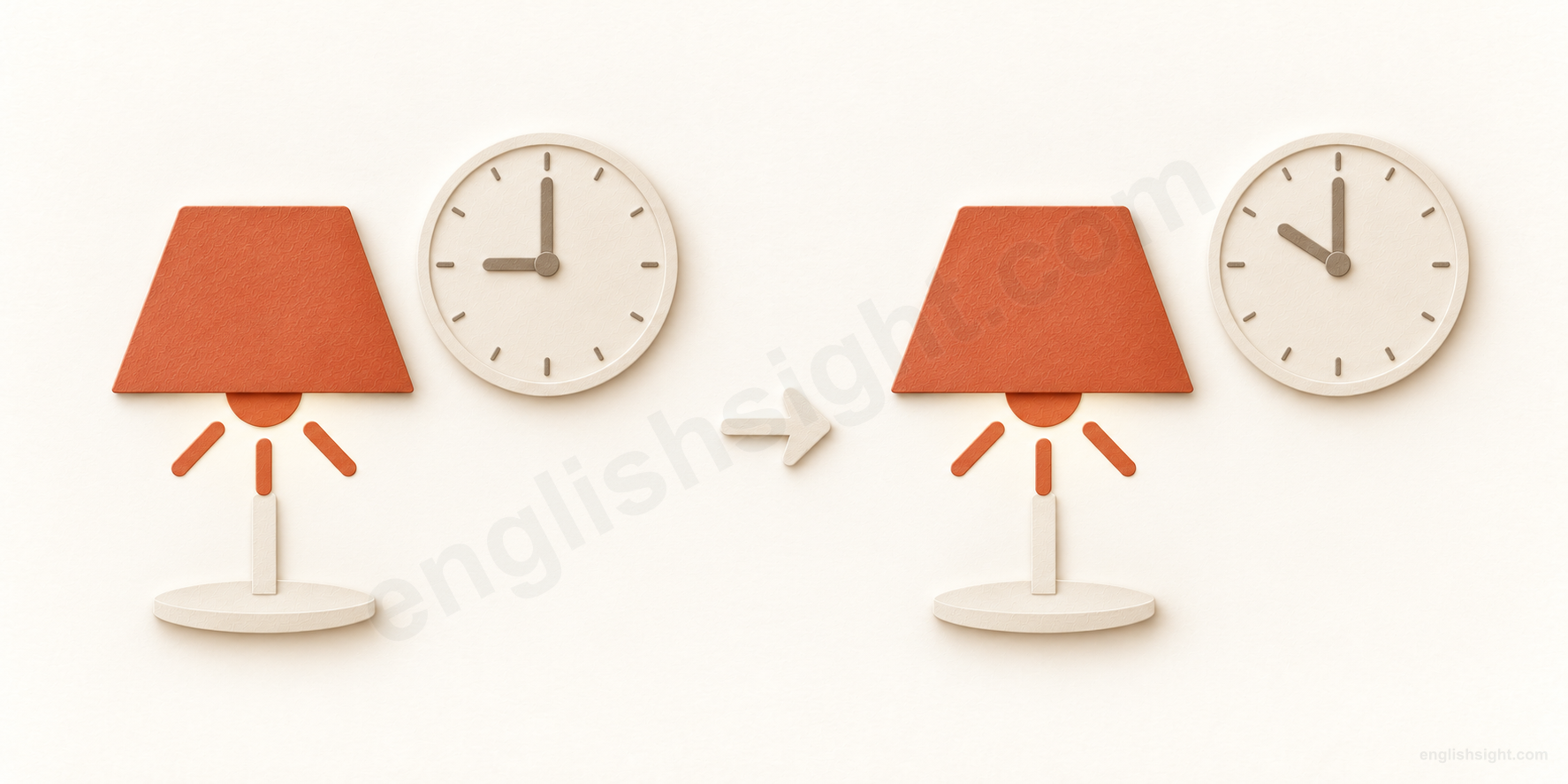
Separate continuing situations from physical stillness, counterpoints, and further degrees.
A condition continues as time advances
A condition survives the passage of time
The lamp is on at nine.
still
At ten, the lamp is still on.
An hour passes; the lamp remains on.
Time changes; the lamp stays on.
Time advances, but the situation being described remains true at the reference time.
This teaching model fits the continuing-time adverb. It does not require every detail to stay identical, and it does not make physical stillness, comparisons, or every fixed phrase the same meaning.
The lamp was on earlier. At a later time, it is still on. For the time adverb, ask which fact remains true as time advances. A person can still be running: continuing does not mean motionless.
The adjective describes rest or calm; conversational and comparative uses do different work. These are useful connections for learning, not a claim that every speaker sees the same mental picture. The equipment noun has a separate history.
01
A situation continues through time
Check what was true earlier and whether it remains true at the time being discussed. That time may be past, present, or future.
01
still + main verb; be + still + complement; first auxiliary / modal + still + verb
still live / be / be doing
the earlier situation continues
Earlier situation / context
A lamp was on earlier.
Later situation / point
Later, it remains on.
Time advances while the stated condition continues.
In I still live here, still says that living here continues. It does not say that I never leave the building. In I am still working, the activity continues; in I am still tired, the state continues.
The usual neutral order is I still work here, I am still here, and I have still got the key. With a modal or auxiliary, still normally follows the first one: I will still be working at six. The tense sets the reference time; still is not limited to now.
In The bridge is still being repaired, the repair process continues. Being repaired is a progressive passive form; still does not create a special passive construction or say the bridge is physically motionless.
In a sentence
At ten, the lamp was still on.
Watch the difference Still on concerns continued illumination. It does not mean that the lamp is motionless.
02
subject + still + negative auxiliary + verb; be + still + not + complement
still haven’t / still don’t / still can’t
an expected change has not happened
Earlier situation / context
You have been looking for a receipt.
Later situation / point
You have not found it after another search.
The negative situation continues, often longer than hoped.
I still haven’t found it highlights continuing failure to find it. Still usually comes before the negative auxiliary here: still haven’t, still don’t, still can’t. I am still not ready uses still after am and before not.
I haven’t found it yet reports noncompletion up to now; still often adds frustration or surprise. By contrast, I no longer need it says a former need has ended. Use I don’t need it any more for the same change in ordinary conversation.
In a sentence
I still haven’t found the receipt.
Watch the difference Still not describes a continuing negative. No longer describes the ending of an earlier positive situation.
03
do / does + subject + still + verb?; be + subject + still + complement?
Do you still…? / Are you still…?
ask whether an earlier situation continues
Earlier situation / context
You know your friend used to work nights.
Later situation / point
You ask if that is true now.
Still checks continuation; yet checks arrival at an expected stage.
Do you still work nights? starts from an earlier fact and asks whether it continues. Are you still at work? asks whether the person has remained there.
Are you at work yet? asks whether the person has arrived or reached that stage. Are you already at work? can express surprise at an early arrival. Keep the normal question order: Are you still waiting?
In a sentence
Do you still work nights?
Watch the difference Do not replace still with yet when asking whether an established routine continues.
04
can / could / may + still + verb
can / could still…
a possibility remains open
Earlier situation / context
The earlier train has gone.
Later situation / point
A later train remains an option.
The opportunity continues even after a setback.
We can still get there tonight says that getting there remains possible. Still does not guarantee success; can supplies possibility, while still says that the possibility has not disappeared.
Could still can present a remaining possibility more tentatively: The package could still arrive today. A future reference is entirely possible even though still connects the present outlook to an earlier one.
In a sentence
We can still catch the last train if we leave now.
Watch the difference Still does not turn could into certainty. Include the condition if the opportunity depends on it.
05
there + be + still + noun; still have + noun + left
There is still time / some left
an amount or resource remains available
Earlier situation / context
Some tickets have been sold.
Later situation / point
A few remain for buyers.
Availability continues even though part of the resource may be gone.
There is still time points to time remaining before a limit. We still have some bread left points to a remaining quantity. Left means remaining; still adds the link to an earlier situation.
There are still three tickets can be reassuring when you feared none remained. It does not say that there were only three tickets originally, or that the quantity has never changed.
In a sentence
There is still time to change the booking.
Watch the difference A remaining quantity need not be unchanged in size. The continuing fact is that some is available.
06
be + still + to-infinitive; still have to + verb; have still to + verb
still to come / still have to…
something remains to happen or be done
Earlier situation / context
Most of the program has finished.
Later situation / point
The final performance has not happened.
What continues is the pending status, not the event itself.
The best part is still to come means it lies ahead. In a program announcement, Still to come: the final interview introduces a later item. The interview has not started and continued; it remains ahead.
We still have to choose a date means that the obligation or unfinished task remains. The details have still to be agreed is a more formal alternative. The infinitive supplies the pending action.
In a sentence
The final interview is still to come.
Watch the difference Still to come does not mean that an interview is happening now. Compare The interview is still going on.
02
A point survives an objection, or a degree increases
In conversation and comparisons, still can keep a claim in force or add a further step. These uses need more than a timeline.
07
Still, + clause; but + subject + still + verb
Still, … / but … still…
a point remains valid despite an objection
Earlier situation / context
The room was small.
Later situation / point
You nevertheless enjoyed staying there.
The first fact does not cancel the second point.
The room was small. Still, we enjoyed our stay acknowledges a drawback and then gives a counterpoint. At the start of a sentence, Still, commonly means nevertheless and is followed by a comma.
The room was small, but we still enjoyed our stay places still inside the clause. This can concern a judgment that holds despite circumstances, without describing an uninterrupted activity. Still, it could be worse can also put a problem in perspective.
In a sentence
The walk was tiring. Still, the view was worth it.
Watch the difference In careful writing, use a full stop or semicolon before linking two independent clauses with Still, rather than only a comma.
08
still + comparative; comparative + still; better still, + suggestion
still better / better still
even greater in the compared quality
Earlier situation / context
One route is fast.
Later situation / point
Another is faster than that.
Still strengthens the comparison rather than describing duration.
This route is faster still means it is even faster than the one already mentioned. Still may come before the comparative too: a still faster route. The comparison supplies the scale.
Better still often introduces an improved suggestion: We could call; better still, we could visit. It does not mean that something remains good after a long time. Compare The old route is still good, where still does express continuation.
In a sentence
The first room was quiet, but the upstairs room was quieter still.
Watch the difference Still very quiet is a continuing state; quieter still adds a further degree in a comparison.
09
still + more + noun; still + another + singular noun
still more / still another
a further amount or item beyond those mentioned
Earlier situation / context
Several forms have already been requested.
Later situation / point
One more is requested.
Another step is added to an existing number or amount.
Still another form emphasizes an additional form after earlier ones. Still more paperwork adds a further amount. Depending on context, the addition can sound surprising or unwelcome.
Compare We still have more forms to fill in: that says extra work remains. They asked for still more forms puts emphasis on the further quantity. The two readings can be close, so read the whole sentence.
In a sentence
After three applications, they asked us for still another form.
Watch the difference Another takes a singular countable noun here: still another form, not still another forms.
10
negative or limiting clause + still less + noun / phrase
still less
and certainly not the more demanding alternative
Earlier situation / context
Someone lacks the smaller amount.
Later situation / point
A larger expense is even less possible.
After a negative point, still less rules out a further possibility.
I can’t afford a bicycle, still less a car says that a car is even further beyond my means. The expression normally follows a negative or limiting idea and is more formal than let alone.
This is not simply a smaller quantity continuing over time. Compare I earn still less than you, where still strengthens an ordinary comparative. The argument pattern depends on the first negative statement.
In a sentence
She had no time for a snack, still less a long restaurant meal.
Watch the difference Use a second option that the context makes less plausible, more demanding, or more extreme.
03
No movement, wind, or disturbance
Still can describe physical rest and calm. This is a different job from the time adverb: someone can still be moving.
11
be / keep / hold / sit / stand + still; keep / hold + object + still
keep / hold / sit / stand still
remain without moving
Earlier situation / context
A camera is ready for a portrait.
Later situation / point
The subject holds the same position.
Here still describes physical rest.
Hold still asks someone not to move, for example during a photo or an examination. Keep your head still and Hold the ladder still make the thing to be kept motionless explicit.
Compare I am still standing, where the time adverb says standing continues, with I am standing still, where still means without moving. Stock-still strengthens the motionless meaning: The rabbit stood stock-still. Some dictionaries classify still after sit or stand as an adverb; the practical contrast stays the same.
In a sentence
Please hold the ladder still while I climb down.
Watch the difference Still is not always a time word. Be still usually asks for no movement and may also ask for quiet.
12
still + noun; subject + be / become + still
still water / air / a still room
little or no movement, wind, sound, or activity
Earlier situation / context
Wind and activity have died away.
Later situation / point
The surroundings are calm.
What is absent depends on the noun being described.
Still air has little or no wind; still water has no obvious movement or disturbance. A still house or room can be quiet and inactive. The adjective describes calm conditions rather than the continuation of a previous event.
Still is not a promise of complete silence in every context: water can be still while birds sing nearby. Quiet mainly concerns low noise or activity; still often brings in lack of movement as well.
In a sentence
The lake was still, but birds were calling from the shore.
Watch the difference Do not infer drinkability from still water in a lake. Still describes its movement in this context.
13
still water / still wine; sparkling or still?
still water
water without carbonation
Earlier situation / context
A server offers two kinds of bottled water.
Later situation / point
You choose the one without gas bubbles.
In a drink order, still contrasts with sparkling.
Still water in a restaurant means noncarbonated water, especially in British usage. It is not an instruction to keep the glass motionless. Still wine likewise contrasts with sparkling wine.
Sparkling or still? asks about carbonation, not temperature. In the US, noncarbonated water is also a clear way to express the choice. Flat can suggest that a drink which should be fizzy has lost its fizz; still does not imply a defect.
In a sentence
Could we have a bottle of still water, please?
Watch the difference Still does not mean cold, and sparkling does not mean alcoholic. Specify those features separately.
14
time + stand / seem to have stood + still
time stands / has stood still
a place or experience seems untouched by change
Earlier situation / context
You enter an old village.
Later situation / point
Its appearance seems unchanged over many years.
Physical nonmovement becomes a metaphor for lack of change.
Time seems to have stood still describes the impression that ordinary change has stopped. It often describes an old interior, village, or way of life. In a dramatic moment, time stood still can describe a feeling that time stopped.
This is figurative: clocks need not have stopped. The expression develops stand still as lack of change, while still standing describes continuing to stand or survive.
In a sentence
In the tiny workshop, time seemed to have stood still.
Watch the difference Do not use this expression as literal evidence about an actual clock or the age of everything in the room.
04
Pictures and art
Photography and painting use established names connected with subjects or images that do not move.
15
a still from + film / video; still image / photography / camera
a still / still photography
a nonmoving picture rather than a moving sequence
Earlier situation / context
A video contains a sequence of frames.
Later situation / point
One frame is viewed as a separate picture.
A single image is shown instead of a moving sequence.
A still is a countable photograph or single image, often from a film or video. Its plural is stills. Still photography and a still camera contrast with recording moving pictures.
A publicity still may be a posed photograph associated with a film, not necessarily a frame extracted from it. Still image names a type of image; The image is still on the screen instead says it continues to be displayed.
In a sentence
The article included two stills from the documentary.
Watch the difference A still need not show a motionless subject: it can capture a runner in midair.
16
still life (genre); a still life; plural still lifes
still life
art showing an arrangement of objects
Earlier situation / context
An artist arranges fruit and a jug.
Later situation / point
The arrangement becomes the subject of a painting.
The phrase names an art subject and the resulting work.
Still life is art depicting arranged objects such as fruit, flowers, or household items. It can name the genre without an article, or one work: a still life.
The plural is still lifes, not still lives: The gallery has three still lifes. Learn the expression as a compound noun. It is not a description of a person whose life continues.
In a sentence
She painted a still life of pears and a blue jug.
Watch the difference Keep the plural lifes in this art term; ordinary life has the plural lives.
05
Other meanings worth recognizing
The verb, the equipment noun, and the quiet-night expression have their own grammar and register.
17
still + object; subject + stilled; be + stilled
still the noise / fears; the wind stilled
make or become calm, quiet, or motionless
Earlier situation / context
Noise or anxiety is present.
Later situation / point
It subsides or is calmed.
Unlike the time adverb, the verb can describe a change.
Still can be a verb, especially in literary writing: The wind stilled; Her voice stilled the crowd. With an object it names what is calmed; without one it describes something becoming quiet.
Still someone’s fears means calm those fears. The forms are still, stills, stilled, stilling; a passive is possible: His fears were stilled. In everyday speech, calm, quiet, or stop moving is often more natural. This verb does not require an object plus to-infinitive.
In a sentence
The reassuring message stilled her fears.
Watch the difference In She is stilling the crowd, stilling is a verb. In She is still talking, still is an adverb and talking is the main activity.
18
a + still; plural stills
a still
equipment used for distillation
Earlier situation / context
A tour guide shows equipment in a distillery.
Later situation / point
The guide names the apparatus.
This noun is a separate equipment meaning, not a frozen moment.
A still is apparatus used to separate substances by vaporizing and condensing liquid, familiar from making spirits. It is countable: a copper still, several stills.
This equipment noun is associated with distil or distill, not derived in this lesson from the idea that something remains unchanged. Distillation is a specialist process; the useful task here is recognizing the noun on a tour or in a description.
In a sentence
The guide pointed to a copper still in the distillery.
Watch the difference Context distinguishes a film still from a whisky still. The plural stills works for both.
19
in + the still of the night
in the still of the night
during the quiet, calm part of the night
Earlier situation / context
Daytime noise has faded.
Later situation / point
A small sound is noticeable in the night’s quiet.
Here still is a noun meaning quietness.
The still of the night is a literary expression for night-time calm and quiet. In the still of the night gives the setting for an event. It does not say that the event continues all night.
For an ordinary conversation, in the quiet of the night is more direct. Distinguish The night is still, with an adjective, from the still of the night, with a noun.
In a sentence
In the still of the night, we heard a distant bell.
Watch the difference This noun use is literary; do not routinely replace quiet with still in everyday noun phrases.
06
Familiar sayings and cautious judgments
Learn the whole expression. Still contributes to the phrase, but cannot predict its complete meaning by itself.
20
Still waters run deep.
still waters run deep
a quiet person may have depth that is not obvious
Earlier situation / context
A person says little in a group.
Later situation / point
You discover strong feelings or considerable knowledge.
A calm surface is the saying’s metaphor, not proof of character.
Still waters run deep is a saying about people whose quiet manner hides or does not reveal depth of feeling or knowledge. It warns against judging only from an outwardly quiet manner.
It is a proverb, not a rule that every quiet person is wise or secretive. Its literal water image supports the metaphor, but the whole expression supplies the human interpretation.
In a sentence
“I never knew Ada cared so deeply about music.” “Still waters run deep.”
Watch the difference Do not treat the saying as a scientific statement about lakes or a reliable personality test.
21
the jury is (still) out on + noun / whether-clause
the jury is still out
a judgment has not yet been settled
Earlier situation / context
A new policy has been tried briefly.
Later situation / point
There is not enough evidence to judge its success.
Still says the undecided situation continues; jury out supplies the metaphor.
The jury is still out on something means people have not reached a definite judgment about it. Outside a courtroom, the jury is a metaphor for people assessing evidence, not necessarily a real legal panel.
Use on before a topic, or on whether before a question: The jury is still out on whether it works. The phrase does not say the idea has failed; the conclusion remains open.
In a sentence
The jury is still out on whether the new timetable helps commuters.
Watch the difference Do not turn lack of a settled judgment into a claim that the proposal is bad.
22
it is (still) early days; it is early days yet
it’s still early days
it is too soon for a firm conclusion
Earlier situation / context
A project has just begun.
Later situation / point
You resist judging its final outcome.
The early stage continues, so the evidence may be incomplete.
It’s still early days is especially British English. It signals that more time is needed before deciding how a project, relationship, or situation will develop.
It’s early days yet is a related expression. Neither phrase means early in the morning. In other varieties, It’s still early or It’s too soon to tell can express the same caution more directly.
In a sentence
The trial looks promising, but it’s still early days.
Watch the difference Do not use a singular day in this fixed expression: it’s early days.
Choose the job still is doing
Continuation does not freeze every detail
A growing child can still be young; a train can still be moving. The stated condition continues even when size, position, or other details change.
Default word order and emphasis
Use I still work here, I am still here, and I can still help. In continuing negatives, use I still can’t help or I am still not ready. Different orders can occur with special emphasis; the patterns here are neutral starting points. Sentence-final time still occurs, especially in informal speech, but is less usual.
Expectation is context, not a compulsory emotion
Still can suggest surprise, impatience, or reassurance. It can also simply report continuation. An English explanation should not attach annoyance to every occurrence.
Forms and word classes
The adverb has no tense or plural. The adjective can be very still, stiller, or stillest. The verb has stills, stilled, and stilling and can be transitive, intransitive, or passive. The countable nouns have plural stills; still life has plural still lifes. There is no productive everyday family of still + particle verbs to memorize.
Find the meaning in the whole pattern
Choose the sentence that fits the intended situation.
1. Mina worked here last year. You want to know whether that remains true. Which question fits?
2. A photographer wants you not to move. Which instruction fits?
3. You have tried repeatedly, but the file will not open. Which emphasizes the continuing problem?
4. The meal cost more than expected, but you judge it worthwhile. Choose a suitable counterpoint.
5. The first design is good; a second design improves on it. Which wording strengthens the comparison?
6. A server asks “Sparkling or still?” What feature is being offered?
Sources and teaching notes
Definitions and usage were checked against the sources below. Explanations, example sentences, and the diagram were written for this lesson; the visual connection is a teaching interpretation.
This diagram helps explain a connection; it is not a picture shared by every native speaker.