Use stitch for sewing, loops, wound closures, and expressions whose meanings need the whole phrase.
Small links join the edges
Thread links hold edges together
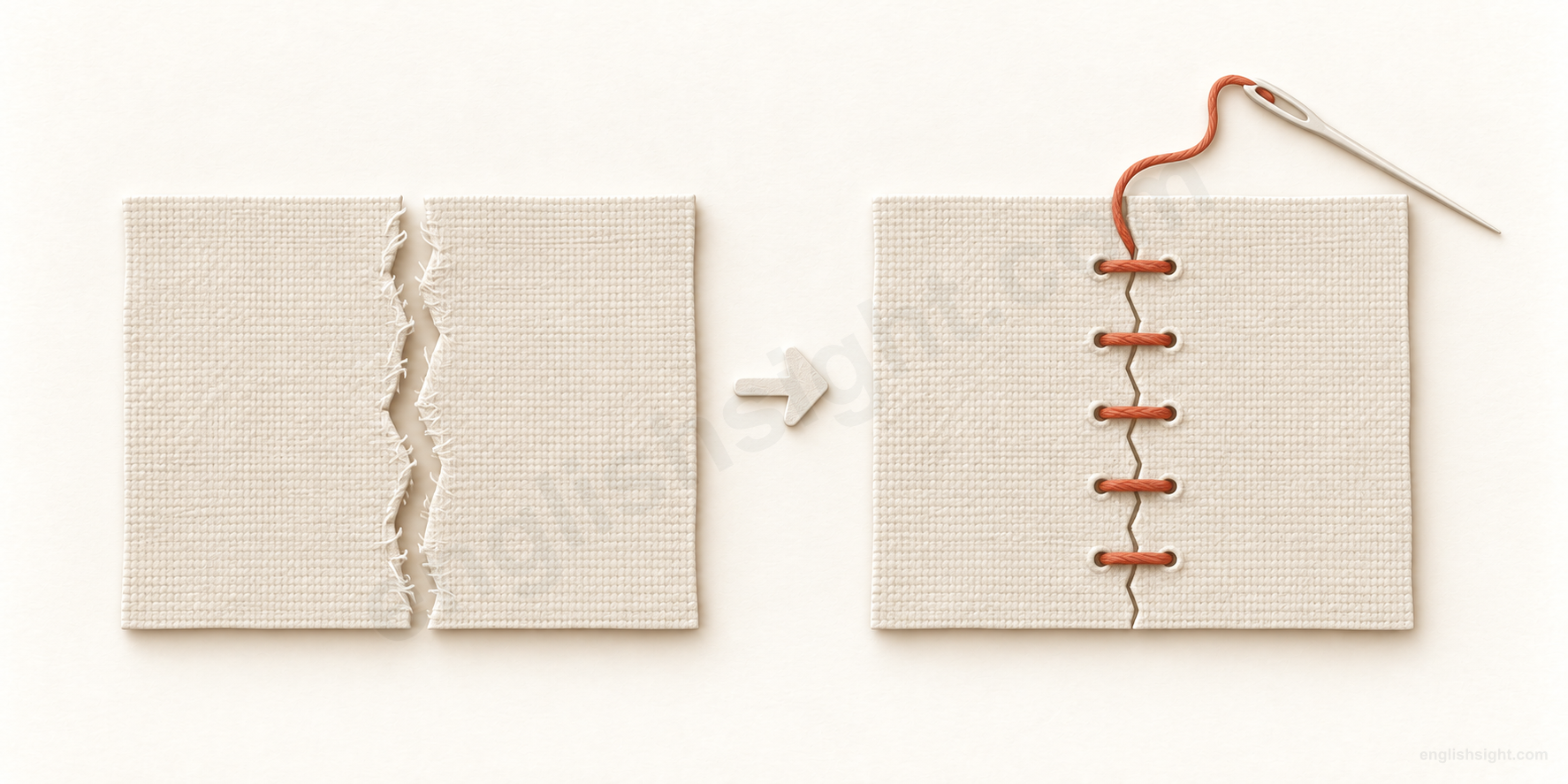
A split leaves the cloth edges apart.
stitch
Five short thread links hold the edges together.
A needle carries thread through the material to make stitches.
Each short thread link is a stitch; a series can hold fabric edges together.
Pass thread through material to make small links that join, secure, or decorate it.
The sketch focuses on joining a split in fabric. Decoration and knitting use different arrangements of thread or yarn; pain and idioms are separate branches.
A stitch is a small unit of thread work. Repeated stitches can join edges, hold something in place, or form a pattern. Stitch is also the verb for doing that work.
That connection helps with figurative joining. A side pain and expressions such as in stitches need their own explanation; one picture cannot predict every use.
01
Thread, fabric, and loops
A stitch can be one small unit, a way of arranging units, or part of the verb describing needlework.
01
a stitch; two stitches; a row of + plural noun
a stitch; a row of stitches
one small unit of sewing, or the thread it leaves behind
Situation before / context
A pocket edge is loose.
Result / meaning in context
A few short lengths of thread hold it in place.
One stitch is a unit; a seam is a line where material is joined.
As a countable noun, stitch can name the sewing action or its visible thread: one stitch, several stitches. A row of stitches may form a seam or decorate fabric.
Look at the result in the sketch: each short line across the split stands for a stitch. The fabric is the material, the thread makes the stitches, and the seam is the joined line.
In a sentence
I put three small stitches in the loose pocket.
Watch the difference Use stitches after a number greater than one. A needle is the tool, not the stitch.
02
stitch + material / seam; stitch + objects + together; be stitched
stitch the edges together
join or repair material using a needle and thread
Situation before / context
Two fabric edges are separate.
Result / meaning in context
Thread holds the edges together.
The verb names making stitches; together identifies the joining result.
Stitch can take an object: stitch the edges, stitch a seam. It can also describe the activity without an object: We sat and stitched. By hand and by machine describe how the work is done.
Both sew and stitch fit many fabric contexts. Stitch often directs attention to the actual thread work. In The lining was stitched by hand, the passive makes the lining the topic.
In a sentence
She stitched the two edges together by hand.
Watch the difference Together does not mean the pieces merely touch: here stitches join them.
03
stitch + patch + on / onto + item; stitch + design + on + surface
stitch a patch onto a jacket; stitch a name
attach something or create a decoration with stitches
Situation before / context
A patch is separate from a jacket; a bag has no name on it.
Result / meaning in context
The patch is attached; a name is formed in thread.
The object can be an attached piece or the design made by sewing.
Stitch a patch onto a jacket names the thing attached and its destination. Stitch initials on a bag instead names the decoration being formed. These are fabric uses of the same verb, with different objects.
You can describe the result passively: Her name was stitched on the bag. On or onto marks the surface; neither word alone means sewing.
In a sentence
I stitched a red patch onto my jacket.
Watch the difference Compare stick a patch on with glue or an adhesive backing. Stitch specifies thread work.
04
count / drop + a stitch / stitches; cast on / off + stitches
count the stitches; drop a stitch
a loop that forms one unit of knitting or crochet
Situation before / context
Loops of yarn sit on the knitting needle.
Result / meaning in context
A loop slips free and is lost from the work.
A knitted stitch is a loop, not a short sewn line.
In knitting and crochet, stitches are loops of yarn. Instructions may ask you to count stitches; drop a stitch means accidentally lose a loop. It does not mean drop the whole needle.
Cast on stitches starts a set of loops for knitting, while cast off stitches finishes an edge by taking them off the needle in the required way. These are knitting expressions, not separate meanings of stitch.
In a sentence
I dropped a stitch halfway through the scarf.
Watch the difference Knitting makes fabric from loops; sewing normally passes thread through existing material.
05
in + stitch name; use / work in + a named stitch
cross stitch; garter stitch
a named style or pattern of sewing or knitting
Situation before / context
A maker chooses how to arrange the thread or yarn.
Result / meaning in context
Repeated stitches produce a particular pattern.
Stitch can name the method, rather than one countable loop or mark.
A stitch name can identify a technique: cross stitch in embroidery or garter stitch in knitting. In worked in cross stitch, the phrase names the style and normally has no a.
Compare six stitches, which counts individual units, with different stitches, which can mean different types. The surrounding words tell you whether you are counting units or naming a technique.
In a sentence
The border is worked in cross stitch.
Watch the difference Cross stitch is a technique name here; it does not mean one stitch lying across an entire object.
02
Wounds and a pain in the side
Medical stitches hold tissue together. A stitch felt while running is a different noun use: a sharp pain.
06
need / have / get + stitches; have / get + stitches + taken out
need stitches; have stitches taken out
thread used to hold the edges of a wound together
Situation before / context
A cut has been examined.
Result / meaning in context
The person receives stitches or later has them removed.
Stitches names the sewn closures; need and have describe different stages.
In a medical context, the plural noun stitches usually refers to the thread closures: He needed four stitches. Have stitches in describes their presence; have stitches taken out describes their removal by someone else.
Have my stitches out is especially British; get my stitches out is common in North American English. Suture is a more technical word. These examples teach vocabulary, not how a wound should be treated.
In a sentence
She had her stitches taken out on Monday.
Watch the difference Having stitches taken out is removal, not receiving new stitches. Read out and the whole construction.
07
stitch + wound + (up); stitch up + wound; stitch + person + up
stitch a wound (up); stitch someone up
close a wound with stitches
Situation before / context
The edges of a cut are apart.
Result / meaning in context
A clinician joins the edges with stitches.
A wound can be the object; a patient can stand for the wound being treated.
Stitch the wound and stitch up the wound describe sewing its edges together. Up emphasizes closing it. The cut was stitched is an ordinary passive.
In The doctor stitched him up, him names the patient. This is the medical meaning in that context, not the informal meaning of cheating someone. With a pronoun, use stitch it up or stitch him up, not stitch up it.
In a sentence
The doctor stitched up the cut above his eye.
Watch the difference Context matters: He was stitched up can describe treatment or, informally in British English, being cheated.
08
get / have + a stitch; a stitch in + possessive + side
get a stitch; a stitch in my side
a sudden sharp pain in the side of the body
Situation before / context
A person is running.
Result / meaning in context
They feel a sharp pain at the side of the body.
This stitch is a pain, with no sewing or thread involved.
I’ve got a stitch commonly reports a sharp side pain during activity such as running. The noun is normally singular in this use; in my side identifies its location.
Keep this as a separate everyday sense. The fabric picture explains thread-related uses, not every sensation or the cause of the pain.
In a sentence
I got a stitch in my side during the run.
Watch the difference I have a stitch usually refers to pain; I have stitches usually suggests a wound has been sewn.
03
Expressions to learn as wholes
These familiar expressions concern laughter, clothing, and dealing with a problem early. Read the full phrase.
09
be in stitches; have / keep / leave + person + in stitches
be in stitches; have someone in stitches
laugh a great deal; make someone laugh a great deal
Situation before / context
A friend tells a very funny story.
Result / meaning in context
The listeners cannot stop laughing.
In stitches is a fixed plural expression for strong laughter.
Be in stitches describes the laughing person. Have someone in stitches makes the source of the laughter the subject: Her story had us in stitches.
Learn the phrase as a whole. It does not say that the listeners have surgical stitches, and you do not need an actual pain to use it.
In a sentence
His impression of the headteacher had us in stitches.
Watch the difference Keep the plural and the preposition: in stitches, not in a stitch.
10
not have a stitch on; not be wearing a stitch
not have a stitch on; not be wearing a stitch
be wearing no clothes at all
Situation before / context
Someone has taken off all their clothes.
Result / meaning in context
A speaker emphasizes that nothing is being worn.
The negative expression treats a stitch as even the smallest amount of clothing.
Not have a stitch on and not be wearing a stitch are informal expressions. On belongs to the clothing pattern have something on; the phrase does not concern a sewing job.
The wording is emphatic and often humorous. Use it with awareness of the situation, rather than as a neutral description in every setting.
In a sentence
The toddler ran out of the bathroom without a stitch on.
Watch the difference This is an established clothing expression. It does not simply mean the clothes have no visible sewing.
11
A stitch in time saves nine.; a stitch in time
a stitch in time saves nine
dealing with a small problem early can prevent more work later
Situation before / context
A small problem is beginning.
Result / meaning in context
Prompt action prevents a bigger repair.
The proverb uses timely sewing as a model for early action.
In time means soon enough. The saying imagines fixing a small tear before it grows, then applies the lesson to problems beyond clothing.
You may hear the shortened a stitch in time. Nine is part of the traditional wording, not a measured promise about how much effort every repair will save.
In a sentence
“Let’s fix that loose hinge now—a stitch in time saves nine.”
Watch the difference The saying recommends prompt action; it does not mean every problem can be solved with literal sewing.
04
Putting parts together—and fixing things unfairly
Figurative uses extend joining to information or arrangements. Informal stitch up also has a separate meaning of cheating someone.
12
stitch together + parts; stitch + whole / parts + together
stitch a story together
assemble separate parts into a connected whole
Situation before / context
Pieces of information are separate.
Result / meaning in context
They are joined into one account.
Figurative thread connects parts such as facts, scenes, or agreements.
Stitch together can describe building a whole from smaller parts. The object tells you whether the joining is literal or figurative: cloth can be sewn, but an account is assembled from information.
Compare a carefully stitched-together account with one hastily stitched together. Carefully or hastily gives the judgment about quality; stitch itself does not guarantee either success or poor work.
In a sentence
The reporter stitched the scattered accounts together.
Watch the difference With a pronoun, say stitch them together. Together emphasizes combination, not forward movement.
13
stitch + a video / someone’s video
stitch a video
combine another video with one you create in a social media feature
Situation before / context
A creator selects part of another video.
Result / meaning in context
Their own contribution is combined with it.
This newer media use names a particular kind of video combination.
In social media usage, stitch a video means combine it with a video you create, for example to respond to another creator. This is a figurative extension of joining pieces.
It is a media feature term, not a general synonym for every kind of video editing or sharing. Its exact operation depends on the service.
In a sentence
She stitched his video and added her own response.
Watch the difference Reposting a video unchanged does not by itself show the meaning taught here.
14
stitch + person + up; be stitched up; a stitch-up
stitch someone up; a stitch-up
cheat someone or arrange matters so they are unfairly blamed
Situation before / context
Other people arrange a situation dishonestly.
Result / meaning in context
Someone loses out or appears guilty.
This British informal meaning is established, not literal sewing.
Stitch someone up can mean put them at a disadvantage through deception, especially make them seem guilty of something they did not do. The person is the object: They stitched me up.
The passive is useful for complaints: I’ve been stitched up. A stitch-up is the related noun for an unfairly arranged situation. The verb is two words; the noun is commonly hyphenated.
In a sentence
He said they had hidden the receipts to stitch him up.
Watch the difference This use is British and informal. In a hospital story, stitch him up may instead mean close his wound.
15
stitch up + deal / agreement; stitch + deal / it + up; have + market + stitched up
stitch up a deal
arrange or complete an agreement
Situation before / context
Several parties are negotiating.
Result / meaning in context
An arrangement is settled.
Here up contributes completion; a deal is the object, not a person being tricked.
Stitch up a deal is informal and especially associated with British usage. It describes arranging the outcome. The expression can suggest behind-the-scenes control in context, but does not always accuse someone of a crime.
Compare stitch together an agreement, which highlights assembling its parts, with stitch up a deal, which highlights getting the arrangement settled. With a pronoun, use stitch it up.
Have a market stitched up describes having secured control of it: With those exclusive contracts, the company has the local market stitched up. Here the result is an advantage already secured, rather than a wound being closed.
In a sentence
They stitched up the agreement before the final meeting.
Watch the difference Person and deal objects guide different readings of stitch up. Do not assume every use means medical treatment or deception.
Read the object and the whole phrase
Forms and pronunciation
Stitch /stɪtʃ/ is both a noun and a verb. The plural noun and third-person verb are stitches /ˈstɪtʃɪz/. The past and past participle are stitched /stɪtʃt/; the -ing form is stitching. The verb can describe ongoing work: She is stitching a hem.
Sewing, knitting, and stitching
Sew names joining or making things with needle and thread; stitch often focuses on making the individual thread units. Knit makes fabric from interlocking loops. Stitching can name the thread work collectively: Check the stitching on the bag.
Passive and arranged actions
The edges were stitched describes what happened to them. I had the lining stitched describes arranging for someone to do the work; have supplies that arrangement meaning. Stitch alone does not mean persuade someone to sew.
No single picture predicts every phrase
The fabric model helps with joining and repair. Learn the side-pain sense and fixed expressions separately. These are selected modern uses, not a frequency ranking or a claim that all speakers share one mental image.
Choose the meaning in context
Use the object, number, and surrounding words to choose a reading.
1. During a run, Leo says, “I’ve got a stitch.” What does he most likely mean?
2. “The storyteller had the children in stitches.” What happened?
3. The cut needs closing with stitches. Which instruction places the pronoun correctly?
4. In an informal British conversation, “They stitched me up with false evidence” means…
5. A knitting pattern says, “Count the stitches.” What are you counting?
Sources and teaching notes
The sources below support the uses and constructions. Explanations and examples are original; the thread-link picture is a teaching model.
The diagram illustrates a useful connection; it does not represent a mental picture shared by every speaker.