From a fitted garment to Christmas gifts and familiar expressions.
A fitted covering
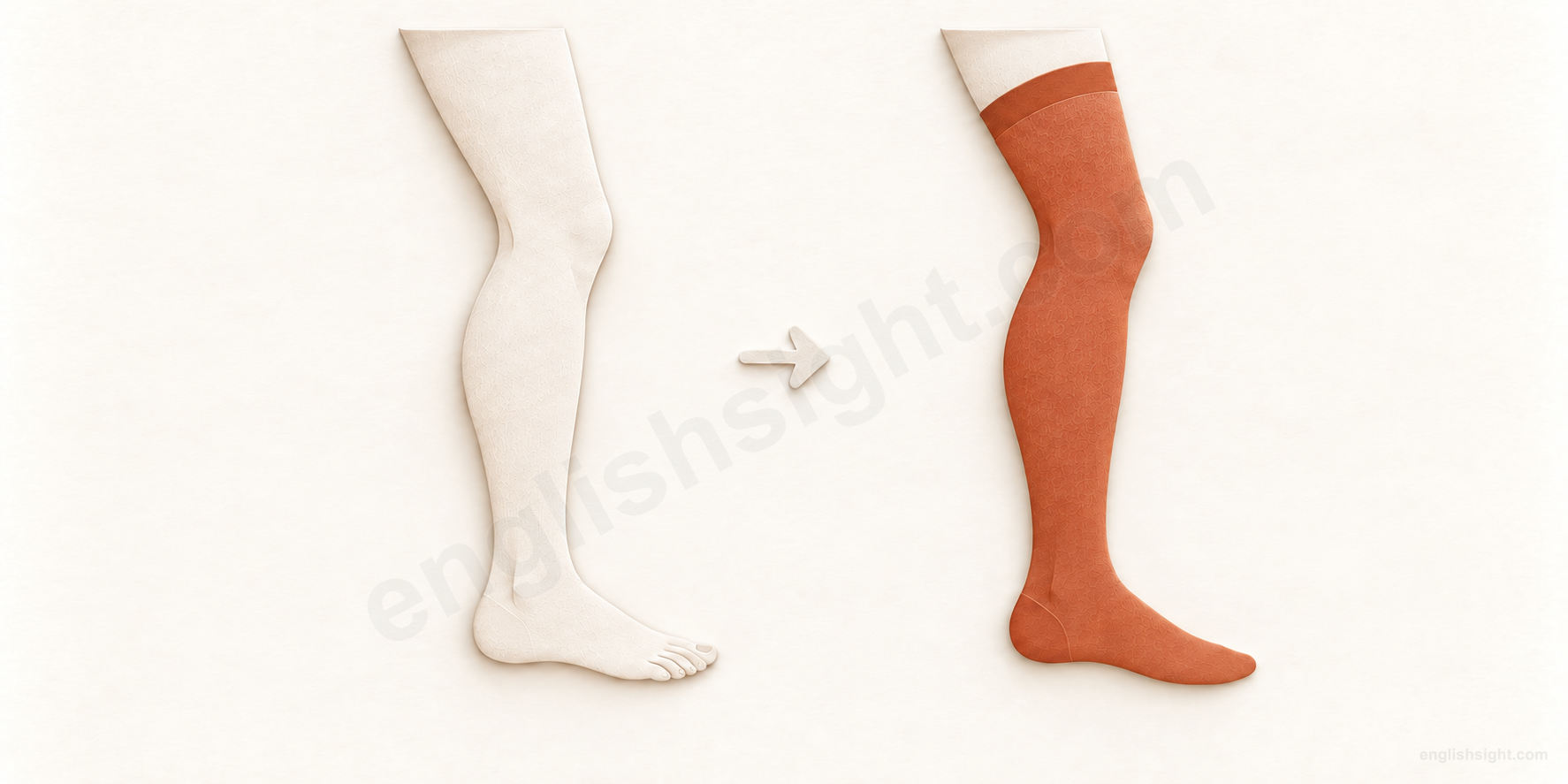
Following the shape of a foot and leg
One foot and leg are uncovered.
stocking
The stocking closely follows the foot and leg.
A separate fitted stocking is put on.
One stocking fits around one foot and leg; these views show before and after putting it on.
A stocking is a separate covering that fits closely around a foot and part or most of a leg.
This model explains the clothing noun. The Christmas container uses its shape; the model does not turn every phrase containing stocking into clothing.
Start with a piece of clothing that fits around one foot and leg. In modern clothing descriptions, stockings often means separate, thin leg coverings; the word also has a broader use for knitted foot-and-leg coverings.
A Christmas stocking keeps the familiar shape but serves as a gift container. Other combinations need their own explanations: stocking feet refers to having no shoes on, while stocking shelves belongs to the verb stock.
01
Choosing and wearing stockings
Name the garment, count separate pieces, describe dressing, and recognize common descriptions of fabric or damage.
01
material / description + stocking(s)
nylon / silk / wool stockings
separate fitted coverings for the feet and legs
Situation
You are describing the legwear worn with an outfit.
What you mean
The listener knows the kind of garment and its material.
Stocking names the garment; a material word describes it.
In a clothing description, stockings often means thin coverings worn separately on the two legs. Nylon stockings and silk stockings specify fabric, not different grammatical senses.
The broader noun can include knitted wool coverings too. Sheer stockings are thin enough to see through; fishnet stockings have an open net pattern. Stocking does not by itself promise one fabric, length, or method of holding the garment up.
In a sentence
She chose black nylon stockings to wear with the dress.
Watch the difference Do not call every garment covering the legs stockings; check whether the two legs are separate or joined.
02
a pair of stockings; two / three pairs of stockings; one stocking
a pair of stockings
two stockings considered together
Situation
You want matching coverings for both legs.
What you mean
You ask for two pieces as one pair.
A pair groups two separate countable garments.
A stocking is one piece, and two stockings make a pair. In a shop, Can I see a pair of black stockings? asks for the set. Three pairs of stockings means six individual stockings.
The noun pair controls standard agreement: This pair is new; these stockings are new. Compare a pair of tights: tights is the name of one garment with two joined legs and a hip section, not two detachable stockings.
In a sentence
I bought two pairs of stockings and kept one pair in my bag.
Watch the difference Use a pair of stockings, not a pair of stocking; use one stocking for just one piece.
03
put / pull stockings on; wear stockings; take stockings off
put on / wear / take off stockings
distinguish getting dressed from having a garment on
Situation
The stockings are ready beside your clothes.
What you mean
You put them on, wear them, and later remove them.
The action or state comes from the verb, not from stocking.
Put on stockings and pull on stockings describe getting them onto your feet and legs. Wear stockings describes having them on. Take off stockings describes removing them.
With a pronoun, say put them on or take them off, not put on them or take off them. Stockings is the object of these clothing verbs; put on is not a phrasal verb built from stocking.
In a sentence
She put her stockings on before putting on her shoes.
Watch the difference She wears stockings describes her clothing or habit; it does not by itself describe the moment she gets dressed.
04
have / get a run (a ladder) in + a stocking
a run / a ladder in a stocking
a line of stitches has come undone
Situation
Thin fabric catches on a rough edge.
What you mean
A visible line of damaged stitches appears.
Run and ladder name the damage; stocking names the affected garment.
A run in a stocking is a line of stitches that have come undone. British English commonly calls this a ladder; American English uses run. The line can resemble the rungs of a small ladder.
You can also say I have laddered my stocking in British English. A hole or tear is a broader description; not every kind of damage is a run. None of these phrases means that the wearer has been running.
In a sentence
There is a run in my left stocking, so I need another pair.
Watch the difference Say a run in my stocking; the preposition locates damage in the fabric.
05
compression / support + stockings
compression / support stockings
stockings designed to apply pressure to the legs
Situation
A conversation concerns a particular type of legwear.
What you mean
The modifier identifies a pressure-applying garment.
Compression describes the stocking’s function, not its color or fabric.
The phrase compression stockings names legwear designed to put pressure on the legs. Support stockings is another name encountered in this context. This is still a physical garment, not a figurative meaning of stocking.
In the example, the question asks where the product is sold. It does not say which type anyone should wear; this unit teaches the product name.
In a sentence
Does this pharmacy sell compression stockings?
Watch the difference Ordinary stockings are not automatically compression stockings; keep the modifier when that function matters.
02
Gifts, shoes, and a named kind of hat
Read each complete expression. The Christmas sense changes the object’s use; the feet expression and the hat name are established combinations.
06
hang (up) a Christmas stocking; fill a stocking with + gifts
a Christmas stocking
a sock-shaped container for Christmas presents
Situation
Someone prepares a place for small Christmas gifts.
What you mean
A large sock or sock-shaped pouch is left out for filling.
The shape remains familiar while the use changes from wearing to holding gifts.
A Christmas stocking is left out or hung up for small presents, traditionally on Christmas Eve. It can be a long sock or a decorative pouch shaped like one. In a clear Christmas context, a stocking is enough.
Hang up a stocking describes putting it in place; fill a stocking with gifts describes adding its contents. These meanings come from hang up and fill with. The container need not be something anyone actually wears.
In a sentence
We hung a Christmas stocking beside the bed and filled it with small gifts.
Watch the difference A single Christmas stocking need not have a matching partner; a pair is not part of this custom’s definition.
07
a stocking filler / stuffer; make a good stocking filler / stuffer
a stocking filler / stocking stuffer
a small present suitable for a Christmas stocking
Situation
You are choosing a little gift rather than a large main present.
What you mean
You describe the gift as suitable for a stocking.
Filler or stuffer names the gift; stocking specifies the Christmas context.
Stocking filler is the usual British expression; stocking stuffer is the North American equivalent. Both name the small present, not the sock-shaped container.
The plural is stocking fillers or stocking stuffers: only the head noun changes. Makes a good stocking filler means that the item would be a suitable small Christmas gift.
In a sentence
This tiny puzzle would make a good stocking stuffer.
Watch the difference A stocking stuffer is not a person hired to fill stockings and is not padding used inside shoes.
08
in + possessive + stocking feet; in + possessive + stockinged feet
in your stocking feet
wearing socks or stockings without shoes
Situation
You remove your shoes but leave your socks on.
What you mean
You can say you are in your stocking feet.
The expression excludes shoes, but keeps a fabric covering on the feet.
In my, your, or someone’s stocking feet is an established expression for having socks or stockings on and no shoes. In your stockinged feet is a variant. Stocking stays singular in the first version because it modifies feet.
The phrase does not require thin fashion stockings. Someone in ordinary socks can be in their stocking feet. Barefoot instead means there are no socks or stockings either.
In a sentence
He answered the door in his stocking feet.
Watch the difference Do not interpret stocking feet as uncovered skin: the person still has socks or stockings on.
09
a stocking cap; wear / put on a stocking cap
a stocking cap
a soft knitted hat
Situation
A North American clothing description mentions a stocking cap.
What you mean
You identify a hat rather than something for the legs.
Cap is the head noun and names what is worn on the head.
A stocking cap is a soft knitted hat, a term used in North American English. It may have a tassel, but that detail is not essential to recognizing the expression.
Learn the combination as a clothing name. Stocking modifies cap; it does not mean someone is wearing a leg stocking as a hat. The plural is stocking caps.
In a sentence
He pulled on a wool stocking cap before going outside.
Watch the difference The head noun matters: stocking cap names a hat, while Christmas stocking names a gift container.
03
When stocking is an action
An -ing spelling alone does not tell you whether a word names a garment. Check the surrounding grammar.
10
be stocking + shelves / a shop; stock + a place + with + goods
stocking the shelves
putting a supply of goods on shelves
Situation
A shop worker brings goods out of storage.
What you mean
The shelves receive a supply of products.
Here stocking is the -ing form of the verb stock.
In They are stocking the shelves, are stocking describes an action in progress. The worker supplies the shelves with goods. Stocking is not the name of the garment in this sentence.
Compare The shop is stocking wool stockings this winter. The first stocking is a verb meaning keeping goods for sale; the plural stockings is the clothing noun. You can also talk about stocking a cupboard with food. The wider meanings of stock belong to a separate lesson.
In a sentence
The assistants are stocking the shelves with notebooks.
Watch the difference Do not force the clothing picture onto an action simply because its spelling ends in -ing.
Keep the garment, the expression, and the verb apart
Stockings, socks, and tights
For everyday short knitted foot coverings, socks is usually the natural word. Stockings often suggests longer, finer legwear, although the words overlap in broader usage. Tights cover both legs and the hips in one garment; thin tights are also called pantyhose in North American English. Do not choose only by whether the material is nylon.
A noun can be singular
One stocking is one separate piece. Stockings is its ordinary plural, unlike plural-only tights. Say a stocking is missing, the stockings are wet, or a pair of stockings is missing.
Shape is a connection, not a universal rule
The gift container resembles a large sock, but a stocking filler is the gift and a stocking cap is a hat. Dictionaries also record stocking for an animal’s contrasting lower-leg marking; that descriptive use is outside the main everyday units here.
Pronunciation and scope
Stocking has two syllables, stressed on the first: British /ˈstɒkɪŋ/, American /ˈstɑːkɪŋ/. The clothing noun has no verb tense or phrasal-verb family. Action forms such as is stocking belong to stock, which has its own meanings and constructions.
Choose what stocking means here
Use the object, the full phrase, and the grammar as clues.
1. One of two separate leg coverings is lost. Which sentence names the missing piece?
2. Jo walks into the room in her stocking feet. What can you conclude?
3. A shop calls a small puzzle a stocking filler. What is the puzzle?
4. The assistants are stocking the shelves. Which interpretation fits?
5. Someone says there is a run in her stocking. What has happened?
Sources and teaching notes
The sources below support the meanings and usage distinctions. The explanations and examples are original; the diagram is a teaching model of the clothing sense.
The picture illustrates a useful connection, not a mental image shared by every English speaker.