Start with the digestive organ, then separate the belly, bodily reactions, and established expressions of tolerance.
Where food arrives; where reactions are felt
Where food arrives; where reactions are felt
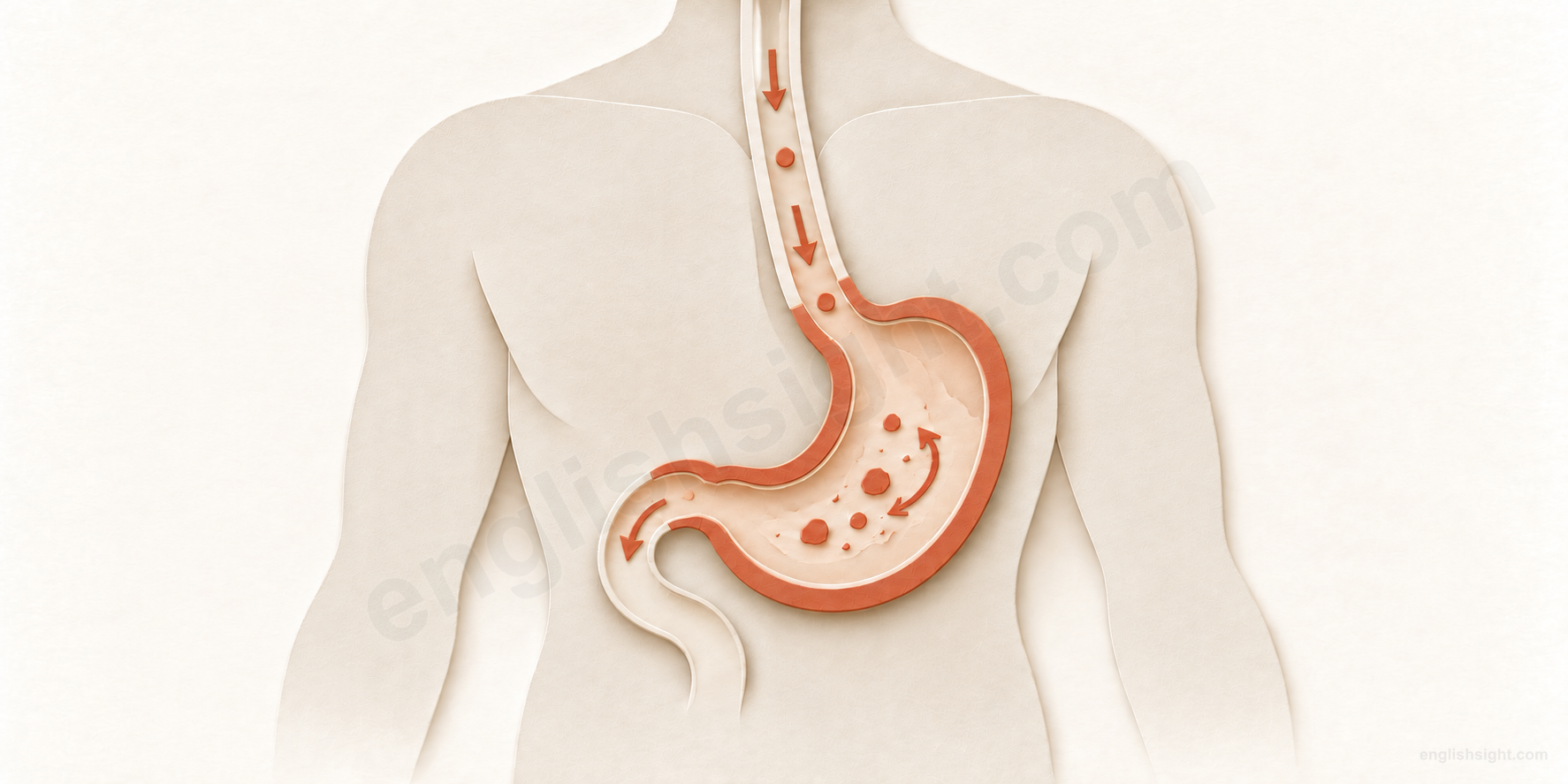
Swallowed food travels down the food pipe.
stomach
Partly digested food passes into the small intestine.
The stomach mixes food and partly digests it.
Food enters the stomach, is mixed there, and passes onward.
The stomach receives swallowed food and partly digests it. Everyday speech also uses stomach for the belly area, for feelings experienced there, and for the capacity to face or tolerate something.
The sketch isolates the physical starting point: food entering a bag-like organ inside the upper abdomen. It is a simplified front view, not a complete anatomy diagram. The emotional and tolerance expressions need their own explanations.
Stomach is usually a countable noun for a digestive organ, but everyday English also uses it for the belly area. Familiar expressions connect it with hunger, nervousness, disgust, and the ability to face something unpleasant.
The physical organ gives us a useful starting point. It does not explain every idiom by itself: learn butterflies, in knots, and have the stomach as whole expressions. This lesson offers a teaching connection, not a shared mental picture claimed for every speaker.
01
The organ, the belly, and discomfort
Stomach can identify an internal organ or the front of the abdomen. Everyday descriptions of discomfort are often less anatomically precise than a medical description.
01
the / my / your stomach; stomach + noun
the stomach
the internal organ that receives food and partly digests it
Situation
Food has been swallowed.
What the expression communicates
It reaches the stomach before passing into the intestine.
The stomach is one organ within the digestive system.
The stomach is a muscular, bag-like organ in the upper abdomen. Food reaches it through the food pipe, is mixed and partly digested there, and then passes onward. Digestion does not happen only in the stomach.
Use the stomach when discussing the organ generally, or a possessive such as my stomach for one person. Stomach acid and stomach contents name the acid or material inside it; stomach modifies the following noun.
The drawing shows the physical organ and its connection to incoming food. The later uses involving willingness are conventional extensions, not claims that decisions happen inside this organ.
In a sentence
The diagram shows where food enters the stomach.
Watch the difference The stomach is not the name of the whole digestive system.
02
lie / sleep on + possessive + stomach; hit someone in the stomach
lie on your stomach
lie with the front of your abdomen facing down
Situation
A person changes position on a mat.
What the expression communicates
The front of the body faces the mat.
Here stomach means the belly area, not just the organ inside.
Stomach also names the front of the body below the chest. A flat stomach and stomach muscles describe the outer abdominal area. In careful anatomical language, abdomen is broader than the stomach organ.
Lie on your stomach means lie face down, with your front toward the surface. Compare lie on your back. In crawl on their stomachs, the plural matches the different people.
In a sentence such as The ball hit me in the stomach, the body area is meant; the sentence does not say that the ball reached an internal organ. Belly is an everyday alternative, while tummy is especially informal or used with children.
In a sentence
Maya lay on her stomach to read the map.
Watch the difference On your stomach describes position; on an empty stomach describes having eaten nothing.
03
have a stomach ache / stomachache; my stomach hurts; stomach pain / cramps
a stomach ache
pain in or near the stomach area
Situation
A child feels pain in the belly.
What the expression communicates
The child describes where it hurts.
This reports discomfort without identifying its cause.
I have a stomach ache and My stomach hurts are ordinary ways to report pain. Stomach pain is another useful description; stomach cramps suggests pains with a gripping or tightening quality.
Stomach ache is written as two words, and stomachache is also used, especially in American English. A stomach ache is a countable episode. Stomach ache can also be uncountable: I have stomach ache. Stomach pain can likewise refer to pain in general without a.
Everyday stomach may refer loosely to the abdomen. A sentence about a stomach ache therefore does not by itself identify a particular organ or illness.
In a sentence
I missed the lesson because I had a stomach ache.
Watch the difference Do not say I am stomach ache. Say I have a stomach ache or My stomach hurts.
04
have an upset stomach; something upsets / settles your stomach; a stomach bug
an upset stomach
a stomach that feels unwell or uncomfortable
Situation
Someone feels digestive discomfort.
What the expression communicates
They describe it without naming a specific disease.
Upset describes disturbed digestion here, not the organ feeling sad.
Have an upset stomach is a familiar way to describe digestive discomfort, which may include nausea or other unpleasant symptoms. In British English, a stomach upset is another noun phrase for this problem.
Something can upset your stomach: That rich sauce upsets my stomach. Settle your stomach means make the discomfort or nausea calmer. These patterns describe causing or easing discomfort; they are not names of specific treatments.
A stomach bug is an informal expression used for an illness affecting the digestive system. Bug here is an illness-related word, not a claim that an insect is inside you. It is more specific than merely saying that your stomach feels upset.
In a sentence
I stayed home with an upset stomach.
Watch the difference Upset stomach names a condition; upset my stomach uses upset as a verb. Neither phrase states the cause.
05
my stomach rumbles / is rumbling; my stomach churns / is churning; my stomach lurched
my stomach is rumbling / churning
describe sounds or unsettled movement in the stomach area
Situation
You notice a bodily sound or sensation.
What the expression communicates
You describe how your stomach feels or sounds.
The following verb tells you whether the focus is noise or unease.
A rumbling stomach makes low noises; people often mention it when they are hungry. My stomach is churning describes an unsettled, turning feeling, often associated with nausea or nerves.
My stomach lurched describes a sudden unpleasant sensation. These vivid verbs let stomach act as the grammatical subject, even though the speaker is reporting their own bodily experience.
Compare My stomach is full, which describes a state after food. Rumbling, churning, and lurching describe different experiences and do not all mean hunger.
In a sentence
My stomach was churning as the boat began to rock.
Watch the difference A churning stomach can accompany worry or nausea; it does not automatically mean that you need food.
02
Food, fullness, and appetite
These expressions describe having eaten, choosing portions, or being able to eat something. Read the whole phrase: the preposition alone does not decide its meaning.
06
do something on an empty / a full stomach; my stomach is empty / full
on an empty / a full stomach
without having eaten / after eating enough to feel full
Situation
You describe an activity in relation to a meal.
What the expression communicates
The listener knows whether you have eaten.
On introduces the bodily condition accompanying the activity.
On an empty stomach means without having eaten beforehand. On a full stomach means after eating enough that your stomach feels full. These phrases describe circumstances, not the position of the body.
I cannot concentrate on an empty stomach says hunger makes concentration difficult for the speaker. My stomach is full describes the state directly. In the full phrase, empty takes an and full takes a.
An empty stomach is a normal everyday expression, not a precise measurement showing that the organ contains absolutely nothing.
In a sentence
I find it hard to study on an empty stomach.
Watch the difference Keep the article: on an empty stomach, not on empty stomach. Compare on your stomach for a face-down position.
07
possessive + eyes + be bigger than + possessive + stomach
your eyes are bigger than your stomach
you chose more food than you can eat
Situation
The food looks tempting.
What the expression communicates
You serve yourself too much and cannot finish it.
The idiom contrasts visual desire with the amount you can eat.
This informal saying is used when someone takes or orders a larger portion than they can manage. Eyes stands for being tempted by the sight of food; stomach stands for eating capacity.
A speaker may use it about themselves with mild humor: My eyes were bigger than my stomach. It can sound critical if directed at someone else, especially if you imply that they were greedy.
It does not compare the real sizes of eyes and an organ, and it does not mean that the person is still hungry.
In a sentence
I left half the noodles; my eyes were bigger than my stomach.
Watch the difference Match the possessives: her eyes were bigger than her stomach, not bigger than my stomach.
08
cannot / could not stomach + food
cannot stomach food
be unable to eat it without feeling sick
Situation
Someone offers food when you feel nauseated.
What the expression communicates
You cannot manage to eat it.
Stomach is a transitive verb here, not the name of an organ.
Cannot stomach any food means cannot manage to eat it without nausea. I cannot stomach that soup can also express strong dislike; context determines whether physical sickness, aversion, or both is involved.
The food follows the verb directly: stomach breakfast, not stomach for breakfast when breakfast is the object. Can and could are followed by the base form stomach.
This connects directly with the digestive organ, but ordinary stomach as a verb focuses on being able to take food, not on neutrally describing every act of digestion.
In a sentence
During the crossing, I could not stomach even a small sandwich.
Watch the difference I cannot stomach it means I cannot eat or tolerate it; My stomach is empty means I have not eaten.
03
Nerves, nausea, and disgust
English often describes feelings through sensations in the stomach area. Some expressions describe a physical sensation; others can also describe a strong emotional response.
09
have butterflies (in + possessive + stomach)
have butterflies in your stomach
feel nervous, often before an event
Situation
An important performance is about to begin.
What the expression communicates
You feel a fluttery nervous sensation.
The fixed image names nervousness, not real insects.
Have butterflies in your stomach is informal and often describes the feeling before an exam, interview, performance, or exciting meeting. Nervous anticipation may include excitement as well as fear.
The shorter have butterflies is possible when the meaning is clear. In the longer phrase, your changes with the person: I had butterflies in my stomach.
Stomach connects the expression to a bodily feeling, but butterflies is a conventional image. It does not mean a digestive illness.
In a sentence
I had butterflies in my stomach before my first solo.
Watch the difference Use the plural butterflies in this expression; do not translate it as an actual animal problem.
10
possessive + stomach + be in knots; have knots in + possessive + stomach
your stomach is in knots
feel very tense or worried
Situation
You wait for an important answer.
What the expression communicates
Anxiety feels tight and uncomfortable in your belly.
Knots pictures tension rather than an actual change in anatomy.
My stomach was in knots describes intense nervous tension. You can also say I had knots in my stomach. The two arrangements describe a similar experience.
Compared with butterflies, knots often emphasizes tightness and worry rather than fluttery anticipation. The exact feeling depends on the situation; these are not clinical categories.
The noun stomach still identifies where the feeling seems to be, while the whole in knots expression supplies the image of tension.
In a sentence
My stomach was in knots while I waited for the result.
Watch the difference In knots is an idiomatic description; it does not say that the stomach has tied itself into a knot.
11
a feeling / sensation in the pit of + possessive + stomach
in the pit of your stomach
deep in the stomach area, especially as a place where fear is felt
Situation
You hear alarming news.
What the expression communicates
A deep sinking sensation accompanies your reaction.
The phrase locates a strong feeling rather than naming a separate organ.
The pit of your stomach is the deep or lower stomach area as described in everyday language. A sinking feeling in the pit of my stomach is a familiar way to describe dread.
Pit provides the image of a deep place. The phrase often goes with feeling, fear, or a sinking sensation, and it can make a description more vivid than simply saying I was worried.
This is an everyday way to describe where an emotion is felt, not a precise anatomical label.
In a sentence
I felt a sinking sensation in the pit of my stomach when the alarm sounded.
Watch the difference Do not confuse the pit of your stomach with a separate body part that must be identified on an anatomy chart.
12
be / feel sick to + possessive + stomach; something makes someone sick to their stomach
sick to your stomach
nauseated, or deeply upset, angry, or worried
Situation
A physical event or disturbing news affects you.
What the expression communicates
You feel nausea or a strong emotional upset.
The same expression can be physical or emotional.
Feel sick to your stomach can mean feel as if you might vomit. A physical setting makes that reading clear: The spinning ride made me sick to my stomach.
After troubling news, the phrase can instead emphasize anger, worry, or distress, sometimes with a real bodily sensation too. I felt sick to my stomach when I discovered the fraud does not necessarily report vomiting.
Compare I have an upset stomach, which ordinarily describes digestive discomfort. Sick to my stomach can express a much broader reaction to something disturbing.
In a sentence
I felt sick to my stomach when I learned that the charity money was gone.
Watch the difference Read the cause and context; sick to your stomach does not always mean a physical illness.
13
something turns + possessive + stomach
turn someone’s stomach
make someone feel sick, disgusted, or horrified
Situation
Someone encounters a repulsive smell or sight.
What the expression communicates
It provokes a sickened reaction.
The cause is the subject; the affected person appears in the possessive.
The smell turned my stomach describes what caused the reaction. The stomach does not literally rotate; turn is part of an established expression for making someone feel sick or disgusted.
The subject can be a smell, a disturbing picture, a description, or an act that horrifies the speaker. A physical and an emotional reaction may overlap.
Compare My stomach churned, which describes my sensation, and I could not stomach the smell, which describes my inability to tolerate it. The focus and grammatical pattern change.
In a sentence
The smell from the overflowing bin turned my stomach.
Watch the difference Say It turned my stomach, not It turned me stomach. This is not a separable phrasal verb.
04
What you can face or accept
Appetite and the ability to keep food down provide a useful comparison for willingness and tolerance. These are established English uses, not rules for inventing new combinations.
14
have a strong / weak stomach; need a strong stomach for + noun
have a strong / weak stomach
be able / unable to face unpleasant things without feeling sick or upset
Situation
A film contains graphic scenes.
What the expression communicates
Different viewers tolerate them differently.
Strong describes tolerance, not abdominal muscle strength.
Someone with a strong stomach can handle unpleasant sights or experiences without becoming sick or upset. A weak stomach suggests being easily sickened; it can also describe sensitivity to food or motion in an appropriate context.
You need a strong stomach for this film concerns the ability to watch its unpleasant content. It does not mean that exercises for the abdominal muscles will make the film easier to watch.
Strong and weak are useful opposites here. The surrounding words tell you whether the speaker means reactions to sights, movement, or food.
In a sentence
You need a strong stomach to watch that documentary.
Watch the difference Stomach muscles are physical muscles; a strong stomach in this expression usually concerns what you can tolerate.
15
have no stomach for + noun / -ing; not have the stomach for + noun / -ing
have no stomach for something
have no appetite, desire, or willingness for it
Situation
An argument is possible, but you do not want one.
What the expression communicates
You express that you have no wish to take part.
For introduces what you are unwilling to face or eat.
I have no stomach for an argument means I do not want to argue or feel unable to face it. Depending on context, the emphasis may be dislike, lack of willingness, or lack of courage.
With food, have no stomach for can mean have no appetite for it: After the journey, I had no stomach for a heavy meal. The food and nonfood readings are related, but should be distinguished in context.
I do not have the stomach for it is another established form. No stomach and not ... the stomach are alternatives; do not combine their articles mechanically.
In a sentence
I have no stomach for another argument tonight.
Watch the difference Use for before a noun: no stomach for conflict. Use to before a verb in have the stomach to do something.
16
not have the stomach to + verb; have the stomach for + noun
not have the stomach to do something
lack the courage or emotional capacity to do it
Situation
An unpleasant action or experience lies ahead.
What the expression communicates
You say you cannot bring yourself to face it.
To introduces the action, rather than the object of a verb stomach.
I do not have the stomach to watch it means I cannot face watching it. The refers to the needed capacity; it does not identify a different physical stomach.
This often appears in negatives and questions: Do you have the stomach to do this? It can concern determination or willingness as well as feeling physically sick.
Compare I cannot stomach watching it: stomach is now the verb, and watching it is its direct complement. In have the stomach to watch it, have is the main verb and the action follows to.
In a sentence
I did not have the stomach to watch the last scene.
Watch the difference Keep the infinitive after to: the stomach to watch, not the stomach to watching.
17
cannot / could not stomach + noun / -ing; be hard to stomach
cannot stomach something / doing something
find it too unpleasant to accept or tolerate
Situation
Someone repeatedly lies to you.
What the expression communicates
You say you cannot accept the behavior.
The person who cannot tolerate something is the subject.
As a verb, stomach can mean tolerate a person, behavior, idea, sight, or situation. I cannot stomach his excuses expresses strong aversion or disapproval; it does not mean that his excuses are food.
Use a direct noun or an -ing complement: stomach the unfairness; stomach being ignored. The verb is especially common in negative sentences and questions, but positive possibilities also occur: If you can stomach the noise, the room is cheap.
Hard to stomach describes something difficult to accept: The extra charge was hard to stomach. Tolerating something does not necessarily mean enjoying or approving of it.
The link to food is a useful teaching comparison: something is difficult to take or keep down. The abstract meaning is established usage, not a claim that emotional acceptance is a digestive process.
In a sentence
I cannot stomach being lied to by someone I trust.
Watch the difference Do not insert for after the verb: I cannot stomach it. Contrast I have no stomach for it, where stomach is a noun.
Keep the organ, the construction, and the idiom apart
Organ or body area?
The stomach is one internal organ. In lie on your stomach, stomach muscles, and many everyday reports of pain, the word refers to the abdominal area more generally. Abdomen is the more precise term for the region; belly and tummy are everyday alternatives with different levels of informality.
Noun and verb forms
The noun is countable: a stomach, two stomachs. A possessive often identifies whose body is involved. Pronounce ch as /k/: /ˈstʌmək/. Verb forms are stomach, stomachs, stomached, stomaching; the past ending in stomached sounds /t/. The tolerance verb takes a direct complement and is often negative or used in questions. It has no everyday particle-verb family to memorize.
Do not read every reaction as an illness
Butterflies, knots, and the pit of the stomach describe experienced feelings. Sick to your stomach and turn your stomach can concern physical nausea or emotional distress. None of these sentences alone establishes a cause or diagnosis.
A diagram cannot predict the whole phrase
On your stomach describes position; on an empty stomach describes your condition in relation to eating. Strong stomach concerns tolerance in the idiom. Cannot stomach is a verb, whereas have no stomach for uses a noun. Learn these differences with the complete expressions.
Coverage boundary
This lesson covers modern everyday senses and selected familiar expressions, not a frequency ranking. Historical stomach meaning pride, temper, resentment, or taking offense, and detailed animal digestive anatomy are outside its scope. In medical reporting, have your stomach pumped means have its contents removed with a pump; it is a specialist expression recognized here, not an everyday action model.
Choose the meaning in context
Use the situation and the full grammatical pattern, not just the word stomach.
1. Maya lies on her stomach to look under a sofa. What does the phrase tell you?
2. Which sentence means that studying is hard when you have not eaten?
3. A singer has butterflies in her stomach before going on stage. What is the likely meaning?
4. After learning that a colleague stole money, you feel sick to your stomach. Must this mean you vomited?
5. You find repeated dishonesty intolerable. Which pattern uses stomach as a verb?
6. A warning says that a graphic film requires a strong stomach. What does it mean?
Sources and teaching notes
The dictionary pages below support the senses, patterns, and idioms. The lesson uses original explanations and examples. The diagram and the links between meanings are teaching aids; the coverage inventory distinguishes definitions from collocation examples.
The diagram shows a physical starting point; it does not claim that all speakers share one mental image.