Hard material, separate pieces, familiar expressions.
Learn when stone names a substance, an object, a fruit center, an action, or part of a fixed phrase.
Material and an individual piece
Material and an individual piece
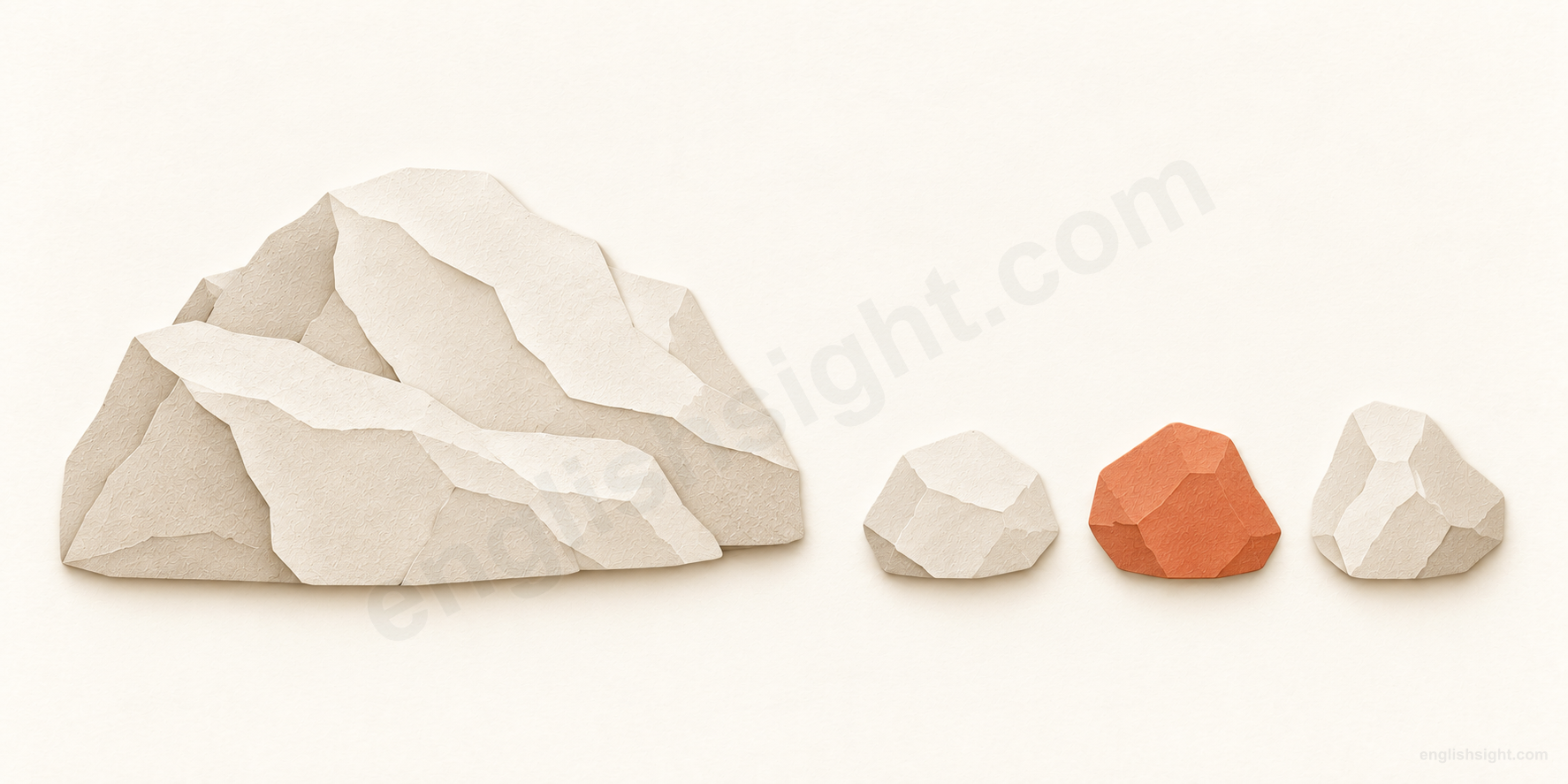
On the left: stone as material.
stone
On the right: three stones, one highlighted.
Compare the material with separate, countable pieces.
Stone names the material; a stone names one separate piece.
Stone is hard natural mineral material; a stone is a separate piece of it.
The sketch contrasts material with countable pieces. It does not explain the weight unit or mechanically predict fruit vocabulary, verb meanings, or idioms.
Stone can name the material in a wall or an individual piece in your shoe. Start by noticing whether the sentence treats it as a substance or a countable object.
Hardness, lasting shape, and weight help us understand some comparisons. Other uses, including the British weight unit and several idioms, must be learned in their own contexts. This lesson offers connections, not a single origin story for every meaning.
01
Material, pieces, and useful objects
Begin with the difference between a substance and an individual object. The context then identifies the kind or purpose of the stone.
01
stone + noun; be made of stone; a block / slab of stone
made of stone
identify a hard natural building material
Situation
You describe what a garden wall is made of.
What is meant
The listener identifies the material, not a single object.
Uncountable stone names the substance.
Stone here is a material noun, like wood or metal. A stone wall describes the material before the noun; a wall made of stone says the same thing with a phrase after it.
Use a block of stone or a slab of stone when you want to count a particular amount or shape. Compare The floor is stone with There is a stone on the floor: the second sentence identifies one separate object.
In a sentence
The old bridge is made of stone.
Watch the difference Do not use a stone for the general substance: made of stone, rather than made of a stone, unless you mean one particular piece.
02
a stone; two stones; pick up / throw stones
a stone / stones
refer to individual pieces of rock
Situation
Something small and hard is inside your shoe.
What is meant
You name and remove the individual piece.
A stone is countable; stone as material is not.
A stone is a separate piece of rock. It can be smooth, sharp, round, or irregular; the word does not require a perfect circle. Pick up a stone and throw stones name ordinary actions with these objects.
Rock can name the material and, especially in American English, an individual piece too. A pebble is a small stone, typically smoothed by water. These words overlap; there is no universal size boundary between a rock and a stone.
In a sentence
I stopped to take a sharp stone out of my shoe.
Watch the difference Use stones for several physical pieces. The unchanged plural in ten stone belongs to weight, not to objects.
03
a paving / memorial stone; a gravestone; carve words on a stone
a paving stone / a memorial stone
name stone prepared for a particular purpose
Situation
You see a path or a marker with an inscription.
What is meant
You identify the function of the shaped piece.
A purpose word tells us what the stone is used for.
A paving stone is a shaped piece used to make a hard walking surface. A memorial stone commemorates a person or event. A gravestone or headstone marks a grave; these are established compound nouns.
The material can be cut or carved, so a stone need not be a small loose object. The context may allow the simple word stone after its function has been established: The date is carved on the stone.
In a sentence
One paving stone near the gate has come loose.
Watch the difference Stone before a noun in stone path describes material; paving before stone in paving stone identifies the object’s purpose.
04
a precious stone; a stone set in a ring
a precious stone
refer to a gem used in jewelry
Situation
A jeweler examines a ring.
What is meant
The discussion concerns the gem rather than the metal band.
In jewelry, a stone can be a valuable gem.
Diamonds, rubies, and other gems can be called stones. Precious stone is an established name; once the context is clear, stone alone is natural.
In have a stone set in a ring, set means fix the gem into its mounting. This literal jewelry construction differs from a plan being set in stone, which means that the plan cannot be changed.
In a sentence
The jeweler replaced the missing stone in my ring.
Watch the difference A stone does not necessarily mean a diamond. The jewelry context identifies the category; another word identifies the particular gem.
02
Fruit, the body, and British weight
A hard center or deposit can be called a stone, but these are not pieces picked up outdoors. The weight unit is a separate established use.
05
a peach / plum / cherry stone; remove the stones
a peach stone
name the hard center of certain fruits
Situation
You cut open a peach.
What is meant
You separate the flesh from its hard center.
A fruit stone is a hard casing around a seed.
In British English, a peach, plum, cherry, or olive has a stone. American English usually calls this a pit. The stone includes the hard shell around the seed; it is not simply any small seed in any fruit.
The plural stones is ordinary here: Remove the cherry stones. A peach stone is one object, while stone fruit is a category name for fruits with such a center.
In a sentence
There was a peach stone beside the empty bowl.
Watch the difference Do not replace seed with stone for every fruit: an apple has seeds, not peach-style stones.
06
a kidney stone; kidney stones; a gallstone
kidney stones / gallstones
name hard deposits that form inside the body
Situation
A person is discussing a diagnosis.
What is meant
Stone refers to a deposit formed in an organ.
The organ name identifies where the hard deposit forms.
Kidney stones are hard deposits that form in the kidneys. Gallstones form in the gallbladder. These compounds use a resemblance in hardness, not the idea that someone swallowed outdoor stones.
The plural is stones when the compound is written as two words: a kidney stone, several kidney stones. Recognizing this medical vocabulary does not establish what caused someone’s symptoms.
In a sentence
The report mentioned a small kidney stone.
Watch the difference Use the complete organ compound when needed. Stone alone may be unclear outside an established medical conversation.
07
weigh + number + stone; ten stone four; lose a stone
weigh ten stone
give body weight in a British unit
Situation
Someone in Britain states their weight.
What is meant
The number is understood as a measurement, not a count of rocks.
One stone equals fourteen pounds, about 6.35 kilograms.
This measurement use is especially associated with Britain and body weight. A stone is fourteen pounds. In a stated weight, the plural normally remains stone: ten stone, not ten stones.
A person can weigh ten stone four, meaning ten stone and four pounds. Lose a stone means lose fourteen pounds of body weight. In a phrase before a noun, use a singular unit: a ten-stone weight.
In a sentence
He weighs ten stone four.
Watch the difference Do not interpret ten stone as ten kilograms. Ordinary physical objects still have the plural stones.
03
Two verbs with different objects
Stone has two important transitive uses. Fruit gives a removal meaning; a person, vehicle, or building gives an attack meaning. Context matters especially with stoned.
08
stone + fruit; stoned + fruit
stone the cherries
remove the hard centers from fruit
Situation
Cherries still contain their stones.
What is meant
The prepared fruit has the stones removed.
The fruit object makes stone a removal verb.
To stone cherries or olives is to take their stones out. This verb is mainly British; pit is the usual American equivalent. The fruit is the direct object: stone them, without out.
Stoned olives are olives with their stones removed. The participle describes the prepared result. In Stone the plums before cooking them, cooking is a later action, not part of the meaning of stone.
In a sentence
Stone the cherries before you add them to the cake mixture.
Watch the difference Stone does not mean add stones here. The fruit object and recipe context select the removal meaning.
09
stone + person / thing; be stoned; be stoned to death
stone a vehicle
attack a person or thing by throwing stones
Situation
A vehicle is targeted during unrest.
What is meant
Stones are thrown at it.
Here the direct object is the target of an attack.
To stone someone or something means throw stones at that target. It does not by itself say that the target was destroyed or that anyone died. Stone someone to death adds the fatal result explicitly.
This use often appears in passive news reports: The bus was stoned. The target becomes the passive subject. Contrast throw stones at the bus, where stones is the object of throw and at introduces the target.
In a sentence
The report said that a parked bus had been stoned.
Watch the difference The fruit-removal and attack meanings have opposite relationships to stones. Read the object and context rather than guessing from the verb alone.
10
be / get stoned
be stoned
recognize an informal adjective about intoxication
Situation
A conversation concerns someone’s drug use.
What is meant
Stoned describes an intoxicated state.
Stoned can be an adjective rather than an attack passive.
In informal speech, someone who is stoned is under the influence of a drug, commonly cannabis. Some dictionary uses also cover alcohol intoxication. This is an established adjective, not a meaning predictable from a piece of rock.
Compare He was stoned after using cannabis with The vehicle was stoned by the crowd and stoned cherries. The subject, surrounding information, and any by-phrase help identify state, attack, or fruit preparation.
In a sentence
In the film, a character gets stoned after smoking cannabis.
Watch the difference Do not use stoned as a neutral synonym for tired, surprised, or confused. This is informal substance-related vocabulary.
04
Properties and useful comparisons
Hardness, permanence, weight, and support help explain several comparisons. Learn each full expression rather than inventing a general rule for every combination.
11
have a heart of stone
have a heart of stone
describe someone as lacking sympathy
Situation
A person refuses to respond to another person’s distress.
What is meant
The speaker judges the person to be unfeeling.
Hardness is used as a metaphor for lack of sympathy.
A heart of stone presents someone as emotionally hard and unmoved by suffering. The heart represents feeling, while stone suggests hardness; the phrase judges a response rather than describing anatomy.
This is stronger than saying someone is firm or has made a difficult decision. You can disagree with a request without having a heart of stone, so the expression can sound accusatory.
In a sentence
You would need a heart of stone not to feel sorry for the lost child.
Watch the difference Learn the full phrase with a: a heart of stone. It describes lack of compassion, not physical strength.
12
sink like a stone; drop / fall like a stone
sink / drop like a stone
describe rapid sinking or a sharp fall
Situation
An object enters water, or a value begins to fall.
What is meant
It sinks quickly, or the value falls sharply.
The comparison highlights a rapid downward change.
A stone usually sinks rapidly in water. Sink like a stone applies that comparison literally to something such as a lost tool. Drop like a stone can describe a temperature, price, or other value falling sharply.
The like-phrase supplies the comparison. It is not a particle verb, and stone does not become a verb in this expression. The comparison emphasizes the fall without giving an exact speed or amount.
In a sentence
The temperature dropped like a stone after sunset.
Watch the difference This is an expressive comparison, not a measurement. A price dropping like a stone need not reach zero.
13
a stepping stone to / towards + goal
a stepping stone to something
name an intermediate help toward a goal
Situation
You have a larger goal beyond your present activity.
What is meant
The activity gives you a useful way to progress.
The present opportunity helps someone reach a further goal.
Literal stepping stones are flat stones placed so that someone can step across water. Figuratively, a course or job can be a stepping stone to something better or more advanced.
The figurative noun names the helpful stage, not the final goal: This certificate is a stepping stone to further study. It does not promise that progress will happen automatically.
In a sentence
This short course can be a stepping stone to further training.
Watch the difference To is a preposition here: a stepping stone to a career or to getting a qualification, rather than an infinitive pattern.
14
a / the cornerstone of + system / activity
the cornerstone of something
name an essential supporting part
Situation
A project depends on one central principle.
What is meant
You identify the principle on which the rest relies.
The metaphor is support at the base, not movement toward a goal.
A literal cornerstone is a stone at a building’s base corner. In the figurative use, something called a cornerstone is fundamental to the larger system or activity.
Compare a stepping stone to a career with a cornerstone of a successful team. The first helps someone advance; the second is a crucial part that the team depends on. Cornerstone is written as one word.
In a sentence
Mutual trust is the cornerstone of our partnership.
Watch the difference Do not replace of with to by copying the stepping stone pattern. These are distinct established compounds.
15
be / go stone cold; be stone-cold sober; stone dead
stone cold / stone-cold sober
intensify a quality in established combinations
Situation
Tea has lost its warmth, or someone’s sobriety is in question.
What is meant
The speaker stresses complete coldness or absence of intoxication.
Stone intensifies selected expressions rather than every adjective.
Stone cold commonly describes something that is completely cold when it should be warm: My tea has gone stone cold. Stone-cold sober means completely sober, with no alcohol intoxication.
These are established combinations. Stone dead similarly emphasizes completely dead. Learn each expression as a unit; you cannot freely replace very with stone in phrases such as very useful or very happy.
In a sentence
By the time I reached my desk, my tea was stone cold.
Watch the difference Stone-cold sober does not mean physically cold. Read sober as the quality intensified by the complete expression.
05
Plans, distance, effort, and judgment
These expressions solve ordinary communication tasks. Their established meanings belong to the whole phrase, not to stone alone.
16
be (not) set / carved in stone
be set in stone
describe a decision as fixed and difficult to change
Situation
A team discusses whether a date can still change.
What is meant
The phrase identifies how fixed the arrangement is.
Words carved in durable material suggest permanence.
A rule or plan that is set in stone is treated as fixed. Not set in stone says there is room to change it, often to reassure someone during planning. Carved in stone is another established version.
The subject is the plan, rule, decision, or detail, not the person who agrees to it. This figurative phrase differs from a gemstone set in a ring, where a real object is fixed into a mounting.
In a sentence
The schedule is not set in stone; we can move the meeting.
Watch the difference Keep in stone in this idiom. Set on stone would normally describe a different physical relationship.
17
a stone’s throw from + place; within a stone’s throw of + place
a stone’s throw from
describe a very short distance
Situation
A visitor asks how far away the station is.
What is meant
You say it is very close.
The throw is a distance comparison, not an actual action.
A place a stone’s throw from another place is nearby. Within a stone’s throw of also works. The expression is approximate; it does not give a fixed distance in meters or require anyone to throw anything.
Stone’s has a possessive ending in this fixed phrase. From follows a stone’s throw directly, while of follows the version with within. Learn the frames together to avoid mixing them.
In a sentence
The apartment is a stone’s throw from the station.
Watch the difference Do not take this as proof of an exact walking time. The expression gives a general impression of nearness.
18
leave no stone unturned; leave no stone unturned in + -ing
leave no stone unturned
make every effort to find or achieve something
Situation
A team is looking for a missing document.
What is meant
They check every possibility they can.
The imagined search under stones stands for thorough effort.
To leave no stone unturned is to examine every possible avenue or make every effort. The search can be for information, a solution, or an opportunity, so the stones need not be physical.
No makes the expression exhaustive in force: no possibility is deliberately left unchecked. In practice it is often an emphatic promise or description of effort, not evidence that success is guaranteed.
In a sentence
We will leave no stone unturned in trying to recover your files.
Watch the difference Unturned belongs to the idiom. Leave a stone unturned literally describes an object and does not express the same promise of thoroughness.
19
kill two birds with one stone
kill two birds with one stone
achieve two aims through a single action
Situation
You need exercise and must collect a parcel.
What is meant
One walk serves both purposes.
One action produces two useful outcomes.
This idiom means solving two problems or achieving two aims at once. For example, walking to collect a parcel can complete an errand and provide exercise. The literal hunting image is not the everyday communicative purpose.
With one stone names the single means or action; two birds names the two aims. The verb can change tense, but keep the conventional words if you want this familiar idiom.
In a sentence
Walking to the post office will kill two birds with one stone: I’ll collect the parcel and get some exercise.
Watch the difference This is about two benefits from one action, not simply doing two unrelated tasks one after another.
20
be like getting blood out of / from a stone
like getting blood out of a stone
describe extreme difficulty in obtaining something
Situation
You repeatedly ask for information and receive almost nothing.
What is meant
You express frustration at how hard it is to get a response.
The image is trying to obtain something an unyielding source will not provide.
Getting blood out of a stone describes an almost impossible effort to obtain money, information, help, or a response. Getting blood from a stone is a common alternative. The imagined impossibility makes the complaint vivid.
The source may be unwilling or simply unable to provide what is wanted. This does not mean every difficult task fits: the phrase particularly suits trying to extract something from an unresponsive source.
In a sentence
Getting a clear answer from that office was like getting blood out of a stone.
Watch the difference The expression can sound critical or frustrated. It does not describe actual injury or a general shortage of blood.
21
cast / throw the first stone
cast the first stone
be the first to condemn someone, with an implication about one’s own faults
Situation
Someone is quick to blame another person for a mistake.
What is meant
A speaker asks them to remember that they are imperfect too.
The fixed expression questions a person’s right to lead the condemnation.
Cast the first stone, also throw the first stone, is commonly used to discourage harsh judgment by someone who also has faults. It alludes to a biblical story; everyday use need not be religious discussion.
For example, I’m not going to cast the first stone can acknowledge that you have made similar mistakes. Cast has the same form in the present and past; it is not casted in this expression.
In a sentence
I have missed deadlines too, so I won’t cast the first stone.
Watch the difference This is more specific than speak first. The expression involves blaming or condemning another person.
22
people (who live) in glass houses shouldn’t throw stones
people in glass houses shouldn’t throw stones
warn against criticism when you have similar weaknesses
Situation
A person criticizes a fault that they share.
What is meant
The saying reminds them that they are vulnerable to criticism too.
The warning concerns a critic’s own vulnerability.
This proverb warns people against attacking others’ faults when their own position is open to similar criticism. A glass house is an image of vulnerability: throwing stones risks damage to your own fragile position.
People who live in glass houses shouldn’t throw stones is the fuller form. Unlike cast the first stone, it need not focus on who begins the blame; its emphasis is the critic’s exposed weaknesses.
In a sentence
You complain about my messy desk, but yours is worse—people in glass houses shouldn’t throw stones.
Watch the difference This is a pointed rebuke, so it may sound confrontational. It is a proverb, not advice about actual glass buildings.
23
a rolling stone gathers no moss
a rolling stone gathers no moss
reflect on the consequences of frequently moving or changing jobs
Situation
Someone repeatedly moves to a new place or job.
What is meant
The saying connects constant change with fewer settled ties or accumulated possessions.
Motion and growing moss form a proverb about settling down.
The proverb compares a person who keeps moving with a stone that does not stay still long enough for moss to grow. It can point to the lack of lasting possessions or relationships that come with settling in one place.
The same image can suggest freedom from responsibilities. Context determines whether the speaker regrets the lack of roots or values that freedom; do not treat the proverb as a universal judgment that change is good or bad.
In a sentence
“Another move?” her uncle asked. “A rolling stone gathers no moss.”
Watch the difference The proverb concerns a pattern of life or repeated change, not simply one trip or one stone rolling downhill.
24
sticks and stones may break my bones, but names will never hurt me
sticks and stones may break my bones, but names will never hurt me
answer insults with a defiant claim that words cannot hurt you
Situation
Someone calls another person insulting names.
What is meant
The person responds with a familiar rhyme to reject the insult’s power.
The saying contrasts physical blows with insulting words.
Names here means insulting labels, not ordinary personal names. The traditional rhyme presents physical injury as real harm and claims that name-calling cannot hurt the speaker. It can be shortened to Sticks and stones… when the listener knows the saying.
This is a defiant saying, not a factual guarantee about emotions. A speaker can use it to show resistance, but it should not be taken as proof that insults never cause distress.
In a sentence
When the children teased him, he answered, “Sticks and stones…”
Watch the difference Recognize the conventional claim without assuming that an upset person ought to feel no hurt.
Choose the meaning from grammar and context
Countability changes the view
Stone as material is normally uncountable. A stone or stones counts objects, gems, fruit pits, or deposits. The British measurement normally stays stone after a number.
Objects distinguish the two verbs
Forms are stone, stones, stoned, stoning: drop the final e before -ing. Stone the fruit means remove its pit; stone a target means throw stones at it. Both are transitive and allow passive forms. There is no ordinary particle-verb family to learn here.
Words before nouns are classified differently
Dictionaries may label stone in stone wall as a modifier, an adjective, or a noun used before another noun. The practical relationship is material. Stone in stone cold is an intensifier, not the material of the cold thing.
A learning model has limits
Hardness can help you remember a heart of stone and permanence can help with set in stone. Those are teaching connections, not proof of how every expression developed. The drawing does not represent a shared mental picture of all English speakers.
Scope of this lesson
The course covers everyday material and object meanings, regional fruit and weight uses, two verbs, and selected established expressions. Specialist printing, stoneworking, game terminology, the slang plural stones for courage, and historical or literary uses are not expanded.
Read the whole expression
Choose the sentence or interpretation that fits the situation.
1. You want to identify the material used to build a wall. Which wording fits?
2. A British recipe tells you to stone the cherries. What should happen?
3. In British weight vocabulary, what does ten stone mean?
4. The organizer says the date is not set in stone. What does that allow?
5. A news report says a bus was stoned by a crowd. What does stoned mean here?
6. You walk to collect a parcel, completing an errand and getting exercise in one trip. Which expression fits?
Sources and teaching notes
The sources below were read to check meanings, grammar, regional labels, and established expressions. Explanations and examples are original; the visual connection is a teaching interpretation.
The diagram is a learning aid, not a picture shared by every native speaker.