Use stop for a halt, an interruption, or prevention—and let the construction show which.
From continuing to no longer continuing
From continuing to no longer continuing
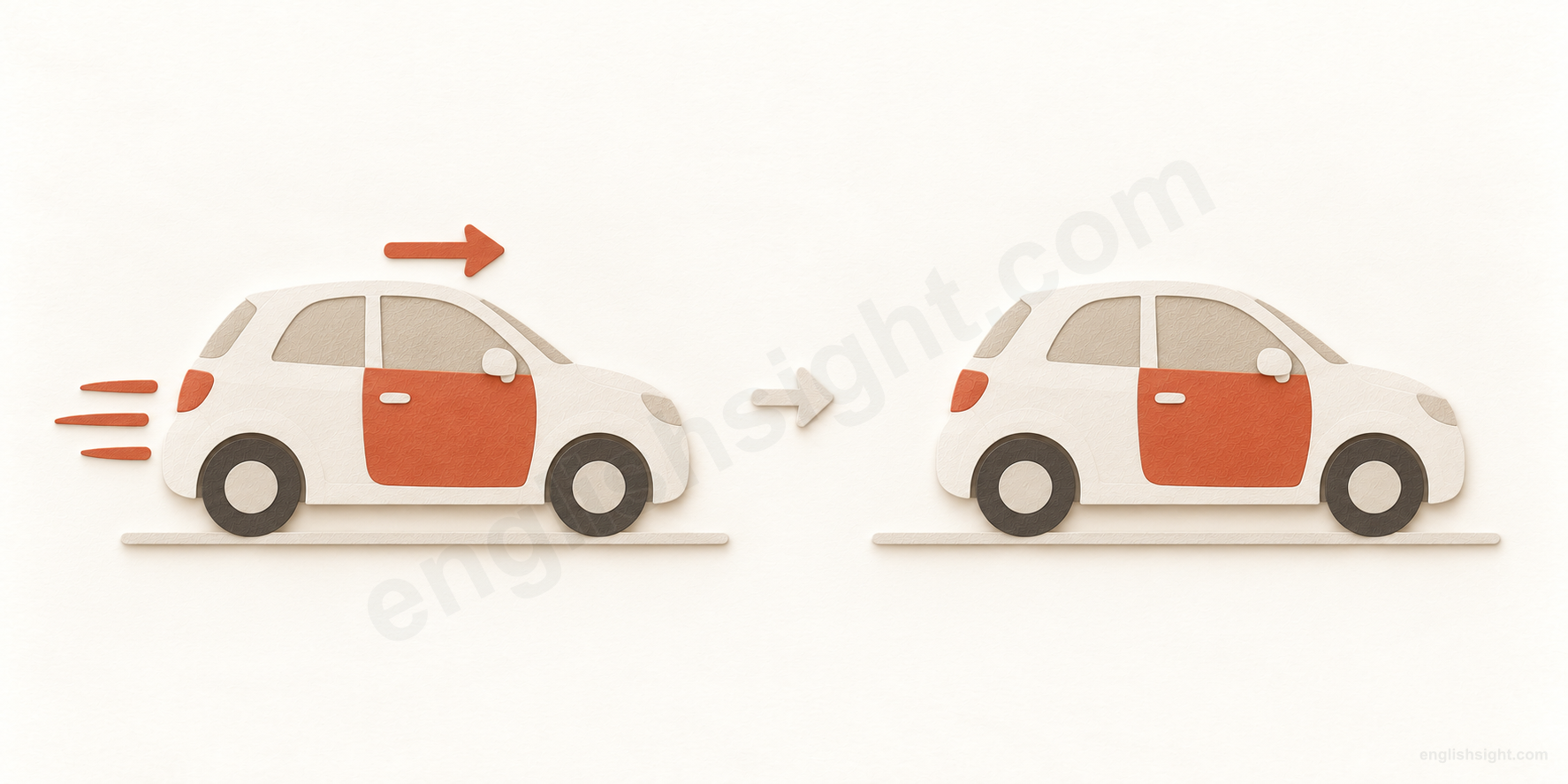
The car is moving to the right.
stop
The same car is stationary.
The movement comes to an end.
Movement ends; the car may move again.
Stop marks or causes an interruption: movement or activity no longer continues, or a possible event is prevented.
The car illustrates the change from moving to stationary. Prevention can happen before an activity begins; informal stay uses and fixed idioms are learned separately.
A car stops moving, a person stops talking, and a rule can stop something from happening at all. The common teaching connection is non-continuation, but the grammar tells you what ends or is prevented.
A stop can be temporary. Stopping work does not guarantee finishing it, and stopping to do something introduces the purpose of a break. Fixed expressions and regional uses need their own explanations.
01
Movement, activity, and a break for a purpose
Identify what ceases, who causes it, and whether the next verb names the activity being ended or the reason for a pause.
01
person / vehicle + stop
The car stopped.
cease moving
Before / situation
The car is moving along the road.
After / interpretation
The car is stationary.
The subject is the thing that no longer moves.
Stop can stand without an object: The car stopped. The subject undergoes the change; the sentence does not identify its cause. A person can stop walking in the same way.
The picture uses movement to illustrate non-continuation. Stop does not specify a permanent end: the car may move again. Unlike slow down, it normally says that movement actually ceases.
In a sentence
Our car stopped just before the bridge.
Watch the difference Stopping does not necessarily mean parking or reaching your destination.
02
stop + person / thing; be stopped + by + agent
stop the car
cause someone or something to halt
Before / situation
A driver is still driving.
After / interpretation
The driver brings the vehicle to rest.
An object identifies what the subject causes to stop.
Compare The car stopped with Maya stopped the car. In the second, Maya causes the change. This is an ordinary transitive verb, not a special particle construction.
A passive is natural when the affected person or vehicle matters: Our van was stopped by a police officer. That usually describes being required to halt; it does not by itself say anyone was arrested.
In a sentence
Maya stopped the car outside the clinic.
Watch the difference Say She stopped it. Do not add to before an ordinary direct object.
03
stop + -ing
stop doing something
cease an activity or habit
Before / situation
Leo is typing while someone speaks.
After / interpretation
Leo no longer types.
The -ing form names the activity that ends.
In stop typing, typing is what ceases. The same construction can describe a brief interruption or a lasting change of habit: Nina stopped smoking last winter. Context supplies how long the change lasts.
Stop working does not guarantee that the work is complete. Finish writing the report presents completion; stop writing the report can leave it unfinished. I can’t stop thinking about it says the thoughts keep returning.
In a sentence
Leo stopped typing when the call began.
Watch the difference Stop to type would mean interrupting another activity in order to type.
04
event / process + stop; stop + event / process
The rain stopped.
an event or process comes to an end
Before / situation
Rain is falling during the afternoon.
After / interpretation
Rain is no longer falling.
The event itself can be the subject, or the affected process can be an object.
An activity or process stops when it no longer continues: The noise stopped; The bus service stops at eleven. No deliberate decision is required.
With an object, stop names what someone brings to an end: The referee stopped the match. Stop the bleeding concerns ending an existing flow; stop the spread of a fire can concern preventing further spread. Context decides whether the event was already underway.
In a sentence
The rain stopped before we left the museum.
Watch the difference The match stopped or was stopped does not necessarily mean it reached its normal conclusion.
05
machine + stop; stop + machine
The engine stopped.
cease functioning
Before / situation
The engine is running.
After / interpretation
It is no longer operating.
Stopping operation can be deliberate or accidental.
A clock, engine, or other machine can stop even when its casing does not move. What ceases is its operation. The engine stopped does not explain whether someone switched it off or it failed.
Stop the engine gives the operator a role in ending operation. My watch has stopped describes the present result of an earlier change, not necessarily permanent damage.
In a sentence
The engine stopped halfway up the hill.
Watch the difference Stop is broader than break down: an intentionally switched-off engine has stopped too.
06
Stop!; stop + it / that; stop + -ing
Stop it!
tell someone to cease an action
Before / situation
Someone keeps tapping your chair.
After / interpretation
You demand an end to the tapping.
The action can be understood from the situation.
Stop! is a direct command. Stop it! points to behavior already clear to the listener, often with annoyance. Stop doing that names the same demand more explicitly.
Please stop tapping my chair identifies the activity and can sound less abrupt. In a discussion, I’m sorry, but I have to stop you there signals an interruption of someone’s speech; there refers to that point in the discussion.
In a sentence
Please stop tapping my chair.
Watch the difference Stop it can sound sharp. Choose a direct command deliberately, especially outside an urgent situation.
07
stop + to-infinitive; stop and + verb
stop to do something
pause another activity in order to act
Before / situation
You are walking through the park.
After / interpretation
You pause the walk to take a photograph.
The to-infinitive gives the purpose, not the activity being ended.
We stopped to take a photo means that we interrupted something else, such as walking, so that we could take the photo. We stopped taking photos means that taking photos ceased.
Stop and think is another familiar way to ask someone to pause and consider something. She didn’t stop to check the address means she continued without taking time to check it; it does not mean she abandoned a checking activity.
In a sentence
We stopped to take a photo of the lake.
Watch the difference Do not use stop to smoke when you mean giving up smoking. It describes taking a break for a cigarette.
08
stop for + meal / purpose / period
stop for lunch
take a break for a stated purpose or period
Before / situation
The journey is continuing.
After / interpretation
The travelers take a lunch break.
For introduces the purpose or duration of the interruption.
Stop for lunch and stop for a coffee name what the break is for. Stop for ten minutes instead says how long it lasts. Stop for the night means interrupting the journey until the next day.
Compare stop at a café, which identifies a place, with stop for coffee, which identifies the purpose. Both can appear together: We stopped at a café for coffee.
In a sentence
We stopped for lunch after crossing the border.
Watch the difference After for use a noun phrase here; use stop to eat when the purpose is expressed with a verb.
02
Preventing, withholding, and blocking
An event need not have begun for someone or something to stop it. Some objects also select specific meanings such as withholding payment or closing a hole.
09
stop + object + (from) + -ing; be stopped from + -ing
stop someone from doing something
prevent an action or event
Before / situation
Rain makes the outdoor plan impossible.
After / interpretation
The planned picnic cannot take place.
The object is the person or thing whose action is prevented.
The rain stopped us from having a picnic does not require a picnic to have started. Stop can prevent a possible event as well as interrupt an existing one. The cause may be a person, a rule, a condition, or a physical obstacle.
Use from plus -ing, not from plus a bare verb. From can be omitted in some active sentences, especially in British English: Nothing stopped her applying. Keeping from is a clear general choice. In the passive, use She was stopped from entering.
In a sentence
The rain stopped us from having a picnic.
Watch the difference Stop us to have a picnic would not express prevention; it suggests halting us for a purpose.
10
there is no stopping + object; nothing to stop + object + from + -ing
There’s no stopping her.
emphasize that someone cannot be held back
Before / situation
A runner keeps making progress.
After / interpretation
Nothing seems able to hold her back.
The negative construction presents the person as unstoppable.
There’s no stopping her is an emphatic way to say that she will keep going or succeeding despite opposition. It can express admiration or exasperation, depending on the situation.
There’s nothing to stop you from applying has a different conversational purpose: no obstacle prevents your application. It leaves the choice to you and does not predict your success.
In a sentence
Once Aisha has a new idea, there’s no stopping her.
Watch the difference Use her, not she, after stopping in this pattern.
11
stop + payment / cheque; have + wages + stopped
stop a payment
prevent money from being paid
Before / situation
A payment is due to go through.
After / interpretation
Someone takes action to prevent payment.
The object payment selects a financial use of prevent.
Stop a payment means arrange for money not to be paid. Stop a cheque is a related banking expression. The phrase describes the intended prevention, rather than taking back money that has already reached someone.
Have one’s wages stopped means no longer receive those wages. British English also uses stop money from someone’s pay for deducting it. These financial constructions are useful to recognize, but they do not tell you a particular bank’s procedures.
In a sentence
He contacted the bank to stop the payment.
Watch the difference Stopping a future payment is different from receiving a refund for an earlier one.
12
stop + opening + up + with + material; stop up + opening
stop up a hole
fill or block an opening
Before / situation
Air can pass through a hole.
After / interpretation
The hole is blocked with material.
Here the direct object is an opening that is closed.
Stop up a hole with cloth means block the opening using cloth. The object is the hole, not the flow: stop the leak names what ceases; stop up the hole names what is physically filled.
With this transitive combination, both stop up the hole and stop the hole up are possible; put a pronoun in the middle: stop it up. This is different from the British informal, intransitive stop up meaning stay awake late.
In a sentence
They stopped up the hole with a piece of cloth.
Watch the difference Keep the meanings apart: stop it up blocks something; stop up late describes staying awake.
03
Stops on a journey and informal stays
Places and particles distinguish a scheduled call, a brief visit, a break in travel, and regional uses meaning stay. Learn the complete expression.
13
stop at + station / specific place; stop in + city
stop at a station
halt at or briefly visit a place
Before / situation
A train is following its route.
After / interpretation
It calls at a particular station.
At supplies the place, not a particle meaning.
Does this train stop at Oakfield? asks whether the service calls there for passengers. A train passing through a station need not stop there.
We stopped at a café can describe a visit or travel break, rather than merely standing motionless outside. In a city, in may locate the stop more broadly: We stopped in Leeds. At and in are ordinary place prepositions here.
In a sentence
Does this train stop at Oakfield?
Watch the difference Stop at does not mean end the whole journey there; the train may continue afterward.
14
stop by + place; stop by; stop in for + reason
stop by / stop in
make a brief visit
Before / situation
You are near a friend’s workplace.
After / interpretation
You visit briefly to say hello.
The whole combination means a short visit, not simply standing beside something.
Stop by can stand alone when the destination is understood, or take a place: stop by the office. The visit is usually presented as short and informal. Stop by my house means visit it, not merely halt next to it.
Stop in also has a brief-visit use, familiar in American English: Stop in for coffee sometime. Context matters because British informal stop in can instead mean stay at home. These visit expressions do not take a movable direct object: by the office remains together.
In a sentence
I’ll stop by your office after lunch.
Watch the difference Do not say stop your office by. A visit to a person can be phrased stop by to see her.
15
stop off at + place; stop off in + town
stop off
break a journey for a short visit
Before / situation
You are traveling to the coast.
After / interpretation
You make a brief visit along the way.
Off marks the established travel-break expression.
Stop off at a place presents the visit as an interruption of a journey. You might collect something, eat, or spend a night there before continuing.
Compare I’ll stop by your shop, which simply presents a brief visit, with We’ll stop off at your shop on the way to the coast, which puts it inside a larger trip. Off does not mean getting off a bus by itself.
In a sentence
We stopped off at a farm shop on the way to the coast.
Watch the difference Use a place preposition when naming the destination: stop off at the shop, not stop the shop off.
16
stop over in / at + place; a stopover
stop over
stay somewhere during a longer journey
Before / situation
Your trip has an intermediate destination.
After / interpretation
You spend some time there before continuing.
Over belongs to a travel expression about an intermediate stay.
Stop over in a city means stay there during a longer journey. It often appears in travel planning. The expression does not itself fix an exact number of hours or require an overnight stay.
Stop off emphasizes a visit or break on the way; stop over emphasizes the intermediate stay. Their uses can overlap. The related noun is one word, stopover: a stopover in Seoul.
In a sentence
We’ll stop over in Seoul before flying to Vancouver.
Watch the difference Write the verb as two words: stop over. Do not use stopover as the verb in this pattern.
17
stop for + meal; stop in
stop for tea / stop in tonight
stay for a while, or stay at home in British informal English
Before / situation
A friend invites you to remain.
After / interpretation
You stay rather than leave immediately.
Some British informal uses of stop mean stay.
Can you stop for tea? can mean can you stay for tea in British informal speech. I’m not stopping can mean I’m not staying. Stay is a clearer choice across varieties when that is all you mean.
British informal I’m stopping in tonight means I’m staying at home rather than going out. Compare the brief-visit meaning of stop in: I’ll stop in for coffee tomorrow. Situation and variety help distinguish them.
In a sentence
I’m tired, so I’m stopping in tonight.
Watch the difference This use does not mean that you are stopping an activity called in.
18
stop out until + time; stop up to + verb
stop out / stop up
stay out late or stay awake late in British informal English
Before / situation
Friends remain out after the usual time.
After / interpretation
They return home late.
Out concerns being away from home; up concerns remaining awake.
British informal stop out means stay out late: We stopped out until midnight. Stop up means stay awake late: We stopped up to watch the final. The two expressions do not describe the same situation.
Stay out and stay up are broadly understandable alternatives. Compare stop up the hole: that is a transitive blocking construction with a direct object, while stop up late has no object.
In a sentence
We stopped out until midnight after the concert.
Watch the difference These regional informal uses are for recognition; do not interpret up as always meaning block an opening.
04
A stop as a place, event, or state
The countable noun can identify a passenger stop, a travel break, or the point at which movement ceases. Related compounds have their own established uses.
19
a bus / subway stop; at the next stop; three stops away
the next stop
a place where passengers get on or off
Before / situation
You are on a bus approaching a stop.
After / interpretation
You plan to get off there.
The noun identifies a place on a service’s route.
A bus stop is a place where buses pick up or set down passengers. The next stop names the next such point on the route. Your stop is the one where you intend to get off.
It’s three stops away counts route intervals in everyday travel. I missed my stop means I failed to get off where intended, not that the vehicle necessarily failed to halt.
In a sentence
We need to get off at the next stop.
Watch the difference Use at for the point where you get off: at the next stop.
20
make a stop at + place; a stop for + purpose
make a stop
an occasion of interrupting a journey
Before / situation
The trip is continuing.
After / interpretation
You pause to buy supplies.
The noun names a break, rather than a scheduled passenger location.
Make a stop at a shop means pause the journey to visit it. A brief stop, a lunch stop, and an overnight stop specify length or purpose. There need not be a bus stop sign or station.
A stop on a tour may be a planned visit to a city. In We made two stops before dinner, stops counts interruptions or visits, not necessarily two public transport stations.
In a sentence
We made a quick stop at the market for fruit.
Watch the difference Use make a stop, rather than treating stop here as the verb: We stopped at the market is another complete pattern.
21
come to a stop; bring + object + to a stop
come to a stop / bring to a stop
reach or cause a state of no movement
Before / situation
The tram is slowing down.
After / interpretation
It is fully stationary.
Come describes the change; bring introduces a cause.
The tram came to a stop describes its movement ending. The driver brought the tram to a stop assigns responsibility to the driver. A sudden, complete, or abrupt stop describes the manner or extent of the halt.
Work came to a stop extends the pattern to activity. The work need not be finished. Come to a full stop also means stop completely; it is not about punctuation in this construction.
In a sentence
The tram came to a complete stop beside the platform.
Watch the difference Keep a in come to a stop; the ordinary expression is not come to stop.
22
a full stop; put a full stop at the end of + sentence
a full stop
the punctuation mark at the end of a sentence
Before / situation
A written sentence needs closing punctuation.
After / interpretation
A dot marks its end.
Full stop is a conventional British name for a punctuation mark.
In British English, full stop names the mark (.). American English usually calls it a period. The mark ends a sentence and can also appear in some abbreviations. Stop alone can have this punctuation sense, but full stop is the more usual British term.
The phrase come to a full stop belongs to a different construction: a vehicle stops completely. Do not decide the meaning from the words full stop without checking the surrounding sentence.
In informal British speech, full stop can also close a statement firmly: We are not selling the house, full stop. The speaker presents the matter as settled. Period is a corresponding expression. This emphatic use can sound blunt.
In a sentence
This sentence needs a full stop at the end.
Watch the difference Full stop is a two-word noun here, not a command to stop fully.
23
non-stop + flight / service / activity
non-stop
without intermediate stops or without a break
Before / situation
You are comparing flight routes.
After / interpretation
One flight has no intermediate landing.
Non- negates the stopping described by the compound.
A non-stop flight has no intermediate stop. Non-stop entertainment instead means entertainment without a break. The relevant kind of interruption depends on the noun being described.
This is a related compound adjective, not a new tense of stop. The first use concerns a journey; the second concerns continuing activity. Neither says that the activity lasts forever.
In a sentence
We booked a non-stop flight to Lisbon.
Watch the difference Do not infer that every use of non-stop is about transport: non-stop noise concerns continuity.
05
Limits, interruptions, and fixed expressions
These expressions extend stopping to conversation, progress, effort, and limits. Their meanings belong to the whole combination, rather than to stop alone.
24
stop short; stop + object + short; stop (object) dead
stop short / stop dead
stop abruptly
Before / situation
You are speaking or moving normally.
After / interpretation
You halt suddenly.
Short and dead emphasize an abrupt end.
She stopped short can describe an abrupt interruption of movement or speech. He stopped me short makes someone else the cause of the interruption. Stop dead likewise emphasizes a sudden, complete halt.
Dead in this expression does not mean that someone dies. A conversation can stop dead. Compare stop short of apologizing, which says an apology was not reached rather than simply describing an abrupt halt.
In a sentence
I stopped short when I realized the door was open.
Watch the difference Do not read short as a brief duration here; the emphasis is on abruptness.
25
stop short of + noun / -ing
stop short of doing something
go some way toward something without taking the further step
Before / situation
A manager admits that a mistake was made.
After / interpretation
The manager does not offer an apology.
Of introduces the further action or limit that is not reached.
Stop short of apologizing means go some way, perhaps acknowledging a problem, but not actually apologize. The phrase often highlights reluctance to make a stronger claim or take a riskier step.
The action after of is specifically left undone. Compare stop apologizing, where apologizing has already been happening and then ceases. A noun is possible too: stop short of a complete ban.
In a sentence
The manager admitted the error but stopped short of apologizing.
Watch the difference Use of plus -ing: stopped short of promising, not stopped short to promise.
26
stop + person + in their tracks; stop in one’s tracks
stop someone in their tracks
make someone halt abruptly through surprise or fear
Before / situation
A person is walking and talking.
After / interpretation
Unexpected news makes the person halt.
The idiom links a sudden reaction to an interruption.
News, a sight, or a question can stop someone in their tracks. The person suddenly breaks off movement or activity because the impact is striking, frightening, or surprising.
The intransitive form is stop in your tracks: I stopped in my tracks. Actual footprints or railway tracks are not required. The possessive follows the affected person: stopped us in our tracks.
In a sentence
The unexpected announcement stopped me in my tracks.
Watch the difference Say stopped me in my tracks, not stopped me in their tracks when me is the affected person.
27
stop at nothing to + verb
stop at nothing
be willing to take extreme measures to achieve a goal
Before / situation
Someone wants a rival’s position.
After / interpretation
They are prepared to do even harmful things to get it.
No moral or practical limit is accepted in pursuit of the goal.
Stop at nothing is emphatic and often critical. It can suggest willingness to do dangerous, dishonest, or otherwise unacceptable things to succeed. It describes determination, not literal immobility.
Compare pull out all the stops, which emphasizes great effort without necessarily suggesting wrongdoing. Learn at nothing together; it is not the same as not stopping at a place.
In a sentence
He would stop at nothing to ruin his rival’s career.
Watch the difference This is stronger than try hard, and its negative implications may make it unsuitable as simple praise.
28
put a stop to + noun / -ing
put a stop to something
act to end or prevent an unwanted activity
Before / situation
Disruptive behavior keeps recurring.
After / interpretation
Someone intervenes to end it.
The whole expression conveys decisive prevention or termination.
Put a stop to the interruptions means intervene so that the interruptions cease or do not recur. It often presents the activity as unwelcome. The person or measure doing the stopping is the subject of put.
To is a preposition here: put a stop to it; put a stop to wasting food. Compare stop wasting food, where stop itself takes the -ing complement.
In a sentence
The chair put a stop to the personal insults.
Watch the difference Keep a and to: put a stop to it, not put stop it or put a stop to do it.
29
pull out all the stops to + verb / for + noun
pull out all the stops
make every effort to achieve something
Before / situation
A team has an ambitious deadline.
After / interpretation
It uses all available effort and resources.
This fixed idiom concerns effort rather than ending movement.
Pull out all the stops means make every effort and use all available resources to make something succeed. It can describe an impressive celebration, urgent work, or a determined attempt to solve a problem.
The expression does not mean remove bus stops or stop all activity. It is an idiom to learn as a unit. Great effort is asserted; success is not guaranteed.
In a sentence
The team pulled out all the stops to finish the exhibition on time.
Watch the difference Keep the plural stops and the complete expression; pull out a stop is not this idiom.
30
in stops and starts
in stops and starts
with repeated interruptions rather than continuously
Before / situation
Progress alternates with periods of inactivity.
After / interpretation
The activity advances irregularly.
The plural nouns describe a repeated pattern.
Work proceeds in stops and starts when it repeatedly gets going and then ceases. The phrase describes uneven continuity, not a single completed stop followed by one restart.
In fits and starts is a related established expression. By contrast, non-stop work has no such breaks. These phrases describe the pattern of activity, rather than its quality or final success.
In a sentence
The repairs progressed in stops and starts as spare parts arrived.
Watch the difference Keep both nouns plural in this expression.
31
stop the clock
stop the clock
pause timing in a game or timed activity
Before / situation
Time is being counted for an event.
After / interpretation
The official measurement pauses.
It is the recording of time that stops.
Stop the clock can mean suspend timing during a game or activity with a time limit. Ordinary time continues to pass; the event’s measured time is paused.
Compare The clock stopped, which can simply report a clock no longer functioning. Stop the clock makes a person or action responsible and, in a sports context, has the established timing meaning.
In a sentence
The referee stopped the clock while the player received treatment.
Watch the difference Stopping the clock in an event does not mean stopping time itself.
32
quality / responsibility + stop + there / at + limit
It doesn’t stop there.
extend beyond a stated point or limit
Before / situation
One benefit has been described.
After / interpretation
Further benefits are added.
There can refer to an abstract point in a discussion.
The benefits don’t stop there says that more benefits follow. My responsibility stops there instead marks a limit to responsibility. Neither statement describes physical travel.
This is an extension of non-continuation to the extent of a quality, situation, or account. The negative does not stop there tells the listener to expect continuation beyond the point just mentioned.
In a sentence
The benefits don’t stop there: the new system also saves water.
Watch the difference There is a reference to the current limit or point, not necessarily a physical location.
33
know when to stop (+ -ing)
know when to stop
recognize when continuing would be excessive
Before / situation
Someone keeps making jokes after others are uncomfortable.
After / interpretation
A sensible limit has been passed.
The expression concerns judgment and self-control.
You need to know when to stop can warn that someone has continued a behavior too far. He doesn’t know when to stop often criticizes teasing, questioning, or other behavior that annoys or upsets people.
When to stop is an embedded question about the appropriate stopping point. It does not necessarily mean knowing an exact clock time. The activity can be named: know when to stop asking questions.
In a sentence
The joke was funny at first, but he didn’t know when to stop.
Watch the difference This can be a criticism of excessive behavior, not a claim that someone cannot physically stop moving.
Read the whole construction
Stop doing and stop to do
Stop reading ends reading. Stop to read pauses something else so that reading can begin. For plus a noun can name the purpose or duration: stop for lunch; stop for ten minutes.
Preventing is different from interrupting
A locked gate can stop someone from entering before any entry occurs. Stop does not always presuppose an activity already in progress. Use from plus -ing for the prevented action.
Forms, voice, and cause
Forms: stop, stops, stopped, stopping; double p before -ed and -ing. Stopped ends with /t/. The car is stopping describes the change in progress. The car stopped is intransitive; she stopped it is transitive; it was stopped by an officer is passive. The transitive verb itself can express causation; do not invent stop someone to do for prevention.
Completion and duration come from context
Stop working need not mean finish all the work, quit a job, or stop forever. Pause explicitly suggests a temporary break; finish highlights completion. Stop alone leaves those distinctions to context.
Scope and the picture
The diagram is a teaching illustration of movement ending, not a universal mental image or a rule that predicts every idiom. British informal stop meaning stay, and expressions such as pull out all the stops, require separate learning. Specialist musical, phonetic, photographic, sporting, and mechanical senses are outside this general lesson.
Choose what stop means
Check the activity, the object, and the words after stop.
1. During a walk, you pause so that you can photograph a bird. Which sentence fits?
2. A locked gate means nobody can enter. Which pattern expresses prevention?
3. A police officer required your van to halt. Which sentence puts the van first?
4. A manager acknowledges an error but offers no apology. Which expression fits?
5. You plan a quick visit to a friend’s office. Which is natural?
6. The team made every possible effort to finish a project. Which idiom fits?
Sources and teaching notes
Publisher entries were consulted for meanings, patterns, and usage labels. The explanations, examples, and teaching diagram are original; the visual model is a teaching interpretation.
The diagram illustrates a relation between states; it does not represent a picture shared by every speaker.