Store things, build reserves, visit a store, and recognize expressions that use the whole phrase.
Kept now, available later
Put away and keep for later
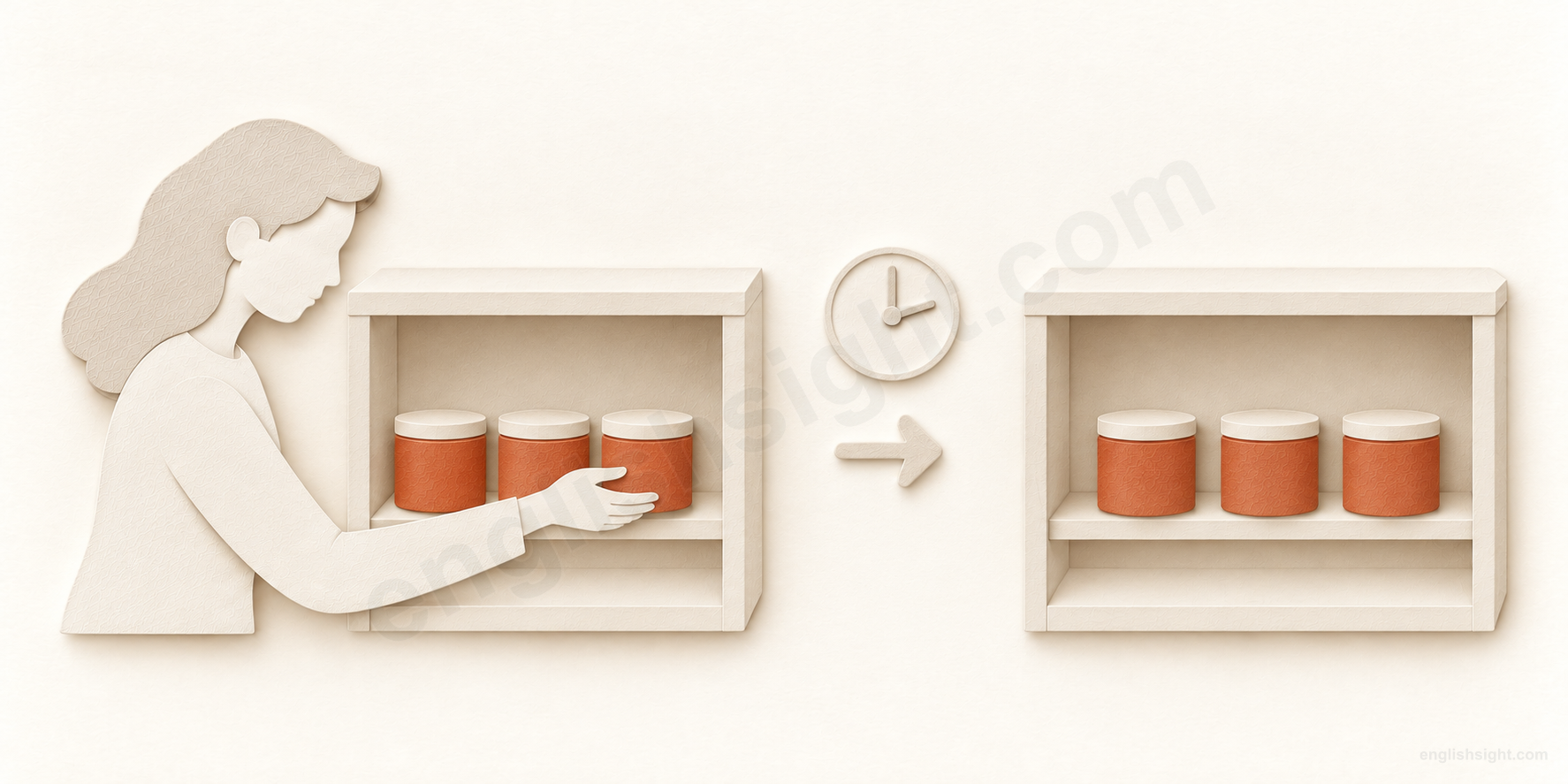
A woman puts a third lidded container beside two others in a cupboard.
store
The same three containers remain in the cupboard for later use.
Put them away and keep them there over time.
Put away now, kept available for later.
Store means to put or keep something in a place or system so it remains available for later use.
This retention model explains the ordinary verb and reserve uses. A shop is a separate everyday noun branch; established idioms need their own explanations. Storage does not guarantee perfect preservation or a useful outcome.
A useful starting point for the verb is to put or keep something in a place or system for later use. The retained thing may be food, equipment, information, or energy.
The noun can name a reserve, a storage place, or a retail business. These uses are related enough to organize a lesson, but a single picture cannot predict every compound or idiom.
01
Put away and keep for later
The verb focuses on retention: what is kept, where it stays, and sometimes how it builds up. The object may be a physical thing, information, or energy.
01
store + object + place; be stored + place / conditions
store something in a safe place
put something somewhere and keep it for later
Situation / starting point
The camping equipment will not be used this month.
Result / intended meaning
It stays in a dry cupboard until the next trip.
The equipment remains available rather than being used now.
In We store our tent in the cupboard, we names the people responsible, our tent is what they keep, and in the cupboard gives the location. Store includes keeping it there, not just the instant of putting it down.
The passive is useful when the object or conditions matter most: The equipment is stored indoors. Instructions often begin Store in a dry place; the product is understood from the label.
Keep is broader: keep smiling and keep a promise do not describe storage. Stow emphasizes packing something into its place; store emphasizes keeping it there for later.
In a sentence
We store our camping equipment in a dry cupboard.
Watch the difference Store is normally transitive in this use. Say We store the tent here, not We store here when you mean the tent.
02
store + data / information; be stored on + device / in + database or memory
store data / information
retain information in a device, system, or memory
Situation / starting point
A photo has been taken.
Result / intended meaning
Its data remains on a device for later access.
Information can be retained without a physical box.
Computers, applications, and people can store information. The location may be on a device or server, in a database, or in memory. These prepositions follow the ordinary way we describe the particular location.
The phone stores photos describes its function; The photos are stored on the phone focuses on the retained files. Store a fact in your memory extends the retention idea to the mind.
Save a file often refers to the action that records current work. Store describes keeping data and does not promise that a backup exists, that the data is secure, or that someone remembers it consciously.
In a sentence
The app stores your notes on your phone.
Watch the difference Use store information, not store an information. Information is uncountable; a piece of information is countable.
03
battery / body / system + stores + energy / fat
store energy
hold energy so it can be released or used later
Situation / starting point
Electricity is available during the day.
Result / intended meaning
A battery holds energy for use after sunset.
The retained resource is energy, not a collection of ordinary objects.
A battery can be the subject of store: it holds energy rather than deliberately deciding to put something away. The same verb can describe biological reserves, such as a body storing fat.
This is an extension of retention, not a claim that energy behaves exactly like jars in a cupboard. Store does not itself describe how the energy was produced or how efficiently it can be recovered.
In a sentence
The battery stores energy for use at night.
Watch the difference Generate energy concerns production; store energy concerns retention. One does not automatically imply the other.
04
food / goods + store + well / badly / duration
store well
remain in usable condition while being kept
Situation / starting point
You choose which apples to keep over winter.
Result / intended meaning
One variety stays in good condition longer.
The goods are the subject, and store takes no object.
These apples store well means that they remain usable under storage conditions. This intransitive pattern evaluates the goods, unlike We store these apples, which describes what people do.
Well, badly, and for a long time can describe storage performance. The actual conditions still matter; the sentence is not a guarantee that the food stays good in every environment.
In a sentence
These apples store well in a cool room.
Watch the difference The subject is not putting other things away. Compare We store the apples and The apples store well.
05
store away + noun; store + noun / pronoun + away
store something away
put something aside and keep it out of immediate use
Situation / starting point
Winter is over and the heavy blankets are not needed.
Result / intended meaning
They are put aside until the weather gets cold again.
Away emphasizes being put aside, not movement to a distant destination.
Store away is a separable particle verb. With a noun, store away the blankets and store the blankets away are both possible. With a personal pronoun, use store them away.
Away often adds a sense of putting something out of the way. It can also describe retaining information or memories, but it does not automatically mean that the thing is secret or forgotten.
In a sentence
We washed the blankets and stored them away for the summer.
Watch the difference Say store them away, not store away them. Away here is a particle, unlike in followed by a place.
06
store up + noun; store + noun / pronoun + up
store up food / savings / memories
accumulate and keep a reserve
Situation / starting point
Small amounts are collected over time.
Result / intended meaning
A reserve is available when the right moment comes.
Up often highlights accumulation rather than a higher location.
Store up can describe building a supply of food, money, or information for later. Store already allows this meaning; up makes the accumulating aspect more noticeable.
This particle verb is separable: store up supplies or store supplies up; store them up with a personal pronoun. A long noun phrase often fits more smoothly after store up.
Memories and experiences may also be described as stored up to draw on later. The metaphor is retention, not a literal container in the head.
In a sentence
The squirrels store up nuts before winter.
Watch the difference Up does not mean upward here. Do not confuse store up food with stock up on food, which uses on before the goods.
07
store up + trouble / problems + for + person / future; store up + emotion
store up trouble / anger
allow problems or feelings to accumulate with later consequences
Situation / starting point
A small fault or an angry feeling is left unaddressed.
Result / intended meaning
The unresolved issue becomes harder to handle later.
The reserve metaphor can describe an unwanted buildup.
Store up trouble or problems warns that present behavior creates difficulties for the future. The person usually does not want that result. The expression is therefore different from deliberately collecting useful supplies.
Store up anger describes holding feelings in so they accumulate: He stored up his anger until he finally shouted. The object identifies the unexpressed emotion, not a box of objects.
In store up trouble for yourself, for names the person affected. It is not a destination and does not make trouble a useful resource.
In a sentence
Ignoring the damaged pipe will only store up trouble for later.
Watch the difference The phrase does not imply a sensible plan or a benefit. Trouble can accumulate unintentionally.
02
A supply, supplies, or a storage place
As a noun, store can name what is held in reserve or the place that holds it. Context matters, especially with plural stores.
08
a + store + of + resource
a store of food / water
an amount kept as a reserve
Situation / starting point
A family prepares for a possible power cut.
Result / intended meaning
Food and water are available if normal supplies stop.
The noun names the reserve, not the building holding it.
A store of water is a supply of water that someone has. Of introduces the contents. Store is countable in this pattern: a store, a large store, or several stores.
A store can be built up, drawn on, or used up. That fits the idea of a resource available for use. Ordinary water is uncountable, but the whole reserve can still be described as a store.
Compare a food store, which may mean a shop or a storage place, with a store of food, which directly names the supply.
In a sentence
We keep a small store of drinking water in the basement.
Watch the difference A store is not the same grammatical noun as storage. Say a store of water or water storage, not a storage of water for this reserve.
09
a + store + of + knowledge / stories / jokes
a store of knowledge / stories
a reserve of things someone knows or can tell
Situation / starting point
Someone has learned a great deal over many years.
Result / intended meaning
That knowledge is available for new questions.
An abstract resource can be treated as a reserve to draw on.
A store of knowledge extends the supply meaning to what a person knows. A store of stories or jokes suggests material the person can recall and use in conversation.
The expression presents accumulated resources, not a shop selling facts. It is often more descriptive than the simple She knows a lot and does not require every detail to have been deliberately memorized.
In a sentence
My grandfather has a wonderful store of stories about the village.
Watch the difference A store of knowledge names a reserve. A knowledge store in a technical text may instead name a system that holds information.
10
food / medical + stores; stores + plural verb
food stores / medical stores
supplies kept for a particular purpose
Situation / starting point
A team loads food and equipment before a long trip.
Result / intended meaning
The supplies are ready to be used during the journey.
Plural stores can mean provisions rather than shops.
Stores can be a plural noun for supplies, especially in organized, expedition, military, or similar contexts. Food stores may be provisions in one sentence and food shops in another.
Use context and the verb: load the stores onto the ship points to supplies; visit three stores points to retail businesses. The plural supplies sense takes a plural verb when it is the subject.
In a sentence
The expedition’s food stores were loaded onto the boat.
Watch the difference Do not assume stores always means several shops. The surrounding activity determines the reading.
11
a + goods / equipment + store; in + the + store
a grain store / equipment store
a place where goods are kept
Situation / starting point
Tools need somewhere to stay between jobs.
Result / intended meaning
A particular room holds them until needed.
Here the noun names the location rather than its contents.
An equipment store may be a room or building used for storage; a grain store holds grain. In the right workplace, the stores can also mean the area where supplies are kept.
This meaning and the shop meaning can overlap in form. An equipment store might be a business selling equipment, so a sentence about the room, stock, or customer helps identify the intended meaning.
Storage is normally uncountable when it means the activity or space: We need more storage. A store is a countable place or supply. In storage is the ordinary general phrase for things being kept somewhere rather than used.
In a sentence
The spare ladders are kept in the equipment store behind the workshop.
Watch the difference A store is not necessarily a retail business. Look for evidence of selling before reading it as a shop.
03
A business that sells things
The retail noun is an everyday branch of store. Learn its shopping patterns and regional differences without treating shopping as an act of storing.
12
go to / shop at / work in + a / the + store
go to the store
visit a business that sells things
Situation / starting point
You need something for dinner.
Result / intended meaning
You visit a nearby business to buy it.
The countable retail noun names a shop, not the act of keeping goods.
Store is an everyday word for a shop in American English, whether it is large or small. British English commonly uses shop for a small retail business and store especially for larger businesses and many established compounds.
At the store identifies the shopping location; in the store can emphasize being inside. Go to the store indicates a destination. These are ordinary prepositions with a noun, not phrasal verbs.
The store may be a familiar local shop understood in context. It does not name one universal type of business, and store does not mean buy as a verb.
In a sentence
I’m going to the store to buy some rice.
Watch the difference Use an article for a singular physical shop: at the store, not at store. Shop as a verb means buy or look for goods; store as a verb means keep them.
13
type / goods + store; store + manager / hours
grocery store / hardware store / department store
name a type of retail business
Situation / starting point
You need food, a tool, or a choice of different goods.
Result / intended meaning
The word before store helps identify the appropriate business.
A modifier describes the goods, scale, or organization of the business.
A grocery store sells food and household groceries; a hardware store sells tools and practical household equipment. A department store has departments for different types of goods. These are established compound nouns, not new verb meanings.
A chain store belongs to a group of stores under one business. Store can also modify another noun: a store manager manages the business, and store hours are the times it opens.
The final noun remains the head in these examples: two grocery stores, but two store managers. Not every word placed before store creates an established type of shop.
In a sentence
Is there a hardware store near here where I can buy a hammer?
Watch the difference A grain store may hold grain without selling it. A compound’s meaning depends on established usage and context, not just word order.
14
buy / order + item + from + an online store; get + app + from + an app store
an online store / app store
a digital business or marketplace where things are offered for sale or download
Situation / starting point
You want a product without visiting a physical shop.
Result / intended meaning
You choose and order through a website or application.
The business need not have a room that customers can enter.
Online store extends the retail noun to a website or service. An app store is a digital marketplace for applications; an app listed there may be free or paid.
Compare buy a game from an online store with store a game on your computer. From names the source of a purchase in the first; on names a storage location in the second. Neither meaning can be substituted for the other.
In a sentence
I ordered the replacement cable from an online store.
Watch the difference A website that stores your files is not automatically an online store. Retail store involves offering products to customers.
15
in-store + noun; buy / ask + in-store
in-store services / buy in-store
available or taking place inside a physical shop
Situation / starting point
A business offers online ordering and a visit to its premises.
Result / intended meaning
You choose the service available inside the shop.
In-store contrasts a physical retail location with other channels.
Before a noun, in-store works as an adjective: in-store repairs or in-store offers. It can also work adverbially: ask in-store. Instore is an alternative spelling; retail writing also uses in store after a verb.
Read the syntax and context. An in-store demonstration takes place in a shop; a surprise in store for you is something awaiting you. The spelling alone does not supply the whole meaning.
In a sentence
The website lists the product, but the discount is available only in-store.
Watch the difference In-store availability does not mean in storage. In stock specifically says goods are available; in-store says where an activity or offer applies.
04
Future events, importance, and familiar comparisons
These expressions have established meanings. A reserve can help you remember some of them, but the full phrase determines what the speaker means.
16
something + be / lie + in store + for + person; have / hold + something + in store
in store for someone
waiting to happen or be experienced in the future
Situation / starting point
A person has not yet seen what the day will bring.
Result / intended meaning
Events or surprises await that person.
The full expression points forward, without naming a real shop.
Something is in store for someone means that it awaits them. Have a surprise in store suggests a planned surprise; what life has in store refers to future events that need not be anyone’s plan.
The expression can concern good or bad events: a treat, a challenge, or trouble. What lies in store? asks what will happen. For identifies the person who will experience it.
A reserve is a useful memory link, but this phrase is established usage. In the store describes an actual retail location instead.
In a sentence
We have a small surprise in store for you after dinner.
Watch the difference Use in store for you for the future expression. In the store for you would normally locate something in a particular shop.
17
set / put + great / much / little store + by + noun / -ing; set store on + noun
set / put great store by something
consider something very important
Situation / starting point
A team chooses what should guide its work.
Result / intended meaning
Accuracy receives considerable importance.
The idiom expresses value rather than physical storage.
Set great store by and put great store by mean attach great importance to. Too much store can criticize an excessive amount of trust or importance: Don’t put too much store by one review.
By introduces what is valued; it does not identify the agent of a passive sentence. Set store on is also recorded, but by is a useful pattern to learn first.
This expression is relatively formal. In everyday conversation, Accuracy matters a lot to us often communicates the same idea more directly. The value meaning belongs to the idiom, not to store in every sentence.
In a sentence
Our team sets great store by checking the facts.
Watch the difference Learn set / put great store by as a complete expression: by introduces what is valued. This idiom is different from storing facts in a database.
18
mind + the store; who is minding the store?
mind the store
take care of business, especially while the usual person is away
Situation / starting point
The manager leaves for a short meeting.
Result / intended meaning
A colleague stays responsible for normal operations.
The store can stand for the business or operation as a whole.
Mind the store can be literal in a shop, but it also describes keeping an organization or project running while another person is absent. Mind means take care of here.
The expression is particularly North American and informal; British English also uses mind the shop. It does not mean remember the location or object to the business.
In a sentence
Could you mind the store while I meet the delivery driver?
Watch the difference Who’s minding the store? can question whether anyone is taking responsibility. It is not necessarily a question about a retail building.
19
be / feel / look + like a kid in a candy store
like a kid in a candy store
very excited by many attractive choices
Situation / starting point
A hobbyist enters a room full of desirable things.
Result / intended meaning
The choices make the person visibly delighted and perhaps overexcited.
A familiar comparison describes excitement, not someone’s actual age.
The image of a child surrounded by sweets is used for someone delighted by tempting choices. It can suggest getting carried away or wanting too much, so tone and context matter.
The comparison can describe an adult anywhere: a musician among instruments or a gardener among plants. The expression is mainly American; like a child in a sweet shop is a British counterpart.
The whole phrase supplies this meaning. Store by itself does not mean excitement, and no candy has to be present in the real situation.
In a sentence
At the camera exhibition, Leo was like a kid in a candy store.
Watch the difference This comparison can sound playful. Avoid it when the childlike suggestion would be unwelcome or disrespectful.
Read the noun, the object, and the whole phrase
Forms and ordinary grammar
The verb forms are store, stores, stored, stored, storing; drop final e before -ing. The ordinary verb takes an object and allows passives and progressive forms: We are storing the chairs here; The chairs are stored here. Goods can also store well, with no object. There is no special linking or causative pattern to memorize for this word.
Store, storage, and stock
A store is countable as a business, place, or reserve. Storage is normally uncountable for keeping goods or the space used: extra storage, in storage. In stock means available among a seller’s goods. In-store describes the retail location or channel; it does not promise that a particular item is in stock.
Limits of the retention picture
Not everything stored is valuable or deliberately wanted: a system may store unwanted data, and someone can store up trouble. The diagram is a teaching model of ordinary retention, not a shared mental image claimed for all native speakers or a rule that predicts every idiom.
Scope
This lesson covers modern everyday noun and verb uses, useful shopping patterns, and selected established expressions. Specialized computing nouns, agricultural livestock senses, older supply-with constructions, and rare or highly regional expressions are not developed here.
Choose what store is doing
Use the situation, grammar, and complete expression to choose the meaning.
1. You put the tent in a cupboard until your next trip. Which sentence describes keeping it there for later?
2. The blankets are clean. You will put them aside for summer. Choose the usual pronoun position.
3. These apples store well. What does this say?
4. A host says, “We have a surprise in store for you.” What should you understand?
5. “The ship’s food stores are running low.” What is becoming scarce?
6. “We set great store by honest feedback.” Which meaning fits?
Sources and teaching notes
Dictionary sources support the uses and grammar below. Explanations, examples, and the visual retention model were created for this lesson; the model is a teaching interpretation.
The diagram shows retention for later use; it does not explain every use of store.