Follow story from imagined adventures to real experiences, news, familiar sayings, and a separate building meaning.
Connect what happens
Connect what happens
Events happen
story
An account to follow
Connect the events into one account.
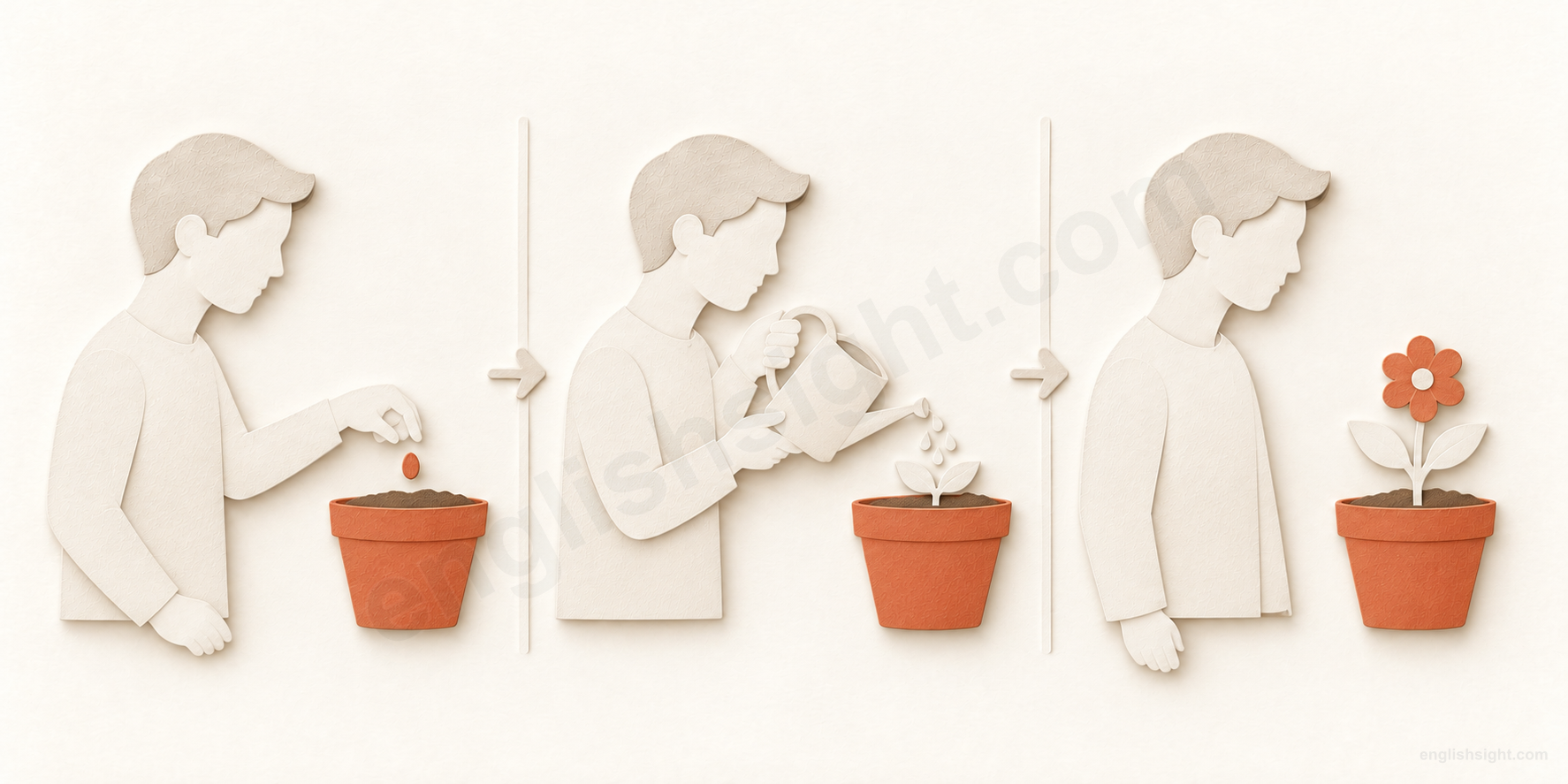
Planting, watering, flowering: connected events make one story.
A story connects events into an account that someone can tell, read, or follow.
The picture uses planting, watering, and flowering as one simple sequence. Stories can be real or invented, and they do not have to present every event in time order.
A story gives events a connected form that someone can tell, read, watch, or follow. It can concern imagined people, real experiences, or a person’s account of an incident. The word alone does not tell you whether it is true.
This connection is a teaching model for the narrative family. Familiar expressions add their own meanings, online stories are a modern media label, and the American building sense belongs to a separate branch.
01
Invented events, plots, and life histories
Start with events connected into an account. A story may entertain you, describe what happened, or show how a person or place developed.
01
a story about + person / thing; a short / bedtime / love story
a story about…
an invented account for people to enjoy
Situation / starting point
A writer imagines a child and a hidden garden.
What the expression conveys
Readers follow the child’s adventures.
Story names the account, rather than the physical book that contains it.
A story can be spoken, written, filmed, or shown in pictures. In a fictional story, people and events are imagined. A book can contain several short stories; a novel is a long work of fiction.
About introduces a subject: a story about a lost dog. Words such as love, ghost, adventure, and bedtime identify a kind of story or when it is told. They do not create a new grammatical pattern.
In a sentence
The children wrote a story about a dog that could open doors.
Watch the difference A story need not fill a whole book, and a book need not contain a story.
02
tell / read + person + a story; tell / read + a story + to + person
tell someone a story
give someone an account to listen to
Situation / starting point
A child asks for something to listen to.
What the expression conveys
An adult tells a story aloud.
The person receives the account; the story is what is told.
Tell a story can mean narrate from memory or imagination. Read a story means read written words; read someone a story means read those words aloud for that person.
Both Tell me a story and Tell a story to me are possible. Read me a story and Read a story to me also work. The preposition to introduces the listener in the second arrangement.
In a sentence
Can you tell us a story while we wait for the bus?
Watch the difference Use tell a story, not say a story. Reading a story does not always mean reading aloud.
03
the story / storyline of + book / film; the story is set in…
the story of a film
the connected events that make up a work
Situation / starting point
You watch what happens to the characters.
What the expression conveys
You can explain the main sequence and ending.
Here story is the narrative content, not the acting or the object that carries it.
You can like a film’s story but dislike its acting. In this use, story is close to plot or storyline. It concerns what happens and how events fit together.
The story is set in a village places its events there. The story unfolds as viewers learn more. The moral of the story is the lesson you draw from it; that phrase can also introduce a lesson from a real experience.
In a sentence
The film’s story follows two sisters who reopen their family shop.
Watch the difference Story is not the same as history here: the film’s story is its narrative, whether true or invented.
04
the story of + person / development; a true story; based on a true story
the story of…; a true story
an account of past events or development
Situation / starting point
A village has changed over many years.
What the expression conveys
A speaker connects its important changes.
Real events can be organized into a story too.
The story of a person, place, or movement presents what happened over time. A life story concerns someone’s life. A story about someone may instead concern just one incident.
A true story is presented as having really happened. Based on a true story says real events were the starting point; it does not promise that every scene or line is accurate. History more directly concerns the past or its study; story emphasizes an account people can follow.
In a sentence
The exhibition tells the story of the village from its first houses to the present day.
Watch the difference Do not assume story means fiction. True story is an ordinary combination.
02
Explanations, viewpoints, and truth
When people explain an incident, story names their account. The surrounding words tell you whose account it is, whether it is complete, and whether anyone believes it.
05
the story behind + thing / event; what’s the story (with / on…)?; the inside story of / on + event
the story behind…; the inside story
the background or explanation of a situation
Situation / starting point
You see a cracked cup kept on a shelf.
What the expression conveys
Its owner explains why it matters to her.
Behind points to circumstances that are not obvious from the thing itself.
The story behind an object, decision, or event explains how it came about or why it matters. Behind is figurative: you are asking for background, not a position at the back.
Informal What’s the story? or What’s the story with the new timetable? asks what is happening or what the explanation is. Sharing or swapping stories means exchanging accounts of experiences; the accounts need not be invented.
The inside story gives details known to people closely involved, rather than just the public account: A former organizer told us the inside story of the festival’s cancellation. Inside identifies access to information. The whole story emphasizes completeness instead; an inside account need not include every relevant fact.
In a sentence
What’s the story behind the blue door in your photograph?
Watch the difference What’s the story? can ask for real information; it is not necessarily a request for fiction.
06
hear / tell + someone’s side of the story; both sides of the story
someone’s side of the story
an account from one participant’s point of view
Situation / starting point
Two colleagues disagree about a missed deadline.
What the expression conveys
You listen to each person’s explanation.
Side identifies a viewpoint, especially in a dispute.
Her side of the story is how she describes what happened and explains her actions. Hearing both sides means considering the different participants’ accounts before judging.
A version of the story likewise marks a particular account. Someone may stick to their story, keeping the same account, or change their story, giving a different one. Neither phrase alone proves whether the account is true.
In a sentence
Before you decide who was responsible, please hear my side of the story.
Watch the difference Both sides need not be equally accurate; the expression asks you to consider the viewpoints.
07
the whole / full story; only part of the story; not the whole story
not the whole story
not all the information needed to understand something
Situation / starting point
You hear that a shop closed because rent rose.
What the expression conveys
You learn that its owner also retired.
An explanation can be true but incomplete.
The whole story or the full story includes the relevant background and details. Only part of the story warns that one fact or explanation is insufficient.
This works beyond spoken narratives. Saying Price is only part of the story means other factors matter to a decision. It does not accuse the person who mentioned price of lying.
In a sentence
Falling sales were part of the story, but the owner also wanted to retire.
Watch the difference Incomplete is different from false: not the whole story does not mean the whole account is wrong.
08
make up / invent + a story; tell stories
make up a story; tell stories
invent an account, sometimes to deceive
Situation / starting point
A child breaks a bowl.
What the expression conveys
The child blames an imaginary visitor.
Context distinguishes imaginative storytelling from a false account.
Make up a story can be a creative activity: Let’s make up a story about the moon. When the purpose is to mislead, the same words mean invent a false explanation.
Tell stories can informally mean tell lies, particularly when someone is being criticized or warned. In The children told stories around the fire, it normally means ordinary storytelling instead. Story by itself does not settle the truth.
In a sentence
He made up a story about a broken alarm to explain why he was late.
Watch the difference Make it up is possible when it refers to inventing the account; the pronoun goes before up. This is a use of make up, not a phrasal verb headed by story.
03
News, posts, and familiar kinds of story
Story also names public reports and online posts. In established combinations, the first word can identify a purpose, a judgment, or a successful person or project.
09
a news / front-page / lead story; cover / run / break a story; the story breaks
a news story
a report of an event in the news
Situation / starting point
A reporter investigates the opening of a bridge.
What the expression conveys
A news outlet publishes the report.
Story can name factual reporting and the event being reported.
A news story may appear in print, online, or in a broadcast. The lead or top story is a prominently presented item. Covering a story means reporting on it, while running a story means publishing or broadcasting it.
The story broke means the news became public. A newspaper broke the story means it first made the information public. Compare The paper ran the story on Friday: that does not by itself claim it was first.
In a sentence
The local paper broke the story about the bridge’s safety problems.
Watch the difference A news story is not called a story because it is fictional. Its accuracy is a separate question.
10
a magazine’s cover story; invent / believe / use a cover story
a cover story
a magazine’s featured report, or an account used to hide the truth
Situation / starting point
You hear the words cover story in two settings.
What the expression conveys
A magazine cover and a secret plan give different interpretations.
The same compound has two established meanings.
In publishing, a cover story is the magazine’s main feature associated with its front cover. The word cover identifies where the feature is promoted.
In another setting, a cover story is an invented account that conceals a person’s identity, actions, or reasons: They said they were filming birds, but that was a cover story. Here cover concerns concealment. The magazine meaning does not imply deception.
In a sentence
The magazine’s cover story explores how cities can stay cool in summer.
Watch the difference Use the context: a cover story can be legitimate journalism or a deceptive explanation.
11
post / share / watch + a story; someone’s story
post a story
share a short-lived photo or video on social media
Situation / starting point
You take a short video of a concert.
What the expression conveys
You share it through a platform’s story feature.
This is a modern media use; the post need not tell a developed narrative.
On social media, a story is a photo or video post designed to disappear after a limited time. Post a story and watch someone’s story refer to this feature.
The duration and saving options depend on the platform. One photograph can count as a story, so the full sequence-of-events model is not a requirement for this digital label.
In a sentence
I posted a short video of the concert to my story.
Watch the difference Do not define every platform’s story as lasting exactly twenty-four hours.
12
person / project + be + a success story
a success story
a person, organization, or project that has done very well
Situation / starting point
A small community project begins with little money.
What the expression conveys
It grows and achieves what it hoped to do.
The phrase can name the successful example itself.
The café is a success story praises the café as an example of success; it need not mean a written account about it. A report may also tell its story of success.
The focus is the successful outcome or development. Do not treat success story as a promise that every stage was easy or that the same result is guaranteed elsewhere.
In a sentence
The volunteer-run library has become a local success story.
Watch the difference A success story can be an actual organization or person, not only a text.
13
tell / give someone + a sob story; a sob story about…
a sob story
an account of hardship told to gain sympathy
Situation / starting point
Someone gives a sad explanation for not paying.
What the expression conveys
A listener thinks it is an attempt to gain sympathy.
This label expresses the listener’s skeptical or dismissive attitude.
Sob story is informal and disapproving. It suggests that the speaker is trying to make you feel sorry for them; the account may be exaggerated or false, but the label alone does not establish that.
Calling a genuine account of loss a sob story can sound unkind. A neutral sad story describes its emotional content without necessarily making this accusation.
A hard-luck story also tells of your own misfortune in order to get sympathy or help: He offered another hard-luck story about losing his wages. The label focuses on the appeal for sympathy; it does not require that the misfortune be false.
In a sentence
The manager dismissed my explanation as a sob story.
Watch the difference Avoid sob story when you intend to respond sympathetically to someone’s suffering.
14
tell / believe + a tall story; tall tale
a tall story
an exaggerated account that is hard to believe
Situation / starting point
A fisherman describes an enormous catch.
What the expression conveys
Listeners doubt the size he claims.
Tall describes exaggeration here, not physical height.
A tall story contains claims that seem too extreme to be credible. It can be a humorous exaggeration rather than a serious attempt to deceive.
Tall story is especially British; tall tale is the usual North American form. It is not simply a story with many pages: that would be a long story.
A cock and bull story is an unlikely account offered as an explanation or excuse: She rejected his cock and bull story about a stranger taking the keys. Compared with a humorous tall story, this expression puts more emphasis on an implausible excuse.
In a sentence
His account of swimming across the lake in three minutes sounded like a tall story.
Watch the difference Tall story and long story describe different things: doubtful exaggeration versus length or complexity.
15
a horror story; horror stories about + experience
a horror story
frightening fiction, or an account of a very bad experience
Situation / starting point
You hear about someone’s disastrous holiday.
What the expression conveys
They describe missed flights and a flooded room.
Everyday horror stories can concern real difficulties.
In fiction, a horror story is intended to frighten and entertain. In informal conversation, a horror story is an account of an extremely unpleasant experience.
Travel horror stories may concern lost luggage or terrible accommodation rather than ghosts. The noun horror supplies the frightening or awful quality; story remains an account.
In a sentence
We heard horror stories about the delays at the airport.
Watch the difference A horror story is not always a work of supernatural fiction.
04
What familiar expressions do in conversation
These expressions manage detail, compare situations, repeat an experience, or react to a claim. Learn the whole wording and its tone.
16
(to cut / make a) long story short, + summary; it’s a long story
long story short
leave out details and give the main result
Situation / starting point
Several things went wrong on your journey.
What the expression conveys
You give the outcome instead of every detail.
This expression signals a summary.
To cut a long story short is especially British; to make a long story short is the usual North American equivalent. Long story short works as a shorter informal introduction.
It’s a long story has a different job: it warns that the explanation is complicated or would take time, and may postpone it. Compare “Why did you move?” “It’s a long story.” with Long story short, we needed a cheaper place.
In a sentence
Long story short, we missed the last bus and walked home.
Watch the difference Long story short introduces the point; It’s a long story may avoid giving the point for now.
17
…but that’s another story
but that’s another story
set aside a topic without explaining it now
Situation / starting point
Your explanation brings up a different event.
What the expression conveys
You return to the main topic.
Another marks a separate account that you are not pursuing.
But that’s another story acknowledges that there is more you could say about a related topic while choosing not to expand on it now.
This does not promise that you will explain it later. Another story for another day makes a possible later telling more explicit.
In a sentence
I met our guide years ago, but that’s another story.
Watch the difference This is not normally a claim that the account is false. It manages the topic.
18
it’s / that’s a different story; evidence + tells a different story
a different story
a different situation or a conflicting picture
Situation / starting point
A task is easy alone.
What the expression conveys
Doing it with a large group is much harder.
Story can stand for how a situation is or what the evidence shows.
It’s a different story compares circumstances: The roads are quiet now, but at five it’s a different story. No one needs to narrate an actual tale.
The figures tell a different story means the figures show a picture that conflicts with a claim or expectation: The shop looks busy, but its accounts tell a different story. Evidence is figuratively doing the telling.
In a sentence
The route is easy in daylight; after dark it’s a different story.
Watch the difference A different story concerns a contrast; that’s another story often sets a topic aside.
19
it’s the same old story; the old story of…
the same old story
a familiar situation happening again
Situation / starting point
A train is delayed again.
What the expression conveys
A regular passenger recognizes the repeated problem.
Old marks a familiar pattern, often one the speaker dislikes.
The same old story, or the old story, refers to what keeps happening. The speaker often sounds disappointed or tired of it.
It need not concern an old written tale. In It’s the same old story: too much work and too little time, the repeated situation itself is the story.
In a sentence
It’s the same old story: the meeting starts late and nothing gets decided.
Watch the difference A story I heard before may simply be a repeated narrative; the same old story often comments on recurring circumstances.
20
“claim or excuse” — “A likely story!”
A likely story!
express disbelief, usually ironically
Situation / starting point
Someone offers a very convenient excuse.
What the expression conveys
You signal that you do not believe it.
The fixed exclamation reverses the apparent approval of likely.
A likely story! is an informal, ironic response to a claim. Although likely normally suggests probability, the whole exclamation commonly communicates disbelief.
Contrast That sounds like a likely explanation, which can sincerely mean a plausible explanation. Tone and the established wording matter; the exclamation may sound sarcastic.
In a sentence
“I couldn’t reply because a bird stole my phone.” “A likely story!”
Watch the difference Do not use this exclamation if your intention is to say that you believe the speaker.
21
the story goes (that) + clause; …or so the story goes
the story goes that…
report what people say without confirming it
Situation / starting point
A local legend has been passed around.
What the expression conveys
You retell it as a report rather than a verified fact.
Goes presents the circulating account; it does not describe movement.
The story goes that… introduces an account that people repeat. So the story goes can follow the account. These forms keep some distance between the speaker and its truth.
A story going around or going round is likewise circulating among people. Circulation is not evidence that the report is accurate.
In a sentence
The story goes that a tunnel once linked the house to the river.
Watch the difference Use a full clause after that. The expression reports a story, rather than proving it.
22
evidence / appearance + tells its own story
tell its own story
make a situation clear without words
Situation / starting point
You see unused chairs after a poorly attended event.
What the expression conveys
The empty places show what attendance was like.
Visible evidence figuratively gives the account.
A face, a room, or a set of figures can tell its own story when the evidence makes the situation clear without much explanation.
The expression does not mean the object literally speaks. Compare The numbers tell a different story, which emphasizes conflict with an earlier claim; tell their own story emphasizes how revealing they are.
In a sentence
The rows of empty seats told their own story.
Watch the difference Use its with a singular thing and their with plural things: the seats told their own story.
23
“disappointing event” — “That’s the story of my life.”
that’s the story of my life
react as if a disappointment keeps happening to you
Situation / starting point
You narrowly miss another opportunity.
What the expression conveys
You comment on a familiar run of bad luck.
The fixed response is often rueful or humorous.
That’s the story of my life treats the present disappointment as typical of your experience. It is not usually the start of a complete biography.
Compare I’m writing the story of my life, where the words can literally mean a life account. The demonstrative that and the conversational response help signal the idiom.
In a sentence
“The cheap tickets sold out just before I arrived.” “That’s the story of my life.”
Watch the difference The response often exaggerates for effect; it does not claim that every event in the person’s life was bad.
24
statement + end of story
end of story
declare that nothing more is open to discussion
Situation / starting point
Someone wants to continue an argument.
What the expression conveys
The speaker presents the decision as final.
The whole expression closes a discussion.
End of story follows a statement to say the matter is settled and there is nothing more to add or debate. It is informal and can sound firm or abrupt.
This differs from the end of the story, which can simply name the final part of a narrative. Compare We discover the thief at the end of the story with I won’t lend him the car. End of story.
In a sentence
We cannot spend more than the budget allows. End of story.
Watch the difference Use with care in a friendly discussion: the tone may shut the other person down.
05
A separate branch: building levels
In American English, story also means a level of a building. British English usually spells this noun storey. The narrative picture does not explain this meaning.
25
a number-story building; number stories high; BrE storey / storeys
a three-story building
a building with three levels, in American English
Situation / starting point
You count the building’s horizontal levels.
What the expression conveys
You describe its total height in levels.
This is a separate meaning of story, spelled storey in British English.
American English uses story, plural stories, for building levels. British English usually uses storey, plural storeys. A three-story building and a three-storey building name the same kind of height.
Before a noun, use a singular form in the compound: a three-story house. After a number describing height, use the plural: The house is three stories high. Floor is the usual word for locating a room: Her office is on the third floor. Floor numbering can differ between countries.
In a sentence
They live in a two-story house near the station.
Watch the difference Write a two-story house, not a two-stories house. This meaning has no narrative connection that the learner needs to infer.
Keep the account and the context in view
A countable noun
Use a story or one story in the singular, and stories in the plural. Say some interesting stories, not some interesting story when you mean several accounts. Story is normally a noun in the uses taught here; tell, read, write, and share supply the actions.
Truth comes from context
A true story, an invented story, and someone’s unverified story are all possible. Calling something a story does not automatically accuse anyone of lying. Read the surrounding words and the situation.
About, of, and behind
About often names the subject; of can introduce the person or development whose events are told; behind asks for background. Their uses overlap, so these are useful tendencies rather than rules that make every other combination wrong.
A model with limits
Stories connect events, but they may be extremely short, jump in time, or leave causes unexplained. The diagram is a memory aid, not a test for every use. The social-media label and the building sense cannot be predicted from the three panels.
Scope
This lesson covers the modern noun, useful combinations, and conversational expressions. Rare literary verbs meaning narrate or decorate with scenes, and specialized architectural terms, are not developed here.
Choose the meaning in context
Use the full expression and the situation, not just a single translation of story.
1. A documentary is based on a true story. What does story imply here?
2. A child wants to listen to an invented adventure. Which request is natural?
3. Price is only part of the story when choosing a home. What is meant?
4. A magazine’s cover story is about local artists. What does cover story mean here?
5. You want to skip a long explanation and give the outcome. Which expression does that?
6. Someone gives an unbelievable excuse and you reply “A likely story!” What are you communicating?
7. In American English, how do you describe a house with two levels?
Sources and teaching notes
The sources below support the meanings, patterns, and usage distinctions. The explanations and examples are original. The connected-events picture is a teaching model.
The picture illustrates a teaching connection; people do not all imagine a word in the same way.