From unbent shapes to direct routes, clear words, and unbroken series.
Follow the line without turning aside
Follow the line without turning aside
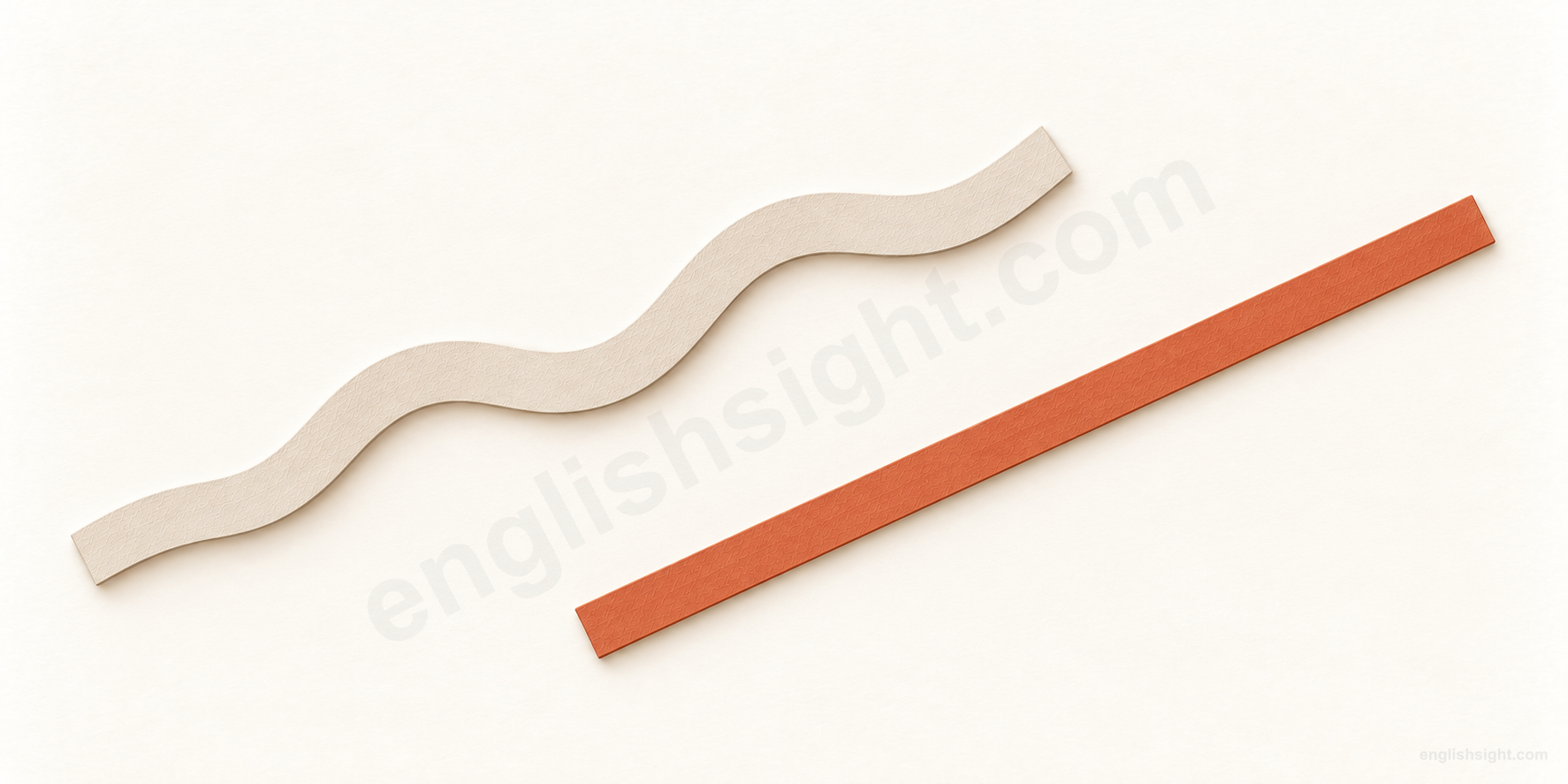
A cream strip bends from side to side.
straight
The orange strip keeps one direction without a bend.
Compare the courses, not their angle.
Straight means no bend or curve here; a diagonal line can be straight.
In its spatial uses, straight describes a line or course that keeps one direction, without a bend or curve. Related uses concern directness, proper alignment, or continuity.
The sketch compares two shapes; it does not show an action or a before-and-after transformation. It is a teaching model for the spatial sense, with other senses explained separately.
A straight line does not bend or curve. That simple relationship is a useful starting point for describing shapes and directions, and a memory aid for direct speech, clear understanding, and uninterrupted runs.
The grammar and situation still matter. Going straight home can involve winding roads; a straight answer can be long. Other established senses, including sexual orientation, drinks, and card hands, need their own contexts.
01
Shape, posture, and arrangement
Start with an unbending line, then notice a different use: something can be straight because it is properly aligned or in order.
01
a straight + noun; be / look straight; straighter / straightest
a straight line / road / edge
having no bend or curve
Situation / starting point
You compare a wavy edge with one that stays in one direction.
Meaning in this situation
The second edge is straight.
Straight describes the course or shape, regardless of its angle on the page.
An edge, road, or drawn line is straight when it does not turn or curve along its length. A diagonal line can be straight: horizontal and vertical describe its orientation instead.
The same adjective describes straight hair in contrast with curly or wavy hair. In clothing, a straight skirt has a cut that neither closely follows the body’s curves nor flares out. These are applications to shape, not judgments about appearance.
A straighter line is closer to the desired unbent shape. Dead straight is an emphatic expression meaning completely straight; dead does not describe a living thing here.
In a sentence
Use the ruler to draw a straight line across the page.
Watch the difference Straight does not mean horizontal, short, or flat. A line can slope and still be straight.
02
sit / stand (up) straight; keep + body part + straight
sit / stand up straight
hold your body upright without slouching
Situation / starting point
A seated person is leaning forward with a rounded back.
Meaning in this situation
They adjust to a more upright posture.
The body’s position is the focus; up belongs to sit up or stand up.
Sit up straight asks someone to sit upright. Straight is an adverb describing how to sit, with the same spelling as the adjective in Keep your back straight. Stand straight also describes an upright position without necessarily describing the act of standing up.
Ramrod straight and as straight as a ramrod strongly emphasize a rigidly upright posture, often with a serious or formal manner. They are vivid comparisons, not the ordinary form of every request to sit properly.
In a sentence
Maya sat up straight when the photographer raised the camera.
Watch the difference Use straight as the ordinary adverb here: sit straight, not sit straightly.
03
be straight; hang + object + straight; get / keep + object + straight
Is the picture straight?
level or aligned in the intended position
Situation / starting point
A rectangular picture hangs at a slight tilt.
Meaning in this situation
Its top edge is level with the wall’s horizontal reference.
The object may have straight edges even while its whole position is crooked.
A picture can have four unbent edges but still not be straight on the wall. Here straight describes alignment. A tie should hang in its intended central position; a row of teeth can be straight when the teeth are properly aligned.
Hang the picture straight describes how it is hung. Get the picture straight or make sure it is straight focuses on the resulting alignment. The verb supplies any action or change; straight supplies the target condition.
In a sentence
Could you move the left side up until the picture is straight?
Watch the difference Do not confuse straight alignment with a straight outline: a rectangular picture can hang crooked.
04
get / put + place / things + straight
get / put the house straight
make a place tidy and properly arranged
Situation / starting point
Boxes and belongings are scattered after a move.
Meaning in this situation
The room is tidy and things are in their proper places.
Straight can describe an orderly overall state, not a geometrically straight house.
Get the house straight means bring the house into order. Put the room straight has a similar organizing sense. The place is the object of get or put, and straight describes the result.
This sense is usually used after a verb. A straight house on its own does not normally tell a listener that the house is tidy. Compare get the facts straight, where the result is accurate understanding rather than a tidy room.
In a sentence
We spent Sunday getting the flat straight after the move.
Watch the difference The construction does not mean repairing bent walls; the situation tells you that order is intended.
02
Direction, destinations, and time
Straight can tell you where to continue, which target to look at, or how directly and promptly to do something. The following words determine the relation.
They continue forward rather than turning left or right.
Straight modifies the direction; ahead or on expresses continuing forward.
Go straight ahead gives a direction relative to where you are facing. Go straight on, especially familiar in British directions, likewise tells you to continue. Go straight is also possible when the intended route is clear.
These combinations are ordinary direction expressions, not a separable phrasal verb called straight on. Straight does not specify a distance or a speed: Go straight for another hundred metres adds the distance separately.
In a sentence
Go straight ahead at the lights, then take the second left.
Watch the difference Go straight ahead is a route instruction. Go straight to the station may instead emphasize avoiding other stops.
06
go / come straight to + place; straight home / back; straight from X to / into Y
go straight to / home / back
go to the destination directly, without another stop or delay
Situation / starting point
A class ends and you need to collect a parcel.
Meaning in this situation
You visit the post office next, without stopping elsewhere.
The destination is the next step; the roads need not form a geometrically straight line.
Go straight to a place often means go there immediately or without an intervening visit. Go straight home and come straight back use home and back without to. Straight from the office to the station identifies both the starting point and the next destination.
The same direct progression can be nonphysical: a student can go straight from school into a job. The surrounding nouns supply the stages. Straight does not promise that travel takes no time or that the road has no bends.
In a sentence
After class, I went straight to the post office to collect my parcel.
Watch the difference Say go straight home, not go straight to home. Distinguish a direct next destination from an unbending physical route.
07
look straight at + target; look + person + straight in the eye; straight + direction phrase
look straight at / straight in the eye
direct your gaze or action exactly toward a target
Situation / starting point
A photographer asks where you should look.
Meaning in this situation
Your gaze is directed at the camera lens.
The preposition names the target or relation; straight emphasizes its directness.
Look straight at something directs your gaze toward that exact target. Look someone straight in the eye combines the person as object with in the eye. It can suggest confidence or openness in context, but the words alone do not prove that someone is honest.
A ball can go straight into a basket, and someone can shoot straight when they aim accurately. A straight punch likewise travels directly toward its target. Read at, into, through, or past to understand the actual route or endpoint.
In a sentence
For the next photograph, look straight at the lens.
Watch the difference Look straight ahead names a forward direction; look straight at the lens names a particular target.
at once, immediately after something, or without hesitation
Situation / starting point
A message requires a prompt reply.
Meaning in this situation
You reply without waiting.
Here directness concerns time rather than the shape of a route.
Straight away means at once. Straight after lunch means immediately after lunch: after introduces the event used as the time reference. Straight after the meeting ends similarly uses a clause to name the event.
Informal straight off can mean without pausing or hesitating: I knew the answer straight off. Do not read every straight off literally as leaving a surface. Straight out can also be used in immediate or unhesitating statements, but with tell or ask it often emphasizes frankness; that use has its own entry below.
In a sentence
I replied straight away and booked the room straight after lunch.
Watch the difference Straight away can stand alone. Straight after normally names the reference event, as in straight after lunch, though context can supply an understood event.
03
Direct speech and correct understanding
These uses concern honesty, avoiding an evasive answer, or clearing up confusion. Learn who receives the truth and what is being made clear.
09
give / want / get + a straight answer; straight talking
a straight answer / straight talking
a clear, honest answer or manner of speaking
Situation / starting point
You ask whether a repair is included, but the reply avoids saying yes or no.
Meaning in this situation
You ask for a clear reply that addresses your question.
A straight answer avoids evasion; it need not be short or friendly.
A straight answer addresses what was asked without hiding the relevant truth. A straight question is similarly direct. Straight talking emphasizes a frank manner of discussing the issue.
The image of not turning aside can help you remember this use, but it is an established meaning about communication. Compare a correct answer: that emphasizes accuracy, whereas a straight answer emphasizes honesty and directness. Blunt adds a stronger suggestion of disregard for someone’s feelings.
In a sentence
Please give me a straight answer: does the price include the repair?
Watch the difference A straight answer can be “I don’t know.” Directness does not guarantee complete knowledge.
10
be straight with + person (about + topic); be being straight with + person
be straight with someone
be honest and open with a particular person
Situation / starting point
A colleague asks for the real reason a project is late.
Meaning in this situation
You openly explain the cause to that colleague.
With introduces the person receiving your honest account.
Be straight with me asks for honesty toward the speaker. About can add the subject: be straight with me about the cost. This is a relationship between a speaker and listener, not a statement about their posture.
The progressive is natural when it describes someone’s current behavior: You’re not being straight with me. The phrase as straight as a die is a stronger established comparison meaning completely honest; it is not about the person’s sexual orientation.
In a sentence
I’ll be straight with you: we cannot finish the work by Friday.
Watch the difference He is straight can have several meanings. Add with me or an explicit honesty context when honesty is what you mean.
11
tell + person + straight (out) + (that)-clause; tell it to + person + straight
tell someone straight / straight out
say something frankly without hiding or softening it
Situation / starting point
A speaker considers hinting at an unwelcome fact.
Meaning in this situation
They state it openly instead.
Straight is an adverb; out can add an emphasis on open, unreserved expression.
Tell me straight asks for a frank account. Tell someone straight out that… introduces the actual message with a that-clause. The phrase can sound forceful because the speaker chooses directness over tact.
Straight from the shoulder is a more colorful informal expression for direct, candid speech, including criticism. Its meaning is conventional: no shoulder movement is required. Compare straight off, which often emphasizes the lack of hesitation rather than honesty itself.
In a sentence
Nora told us straight out that she would not join the trip.
Watch the difference Use the normal objects of tell: tell me straight or tell it to me straight. Straight does not remove the need to identify the message or listener where required.
12
come / get straight to the point
come / get straight to the point
begin the main issue without a long introduction
Situation / starting point
You have little meeting time and need to raise the main problem.
Meaning in this situation
You state that problem immediately.
The point is the main topic; straight removes the detour through introductory talk.
Come straight to the point presents the important matter directly. Get straight to the point has the same practical function. This resembles going directly to a destination, but the destination is a topic rather than a place.
The phrase concerns relevance and timing, not necessarily honesty. A person can get straight to the point and still be mistaken. Saying this before an announcement often signals that the next words will be direct.
In a sentence
I’ll come straight to the point: the kitchen needs a new window.
Watch the difference Keep to in the phrase: to the point. Do not replace it with at just because a topic is a target.
13
get / keep + facts / details / this + straight
get something / your facts straight
make sure that information is understood correctly
Situation / starting point
Two accounts give different dates for a delivery.
Meaning in this situation
You establish which date is correct.
Get describes reaching clear, accurate understanding; straight describes that result.
Get the facts straight means check and organize the facts correctly. Let’s get this straight often introduces a clarification or a question checking what someone means. The object may be facts, details, this, or things.
The phrase can sound firm, especially in an argument. Keep the facts straight emphasizes continuing to remember or report them accurately. Neither expression necessarily means that someone deliberately lied.
In a sentence
Let’s get the dates straight before we send the invitations.
Watch the difference This is a result construction, not a separable phrasal verb called get straight: the object normally comes before straight.
14
set / put + person + straight (about / on + topic)
set / put someone straight
correct someone’s mistaken understanding
Situation / starting point
You believe a museum opens on Monday.
Meaning in this situation
A colleague tells you the correct opening day.
The person is the object; the information supplied corrects their belief.
Set someone straight about something or on something means explain the correct facts to that person. Put someone straight is another form. Straight describes their corrected understanding, not how their body is positioned.
Compare get something straight: that centers on establishing accurate information. Set me straight if I’m wrong invites correction from someone else. The whole construction can sound firm, but correction need not be hostile.
In a sentence
I thought the museum opened on Monday, but Jo set me straight about the opening day.
Watch the difference Set me straight means correct my understanding. Set the picture straight concerns an object’s alignment instead.
15
set / put the record straight (about / on + topic)
set / put the record straight
correct a false account that people have accepted
Situation / starting point
A report says a shop has permanently closed.
Meaning in this situation
The owner explains that it is only being painted.
The record is the accepted account, not necessarily a physical recording.
Set the record straight replaces a misleading public or shared account with the correct information. Put the record straight has the same meaning. The expression is useful when responding to a rumor, report, or misunderstanding.
Compare get the facts straight, which can be a private check before anyone speaks. Setting the record straight specifically responds to something inaccurate that has already been believed or said.
In a sentence
To set the record straight, the shop is closed for painting, not for good.
Watch the difference This does not require an audio record, and it is more specific than simply telling someone a new fact.
16
(can / cannot) think straight
think straight
think clearly and logically
Situation / starting point
Noise and tiredness make it hard to work something out.
Meaning in this situation
You say your thinking is not clear enough.
Straight describes the quality of thinking, not a direction in physical space.
Cannot think straight commonly describes confusion caused by tiredness, stress, or distraction. The positive form is possible too: I need some quiet so I can think straight.
This is about clear reasoning. It is different from being straight with someone, which concerns honesty toward another person. Someone may be honest while too upset to think clearly.
In a sentence
With the alarm ringing, I could not think straight enough to remember the code.
Watch the difference Straight already works as an adverb. Think straightly is not the ordinary expression.
04
Unbroken series and clear choices
In a series, straight excludes an interruption. In a choice, it presents two clear alternatives. Neither use describes a physical line.
17
number + straight + plural noun; ordinal + straight + singular noun; win in straight sets
three straight wins / win in straight sets
a series with no intervening loss
Situation / starting point
A team wins its first, second, and third matches in succession.
Meaning in this situation
You describe three straight wins.
Straight excludes an interruption in the relevant series.
Three straight wins means three consecutive wins, without a loss or draw between them. Our third straight win identifies the latest win in that run. Straight normally comes before the noun in this adjective use.
In tennis, winning in straight sets means winning the match without losing a set. It does not mean winning every point or game. The relevant units come from the sport, not from the word straight alone.
In a sentence
Saturday’s result gave the team its fourth straight win.
Watch the difference Four wins in a season need not be four straight wins; a losing match between them breaks the run.
18
(for) + duration + straight; for + number + straight + time unit
for two hours straight / two straight hours
continuously for the stated period
Situation / starting point
You read from two o’clock until four without taking a break.
Meaning in this situation
The reading lasted two hours straight.
The period is uninterrupted; straight does not mean fast or exactly on schedule.
After a duration, straight is an adverb meaning continuously. In two straight hours, it is an adjective before the time noun. For can introduce the duration, but some verbs also allow it to be omitted: We talked two hours straight.
Compare every day for a week: that can allow overnight breaks. For a week straight emphasizes a continuous or unbroken run at the level intended by the context; the activity and time unit tell you what counts as an interruption.
In a sentence
We waited outside for two hours straight, without going indoors.
Watch the difference Straight emphasizes continuity, not speed. A slow activity can continue for hours straight.
19
get / earn straight A’s; a straight-A student
get straight A’s / a straight-A student
receive A grades in all the relevant subjects
Situation / starting point
A report shows an A in every subject.
Meaning in this situation
You call the results straight A’s.
The grades are consistently A’s across the relevant set.
Straight A’s refers to A grades throughout the relevant report or group of classes. The expression is especially associated with North American grading. A straight-A student is a student with such results.
This resembles an unbroken series, but the full expression has a school-specific meaning. It does not say that every numerical mark was perfect or that the student has had no other grade in their entire life.
In a sentence
Leah earned straight A’s on her final report this year.
Watch the difference Keep A as the grade name. Straight does not mean that the written letters have straight strokes.
20
a straight choice / fight between X and Y
a straight choice / a straight fight
a decision or contest involving two clear alternatives or opponents
Situation / starting point
The printer cannot be repaired because spare parts are unavailable; you must replace it or do without it.
Meaning in this situation
You present those two options directly.
The choice is clearly defined; it is not necessarily easy or morally obvious.
A straight choice between X and Y presents two alternatives without other possibilities complicating the choice. Straight comes before choice in this meaning. Both alternatives can still be expensive or difficult.
A straight fight between two candidates or teams describes a contest directly between those two, especially in British English. Here fight can mean competition rather than physical violence; straight is not merely a claim that the contest is honest.
In a sentence
With no spare parts available, it is a straight choice between replacing the printer and doing without it.
Watch the difference A straight choice means a clear two-way choice, not automatically a simple decision to make.
05
Expressions to learn as a whole
A face, a horse’s mouth, a way of playing, and a way of living give the complete expressions their established meanings.
21
keep a straight face; say + something + with a straight face
keep a straight face / with a straight face
avoid smiling or laughing when something seems funny
Situation / starting point
A friend gives an absurd excuse and you want to laugh.
Meaning in this situation
You manage to keep your expression serious.
The expression concerns visible amusement, not the shape of facial features.
Keep a straight face means hold back a smile or laugh. Say something with a straight face describes delivering it seriously even if it is funny, absurd, or hard to believe.
A straight face does not prove that the speaker believes the statement. A person can tell a joke or an untruth with a serious expression. This is an established idiom; do not build its meaning from the geometry of a face.
In a sentence
I tried to keep a straight face when Ben blamed the missing cake on the cat.
Watch the difference It does not mean having a narrow or uncurved face, and it does not guarantee honesty.
22
hear / get + information + (straight) from the horse’s mouth
straight from the horse’s mouth
directly from a person who knows through personal involvement
Situation / starting point
You want to know whether a shop will reopen.
Meaning in this situation
The owner tells you the news personally.
The source is directly involved rather than another person passing on a rumor.
This informal idiom marks information as coming from someone closely involved in the matter. For example, a plan’s organizer may tell you the plan directly. Straight reinforces the absence of intermediaries.
The horse is part of the fixed expression, not a real participant in the conversation. Direct involvement can make information useful, but the idiom is not a guarantee that the source is correct or truthful.
In a sentence
The shop reopens next week; I heard it straight from the horse’s mouth when the owner called.
Watch the difference Use the whole idiom for a directly involved source; it does not mean any news that happens to arrive quickly.
23
play it straight; play straight with + person
play it straight
act honestly without trying to deceive someone
Situation / starting point
A seller could hide a fault from the buyer.
Meaning in this situation
They explain the fault openly.
Play refers to how someone handles the situation, not necessarily a game.
Play it straight can mean deal honestly and avoid tricks. It is possible in a sale, negotiation, or personal relationship as well as in games. The pronoun it is fixed in this expression; replacing it with an arbitrary noun does not automatically preserve the idiom.
The phrase also has a performance use: play a scene straight means perform it seriously rather than turn it into a joke. Read the object and context to distinguish honest conduct from a serious acting style.
In a sentence
We decided to play it straight and tell the buyer about the damaged screen.
Watch the difference This use does not tell someone to move a game piece in a straight line. A performance context may instead mean acting seriously.
24
go straight; stay on the straight and narrow; keep + person + on the straight and narrow
go straight / stay on the straight and narrow
leave crime behind or continue on an honest, acceptable course
Situation / starting point
A former criminal decides to stop breaking the law.
Meaning in this situation
They try to live honestly.
These expressions concern a way of living, not a literal walking direction.
Go straight is an informal expression for giving up a criminal way of life. Compare Go straight at the crossroads, where the route context produces an ordinary direction instruction.
The straight and narrow is a fixed noun phrase for an honest or morally acceptable course. Stay on the straight and narrow or keep someone on the straight and narrow can concern avoiding trouble more generally; it does not always imply a past criminal conviction. The standards of acceptable behavior depend on the speaker and situation.
In a sentence
After leaving prison, he found steady work and was determined to go straight.
Watch the difference Go straight can be literal in directions or idiomatic in a crime context. It does not ordinarily mean change your sexual orientation.
06
Meanings supplied by the setting
People, drinks, races, cards, and theatre activate different established senses. Use the context rather than trying to turn each one into a claim about shape or honesty.
25
be straight; a straight person; straight people
be straight
be heterosexual
Situation / starting point
People are discussing sexual orientation.
Meaning in this situation
A person describes themselves as straight.
This is a sense about attraction, separate from shape, honesty, and correctness.
In this context, straight is an informal adjective meaning heterosexual, ordinarily describing someone attracted to people of a different sex or gender. A straight friend uses it before a noun; I’m straight uses it after be.
Dictionaries also record the count noun a straight and the plural straights. For ordinary reference, straight person or straight people is often a clearer way to keep the person explicit. The label does not tell you whether someone is married or currently in a relationship.
Treat this as a separate established sense. It does not imply that other sexual orientations are bent, dishonest, or wrong; the line drawing is not an explanation or a standard for people’s identities.
In a sentence
When the conversation turned to dating, Alex said that he was straight.
Watch the difference Be straight with me asks for honesty. Be straight in a conversation about attraction refers to orientation; context distinguishes them.
26
drink + liquid + straight; a straight + drink name
drink something straight / a straight drink
have a drink without mixing another liquid into it
Situation / starting point
A person can add water or a mixer to a drink.
Meaning in this situation
They choose to drink it on its own.
Straight concerns the absence of mixing, not a drinking speed or a direction.
Drink whisky straight means drink it without adding another liquid. A straight whisky uses the adjective before the drink name. Neat is a familiar equivalent, particularly in British English.
The same basic idea can apply outside alcohol: concentrated juice drunk straight has not been diluted. Follow the product instructions; the word describes how something is served or consumed, not whether that is the intended preparation.
Bar expressions such as straight up can have more specific serving conventions. Do not infer an exact temperature or ice treatment from a general lesson about straight; make the serving request explicit when it matters.
In a sentence
Ravi prefers his whisky straight rather than mixed with soda.
Watch the difference Drink it straight means without mixing; drink it straight away means drink it immediately.
27
a / the + straight; on / along + the straight; plural straights
a straight / the back straight
a part of a road or racetrack that does not curve
Situation / starting point
A racing circuit has bends and unbending sections.
Meaning in this situation
A driver reaches one of the unbending sections.
Straight is now a countable noun naming a section.
A straight is a straight stretch of road or track. It can take an article and a plural: the next straight, the long straights. Back straight names the straight section on the back part of a circuit.
North American English also uses straightaway for this noun. Compare a straight road: there straight is an adjective describing road; in on the straight, straight itself is the noun.
In a sentence
The driver passed the blue car on the back straight.
Watch the difference A straight section can follow a bend; the noun does not say the entire circuit is straight.
28
be in / on the home straight; enter / reach the home straight
in / on the home straight
in the final part of a race or task
Situation / starting point
Most of a report is finished and only its conclusion remains.
Meaning in this situation
You describe the project as nearing completion.
The final straight part of a race supplies a metaphor for the last stage.
The home straight is the last part of a race. It can also name the last stage of an activity. In the home straight and on the home straight both occur; the key idea is approaching the finish.
The expression is especially British. The home stretch is the familiar North American alternative. Being in this stage does not mean the race or work is already finished, and it does not promise that the final part will be easy.
In a sentence
With only the conclusion left to write, we are in the home straight with the report.
Watch the difference Home belongs to the fixed expression here. It need not describe anyone’s house or a journey home.
29
have / make + a straight; a straight flush
a straight / a straight flush
a poker hand with five cards of consecutive ranks
Situation / starting point
A poker hand contains five ranks in sequence.
Meaning in this situation
The hand can be classified as a straight.
This is a technical card-game noun, not the physical arrangement of the cards.
In poker, a straight consists of five cards in rank order, such as 4, 5, 6, 7, and 8. The suits need not be the same. A straight flush adds the requirement that all five cards are in one suit.
The sequence is what connects this sense with continuity. Merely laying five unrelated cards in a straight physical row does not make a straight. This entry recognizes the term; detailed poker rankings and special ace rules are outside the lesson.
In a sentence
Her 4, 5, 6, 7, and 8 formed a straight despite their different suits.
Watch the difference A straight concerns consecutive ranks; a flush concerns a shared suit. A straight flush satisfies both.
30
a straight play / actor; play + scene / role + straight
a straight play / play a scene straight
serious drama or a performance without comic treatment
Situation / starting point
An actor is known for comedy and now takes a serious dramatic role.
Meaning in this situation
A review contrasts the new performance with the actor’s comic work.
Theatre supplies a separate sense; this is not a statement about the actor’s identity.
A straight play or a straight actor can refer to serious dramatic theatre in contrast with comedy or musical theatre. This adjective normally comes before the noun in that use. The sense is useful when reading reviews, rather than a general synonym for good acting.
Play the scene straight means perform it seriously instead of emphasizing its comic possibilities. The situation distinguishes this from play it straight meaning act honestly. An actor’s sexual orientation is a different matter entirely.
In a sentence
Known for comedy, she surprised the audience with a role in a straight play.
Watch the difference A theatre contrast can make straight mean serious. In an identity discussion, a straight actor can instead mean an actor who is heterosexual.
Read the whole construction
The adjective and adverb share a form
Pronunciation is /streɪt/. Compare a straight line, where straight modifies a noun, with walk straight, where it modifies the action. Straighter and straightest are available when degrees make sense. Straightly is not the ordinary adverb in these patterns. To describe the action of making something straight, normally use straighten or make something straight rather than treating straight as an everyday verb.
A state is different from a change
The picture is straight reports alignment. Get the picture straight describes achieving that alignment; keep it straight describes maintaining it. These are verb + object + result/state constructions, not a family of separable phrasal verbs headed by straight. The adjective itself supplies neither a tense nor a causative action.
Two different kinds of directness
Go straight ahead concerns a direction. Go straight to the office often means make the office your next destination. Straight away and straight after concern timing. An honest answer, a correct belief, and a clear argument are also different: use the expression that matches what you want to emphasize.
Do not apply the line metaphor to identities
Straight meaning heterosexual is an established sense, not a judgment that one orientation is correct. The adjective also has informal uses for conventional, sometimes supposedly boring behavior. For example, They thought his lifestyle was too straight expresses their attitude toward his conventional lifestyle; it is not a neutral definition of normality. Context is essential.
Recognition and scope
Older informal British Straight up? can ask whether something is really true; Straight up! can insist that it is. It is not a universal everyday reply. Specialized engine layouts, pricing terms, boxing combinations, and slang for sobriety or settled debts are not developed here. Compounds such as straight-faced, straight-laced, and straight shooter have their own usage restrictions. This is a practical selection, not a frequency ranking or a claim to cover every historical sense.
Choose the meaning that fits
Use the situation, the grammar, and the complete expression. The line sketch is a starting point, not an answer to every question.
1. A line rises diagonally across a page without bending. Which description fits?
2. You go straight to the hospital after work. The road has several bends. Which interpretation fits?
3. A menu says Ravi drinks whisky straight. What does straight describe?
4. A newspaper says your shop has closed forever. You explain that it is closed for painting. Which expression best names that correction?
5. A team’s results are win, win, loss, win. Which statement fits?
6. Someone tells a ridiculous joke with a straight face. What can you conclude from the phrase alone?
7. A colleague says, “Please be straight with me about the delay.” What are they asking for?
8. You want a person to continue forward at a junction. Which ordinary direction is natural?
Sources and teaching notes
Usage was checked against the dictionary pages below. The explanations, examples, and comparison sketch were written for this lesson. The spatial connection is a teaching aid, not a rule that predicts every expression.
This comparison helps explain a spatial relationship; it does not represent a picture shared by every native speaker.