From physical material to essential content, value, and factual support.
Material and form are different
Material and form are different
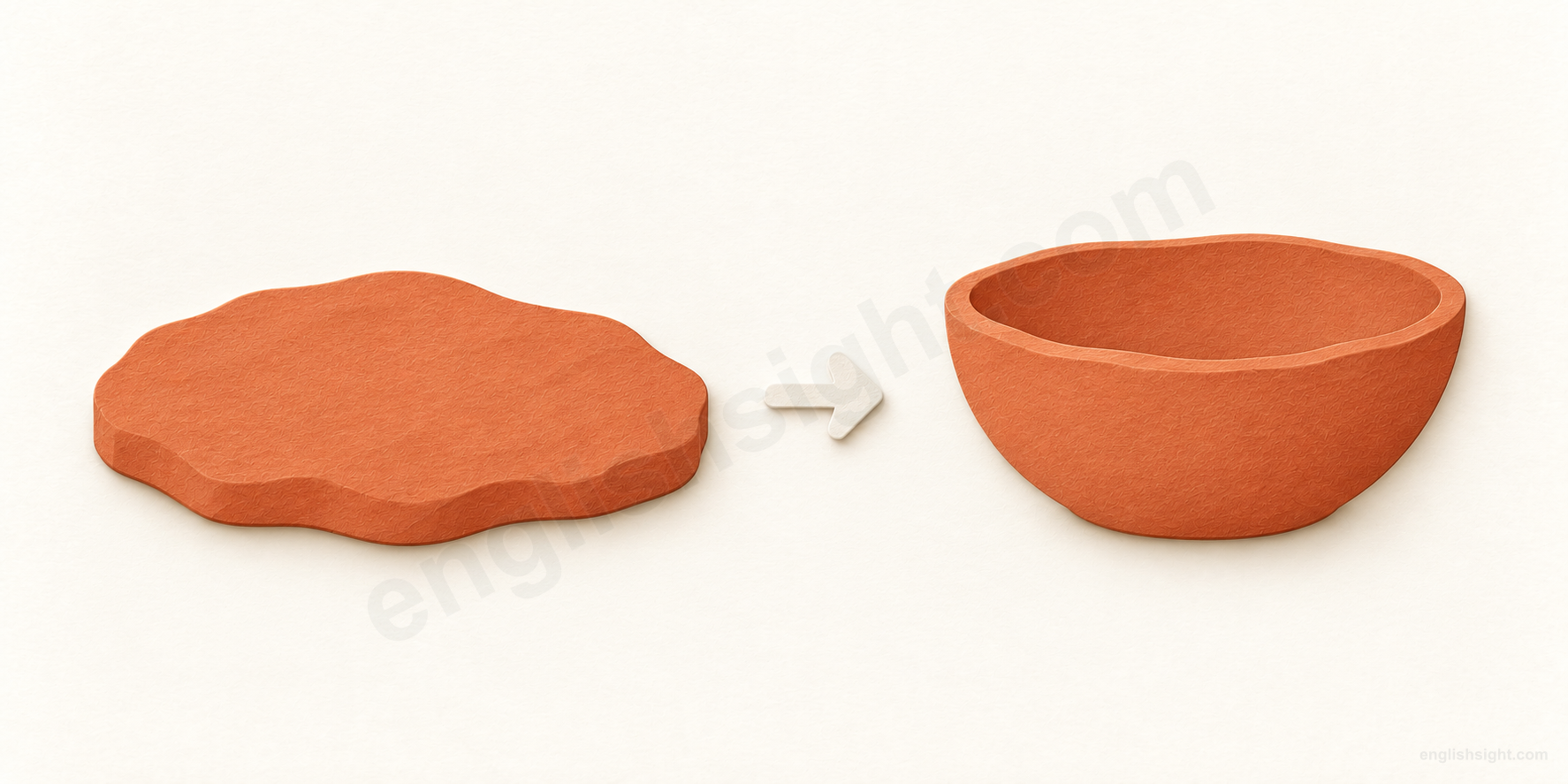
A flattened piece of clay
substance
A bowl of the same clay
The clay is reshaped.
The shape changes; the substance remains clay. Abstract uses concern content, value or support rather than literal clay.
Substance can name what something is made of, or the real content, value, or factual support it has.
The clay example isolates material from shape. In abstract uses, content is not literally clay inside words; each construction tells you which kind of substance is meant.
A substance may be a liquid you cannot identify. The substance of a conversation is the main content of what was said. A speech with substance offers something worth hearing. These uses share a useful teaching connection: attention to what is really there.
That connection is a memory aid, not a rule that predicts every phrase. The drug-related combinations and the expression a person of substance need their own context. The diagram is not a claim about an image shared by every English speaker.
01
Materials and drug-related language
Start with a kind of material, then notice the special drug-related combinations used in reports and information leaflets.
01
a/an + adjective + substance; plural substances
a substance / substances
a kind of physical material
Situation
You notice a clear film on a window.
What the expression conveys
You describe the material without identifying it.
Substance identifies material; it does not tell us its exact name.
A substance can be solid, liquid, or gas. A sticky substance describes a property, while an unknown substance says its identity is uncertain. Neither expression implies that it is artificial or dangerous.
Use a substance for one material or kind, and substances for several kinds: The sample contains two substances. This does not count two drops of the same liquid as two substances. Matter is usually uncountable; stuff is an informal, less precise alternative.
Substance is uncountable when it refers to physical body or solidity: The soup needs more substance means it needs more body or substantial ingredients. This is different from identifying a chemical.
Example
A sticky substance had dried around the lid.
Watch the difference Do not use substance as a general replacement for thing: a chair is an object, not normally a substance.
02
a controlled / illegal / banned substance
a controlled / banned substance
a drug in a legal or rule-based context
Situation
A report discusses a drug rather than an ordinary material.
What the expression conveys
The modifier identifies a restriction.
Controlled, illegal, and banned describe different kinds of restriction.
In official reporting, substance can stand for a drug. A controlled substance is regulated by law; it is not necessarily forbidden in every circumstance. Banned substance often occurs in sport, where rules prohibit a particular drug.
The context and adjective supply the restriction. Chemical substance is a broader expression and does not itself mean drug. Learn the combination rather than assuming that every use of substance refers to drugs.
Example
The runner was suspended after a test detected a banned substance.
Watch the difference Do not treat controlled as a synonym for always illegal; this lesson explains wording, not a particular legal classification.
03
substance + use / abuse
substance use / substance abuse
expressions about using drugs or alcohol
Situation
A leaflet discusses problems connected with drugs or alcohol.
What the expression conveys
Substance modifies a noun naming use or harmful use.
Use does not automatically mean abuse.
In substance use, substance functions as a noun modifier. The expression refers to the use of drugs or alcohol in the relevant context. Substance abuse is an established expression for harmful or improper use, not the ordinary use of any material.
The whole expression supplies the meaning. A workshop about substance abuse is not about damaging physical objects. Keep substance singular in these noun combinations even when several drugs are being discussed.
Example
The community centre runs workshops on substance abuse.
Watch the difference Substance use and substance abuse are related expressions, but they are not interchangeable in every sentence.
02
The essentials of a message
Separate the main content from its words, format, and smaller details.
04
the substance of + noun phrase
the substance of…
the central content or message
Situation
A report contains many pages and details.
What the expression conveys
You identify what it mainly says.
Of introduces the speech, report, or discussion whose content matters.
The substance of a message is what it essentially communicates. To ask for the substance of a discussion is to ask what was really discussed, rather than who spoke first or which exact words they used.
This use normally has the substance of, not a substance of. A topic is what a discussion is about; its substance is the actual main content. The substance may be complex, not just a one-sentence summary.
Example
Please explain the substance of the agreement in two minutes.
Watch the difference Do not confuse the substance of the agreement with the physical material of the paper it is printed on.
05
in substance; the same / different in substance
in substance
in the essentials, despite differences of form or detail
Situation
Two proposals use different words.
What the expression conveys
You compare what they actually amount to.
The phrase directs attention to essentials.
In substance is a fairly formal way to focus on the underlying content. Two plans can be the same in substance even if their headings and wording differ. Compare form and substance: how something is presented versus what it contains.
In substance, I agree can leave room for disagreement over details. In substance can also mean in reality: a change described as temporary may in substance be permanent. This is an established phrase, not a location inside material.
Example
The revised plan is the same in substance, although the wording is clearer.
Watch the difference In substance does not mean in detail; agreement on essentials need not cover every small point.
03
Depth, significance, and standing
These abstract uses assess content or importance. The established expression about a person has its own meaning.
06
have / lack substance; lack of substance; style over substance
have / lack substance
contain worthwhile ideas, detail, or depth
Situation
A presentation looks impressive.
What the expression conveys
You assess whether it says anything useful.
Substance evaluates the content, beyond its presentation.
A proposal with substance offers real ideas or useful detail. A proposal that lacks substance may sound attractive but leave the practical questions unanswered. Without substance and lacking in substance express a similar criticism.
Style over substance criticizes attention to appearance at the expense of meaningful content. This is an evaluation, not a claim that the words have no physical existence. Unlike the substance of the report, which identifies its content, the report lacks substance judges that content insufficient.
Example
The pitch had plenty of style but very little substance.
Watch the difference A claim lacking substance may lack evidence; a plan lacking substance may lack detail. Let the noun and context guide the interpretation.
07
noun / something / nothing + of (any) substance
something / matters of substance
something significant or worthwhile
Situation
A long meeting has ended.
What the expression conveys
You ask whether anything important was achieved.
Of substance describes significance, not physical composition.
Of substance can follow a noun or an indefinite pronoun: matters of substance, something of substance, nothing of any substance. These are fairly formal ways to refer to important issues or meaningful results.
Compare an issue of substance with an issue about a substance. The first is significant; the second concerns a material. Something substantial is often a simpler alternative, but the adjective can also mean large in amount.
Example
After an hour of discussion, we had agreed on nothing of substance.
Watch the difference Use nothing of substance, not nothing of a substance, for this abstract meaning.
08
a man / woman / person of substance
a person of substance
a person with wealth, power, or influence
Situation
A formal description introduces an influential local figure.
What the expression conveys
Of substance refers to that person’s standing or resources.
This established description is different from an important issue.
A man or woman of substance is a formal expression for someone wealthy or influential. You may meet it in older stories, biographies, or formal descriptions; person of substance is a gender-neutral version.
Do not infer moral goodness from the expression. It describes social or material standing. Its connection with material resources is worth recognizing, but it is not a general rule for interpreting every noun followed by of substance.
Example
The novel describes her uncle as a man of substance in the town.
Watch the difference A man of substance is not simply a man made of physical material, and it does not guarantee good character.
04
A basis for belief or a more definite idea
Ask what supports a statement, or what gives a vague plan real content.
09
have substance; there is some / no substance to / in + claim
substance to / in a claim
a factual basis for believing something
Situation
A rumour is circulating.
What the expression conveys
You assess whether it has factual support.
Substance here concerns grounds for belief.
There is some substance to a claim says it has a factual basis; there is no substance in a rumour rejects such a basis. To and in both occur in this family of expressions. A claim can also be without substance.
Some substance is a cautious assessment, not confirmation of every allegation. This is separate from summarizing the substance of a claim, which reports what the claim says without deciding whether it is true.
Example
There may be some substance to the complaints about late deliveries.
Watch the difference Do not add a or make substance plural when you mean factual support.
10
give / lend / add substance to + claim / idea / proposal
give / lend substance to…
provide support or make an idea more concrete
Situation
An argument has little support, or a plan is vague.
What the expression conveys
Evidence or detail makes it more credible or definite.
The subject supplies support or content; the to-phrase names what gains it.
When records give substance to a claim, the records provide support. Lend substance to works similarly; lend does not imply a later return. Add substance to can describe contributing more detail or weight.
With an idea or plan, give substance to can mean turn something vague into something definite: A budget gave substance to the proposal. Here substance refers to definite content, not the literal transfer of a material. Evidence can strengthen a claim without proving it completely.
Example
The dated receipts lent substance to her account of the journey.
Watch the difference Say give substance to a claim, not give a substance to a claim, for this abstract meaning.
Choose the meaning from the construction
Count kinds, not abstract support
A substance and several substances normally name materials or drugs. Use much, little, some, or no substance for depth, content, or factual basis. The substance of a report takes singular agreement.
Form, style, content, and truth
A report may be stylish, have a clear main message, and still lack evidence. The substance of the report names its content; a report with substance praises its depth; substance to its claims concerns factual support.
Noun grammar and scope
Substance is a noun, pronounced /ˈsʌbstəns/, with plural substances. Substance use is a noun combination; give substance to is a verb–noun construction, not a phrasal verb. Verb-specific passive, progressive, and causative patterns are therefore not separate forms of this headword.
Coverage boundaries
This lesson selects modern general uses and recognizable formal expressions. Specialized philosophy, religious doctrines, paper-weight terminology, and technical chemical measurement are outside its scope. It does not rank these expressions by frequency.
Read the whole expression
Decide whether substance concerns a material, content, value, or support.
1. A sample contains water and oil. Which sentence treats them as two kinds of material?
2. A colleague asks for the substance of the meeting. What should you explain?
3. New records make an allegation more credible. Which sentence fits?
4. Two agreements differ in wording but have the same essential terms. Which description fits?
5. A historical novel calls someone a woman of substance. What does that established expression suggest?
Sources and teaching notes
Dictionary entries support the meanings and patterns below. The explanations, examples, and clay diagram are original teaching material; the visual link is a teaching interpretation.
This diagram is a teaching aid, not an image shared by every native speaker.