From a kitchen ingredient to drink servings and established expressions.
A substance that adds sweetness
A sweet substance added to something
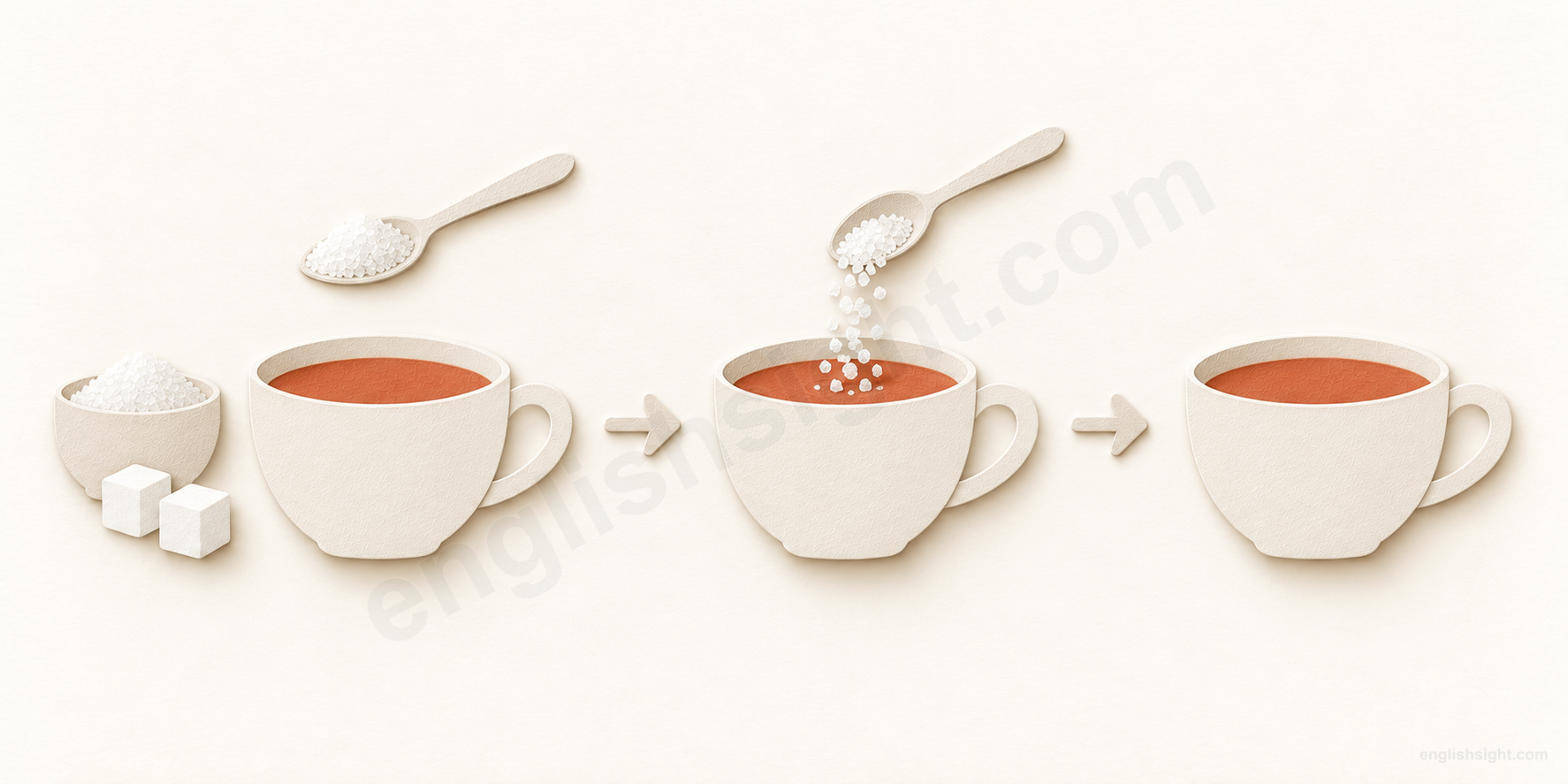
The sugar is separate from the tea.
sugar
After the sugar dissolves, the tea is sweeter.
A spoon tips sugar grains into the tea.
Sugar can dissolve and make the tea sweeter without changing its color.
Sugar is a sweet substance; adding it to food or drink can make that food or drink sweeter.
The picture illustrates adding table sugar. It does not explain chemical categories, prove a change in energy, or predict every informal expression.
Picture sugar separate from a drink, then being added to it. The substance can dissolve while the drink becomes sweeter. This simple relationship helps with the ingredient and the verb.
Other uses need their own grammar or convention: two sugars counts servings, natural sugars names substances, and sugar the pill is an idiom. The picture is a teaching model, not a shared mental image claimed for every English speaker.
01
Sugar in the kitchen and at the table
Start with the sweet ingredient. Choose a quantity, describe your drink, or identify the kind a recipe needs.
01
some / a little / much sugar; sugar + singular verb
some sugar
the sweet substance used in food and drink
Situation before
You are preparing a cake mixture.
Meaning or result
You add the sweet ingredient.
Sugar usually names a material, not separate objects.
As an everyday ingredient, sugar is normally uncountable: some sugar, a little sugar, or too much sugar. Say The sugar is in the cupboard, using a singular verb even when the bag contains thousands of grains.
Sugar names a substance; sweet describes a taste. A sweet apple need not have had table sugar added. For individual pieces of confectionery, use sweets in British English or candy in American English rather than calling every piece a sugar.
In a sentence
There is a little sugar left in the jar.
Watch the difference For a general amount, say a little sugar, not a few sugar.
02
a / two + measure(s) + of sugar; add sugar to + food
a spoonful of sugar
give a measured amount of the substance
Situation before
The recipe specifies an amount.
Meaning or result
You measure sugar before mixing it in.
The measure word supplies the countable unit.
A spoonful of sugar, two teaspoons of sugar, a bag of sugar, and 100 grams of sugar measure or package an uncountable substance. The plural belongs to spoonfuls, teaspoons, bags, or grams, not to sugar.
Ask How much sugar do we need? when you want an amount. Ask How many bags of sugar? when you are counting packages. Add sugar to the mixture and sprinkle sugar over the fruit name different ways of putting it in or on food.
In a sentence
Stir two teaspoons of sugar into the mixture.
Watch the difference A bag of sugar is a package; two sugars usually means servings for a drink.
03
take sugar in + drink; one sugar / two sugars
take sugar / two sugars
have sugar in a drink; count its servings
Situation before
You are making tea for a visitor.
Meaning or result
You learn whether they want sugar and how much.
A drink context allows sugar to count spoonfuls or cubes.
Do you take sugar? asks whether someone has sugar in tea or coffee. Here take describes a preference; it does not ask them to carry sugar away. No sugar, please and I have mine without sugar are useful replies.
One sugar or two sugars means one or two small spoonfuls, cubes, or similar serving units in this context. It does not count individual grains. In a recipe, use a precise measure instead, since serving sizes can vary.
In a sentence
“How many sugars would you like?” “One, please.”
Watch the difference How much sugar? asks about an amount; How many sugars? counts drink servings.
04
white / brown / granulated + sugar; sugar + bowl / cube / lump
white / brown / granulated sugar
identify a kind or form of the ingredient
Situation before
You see several bags on the shelf.
Meaning or result
You choose the kind the recipe names.
The describing word identifies the sugar, not a new action.
White sugar and brown sugar distinguish familiar kinds by color. Granulated sugar describes sugar in small grains. A sugar cube or sugar lump is a solid serving piece; a sugar bowl is the container used to hold sugar.
Sugar cane and sugar beet name plants used to produce sugar. In these combinations, sugar helps specify another noun. A sugar bowl is a kind of bowl, not a bowl made from sugar; read the whole compound rather than applying one material rule to every combination.
In a sentence
The recipe calls for brown sugar, so I bought a small bag.
Watch the difference Sugar is normally singular before another noun: a sugar bowl, not a sugars bowl.
You identify the intended texture and regional name.
Fine grains and powder are different forms.
Caster sugar, also spelled castor sugar in British English, has very fine grains. Icing sugar is a fine white powder used to make icing. These are names to learn as whole ingredient expressions, not verb instructions involving casting or ice.
In American English, icing sugar is called powdered sugar or confectioners’ sugar. The different names can refer to the same ingredient across recipes; caster sugar and icing sugar do not simply mean the same thing.
In a sentence
I need icing sugar for the topping, not caster sugar.
Watch the difference Do not identify icing sugar only as any sugar used while baking.
02
Sugar in food and everyday information
A label, a science explanation, and a conversation about blood sugar use related vocabulary with different scopes.
06
natural / fruit sugars; a sugar; types of sugar
natural sugars
members of the chemical family found in foods
Situation before
A text describes what is in fruit.
Meaning or result
You understand sugars as substances rather than drink portions.
Plural sugars can name different sugar substances.
In food and science writing, sugars can mean substances such as glucose and fructose. A sugar can identify one member of this family. This countable use differs from uncountable sugar as a kitchen ingredient.
Fruit contains natural sugars is about substances present in the fruit. Two sugars in my tea is about serving units. The plural alone does not tell you which meaning is intended; the subject matter does.
In a sentence
The lesson names glucose and fructose as two sugars.
Watch the difference Two sugars in a science explanation need not mean two spoonfuls.
07
no added sugar; high / low in sugar; sugar-free + noun
no added sugar / sugar-free
distinguish adding sugar from containing it
Situation before
You read wording on a drink carton.
Meaning or result
You distinguish a process claim from a content description.
No added sugar says what was not put in.
Added sugar refers to sugar put into food or drink. No added sugar therefore does not, by itself, say that the product contains no naturally occurring sugars. High in sugar and low in sugar describe the amount it contains.
Sugar-free is an adjective meaning without sugar in ordinary dictionary usage; sugarless is another form, especially in North American English. The suffix -free means absence here, not a price of zero. This is a language distinction, not a guide to technical labeling thresholds.
In a sentence
This juice has no added sugar, but it still contains natural sugars.
Watch the difference Do not automatically replace no added sugar with sugar-free.
Blood sugar is an established compound about glucose.
Blood sugar refers to the amount of glucose in a person’s blood. Blood sugar level makes the measurement explicit. In this compound, sugar does not mean visible white crystals or a serving added to tea.
You can say check someone’s blood sugar or blood sugar levels. In My blood sugar is high, the phrase is treated as singular. The lesson explains the expression; it gives no numerical ranges or treatment instructions.
In a sentence
The nurse recorded my blood sugar level.
Watch the difference Sugar here is part of a fixed measurement expression, not a count of sugar cubes.
09
have / get a sugar rush
a sugar rush
a short burst of energy attributed to eating sugar
Situation before
A character eats sweets in a story.
Meaning or result
The narrator describes a brief energetic spell.
Rush suggests a sudden, short-lived feeling or effect.
A sugar rush is a familiar expression for a brief burst of energy attributed to sweet food or drink. It is countable: a sugar rush. You may hear have a sugar rush or get a sugar rush.
This unit teaches what people mean by the expression. Its use in a story or conversation does not establish a medical explanation for someone’s behavior. The cup diagram does not represent a measured change in energy.
In a sentence
The narrator calls the child’s sudden excitement a sugar rush.
Watch the difference Do not use sugar rush as another name for a blood sugar measurement.
03
Adding sweetness, literally and figuratively
The verb names adding sugar. Established expressions extend sweetness to making something easier to accept.
10
sugar + food / drink; sugared + noun; be sugared; figurative be sugared with + pleasant addition
sugar the fruit
add sugar to food or cover it with sugar
Situation before
The fruit has not been sweetened.
Meaning or result
Sugar is mixed with it or sprinkled over it.
The noun also supplies a verb for adding the substance.
To sugar something means to add sugar to it or cover it with sugar. The food or drink is the direct object: sugar the fruit, sugar the coffee. Sugared fruit describes the result; The fruit was sugared is an ordinary passive.
Forms are sugar, sugars, sugared, and sugaring. Add sugar to the fruit often makes the action especially clear. Sweeten the fruit is broader: sweeten describes the change of taste and does not specify sugar as the ingredient.
In writing, sugar can also mean make something more pleasant or attractive: The criticism was sugared with praise. This figurative use depends on context; it does not describe an ingredient being added.
In a sentence
She sugared the sliced strawberries before serving them.
Watch the difference Say sugar the fruit or add sugar to the fruit, not sugar to the fruit.
11
sugar / sweeten the pill; sugar the pill by + -ing
sugar / sweeten the pill
make an unpleasant situation easier to accept
Situation before
A service price is going to rise.
Meaning or result
The company offers a benefit alongside the unwelcome change.
Something pleasant accompanies something unwelcome.
Sugar the pill, also sweeten the pill, is an established idiom, particularly associated with British English. It uses the idea of making bitter medicine easier to take: a benefit or pleasant message softens an unwelcome situation.
The pill need not be real medicine. The company can sugar the pill by offering free delivery while raising prices. The higher price remains; the added benefit may make it more acceptable. Learn the whole expression rather than treating pill as any arbitrary object.
In a sentence
The company raised its prices but sugared the pill with free delivery.
Watch the difference The idiom does not mean that the unpleasant change disappears.
12
sugar-coat / sugarcoat + fact / situation; not sugar-coat it
sugar-coat the truth
present something unpleasant in a more pleasant way
Situation before
You need to report a serious delay.
Meaning or result
You choose whether to soften the presentation.
A sweet outer coating provides a metaphor for presentation.
Sugar-coat, also written sugarcoat, is a compound verb. In figurative use, it makes an unpleasant fact or situation sound less unpleasant. I won’t sugar-coat it introduces a direct account rather than a softened one.
Compare sugar the pill: an actual benefit can make a change easier to accept, while sugar-coating can focus on how it is described. These uses overlap, but neither guarantees that the underlying problem has improved. Sugar-coat is not a separable verb-plus-particle construction.
In a sentence
I won’t sugar-coat it: the repairs will take another month.
Watch the difference Use sugar-coat it, not sugar it coat.
04
Recognizing informal expressions
Tone and context matter: sugar can address a loved person, express annoyance, or form a compound with a meaning of its own.
13
greeting / sentence + , sugar
Hello, sugar.
address a person affectionately
Situation before
A grandmother greets someone she loves.
Meaning or result
She uses a familiar affectionate name.
Sugar addresses the listener rather than naming an ingredient.
Sugar can be an informal way to address someone you love or like, especially in North American English. The connection with sweetness helps explain the affectionate tone, but this is a conventional social use, not a claim about the person’s taste.
A comma normally separates a term of address in writing: Come in, sugar. Use depends on the relationship. With a stranger or colleague it can sound overly familiar or patronizing; it is not a neutral replacement for someone’s name.
In a sentence
“Come in, sugar,” her grandmother said.
Watch the difference Here sugar is a form of address, not the subject or object of come in.
14
Oh, sugar! + statement about a mistake
Oh, sugar!
express annoyance without a strong swear word
Situation before
You discover a small mistake.
Meaning or result
You react with a mild exclamation.
An exclamation works as a reaction on its own.
Oh, sugar! can express annoyance when something goes wrong. It is a mild substitute for a stronger swear word. This is an established exclamation; the meaning is not an instruction to fetch or add sugar.
Compare Oh, sugar, are you all right? addressed tenderly to a person: there sugar may be a term of affection. Tone, punctuation, and the following words help identify the intended use.
In a sentence
Oh, sugar! I left the keys inside.
Watch the difference The exclamation does not imply pleasure just because sugar tastes sweet.
15
a sugar daddy; plural sugar daddies
a sugar daddy
an older wealthy man supporting a much younger partner
Situation before
A novel describes a relationship involving money and gifts.
Meaning or result
You recognize the informal compound.
The compound has a specific social meaning.
Sugar daddy is an informal term for a wealthy older man who gives money or gifts to a much younger person, typically in return for a sexual relationship. It does not simply mean a generous father.
This is a recognition item for reading and conversation. Calling someone a sugar daddy can make a personal or insulting suggestion about their relationship. Its meaning belongs to the whole compound; sweet taste alone cannot predict it.
In a sentence
The novel describes her wealthy older partner as a sugar daddy.
Watch the difference Do not use sugar daddy as a neutral compliment to a father who buys presents.
Keep the material, the grammar, and the convention separate
Sugar and sweet
Sugar names a substance or serves as a verb. Sweet is an adjective for taste and other established qualities. Something can taste sweet without added table sugar.
Read the plural in context
Sugar is normally uncountable as an ingredient. Sugars may count drink servings or identify sugar substances. Measures such as grams and teaspoons make recipe amounts precise.
Scope and word forms
The food verb allows objects and passives: sugar the fruit; the fruit was sugared. It is not a linking verb or a causative construction like make someone do something. Specialist sugar production, crystallization, regional sugar off, historical money or drug slang, and specialist compounds are not expanded here.
Choose the meaning in context
Use the situation and the whole expression, not just the idea of sweetness.
1. You are asking for the total amount of an ingredient in a recipe. Which question fits?
2. A guest asks for two sugars in coffee. What are they asking for?
3. A fruit juice says no added sugar. Which conclusion follows from that wording alone?
4. A company raises its prices but offers free delivery to sugar the pill. What does the idiom mean?
5. Someone says Oh, sugar! I missed my train. What is sugar doing here?
Sources and teaching notes
The dictionary pages below were read to check meanings, grammar, and register. The explanations, examples, and visual teaching model were created for this lesson.
This diagram helps explain a connection; it is not a picture shared by every native speaker.