Use summer for a season, a seasonal activity, or a stay—and recognize the expressions built around it.
A warm interval in the yearly cycle
A warm interval in the yearly cycle
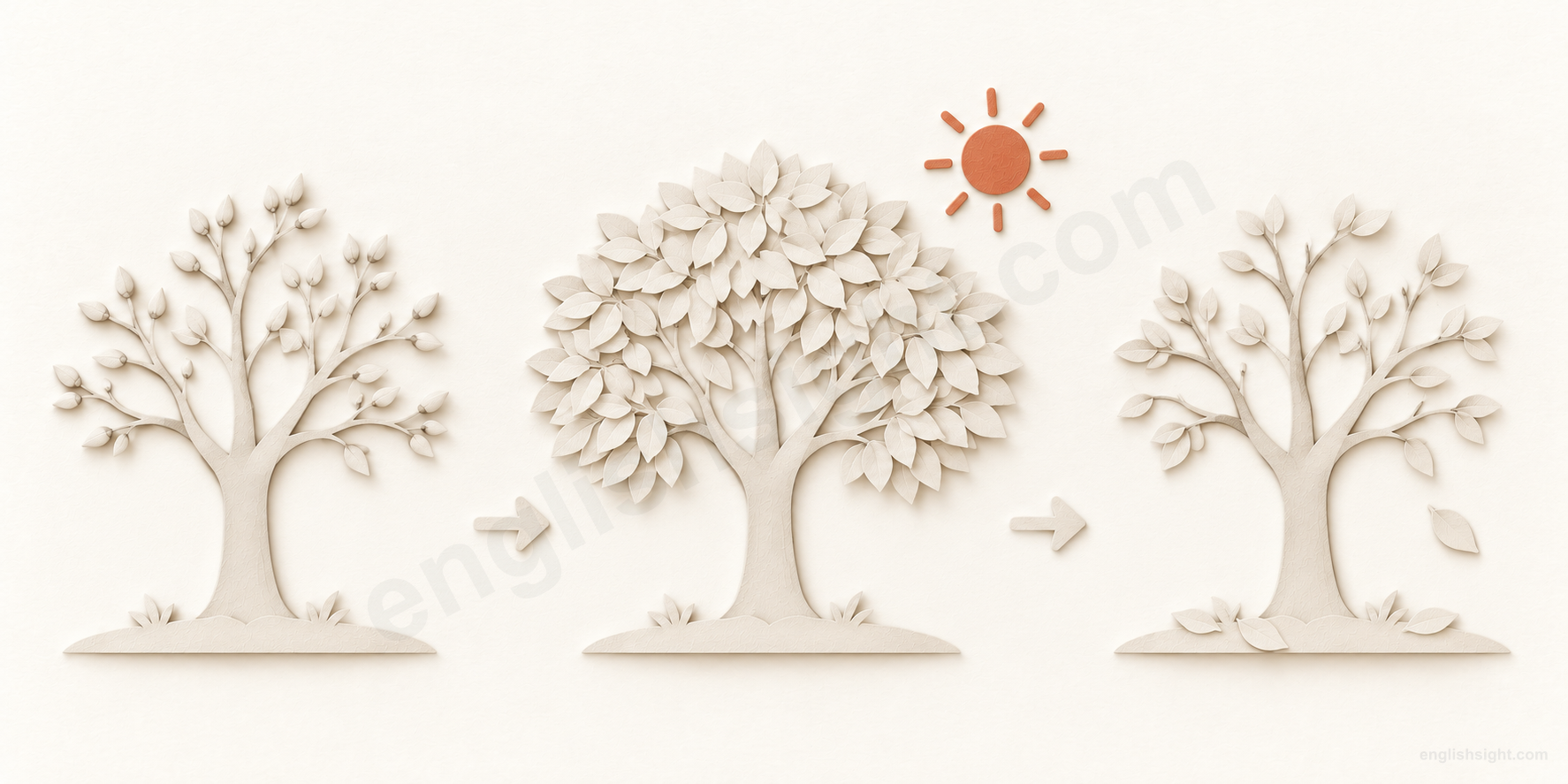
Spring: small leaves begin to grow.
summer
Autumn: leaves fall from the tree.
Summer: a full leafy canopy beneath a sun.
Summer lies between spring and autumn; the sun suggests usual warmth, not constant sunshine.
Summer is the season between spring and autumn, usually the warmest part of the year; it names a stretch of the year, not any hot day.
A sequence of the same tree budding, fully leafy under a sun, and losing leaves locates summer between its neighboring seasons. The model uses a temperate-climate tree as a memory aid; local vegetation and weather vary.
Summer places us in a recurring part of the year. Its characteristic warmth helps explain many associations, but the word does not mean every hot day, every school holiday, or the same months everywhere.
The seasonal sequence is a teaching model grounded in ordinary usage. It does not claim that every English speaker pictures the same tree or scene.
01
A season and its place in time
Name the season, distinguish one year from another, and choose time phrases that fit your meaning.
01
in (the) summer; summer comes / begins / ends
in (the) summer
during the season between spring and autumn
Situation / starting point
You are describing the usual yearly weather where you live.
Meaning in context
You identify summer as the season when the air is usually warmest.
Summer names a seasonal period rather than a single type of weather.
Summer is the season after spring and before autumn, also called fall in American English. Warmth is characteristic, but a rainy or cool summer is still summer. A hot afternoon in another season does not by itself become summer.
In summer and in the summer are both normal. A sentence about a general habit can use either: We eat outside in summer. Context can also make in the summer refer to a particular coming or past summer.
The months depend on the hemisphere and on the calendar convention. June to August is a familiar Northern Hemisphere grouping; December to February is a familiar Southern Hemisphere grouping. Astronomical seasons have different boundaries. Do not treat one set of months as the meaning everywhere.
In a sentence
The lake is warm enough for swimming in summer.
Watch the difference Say in summer, rather than on summer, for the season. The season name normally begins with a lowercase s.
02
a / an + adjective + summer; plural summers; in the summer of + year
a wet summer / the summer of 2024
one summer described or identified as a whole
Situation / starting point
You compare the weather in different years.
Meaning in context
You describe one particular summer or identify it by its year.
Summer can be counted when individual seasons are distinguished.
Use a or an when describing one instance of the season: a wet summer, an unusually cool summer. The plural summers counts repeated seasons: Our last three summers were dry.
Use the summer of plus a year to identify a particular summer: in the summer of 2024. The noun is still a season; of 2024 specifies which one.
We hardly had a summer can complain that the weather never felt properly warm. It does not normally claim that the calendar skipped a season. The context supplies this weather-focused interpretation.
In a sentence
We had a surprisingly wet summer in 2024.
Watch the difference Use a wet summer for one described season. Do not add an article to every seasonal time phrase: last summer needs none.
03
this / next / last / every summer; number + summers ago
this / next / last summer
place a summer relative to the time of speaking
Situation / starting point
A friend asks when you plan to visit your family.
Meaning in context
You identify the coming summer without naming a month.
This, next, last, and every form time phrases without in.
Next summer usually means the coming summer, and last summer the previous one. This summer means the current or contextually relevant summer; the verb and situation tell you whether you are looking ahead or back.
Use these phrases directly: We travelled last summer; We will travel next summer. Every summer describes a repeated yearly habit, while two summers ago counts back two summer seasons.
Compare next summer with in the summer of 2024: the first is relative to the conversation, while the second names a particular year.
In a sentence
Next summer, I’m going to stay with my sister.
Watch the difference For the ordinary time expression, say next summer, not in next summer. In the next summer can occur in a narrative with a different reference point.
04
over / during / throughout the summer; all summer; for the summer; until the end of summer
over the summer / all summer
locate something within the season or describe its duration
Situation / starting point
You explain how you used the break between school years.
Meaning in context
You say when a project happened or how long a situation lasted.
The time expression determines whether the season is a time window or a duration.
Over the summer and during the summer put an event or activity within that seasonal period. They do not require it to last every day: I took a two-week course over the summer.
All summer, the whole summer, and throughout the summer emphasize the full period. The action may be continuous or repeated, depending on the verb: It rained all summer can describe frequent rain rather than uninterrupted rain.
For the summer describes an intended period of use or stay: We rented a flat for the summer. Until the end of summer gives an endpoint. These are ordinary prepositional and duration constructions, not phrasal verbs.
In a sentence
I worked at a café for six weeks over the summer.
Watch the difference Over the summer does not automatically mean for the whole summer. Use all summer if the whole season matters.
05
in early / late / high summer; at the height of summer; in midsummer
early summer / high summer / late summer
identify a part or the peak of the season
Situation / starting point
Someone asks when the garden is at its hottest and fullest.
Meaning in context
You place the visit near the peak of summer.
Early and late locate time; high summer evokes the season at its peak.
Early summer is the first part of the season, and late summer its final part. In early summer and in late summer normally need no article in these general time phrases.
High summer is the hottest or fullest part of summer, not a season at a high altitude. At the height of summer similarly points to its peak. Midsummer names the middle of summer, especially a period in June in northern regions or December in southern regions; it need not be the exact halfway date of a particular three-month calendar definition.
These expressions divide or characterize the same seasonal interval. They do not establish fixed dates valid in every country.
In a sentence
In high summer, we close the shutters before noon.
Watch the difference High summer means the peak of the season. Summer in the mountains is a different idea.
02
Things we do and use in summer
Summer links clothing, work, days, and organized activities to the season. The following noun supplies the activity or object.
describe something associated with, suited to, or happening in summer
Situation / starting point
You need light clothing and temporary work for the warm season.
Meaning in context
Summer identifies the season relevant to the clothes or the job.
Summer before another noun expresses a relationship to the season.
Summer clothes are clothes suited to the season; summer weather is weather associated with it. A summer job is a job for that seasonal period. The following noun and context determine the exact relationship.
Merriam-Webster labels this use adjective; Collins also describes summer as a noun used as a modifier. The practical pattern is the same: summer comes before the head noun, and the head noun carries the main meaning.
Keep summer singular in ordinary combinations: summer clothes, summer jobs, summer evenings. For a predicative description, say These clothes are for summer or This dress is summery, rather than treating summer as an ordinary gradable adjective.
In a sentence
I’m looking for a summer job at the swimming pool.
Watch the difference A summer job is not necessarily permanent work. Do not use very summer as though summer behaved like hot.
07
a + (adjective) + summer day; a + (adjective) + summer’s day
a summer’s day / a summer day
a day belonging to or characteristic of summer
Situation / starting point
You describe a bright day while recalling a trip.
Meaning in context
The day is presented as part of summer.
The apostrophe form relates the day to the season; it does not make summers plural.
A summer day and a summer’s day can both refer to a day in summer. The first uses summer as a modifier; the second uses the possessive form to express an association with the season.
An adjective can describe the day: a warm summer day or a lovely summer’s day. The warmth comes from warm or the context, not from a guarantee that every summer day is hot.
Use the plural summer days to speak about several days. Summers, without an apostrophe, is the plural of the season itself.
In a sentence
We ate under the trees on a quiet summer’s day.
Watch the difference Use on for a particular day: on a summer’s day, but in summer for the season.
08
the summer holidays; on summer vacation / summer break; during the summer holidays
the summer holidays / summer vacation
a break from the usual school schedule in summer
Situation / starting point
Classes stop for the seasonal school break.
Meaning in context
A family discusses plans for the time away from regular lessons.
The break belongs to the calendar; summer itself does not mean a holiday.
The summer holidays is usual British wording for the school break; summer vacation is usual American wording. Summer break is another familiar expression. The length and dates vary across school systems.
On summer vacation describes being on that break: The children are on summer vacation. During the summer holidays locates an activity within it. Having a summer holiday can also mean taking a trip or time off in summer, especially in British usage.
Compare a summer job: someone can work during the school break. The season does not imply that everyone is free from work or study.
In a sentence
The children are on summer vacation, but their parents are still working.
Watch the difference Summer is a season; summer vacation is time away from normal classes. Their boundaries need not be identical.
09
go to / attend summer camp; be at summer camp; a summer camp
go to summer camp
join an organized summer activity program, especially for children
Situation / starting point
Parents and a child choose organized activities for the school break.
Meaning in context
The child attends a program with sports or other planned activities.
Camp here names an organized program or place, not merely sleeping in a tent.
Summer camp is especially associated with North America. Children attend a place or program offering activities during the summer. Go to summer camp and be at summer camp describe participation or attendance.
A summer camp can identify one particular organization or program: We found a summer camp near the lake. The word camp does not by itself require the activity to consist of a family camping trip.
Summer supplies the season; camp supplies the organized setting. Learn the compound as a familiar activity rather than interpreting it as any campsite used in hot weather.
In a sentence
Maya learned to paddle a canoe at summer camp.
Watch the difference Going camping and going to summer camp are not interchangeable descriptions.
10
go to / attend summer school; a summer school
go to summer school
attend courses held during summer
Situation / starting point
A student wants extra study while ordinary classes are on a break.
Meaning in context
The student attends a summer course.
School refers to organized teaching in the summer period.
Summer school provides courses during the summer, often at a college or university and also at schools in the US. It can mean the teaching program rather than a separate building.
Go to summer school and attend summer school focus on participation. A summer school can refer to a particular organized course or program, such as a language summer school.
The expression does not by itself say why the student attends. Extra study, a special interest, or catching up may be supplied by the situation. Do not assume every participant has failed a class.
In a sentence
I’m attending summer school to improve my spoken French.
Watch the difference Summer school is study, while summer vacation describes a break from the usual classes.
03
Passing the summer somewhere
The noun pattern spend the summer is ordinary conversation; summer can also be a verb describing a seasonal stay.
11
spend the summer + in / at + place; spend the summer + -ing; spend plural summers
spend the summer somewhere
say where or how someone passes the season
Situation / starting point
Someone asks about your plans for the whole seasonal period.
Meaning in context
You describe where you will stay or what you will do.
Spend takes the time period as its object; another phrase adds place or activity.
Spend the summer in a place describes passing that period there. Spend the summer doing something instead describes the activity: We spent the summer repairing the house.
The forms belong to spend: spend, spent, spent. Summer is the time noun, so this pattern does not mean spending money. In ordinary conversation it is a straightforward way to discuss a seasonal stay.
Spend our summers there describes a recurring habit across years. It need not promise that every minute of every summer is spent in exactly that place.
In a sentence
We spent the summer helping at our uncle’s farm.
Watch the difference Say spent the summer working, not spent the summer to work, when describing the activity that filled the time.
12
person / family + summer(s) / summered + in / at + place
summer in a place
spend the summer in that place
Situation / starting point
A description tells you where a family stays in the warm season.
Meaning in context
The seasonal stay is expressed with summer as the verb.
The subject is the person or group staying; the location follows a preposition.
Summer can itself be an intransitive verb: They summer in the mountains. The verb means to spend the summer somewhere; it does not mean to make the place hot.
The regular forms are summer, summers, summered, and summering. This wording is more marked than the everyday spend the summer and is often encountered in descriptions of seasonal residences or travel.
There is also a farming use, summer cattle on higher ground, meaning to keep or graze the animals there for the summer. That specialized transitive use is recorded in the sources but is outside the main practice here.
In a sentence
The family summered in a village beside the lake.
Watch the difference For a neutral conversational plan, We’re spending the summer there is an easy choice. Summered refers to the seasonal stay, not to becoming summery.
04
Returning warmth and cautious conclusions
These established expressions use summer in conventional ways. Learn the whole phrase and the situation it fits.
13
an Indian summer; have / enjoy an Indian summer
an Indian summer
a spell of warm, dry weather in autumn
Situation / starting point
Autumn has arrived and cooler weather is expected.
Meaning in context
A period of dry warmth feels like a return of summer.
The established expression can refer to autumn, even though it contains summer.
An Indian summer is a period of warm, dry weather in autumn. It is not a name for the regular summer season in India, and it does not move the whole seasonal calendar backwards.
Use an for one such spell: We had an Indian summer. Indian takes a capital I in this established expression, while summer normally remains lowercase.
The link to the lesson’s model is a return of summer-like conditions after the season’s expected end. Learn the full expression; its meaning cannot be obtained simply by joining a country adjective to summer.
In a sentence
An Indian summer let us eat outdoors again in October.
Watch the difference The example describes an autumn October in the Northern Hemisphere; October is not autumn everywhere.
14
have / enjoy an Indian summer; an Indian summer in + career / life
an Indian summer in a career
a later period of renewed success or improvement
Situation / starting point
A person’s most successful years seem to be over.
Meaning in context
A later improvement brings another successful period.
The whole expression transfers the idea of returning warmth to renewed good fortune.
An Indian summer can figuratively describe a pleasant period of success or improvement, especially later in life or a career. The later improvement is important; it is not simply any enjoyable summer holiday.
Have or enjoy an Indian summer can describe this revival. Context identifies the field of success: a career, an artist’s work, or a player’s later performance.
This is an established metaphor related to the weather expression. It does not imply a person’s literal temperature or require the improvement to happen during summer.
In a sentence
After years away from the stage, the actor enjoyed an Indian summer in her career.
Watch the difference Use context to distinguish an autumn warm spell from a later revival in someone’s fortunes.
15
one swallow doesn’t make a summer
One swallow doesn’t make a summer.
one encouraging sign is not enough to establish a general improvement
Situation / starting point
A shop has one busy day after several quiet weeks.
Meaning in context
Someone warns against declaring that business has fully recovered.
Swallow is a bird; make means establish here, not physically create a season.
The saying warns that a single small sign does not prove a lasting or general change. One good result may be encouraging without showing that the situation has truly improved.
The image is one returning swallow, a bird associated with the warmer season. Seeing just one does not establish the arrival of summer. Swallow does not mean the action of taking food down the throat in this saying.
Use the full proverb when drawing a cautious conclusion: one profitable day does not prove a shop’s troubles are over. It is a set saying rather than a freely predictable new meaning of summer.
In a sentence
Sales rose on Saturday, but one swallow doesn’t make a summer.
Watch the difference The proverb warns about insufficient evidence; it does not say that improvement is impossible.
Keep the season, grammar, and whole expression distinct
Warmth is typical, not a daily promise
Summer is a calendar season with characteristic weather. A cool summer is possible. The tree sequence illustrates a temperate seasonal cycle rather than describing every region.
Articles and prepositions depend on the phrase
Use in (the) summer, next summer, a wet summer, the summer of 2024, and on a summer’s day. These are different noun-phrase patterns; there is no rule that summer always takes—or never takes—the.
Read the head noun and the full expression
Summer clothes, summer school, and summer vacation all relate to the season but describe different things. Indian summer and the swallow proverb are established expressions, not meanings you can derive from summer alone.
Grammar and scope
The seasonal noun is countable or uncountable; its plural is summers. Before another noun, summer stays singular in the combinations taught here. The regular verb has summered and summering; its ordinary seasonal-stay use is intransitive. Specialist farming objects, poetic summers meaning years, literary periods of fulfillment, and the unrelated architectural noun are outside the main practice. No causative or particle-verb family is implied.
Choose the seasonal meaning
Use the situation and the whole phrase to decide.
1. A friend spends December in Australia. Which conclusion respects the meaning of summer?
2. Which ordinary time phrase introduces your plan for the coming summer?
3. You say, “I took a two-week course over the summer.” What follows?
4. Which phrase names an organized program of summer study?
5. A singer has a new period of success late in her career. What can “an Indian summer” describe here?
6. A shop has one good sales day. Someone says, “One swallow doesn’t make a summer.” What is their point?
Sources and teaching notes
The dictionary entries below were consulted for meanings and patterns. Explanations and example sentences are original; the tree sequence is a teaching interpretation.
The seasonal picture is a teaching aid, not an identical image shared by every English speaker.