Connect the star with its light and heat, then learn the whole expressions.
From the source to the light reaching here
A source and the places its light reaches
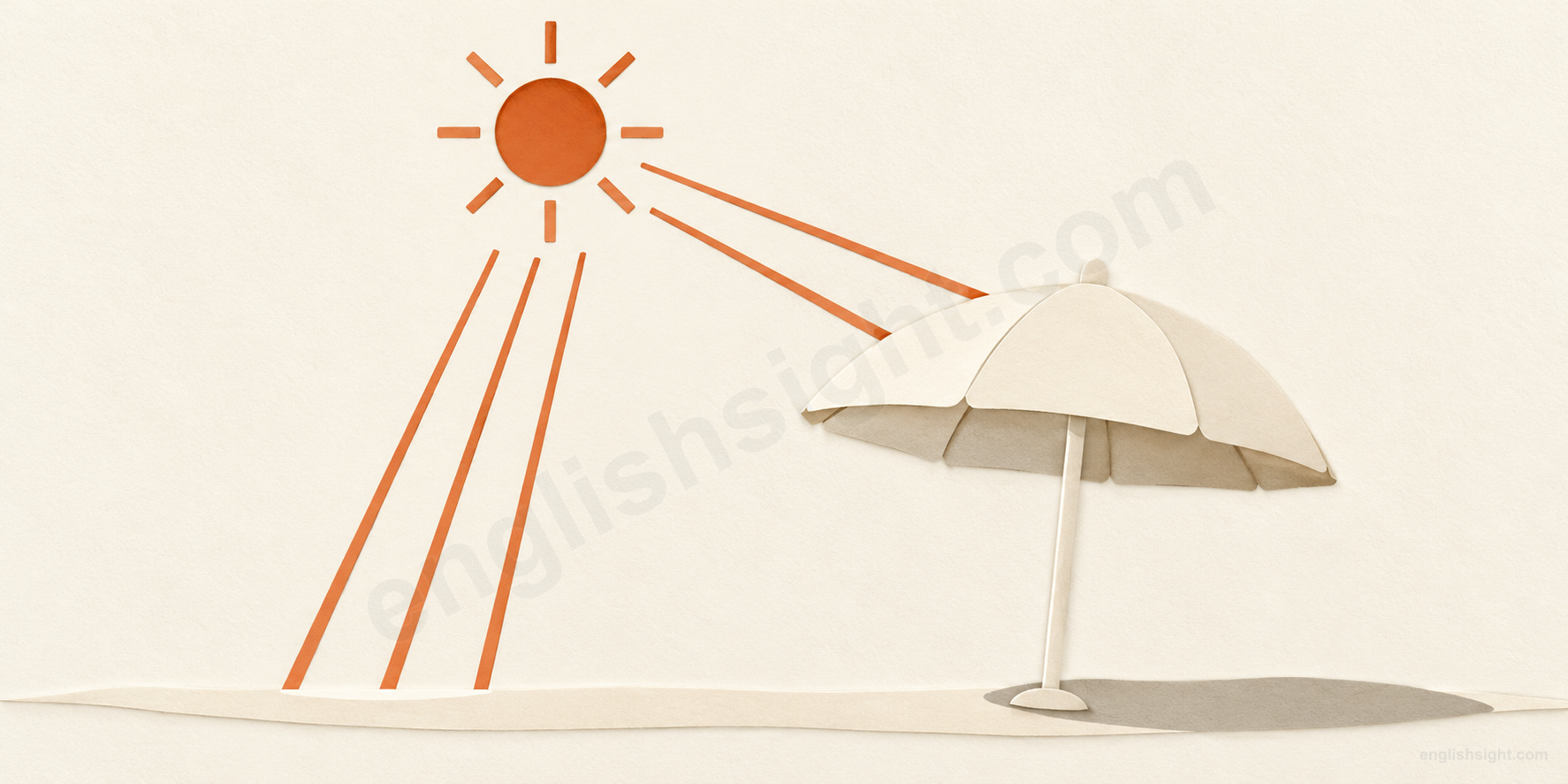
A terracotta sun sits above open ground and an ivory parasol.
sun
A shaded patch lies beneath and to the right of the parasol.
Its light reaches the exposed ground but is blocked by the canopy.
Sun names the source and also its light and heat; the parasol shows where direct sunlight is blocked.
Sun names the star that gives Earth light and heat, or the light and heat reaching a place from it.
This is a source-and-exposure relationship, not a required before-and-after change. Shade blocks direct sunlight; idioms extend beyond this literal scene.
Sun can name the familiar star, but in a room that gets some sun it names the sunlight reaching the room. Keeping that source-and-effect distinction helps with everyday weather, home, and outdoor talk.
The picture offers a teaching connection. Fixed sayings need their own explanations, and individual English speakers need not imagine the same scene.
01
The star and the changing sky
Identify the sun, describe its apparent daily movement, and say when it becomes visible.
01
the sun + singular verb; the morning / evening / winter sun
the sun
the star that supplies Earth with light and heat
Situation
You name the bright object above the horizon.
What you communicate
Your listener knows which star you mean.
The sun names a particular star, not the weather as an adjective.
In everyday Earth-based conversation, say the sun. The definite article identifies the familiar star. Lowercase sun is ordinary in general writing; the Sun is also used, especially when treating it as an astronomical name.
Morning sun and winter sun describe how that same sun appears or affects us at a time or season; they do not introduce different stars.
Example
The sun was low above the hills.
Watch the difference Use The sun is bright, not Sun are bright.
02
the sun rises / comes up / sets / goes down; be up; get up with the sun
the sun rises / sets
describe the beginning or end of daylight
Situation
You plan an early walk or an evening journey.
What you communicate
You specify the sun’s appearance above or disappearance below the horizon.
Rise and set describe the sun’s apparent movement as seen from Earth.
The sun rises or comes up at the start of the day; it sets or goes down at the end. These are ordinary viewpoint descriptions, not a claim that the sun travels around Earth.
The sun is up describes a state after sunrise. I get up with the sun means I rise at sunrise. With here connects the timing of two events; it does not mean carrying the sun. With the sun can refer to sunrise or sunset; the action and context show which is meant.
Example
We left before the sun came up.
Watch the difference Say The sun rises; raise normally needs an object, as in raise a flag.
03
the sun + come out
the sun comes out
become visible after being hidden
Situation
Clouds hide the sun during the afternoon.
What you communicate
A gap appears and the sun becomes visible.
Coming out concerns visibility; coming up concerns sunrise.
The sun came out can describe a change in the middle of the day. Come out is the phrasal verb; sun is its subject, not part of a phrasal verb beginning with sun.
Compare The sun came up at six, which places the event near sunrise. After clouds clear at noon, came out is the natural choice.
Example
The sun came out just as we reached the park.
Watch the difference Do not use came up merely to mean that daytime clouds stopped hiding the sun.
04
the sun shines; the sun beats down on + place; the sun warms + object
the sun shines / beats down
describe sunlight, sometimes with strong heat
Situation
You report conditions on an exposed road.
What you communicate
The listener understands that the sunshine is intense.
The verb describes what the sun’s light and heat are doing.
The sun is shining reports the current weather. The sun beats down on the road suggests strong, uncomfortable sunlight and heat; beat down adds intensity rather than a new sense of sun.
In The sun warms the wall, the wall receives the effect. In Clouds block out the sun, clouds obstruct the view or incoming light. Read the whole verb phrase.
Example
The sun beat down on the empty road.
Watch the difference Sun is a noun here. For a weather adjective, use sunny.
02
Sunlight reaching people and places
Talk about exposure, shade, bright rooms, gardens, and enjoying sunshine. The star itself does not enter the room.
05
in / into / out of the sun; keep + object + out of the sun
in the sun / out of the sun
be exposed to sunshine or sheltered from it
Situation
You choose where to put a chair.
What you communicate
You put it where sunlight reaches, or move it into shade.
In the sun means within the sunlight, not inside the star.
Sit in the sun and dry in the sun refer to receiving sunlight. Move into the sun describes entering an exposed area; stay out of the sun describes avoiding it.
The opposite location is often in the shade. A holiday in the sun describes a trip to a sunny destination rather than a journey into space.
Example
We moved the chairs out of the sun.
Watch the difference Use in the sun for ordinary exposure. Under the sun also has an idiomatic meaning, explained below.
06
get (the / some / any / no) sun; in full sun
get some sun / get the sun
receive sunlight
Situation
You compare two rooms before choosing one.
What you communicate
You identify the room that sunlight reaches.
Get describes receiving light; sun here is not a countable object.
A room gets the sun when sunlight reaches it. Plants get some sun, little sun, or no sun according to their position. Full sun means an open, sunny exposure, especially in gardening; it does not mean a different or larger star.
Get some sun can also mean spend some time in sunshine. Some measures an amount of exposure, not several suns.
Example
The kitchen gets some sun in the afternoon.
Watch the difference Say a little sun for a small amount of sunshine; a sun normally refers to a star.
07
have / get the sun in + possessive + eyes; the sun on + body part
have the sun in your eyes
have sunlight shine toward your eyes and hinder seeing
Situation
You look toward a bright window.
What you communicate
You find it harder to see the person in front of you.
The expression describes the direction of the light, not an object inside your eye.
Your eyes receive the direct light in this familiar expression. Change the possessive with the person: in my eyes, in her eyes, in our eyes.
Compare the sun on my back: on names the surface receiving sunlight. The body-part phrase helps describe where the light falls.
Example
I could not see his face with the sun in my eyes.
Watch the difference In my eyes can mean in my opinion elsewhere; the sun makes the literal light context clear.
08
soak up the sun / some sun; bask in the sun
soak up the sun
relax and enjoy sunshine
Situation
You have free time outdoors on a bright day.
What you communicate
You spend it enjoying the sunshine.
Soak up contributes the idea of taking in and enjoying an experience.
Soak up the sun is a familiar leisure expression. The phrasal verb is soak up, and the sun is its noun object; this is not a verb sun up.
The phrase focuses on enjoyment rather than the exact length of time or a guaranteed change in skin colour. You can also say enjoy the sunshine.
Bask in the sun similarly means enjoy sitting or lying in its light or warmth: We spent the morning basking in the sun. Compare the grammar: soak up takes the sun as its object, whereas bask uses in before the sun.
Example
They sat on the steps, soaking up the sun.
Watch the difference This expression does not mean that the sun is a liquid being absorbed.
09
person / face + catch the sun; have caught the sun
catch the sun
develop some colour or redness after sun exposure
Situation
Someone returns from an outdoor afternoon.
What you communicate
You notice that their face looks redder or browner.
This British expression describes an effect of exposure, not grasping the star.
You’ve caught the sun is used in British English when someone’s skin shows the effects of sunshine, often mild sunburn. Context distinguishes this from a window or surface catching sunlight.
Compare The window catches the afternoon sun, which describes receiving light. In the skin expression, caught does not mean that someone deliberately tried to get a tan.
Example
Your cheeks have caught the sun after that long walk.
Watch the difference Do not assume catch the sun always describes pleasant or harmless exposure.
03
Sunning and related word choices
Recognize sun as a verb, and choose between sun, sunlight, sunshine, and sunny.
10
sun + reflexive pronoun; be sunning yourself
sun yourself
sit or lie where sunshine falls on you
Situation
Someone settles in a bright outdoor spot.
What you communicate
They remain there enjoying exposure to the sun.
The noun becomes a verb meaning expose to sunshine.
Sun yourself uses a reflexive object: I sun myself, she suns herself, we sun ourselves. Sunning herself describes an activity in progress. Sunbathe is another verb for this leisure activity.
Forms are sun, suns, sunned, sunning: double the final n before -ed and -ing. Wider dictionaries also record sun an object, meaning expose it to sunlight, for example to warm or dry it; everyday instructions often simply say put it in the sun.
Example
The cat was sunning itself beside the open door.
Watch the difference Do not write suning or suned. Sun is a regular verb with a doubled consonant in these spellings.
11
the sun; some sunlight / sunshine; a sunny + noun; it is sunny
sun / sunlight / sunshine / sunny
choose a noun for the source or light, or an adjective for conditions
Situation
You describe a bright but cold morning.
What you communicate
You choose a form that fits the sentence.
Sun can name the source or its light; sunny describes a place or day.
Sunlight names light coming from the sun: A stripe of sunlight crossed the floor. Sunshine names the sun’s light and warmth, often in weather or enjoyable outdoor settings: We had an hour of sunshine.
Sunny is an adjective: a sunny day; It is sunny. It does not guarantee hot weather. Sun can modify another noun, as in a sun hat; that noun phrase still needs the grammar appropriate to hat.
Example
It was sunny, but the wind was cold.
Watch the difference Say It is sunny or The sun is shining, not It is sun.
12
a sun; plural suns
a sun / two suns
refer to a star associated with planets
Situation
You discuss a fictional planet’s sky.
What you communicate
You count the stars that light that world.
The countable use belongs to a wider space setting.
A sun can mean a star around which planets move. In science or science fiction, a sun and two suns can therefore be sensible noun phrases.
That countable use does not turn everyday sunshine into individual items. Compare The terrace gets lots of sun with The imagined planet has two suns.
Example
The story describes a planet with two suns.
Watch the difference Do not use two suns for two hours or two patches of ordinary sunshine.
04
Whole expressions with sun
Learn these established expressions as units. Their meanings extend beyond a literal patch of sunshine.
13
everything / anything / nothing + under the sun; every + noun + under the sun
everything under the sun
emphasize a very wide range of things
Situation
A long conversation moves through many unrelated topics.
What you communicate
You stress how varied the conversation was.
The whole phrase expands the scope to almost anything imaginable.
Everything under the sun means an extremely broad range, not only objects outdoors. Every excuse under the sun similarly emphasizes many possible excuses.
Nothing new under the sun means that something apparently new has happened or existed before. It is an established comment about novelty, not a weather report.
Example
We discussed everything under the sun on the train.
Watch the difference The idiom can describe an indoor conversation. It does not locate the speakers in sunlight.
14
find / earn / secure + a place / your place + in the sun
a place in the sun
a favourable or satisfying position in life
Situation
A musician works for years without a secure role.
What you communicate
She finds work in which she can succeed and feel fulfilled.
A pleasant sunny place becomes a metaphor for a desirable situation.
Find a place in the sun can describe a satisfying job, success, or a favourable position. A literal place in the sun is also possible; the surrounding story tells you which meaning fits.
The idiom can suggest comfort or advantage. It does not promise celebrity, and its meaning belongs to the full expression rather than to sun alone.
Example
After years of temporary work, she found her place in the sun at a small theatre.
Watch the difference A place in the sun need not be physically warm or outdoors.
15
have / enjoy + a / your + moment / day / time + in the sun
a moment / day / time in the sun
a period of popularity or public attention
Situation
A small team achieves an unexpected victory.
What you communicate
For a while, people pay attention to it.
Here sunshine is a metaphor for being noticed.
Have your moment in the sun means enjoy a period of attention or popularity. Day and time can replace moment; none requires a precise clock duration.
Compare a place in the sun, which emphasizes a favourable position. A moment in the sun emphasizes a period when someone or something attracts attention.
Example
The local team had its moment in the sun after the surprise win.
Watch the difference The phrase does not necessarily mean permanent success or an entire literal day.
16
make hay while the sun shines
make hay while the sun shines
use a good opportunity while it lasts
Situation
Extra staff are available for a short time.
What you communicate
You finish work while those favourable conditions continue.
The saying connects useful action with a temporary favourable condition.
The full saying advises you to act while you have a chance. Its farming image is drying cut grass in suitable sunny conditions; the lesson can apply to work, study, or other opportunities.
While contributes the time relationship: do the useful thing during the favourable period. This is an established saying, not a literal instruction about weather in every context.
Example
With extra help available this week, let’s make hay while the sun shines.
Watch the difference The phrase calls for taking advantage of an opportunity, not merely waiting for a sunny day.
Keep the form and context clear
Pronunciation and spelling
Sun is pronounced /sʌn/, exactly like son in standard British and American pronunciation. Son names someone’s male child. The written abbreviation Sun. means Sunday and is separate from the weather word.
Noun amounts and verb forms
For sunshine, use some sun, too much sun, or no sun. For stars in a wider space setting, a sun and suns are possible. The verb has suns, sunned, and sunning. A passive such as blankets were sunned is possible for the transitive exposure sense, but put the blankets in the sun is usually a clearer everyday instruction.
Related words are not all senses of sun
Sunny, sunlight, sunshine, sun-dried, and sun hat belong to the same family of ideas but have their own grammar. This lesson explains the most useful contrasts rather than treating every compound as another dictionary sense.
Scope and the picture
The picture shows the literal source and direct exposure. It does not predict idioms or claim that sun always implies comfort. Poetic sun meaning a day or year, specialist navigation expressions, and the separate plant name sun hemp are outside this beginner lesson.
Read sun in context
Choose the sentence or interpretation that matches the situation.
1. It is noon. Clouds move away and sunlight returns. Which sentence best describes the change?
2. “This room gets a little sun.” What reaches the room?
3. Choose the natural way to describe bright weather.
4. A young artist becomes widely noticed for a short time. Which expression fits?
5. A good opportunity will last only a week. What does “make hay while the sun shines” advise?
Sources and teaching notes
Usage was checked against the publisher pages below. Explanations and example sentences are original; the source-and-exposure picture is a teaching aid.
The diagram explains a relationship; it does not represent a picture shared by every native speaker.