Connect unexpected events, the reaction they cause, and the ways English describes both.
Expectation meets reality
An expectation meets something unexpected
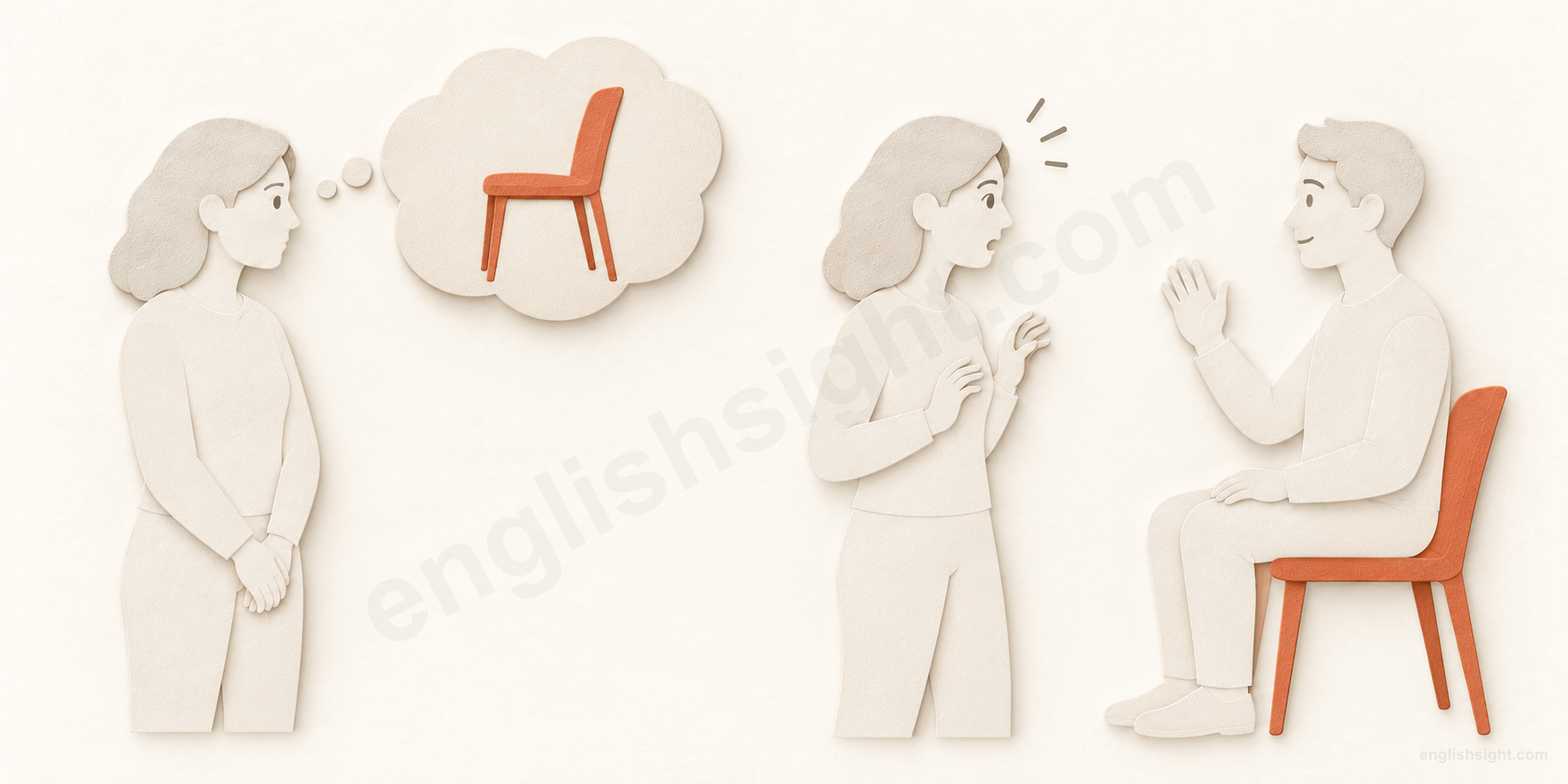
She expects an empty chair.
surprise
A man sits there and waves; she reacts with raised hands and an open mouth.
She encounters a visitor she did not expect.
She expected an empty chair; an unexpected visitor makes her react.
Something happens that a person did not expect, creating a reaction or catching them unprepared.
The picture contrasts an expected empty chair with an actual visitor. It is a teaching example of the expectation–reality difference, not a universal mental picture. It does not explain every fixed expression by itself.
Surprise brings expectation and reality into contact: something happens that a person was not prepared for. It can name the unexpected event, the feeling, or the act of causing that feeling.
The unexpected may be welcome, unwelcome, or simply puzzling. A secret party is only one example; neither happiness nor deliberate planning belongs to every use.
01
An unexpected thing, a feeling, or a plan
Surprise can name what happens, the reaction it causes, or the unexpectedness built into an event. Articles and surrounding words help separate these uses.
01
a + (adjective) + surprise; get / have a surprise; the surprise of + event
a surprise; a pleasant / nasty surprise
an event, discovery, or person that is unexpected
Expectation / situation
You expect your sister to stay abroad.
Event / reaction
She arrives at your graduation.
The noun names the unexpected thing, not just your emotional response.
An arrival, a result, a gift, or a piece of news can be a surprise. This use is countable: a surprise, two surprises, and a series of surprises. What a surprise! reacts to one such event.
Surprise alone does not say whether the experience is welcome. A pleasant surprise is welcome; a nasty surprise is unwelcome. I got a surprise when I checked the price describes an unexpected discovery or the reaction it gave me, not necessarily a gift.
A person or performance can also be the surprise of a competition when they turn out much better than expected. That is an evaluation against expectations, not a claim that nobody knew the person existed.
In a sentence
My sister’s arrival was a wonderful surprise.
Watch the difference Use an article for one unexpected thing: It was a surprise, not It was surprise.
02
in / with surprise; show / express surprise at + noun / -ing
in surprise; surprise at something
the feeling produced by the unexpected
Expectation / situation
You thought the shop had closed.
Event / reaction
You react when the lights come on.
Surprise names the reaction; at introduces what prompted it.
In surprise and with surprise describe the manner or feeling of a reaction: She stared in surprise; He listened with surprise. The feeling is normally uncountable in these expressions.
Express, show, hide, or conceal surprise describe how visible that feeling is. Use surprise at the news or surprise at seeing someone: at is a preposition, so a following verb takes the -ing form.
Compare I felt surprise with I got a surprise. The first names an emotion; the second packages an unexpected experience or reaction as one occurrence. A look of surprise describes a face expressing that emotion.
In a sentence
The staff expressed surprise at the early closure.
Watch the difference In surprise describes a reaction. For an event that happens unexpectedly, learn by surprise in its own expression.
03
to + possessive / person’s + (great) surprise, + clause
to my surprise
the result was unexpected to the named person
Expectation / situation
You think a repair will be expensive.
Event / reaction
The repair turns out to be free.
The possessive identifies whose expectation was overturned.
To my surprise introduces the speaker’s reaction to the fact in the main clause. Change the possessive for another viewpoint: to her surprise, to our surprise, or to everyone’s surprise.
Much to my surprise and to my great surprise strengthen the reaction. The expression can go first or last: The repair was free, to my surprise.
This is a fixed reaction pattern. To does not mark a destination or a purpose, and the main clause still reports what actually happened.
In a sentence
To my surprise, the repair cost nothing.
Watch the difference Say to my surprise, not to my surprised. The slot needs the noun.
04
something comes as a / no surprise (to someone); it is no surprise (that) + clause
come as a surprise; come as no surprise
be received as unexpected, or as entirely predictable
Expectation / situation
You have heard that an employee plans to leave.
Event / reaction
The official announcement confirms what you expected.
Come as describes the way news or an event strikes someone.
The announcement came as a surprise to me means I did not expect it. Come does not require physical travel here. To me identifies the person affected; as presents how the news was received.
Come as no surprise and It is no surprise that… say the outcome is understandable or predictable. It comes as no surprise that the café is busy after a good review does not report a surprising event.
A complete surprise strengthens unexpectedness. Something of a surprise means somewhat surprising. Compare a surprise to me, which concerns my reaction, with a surprise for you, which can refer to something arranged for you.
In a sentence
Her resignation came as no surprise to her colleagues.
Watch the difference Keep the article after as for a countable surprise: as a surprise. After no, omit a.
05
surprise + noun
a surprise party / visit / winner
an event kept unexpected, or a result people did not predict
Expectation / situation
Friends arrange a party without telling its guest.
Event / reaction
The guest discovers the party on arrival.
Before another noun, surprise describes that event or result.
A surprise party is arranged without the guest of honor knowing in advance. A surprise visit or inspection is unannounced; a surprise winner is someone whose victory was not predicted. Intentional secrecy fits the party or inspection, but is not required for the winner.
Oxford presents examples such as surprise attack under the noun; Collins also labels surprise before a noun as an adjective. The practical pattern is the same: surprise comes before the noun it qualifies.
Compare a surprised visitor, a visitor who feels surprise, with a surprise visitor, a visitor whose arrival was unexpected. A surprising result emphasizes the reaction the result can cause.
In a sentence
We organized a surprise party for Mina.
Watch the difference For a party kept secret from its guest, use surprise party. Surprised party does not name that kind of event.
06
be in for + a surprise; have a surprise in store for + someone
be in for a surprise
be going to experience something unexpected
Expectation / situation
The visitors expect an ordinary school hall.
Event / reaction
You know an impressive performance is waiting for them.
The speaker anticipates another person’s unexpected experience.
You are in for a surprise says something will happen that you do not yet expect. In for is part of the larger be in for construction; it does not mean physically inside a surprise.
The speaker often knows more than the listener. A pleasant surprise offers encouragement; a nasty surprise warns of trouble. Without an adjective, the tone and context decide whether the prospect is good or bad.
Compare a surprise in store for you, which also presents an unexpected experience waiting ahead. Neither expression necessarily means a purchased gift.
In a sentence
If you think the hall is empty, you’re in for a surprise.
Watch the difference This is a prediction about an experience, not a report that the person is already feeling surprised.
02
What causes the reaction?
The active verb puts the cause first and the person affected after it. Other patterns show a planned treat, an unexpected achievement, or finding someone unprepared.
07
cause / person + surprise + person; surprise someone by + -ing
something surprises someone
make someone react to something unexpected
Expectation / situation
You expect the quiet student to avoid performing.
Event / reaction
She volunteers to sing a solo.
The cause is the subject; the person affected is the object.
Her decision surprised us places the unexpected decision first and the people reacting second. The subject can also be a person: She surprised us by volunteering. By volunteering tells us which action caused the reaction.
The verb does not require planning or a pleasant result. An error, a kind gesture, or a sudden improvement can surprise someone. The cause can be surprising even when it is not unusual in general; it only needs to run against someone’s expectations.
To name your own feeling, say I am surprised. I surprise my friends means I cause their reaction. This difference follows the participants in the verb, not simply the tense.
In a sentence
Her decision to sing surprised the whole class.
Watch the difference For the person having the feeling, use be surprised rather than I surprise.
08
it surprises + person + that / how / what + clause; it surprises + person + to hear / learn / see…
It surprises me that… / how…
make a whole fact or discovery the cause of surprise
Expectation / situation
You believe the two neighbors have met.
Event / reaction
You learn they have never spoken.
It can introduce a longer clause that explains the unexpected fact.
It surprised me that they had never met makes the entire fact the cause. It surprised me how quickly they agreed focuses on an unexpected degree or manner; the words after how have statement order.
It surprised me to hear that they had never met uses an infinitive to introduce the discovery. Here me identifies the person who heard the news. It surprised me to hear… can be rephrased as I was surprised to hear….
These are ways of arranging information around the same causative verb. They are not three unrelated meanings of surprise.
In a sentence
It surprised me how quickly the team agreed.
Watch the difference Use statement order: how quickly the team agreed, not how quickly did the team agree.
09
it would not surprise + person + if + clause
It wouldn’t surprise me if…
say a possible outcome would be quite believable
Expectation / situation
The sky is dark and rain is forecast.
Event / reaction
You consider the possibility that the match will be cancelled.
A negative reaction pattern can express an expectation about the future.
It wouldn’t surprise me if… means the outcome would fit what I know. It does not announce that the outcome has happened. Would makes the reaction hypothetical, while if introduces the possible situation.
It wouldn’t surprise me if the match was cancelled is natural even when the cancellation is still in the future. The past form can mark hypothetical distance rather than past time.
Compare It didn’t surprise me that the match was cancelled, which reports your reaction to an actual cancellation. The shorter reply I wouldn’t be surprised also means that an outcome seems plausible.
In a sentence
It wouldn’t surprise me if they cancelled tomorrow’s match.
Watch the difference This expression shows plausibility, not certainty and not a report of a completed cancellation.
10
surprise + person + with + noun; have a surprise for + person
surprise someone with something
give or present something the person was not expecting
Expectation / situation
Your friend thinks you have forgotten her performance.
Event / reaction
You turn up with flowers afterward.
With names the unexpected thing used to create the reaction.
The subject is the person arranging or causing the surprise, the object is the person affected, and with introduces what is presented. This pattern often describes a deliberate pleasant gesture.
Pleasantness comes from the gesture and context, not an absolute rule about with. A company can surprise customers with an unexpected charge too. By turning up names an action; with flowers names the thing brought.
I have a surprise for you keeps the unexpected thing unnamed until the reveal. For identifies the intended recipient. Surprise itself does not mean that the thing must be wrapped or bought.
In a sentence
Leo surprised his friend with flowers after the concert.
Watch the difference Say surprised her with flowers or gave her flowers as a surprise, rather than surprised her flowers.
11
surprise + reflexive pronoun + (by + -ing)
surprise yourself
do something that exceeds or differs from your own expectations
Expectation / situation
You doubt you can speak to a large group.
Event / reaction
You give a confident speech.
The person causing the surprise and the person feeling it are the same.
A reflexive pronoun links these two roles: I surprised myself; she surprised herself. The person discovers something unexpected about their own action or ability.
By giving a confident speech identifies the action that caused the surprise. The expression often describes doing better than expected, but it can also refer to unexpected behavior that is not admirable.
You might surprise yourself encourages someone to try. It does not usually mean arranging a secret gift while somehow keeping the secret from yourself.
In a sentence
I surprised myself by speaking confidently to the whole group.
Watch the difference Match the pronoun to the subject: She surprised herself, not She surprised myself.
12
surprise + person + (-ing / place phrase); surprise + enemy / guards
surprise someone doing something
come upon or attack someone who is unprepared
Expectation / situation
A thief assumes nobody will return to the workshop.
Event / reaction
The owner walks in while the thief is opening a drawer.
Here the action is an unexpected encounter, not only an emotional effect.
The owner surprised a thief opening a drawer means the owner came upon the thief without warning. The -ing phrase describes what the thief was doing. Compare The owner was surprised to see a thief: that sentence focuses on the owner’s reaction.
The same verb can describe an unexpected attack or capture: The patrol surprised the guards before dawn. This use is more typical of reports and narratives than ordinary descriptions of feelings.
The shared link is being unprepared. An account of surprising someone in the act does not need to describe their facial expression or prove that they felt amazed.
In a sentence
The owner surprised a thief opening a drawer.
Watch the difference Check whose action the -ing phrase describes; the thief, not the owner, is opening the drawer here.
03
Describe the person or the cause
Surprised describes the reaction; surprising describes what produces it. Complements identify the news, encounter, or behavior involved.
13
be / feel / look / seem + surprised; surprised at / by + noun / -ing
be surprised at / by something
feel or show a reaction to the unexpected
Expectation / situation
You expect a small crowd.
Event / reaction
A large crowd turns up.
Surprised describes the experiencer; at or by introduces the cause.
I was surprised by the crowd and I was surprised at the crowd can both express a reaction to its unexpected size. By often highlights a cause; at often points to what is being evaluated. These are tendencies, not a rule that divides the two into different meanings.
Surprised works after be, feel, look, or seem: She looked surprised. It can describe a state and also occurs in passive constructions corresponding to The result surprised us.
I’m surprised at you, speaking so rudely signals disappointment with a person’s unexpected behavior. A pleasantly surprised customer enjoyed the unexpected result; very surprised strengthens the reaction.
In a sentence
I was surprised by the number of people at the meeting.
Watch the difference Both at and by are possible in many contexts. Do not invent a rule that one always means happy and the other unhappy.
14
be surprised + to hear / see / find…; be surprised + (that) / if / how + clause
be surprised to hear / find / see…
react to an unexpected discovery or encounter
Expectation / situation
You assume the library opens late.
Event / reaction
You find it is already open.
The infinitive introduces the encounter or discovery that prompts the feeling.
Be surprised to find, hear, see, learn, or discover… tells us how someone encounters the unexpected fact. I was surprised to find the doors open means finding them open caused my reaction; it does not mean surprise made me open the doors.
Be surprised that… states the fact more directly: I was surprised that the library was open. That can be omitted. Don’t be surprised if… prepares the listener for a possible event: Don’t be surprised if the queue is long.
You’d be surprised how much it costs tells someone the amount is greater, smaller, or otherwise more unexpected than they think. The context supplies the direction; surprised alone does not mean expensive.
In a sentence
We were surprised to find the library already open.
Watch the difference Use surprised to hear the news, not surprised for hear. After the preposition at, use hearing instead.
15
surprising + noun; be surprising + that / how + clause; surprisingly + adjective / clause
surprising; surprisingly
causing surprise, or marking an unexpected quality or fact
Expectation / situation
You expect a large repair bill.
Event / reaction
The bill is unusually low.
Surprising describes the cause; surprised describes the person’s reaction.
The bill was surprising evaluates the bill as a cause of surprise. I was surprised describes my reaction. A person can be surprising when their behavior causes surprise; the distinction is about roles, not simply people versus things.
It is surprising that… and It is surprising how… evaluate a fact or degree. Hardly surprising and not surprising say the outcome is understandable: It’s hardly surprising that she is tired after a night shift.
Surprisingly is an adverb: The repair was surprisingly cheap modifies cheap; Surprisingly, the repair was free comments on the whole fact. Compare a surprising result with the surprise winner: the latter emphasizes a winner not predicted in advance.
In a sentence
The repair was surprisingly cheap, and I was pleasantly surprised.
Watch the difference I am surprising says I cause surprise. To describe your own reaction, say I am surprised.
04
Unexpectedness in familiar expressions
Learn these expressions as combinations. The other words explain whether someone is unprepared, presents unexpected news, uses a tactic, or speaks ironically.
16
take + person + by surprise; be taken by surprise
take someone by surprise
affect someone unexpectedly, leaving them unprepared
Expectation / situation
You are ready to discuss the budget.
Event / reaction
Someone suddenly asks about your private life.
The whole expression focuses on the affected person being unprepared.
Her question took me by surprise means I had not expected it and had to react without preparation. In the passive, I was taken by surprise keeps the same participant roles. By surprise is fixed here; it does not name a person doing the action.
The expression also describes an unexpected attack or capture: The police took the thieves by surprise. That is a separate event use, related through lack of warning, not a statement that police were emotionally surprised.
A neutral surprise need not be unpleasant. Take by surprise often emphasizes the moment of being caught unprepared, whereas simply surprise can describe a result that is unexpected without any dramatic interruption.
In a sentence
The interviewer’s final question took me by surprise.
Watch the difference Use by surprise, not with surprise, in this fixed expression. With surprise can describe a feeling in other sentences.
17
spring + a surprise / something + on + person; spring a surprise by + -ing
spring a surprise on someone
suddenly present unexpected news, a plan, or an action
Expectation / situation
The class thinks the regular lesson will begin.
Event / reaction
The teacher announces an unplanned-for quiz.
Spring contributes sudden presentation; on names the person affected.
To spring a surprise on someone is to confront them with something unexpected, often without time to prepare. It can be a pleasant reveal or unwelcome news; the expression does not itself promise delight.
The team sprang a surprise by winning describes producing an unexpected result. No secret party or deliberate trick is required in that version. By winning explains what constituted the surprise.
Learn the phrase with spring’s forms: sprang is a standard past tense and sprung the past participle; North American English also uses sprung as a past tense. In spring it on me, it replaces the unexpected news or plan, not the person affected.
In a sentence
The teacher sprang a surprise on us by announcing a quiz.
Watch the difference The person comes after on: spring a surprise on us. This is not a phrasal verb built from surprise.
18
the element of surprise; use / lose the element of surprise
the element of surprise
an advantage created by doing what others do not expect
Expectation / situation
The other team assumes your usual plan will continue.
Event / reaction
You try a different tactic before they can adapt.
Here surprise names unexpectedness used as part of a strategy.
The element of surprise is the unexpected part of a plan that can help it succeed. A team, campaign, or performance can use it; the setting need not be military.
The expression focuses on the method or advantage, rather than a person’s visible emotional reaction. Lose the element of surprise means the other side now expects the plan and can prepare for it.
In a surprise attack, the same lack of warning describes a particular event. The element of surprise names what the plan gains from that lack of warning.
In a sentence
Changing our opening move gave us the element of surprise.
Watch the difference Surprise is uncountable in this expression: the element of surprise, not the element of a surprise.
19
Surprise!; surprise, surprise + (comment)
Surprise!; surprise, surprise
announce a reveal, or ironically point out the predictable
Expectation / situation
The lights come on at a secret party.
Event / reaction
The guests announce the reveal; in another context, a speaker mocks a predictable outcome.
Tone and context separate genuine presentation from irony.
Surprise! can announce something arranged to be unexpected, such as friends waiting at a party. Surprise, surprise! can also be used when revealing an unexpected visitor or gift.
In ironic use, surprise, surprise means the opposite of a genuinely unexpected result: He forgot the tickets again—surprise, surprise. The repetition often conveys annoyance or criticism because the outcome was easy to predict.
The words alone do not settle the tone. At a reveal the speaker creates a surprise; with a complaint the speaker can be saying there was no surprise at all. What a surprise! can likewise be sincere or ironic depending on context.
In a sentence
“Surprise!” the guests shouted as Ava walked in.
Watch the difference Do not use the ironic repeated phrase as a neutral way to show sympathy; it can sound dismissive.
Keep the event, cause, and reaction distinct
Surprise is not always a happy feeling
A surprise can be pleasant or nasty. Startle emphasizes a sudden reaction, often with a little fear; amaze and astonish usually express stronger surprise. Choose according to the situation rather than treating these as exact substitutes.
Count what happens; name the feeling
An unexpected thing is a surprise, with plural surprises. The feeling is usually uncountable in in surprise, with surprise, and show surprise. Get a surprise can package a reaction or discovery as one experience.
Forms and participant roles
The forms are surprise, surprises, surprised, and surprising. She is surprising us with a visit is an active ongoing arrangement; She is surprised describes her reaction. Ordinary feeling statements use be surprised, rather than I am surprising to mean I feel surprise.
Read the whole construction
Surprise someone is already causative: it makes them feel surprised. There is no need for a get-style causative family or an invented surprise up/out particle family. Spring a surprise on and take by surprise are expressions containing the noun, not phrasal verbs headed by surprise.
The scope of this lesson
This is a selection of common modern uses and important contrasts, not a frequency ranking. Rare literary elicitation senses, legal uses, and the geographical name Surprise are outside the lesson. Being surprised into saying something is possible, but is not a general pattern meaning persuade someone to act.
Choose the right role and expression
Decide whether the sentence names an unexpected event, the cause, the person’s reaction, or a possible future outcome.
1. You hear unexpected news and want to describe your own feeling. Which sentence fits?
2. One unexpected thing happened. Which sentence uses the countable event noun correctly?
3. An interviewer asks a question you did not prepare for. Which expression describes its effect on you?
4. The weather makes tomorrow’s cancellation quite plausible, but no decision has been announced. Which sentence fits?
5. A colleague who always arrives late is late again. You say “Surprise, surprise.” What are you most likely conveying?
6. The owner surprised a thief opening a drawer. Who was opening the drawer?
Sources and teaching notes
The sources below were consulted for meanings, grammar, and expressions. Explanations and example sentences are original. The expectation–reality picture is a teaching interpretation of the verified uses.
The picture illustrates a relationship between expectation and reality; English speakers do not all share one mental image.