Learn the action, the useful patterns, and the expressions that carry swimming beyond water.
Moving through water using the body
Body movement produces movement through water
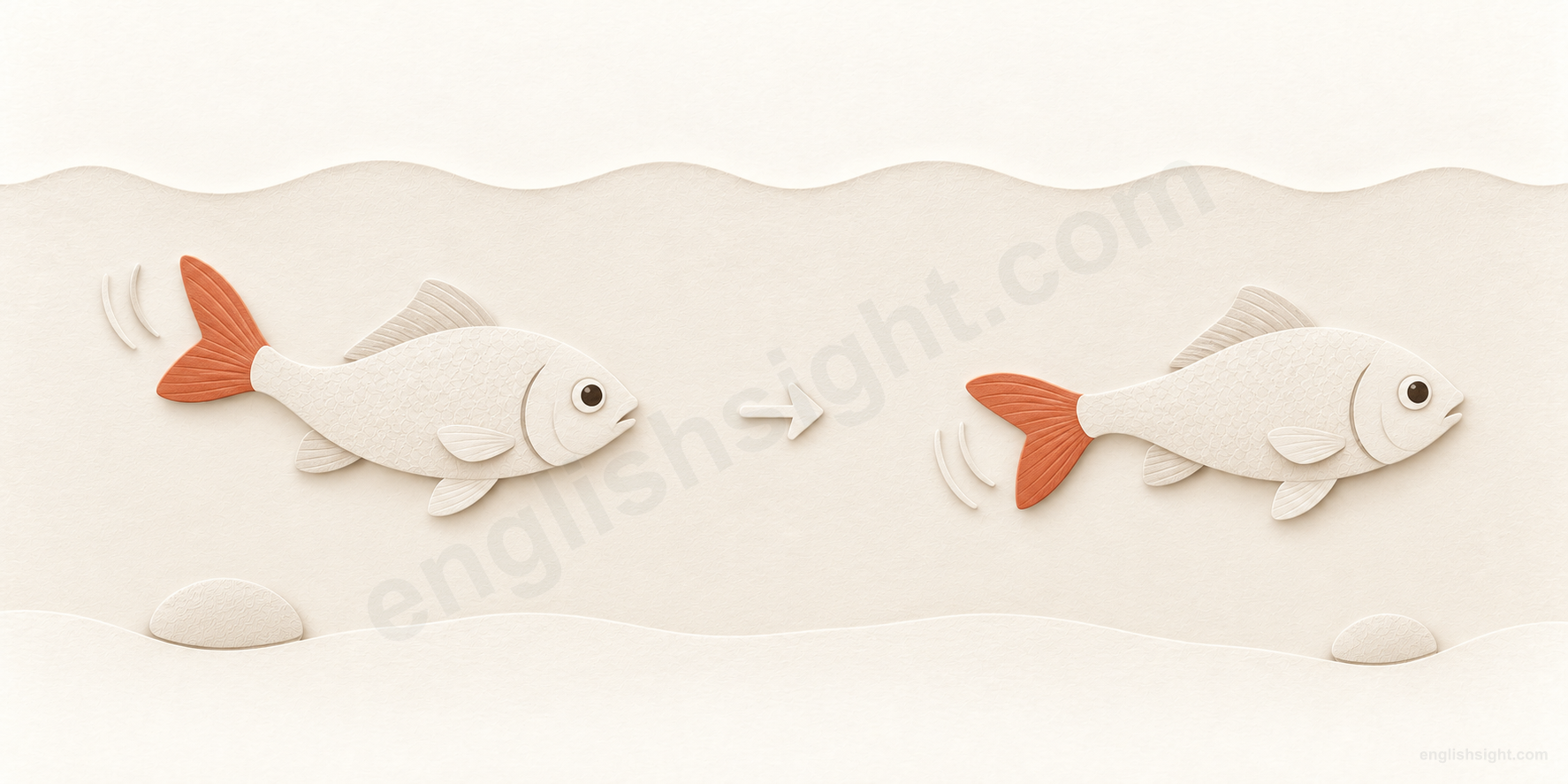
The fish is at an earlier position underwater, with its tail raised.
swim
The same fish is farther right, with its tail bent downward.
It bends its body and beats its tail to move through the water.
Body and tail movement propel the fish through water; the two poses show one fish at two moments.
A person or animal moves through water by moving its own body.
This model explains the central active sense. Floating, dizzy perception, abundant liquid, and fixed idioms require their own contextual explanations.
Swim usually describes a person or animal moving through water by moving its own body. The route, distance, style, and purpose come from the words around it.
Other uses describe liquid surrounding something, an unsteady sensation, or an established social metaphor. Treat these as related branches, not meanings that one drawing can mechanically predict.
01
Moving through water
Start with the action, then add ability, a route, a distance, a stroke, or an event. These additions answer different questions.
01
can + swim; learn (how) to swim; teach + person + to swim
can swim / learn to swim
have or acquire the skill of moving through water
Starting situation
Someone asks what you can do in the water.
What the expression says
You describe your ability, rather than an action happening now.
Can marks ability; swim names the skill.
Swim /swɪm/ is usually an action verb. A person moves through water using their body; fish use their fins and tails. No object is needed in I swim or Can you swim?
I can swim describes ability. I am swimming describes an action in progress. Learn to swim describes acquiring the skill, and teach someone to swim describes helping another person acquire it.
Use can swim, without to. After learn or teach someone, use to swim: My aunt taught me to swim.
In a sentence
I learned to swim at the local pool.
Watch the difference Do not use swim someone as the ordinary way to say teach someone to swim.
02
go swimming; swim + time expression; swimming as an activity noun
go swimming
spend time swimming as an activity
Starting situation
You and a friend are planning an afternoon.
What the expression says
You suggest swimming together.
Go swimming names an activity; it need not describe a journey.
Use go swimming to suggest or describe a leisure or exercise activity. Let’s go swimming is an invitation, while I go swimming on Tuesdays describes a routine.
Swimming can also name the activity itself: Swimming helps me relax. Compare I am swimming: here am + swimming forms the progressive verb phrase.
I swim every Tuesday also describes a routine. Go swimming places the activity within what you go and do; it does not require travel to a distant place.
In a sentence
We go swimming together on Saturday mornings.
Watch the difference Use go swimming for this activity pattern; do not replace it mechanically with go to swimming.
The animal propels itself; upstream supplies the direction.
Swim applies to animals as well as people. Fish can swim underwater; ducks can swim on the surface. The word does not require a human arm movement or a particular stroke.
Upstream means toward the source, opposite the usual flow; downstream means in the direction of the flow. These directional words add information to the ordinary swimming action.
Float emphasizes being supported by water. A leaf can float along without actively swimming. A duck may float or swim, depending on whether support or active movement is the point.
In a sentence
The small fish swam upstream between the stones.
Watch the difference Do not assume swim simply means stay on the surface; fish can swim below it.
04
swim in + place; swim across + area; swim to + destination; swim back / out / ashore
swim in / across / to / back
say where swimming happens or where the swimmer goes
Starting situation
You are describing movement in a pool.
What the expression says
You specify the starting area and the destination.
Swim supplies the manner; the following words supply location or route.
Swim in the pool says where the activity happens. Swim across the pool gives a crossing route. Swim to the steps gives a destination; swim back gives a return direction.
Swim out normally means move away from the shore or an inner area, while swim ashore means reach land by swimming. In swim out to the boat, out gives outward direction and to the boat names the goal.
These are ordinary combinations of a movement verb with adverbs or prepositions. Across does not turn swim into a new idiom, and in does not itself express entry: swim into a cave does.
In a sentence
Nora swam across the pool to the steps.
Watch the difference Swim in the lake does not by itself mean cross the lake or enter it.
05
swim + distance / number of lengths / body of water
swim a distance / swim a river
cover a specified distance or cross a body of water by swimming
Starting situation
You want to measure a completed swimming effort.
What the expression says
You report the distance covered or the water crossed.
A direct noun phrase can measure the action or name the crossing.
In swim five hundred metres, the noun phrase tells us how far the person swims. In swim the river, the river is the stretch of water crossed. It is not a thing the swimmer pushes or changes.
Compare swim in the river, which gives only a location. Swim across the river makes the crossing route explicit with a preposition; swim the river names the water to be crossed directly. Whether the crossing is completed depends on the sentence: She was swimming the river does not tell us that she reached the other side.
In pool talk, swim ten lengths counts ten trips from one end of the pool to the other. A length is a unit of that particular pool’s distance, not a fixed number of metres.
In a sentence
I swam twenty lengths before breakfast.
Watch the difference Do not add an object merely to name a location: use swim in the sea when no crossing is intended.
06
swim + name of stroke
swim breaststroke / backstroke
use a particular swimming technique
Starting situation
A coach asks which technique you can use.
What the expression says
You name the stroke rather than the route or distance.
The stroke name identifies how the swimmer moves.
A stroke is a coordinated swimming movement or style. You can swim breaststroke, backstroke, butterfly, or freestyle. The stroke name can follow swim directly.
I can swim backstroke reports a skill; I was swimming backstroke describes the technique in use at that time. A technique is different from a location: backstroke needs no in here.
In a sentence
Mina swims breaststroke when she wants a slower workout.
Watch the difference Do not confuse a stroke with a distance: swim backstroke says how, not how far.
07
swim + race / event; swim for + team / country
swim a race / swim for a team
take part in a swimming event or represent a team
Starting situation
A swimmer is listed for a competition.
What the expression says
You identify the event or the team represented.
The object names the event; for names the represented team.
Swim the final or swim the 100 metres means compete in that event. The sentence alone does not say who wins. She swam well in the final evaluates the performance.
Swim for a club or a country identifies whom the swimmer represents. It is a sports use of for, not an instruction to move toward the club building.
A passive is possible with a suitable event or crossing as subject, as in The final will be swum tomorrow. This formal sports wording differs from the ordinary intransitive action I am swimming.
In a sentence
Eva will swim the 100 metres for her school.
Watch the difference Swim a race means participate; it does not mean win the race.
02
An outing and things for swimming
Swim can name a period in the water or help name equipment and organized activities.
08
go for / have / take + a swim; a short / morning swim
go for a swim / have a swim
have one period of swimming
Starting situation
You have time for an activity before lunch.
What the expression says
You suggest a short session in the water.
A swim packages the activity as one occasion.
In a quick swim, swim is a noun. Go for a swim, have a swim, and take a swim all refer to an occasion of swimming. A morning swim can become part of a routine.
Compare Swimming is enjoyable, where swimming names the activity in general. A swim identifies one session or outing; the article belongs with the singular noun.
Go swimming and go for a swim often fit the same plan. Their grammar differs: swimming follows go directly in the activity pattern, while a swim follows for.
In a sentence
We had a short swim before lunch.
Watch the difference Say go for a swim, with a, in this singular noun pattern.
09
swim + noun: swim team / swim meet / swim trunks
swim team / swim trunks
name a group or item connected with swimming
Starting situation
You read a club notice or pack clothing for the pool.
What the expression says
You recognize swim as a modifier before another noun.
The second word names the thing; swim identifies its connection to swimming.
A swim team is a team of swimmers; a swim meet is a swimming competition. These combinations are especially familiar in North American English. The swimmer does not literally swim the team.
Swim trunks are shorts worn for swimming. Trunks is plural in this clothing sense: a pair of swim trunks. Swimming trunks is another established name.
Dictionaries may call this use an adjective or a noun modifier. Either analysis helps you read the combination: it describes a type of clothing, team, or event, not a new verb meaning.
In a sentence
Leo packed a pair of swim trunks for the trip.
Watch the difference Do not use a swim trunk for the whole garment; use swim trunks or a pair of swim trunks.
03
When water is an image
Some uses describe unsteady perception; others suggest being surrounded by a large amount. Read the subject and the complement to choose the meaning.
10
someone’s head swims / is swimming; make + someone’s head + swim
my head is swimming
feel dizzy or mentally overwhelmed
Starting situation
Someone tries to take in a confusing amount of information.
What the expression says
They describe feeling unsteady or unable to think clearly.
The head is the experiencer’s head, not a swimmer.
My head is swimming can describe dizziness, confusion, or a mixture of the two. The context tells us whether bodily unsteadiness or mental overload is central.
The numbers made my head swim presents the information as causing that feeling. This is make + object + bare infinitive; the causative grammar belongs to make.
The water connection is a teaching comparison with unstable, floating movement. The expression does not say that the head is literally full of water.
In a sentence
My head was swimming after an hour of conflicting instructions.
Watch the difference Do not infer a particular cause of dizziness from swim alone; it describes the experience.
11
room / words / image + swim; swim before + someone’s eyes
the room swam / words swam before my eyes
seem to move or become visually unstable
Starting situation
You look at a page while feeling faint.
What the expression says
The print seems to shift instead of staying steady.
The thing seen is the subject; the apparent movement is in the experience.
In The words swam before my eyes, the words appear to move or lose their stable outline. They do not actually travel through water. Before my eyes means in my field of vision.
Compare My head swam, which describes how the person feels. The room swam describes how the surroundings appear to that person. Both can occur in the same episode, but the subjects focus attention differently.
In a sentence
The printed lines swam before my eyes, and I put the book down.
Watch the difference Do not treat this as a claim that the room or the printed page physically moved.
12
be swimming in + liquid; eyes be swimming with tears
swimming in sauce / eyes swimming with tears
be surrounded, covered, or filled with a lot of liquid
Starting situation
Food is served with a very large amount of sauce.
What the expression says
You emphasize how much liquid surrounds it.
Here the subject need not propel itself: liquid is the surrounding medium.
Potatoes swimming in sauce suggests much more sauce than a light coating. The expression often draws attention to an excessive amount, but whether the speaker approves depends on the context.
Eyes swimming with tears describes eyes full of tears. In names a surrounding liquid; with can identify the liquid filling or covering something. Learn the natural combination with its noun rather than exchanging the prepositions everywhere.
This descriptive sense is usually used as be swimming. It extends the water setting, but does not describe food or eyes doing a swimming stroke.
In a sentence
The vegetables were swimming in butter.
Watch the difference Swimming in butter says how much butter there is; it does not mean cooked by the act of swimming.
13
be swimming in + money / a large supply of something
swimming in money / work
have a very large amount of something
Starting situation
A colleague assumes a successful company needs financial help.
What the expression says
You point out how much money the company already has.
An abstract abundance is presented as if it surrounded the subject.
Informal be swimming in money exaggerates abundance. The money is not a literal liquid: the subject has so much of it that the surrounding-water image feels apt.
The pattern can describe less welcome abundance too: We’re swimming in applications. The noun and context decide whether the large quantity is welcome or overwhelming.
This use does not mean earn or receive by itself. The company is swimming in money describes its situation; it does not identify where the money came from.
In a sentence
The firm is swimming in money after the sale.
Watch the difference Do not interpret swimming in money as a literal action or assume all swimming in expressions are positive.
14
person + be swimming in + oversized clothing
swimming in a coat
wear clothing that is much too large
Starting situation
A child tries on an adult-sized coat.
What the expression says
The coat has far too much room around the child.
The oversized garment surrounds the wearer like a large space.
Informal She’s swimming in that coat means the coat is far too big for her. This is about the fit of the garment, not its being wet.
Compare The coat is swimming in water: that describes the coat surrounded by liquid. In the clothing-fit use, the person is the subject and the oversized garment follows in.
In a sentence
Rafi was swimming in his older brother’s jacket.
Watch the difference Do not use this expression merely because clothes are loose or comfortable; it emphasizes excessive size.
04
Effort, opinions, and involvement
Learn these established expressions as wholes. The water image can help you remember them, but it cannot supply every detail of their meaning.
15
sink or swim; leave + someone + to sink or swim
sink or swim
succeed by your own efforts or fail without sufficient support
Starting situation
A new employee receives a difficult assignment with little guidance.
What the expression says
Their success depends on working things out for themselves.
The whole expression contrasts managing with failing.
Sink or swim describes a situation that tests whether someone can manage by their own efforts. Left to sink or swim often criticizes the lack of help offered to a newcomer.
The swimmer image helps distinguish staying afloat from going under, but the idiom is about coping, not necessarily a physical danger. It does not guarantee that hard work will produce success.
It was sink or swim can summarize the situation. A sink-or-swim approach uses the whole expression before a noun to describe that approach.
In a sentence
On my first day, they gave me the keys and left me to sink or swim.
Watch the difference The idiom can be critical; it is not automatically praise for independence.
16
swim against the tide / stream; swim against the tide of + opinion / trend
swim against the tide
oppose the views or behavior of most other people
Starting situation
Nearly everyone supports a proposal.
What the expression says
One person continues to argue against it.
Against puts the action in opposition to the prevailing direction.
Figurative swim against the tide means act or think differently from the majority. The tide represents the prevailing opinion or trend, so resistance may take effort.
It can also be literal in a water setting. In a meeting about fashion or policy, the surrounding topic normally makes the figurative reading clear.
Swim against the stream is a recorded variant. The image may suggest difficulty; the idiom does not tell us whether the minority view is right.
In a sentence
By refusing to replace the old system, Jo was swimming against the tide.
Watch the difference Against means opposition here; it does not itself mean failure or moral courage.
17
swim with the tide / stream
swim with the tide
follow prevailing opinion or behavior
Starting situation
A style has become popular throughout an industry.
What the expression says
A company chooses to follow it too.
With aligns the action with the prevailing direction.
Figurative swim with the tide means go along with the dominant view or trend. It contrasts with swim against the tide, where the person resists that direction.
Swim with the stream is also recorded. The expression can be neutral or suggest conformity, depending on the speaker’s attitude. It does not mean agree with one particular person in every situation.
In a sentence
Instead of defending its unusual design, the company swam with the tide.
Watch the difference Do not confuse with the tide with with a friend: the latter simply names a companion.
18
be / keep + in the swim (of things); be out of the swim
in the swim (of things)
actively involved in current events or activities
Starting situation
Someone has been away from a busy organization.
What the expression says
They return to its conversations and activities.
The swim stands for the ongoing current of activity.
Informal in the swim of things describes being involved in what is happening, especially social or organizational activity. Out of the swim suggests being outside that active circle.
Unlike go for a swim, this idiom contains the fixed article the and does not require water. You can keep in the swim by attending events or staying involved with a group.
Involved and up to date are useful plain alternatives when the idiom may be unfamiliar. In some contexts, in the swim also suggests keeping up with current fashions. Knowing one fact alone does not necessarily make someone in the swim of things.
In a sentence
Regular visits to the studio keep Ana in the swim of things.
Watch the difference Keep the in this idiom; in a swim would refer to a swimming occasion in a suitable context.
Keep the subject and the pattern in view
Swim, swam, swum
The forms are swim /swɪm/, swims, swam /swæm/, swum /swʌm/, and swimming. Use swam for a finished past event: I swam yesterday. Use swum after have: I have swum here before. Standard learner English uses neither swimmed nor have swam.
Action, support, and movement along the bottom
Swim normally emphasizes bodily movement in water; float emphasizes support by the liquid, and wade means walk through water with your feet on the bottom. Dictionaries also record swim meaning float, but float is usually clearer when there is no active propulsion.
Objects and passive sentences
Most everyday swimming sentences need no object. Direct objects can name a distance, crossing, stroke, or race. A suitable transitive use permits a passive, but I was swum is not the ordinary passive counterpart of I swam. Use I was taught to swim when learning is intended.
Scope of this lesson
This is a selection of useful modern uses, not a frequency ranking. Literary gliding through air, old noun senses for dizziness, fishing-place terminology, and rare causative uses are not developed here. Swimwear and swimmer are related words, not extra meanings of the verb.
Read the whole swimming expression
Choose the sentence that matches the situation. Pay attention to the subject, preposition, and verb form.
1. You report a completed experience using have. Which sentence uses the standard form?
2. You want to say that someone crossed a lake, rather than merely naming where they swam. Which sentence is explicit?
3. A dry jacket is far too big for a child. What does “He is swimming in that jacket” mean?
4. A new worker receives no guidance and is “left to sink or swim.” What is the point?
5. “The words swam before my eyes” describes which situation?
6. Everyone supports a new trend, but you keep resisting it. Which expression fits?
Sources and teaching notes
Dictionary entries were consulted for meanings, grammar, and idioms. The explanations and examples are original. The visual model is a teaching aid, not evidence for every extension.
The diagram is a teaching model, not an image shared by every native speaker.