Connect a tail’s position with endings and pursuit, then learn the fixed expressions separately.
A rear extension of a larger whole
A rear extension belongs to a larger whole
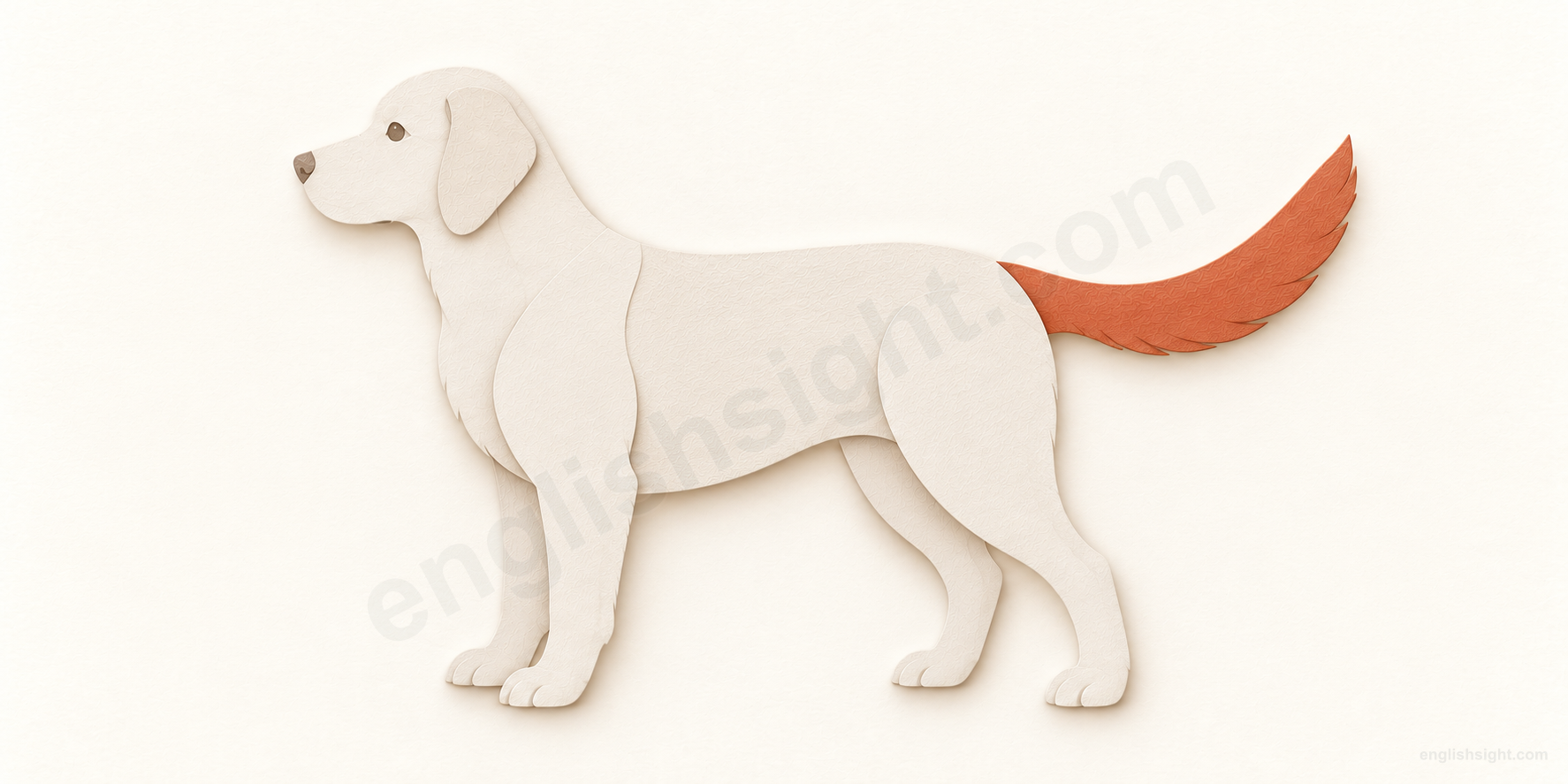
The dog's head faces left, identifying the front of its body.
tail
The tail curves out to the right and upward; the dog remains still.
The orange tail connects to the rear of that same body.
The highlighted tail extends from the rear of the same animal.
A tail is a part that projects from the rear of a body, or a comparable rear or final part of something larger.
The sketch shows a static part–whole relationship. No before-and-after change is needed. Following and ending uses extend the relationship; the coin term and fixed idioms need their own explanations.
A tail belongs at the rear of a body or extends from a main part. This relationship helps connect an animal’s tail, a kite’s tail, the rear of a procession, and some expressions about following.
It is a useful teaching connection, not a formula for every use. Coin tails and familiar idioms have established meanings that you learn in context; this lesson does not claim that all speakers picture the same scene.
01
Bodies, objects, and endings
Start with a body part, then recognize a similar shape or a position at the back. These uses describe a relationship within a whole.
01
possessive + tail; the tail of + animal; adjective + -tailed + noun
an animal’s tail
the body part extending at the rear
Situation / starting point
A cat faces the window.
Part, position, or outcome
Its tail curves out behind its body.
Identify the appendage by its connection to the body.
Use a possessive or an of phrase to connect the part with its owner: the cat’s tail or the tail of the cat. The plural is tails: Both cats have short tails.
Wag, swish, flick, and twitch describe different movements of a tail. Tail feathers and tail fin name structures at the rear of birds and fish; a tail need not be a thin furry line.
In a long-tailed bird, -tailed means having that kind of tail. Compare a bird with a long tail: with introduces the feature; the compound adjective puts it before bird.
In a sentence
The cat flicked its tail when a fly landed nearby.
Watch the difference Tail and tale sound alike /teɪl/, but a tale is a story. Write a long tail for the body part.
02
the tail of + object; tail + section / fin
the tail of a plane / kite
a rear section or a tail-like extension
Situation / starting point
You identify an object’s main body.
Part, position, or outcome
You distinguish the structure at its rear.
Shape or rear position motivates this extension of the body-part use.
A plane has a tail section; a kite can have a ribbon tail. Use tail of to identify the whole, or use tail before another noun: the plane’s tail fin.
A comet’s tail is a visible stream, not a solid appendage. Similar appearance motivates the name; it does not mean a comet has an animal body. Its tail does not simply mark the direction opposite its travel.
Tail is more specific than back. The back of a chair supports a sitter; it is not normally called the chair’s tail. Check the established name instead of naming every rear surface a tail.
In a sentence
The kite’s ribbon tail caught on a branch.
Watch the difference Do not assume tail means a detachable extra: an aircraft’s tail is part of the aircraft.
03
at the tail of + moving group; the tail end of + noun
the tail end of something
the last section in space or time
Situation / starting point
A line or an event has a beginning and an end.
Part, position, or outcome
You refer only to the final part.
The rear of an ordered whole becomes its ending.
At the tail of a procession identifies its rear. The tail end of a queue makes the same final position explicit.
With an event, tail end picks out the closing portion: the tail end of a meeting or of summer. It need not mean the exact final second. Catch the tail end of a broadcast means arrive in time to hear only its final portion.
In a sentence
We arrived in time for the tail end of the concert.
Watch the difference At the end can describe a point; the tail end usually emphasizes a final portion.
04
wear / be in + tails; a tailcoat
wear tails
wear a formal coat with two long back pieces
Situation / starting point
An invitation specifies very formal evening dress.
Part, position, or outcome
A guest wears a coat with divided back panels.
The garment is named through its hanging rear parts.
In clothing, tails is a plural expression for a tailcoat or formal dress including one. A coat’s two hanging back pieces are its tails.
Say He wore tails or He wore a tailcoat. The clothing expression is not the ordinary plural of several animals’ tails, and context distinguishes it from the coin call.
In a sentence
The pianist wore tails for the gala performance.
Watch the difference Tails does not mean any suit jacket; the distinctive long back pieces matter.
05
heads or tails?; choose tails; come up / land + tails
heads or tails?
choose a side in a coin toss
Situation / starting point
Two people want to decide who goes first.
Part, position, or outcome
One calls a side before the coin lands.
Tails is a conventional name for one coin face.
Heads or tails? asks someone to choose a side before a toss. I’ll take tails names your choice; It came up tails reports the result.
The name contrasts with heads, traditionally the face bearing a head. Read tails as a fixed coin term, not as a claim that an animal’s tail appears on the coin.
In a sentence
“Heads or tails?” “Tails. If I win, I’ll serve first.”
Watch the difference Use tails in the usual call and result: It landed tails, not It landed a tail.
02
Following and watching
As a verb, tail puts a follower behind someone. Related noun phrases describe a watcher or a close pursuer.
06
tail + person; be tailed; have + person + tailed
tail someone
follow a person to watch their movements
Situation / starting point
A detective needs to know where a person goes.
Part, position, or outcome
The detective follows and observes.
The follower stays behind the person being watched.
Tail takes a direct object: tail a suspect, tail her. It is often used in detective or surveillance contexts, especially informally. It is not just a neutral way to say walk with a friend.
The regular forms are tails, tailed, and tailing. The passive is possible: She was being tailed. Have someone tailed means arrange for another person to follow them; have supplies the arrangement meaning.
In a sentence
The detective tailed the driver from the station to a hotel.
Watch the difference Say tail him, without after. Tail after occurs separately in some contexts, but is not needed for this surveillance construction.
07
a tail; put a tail on + person
put a tail on someone
assign a person to follow and watch someone
Situation / starting point
Investigators decide that a person should be watched.
Part, position, or outcome
A watcher follows the person’s movements.
The noun names the follower rather than the followed person.
In informal surveillance language, a tail is the person following you. Put a tail on someone means arrange that surveillance.
Compare They tailed him, which uses a verb, with They put a tail on him, which uses a countable noun. Neither sentence says that he has grown a body part.
In a sentence
In the novel, the inspector puts a tail on the courier.
Watch the difference A tail is the watcher here, not the person under observation.
08
be / stay / get + on + possessive + tail
on someone’s tail
following very closely behind
Situation / starting point
A cyclist notices a vehicle close behind.
Part, position, or outcome
The vehicle continues to follow closely.
On marks close pursuit in this established phrase.
Be on someone’s tail describes close following, particularly on the road. A pursuer may be chasing someone openly; secrecy is not required.
Compare tail someone, which often involves watching, with be on their tail, which emphasizes closeness or pursuit. In a road complaint, get off my tail asks the follower to leave more space.
In a sentence
A delivery van was on my tail all the way to the bridge.
Watch the difference Do not infer secret surveillance whenever you hear on my tail.
03
Fading activity and traffic lines
Particles change the construction. Tail off and tail away describe a gradual reduction; tail back describes traffic extending into a queue.
09
amount / activity / interest + tail off
tail off
gradually decrease in amount or strength
Situation / starting point
Orders are high at the start of a sale.
Part, position, or outcome
The number slowly drops afterward.
Off belongs to a gradual-decrease construction.
The thing decreasing is normally the subject: orders tail off, interest tails off, activity tails off. These examples are intransitive: tail off has no direct object here.
Gradual change is central. Tail off does not by itself say that the activity stops completely. Stop abruptly would describe a different course of events.
In a sentence
Online orders tailed off after the first week of the sale.
Watch the difference Use Sales tailed off to describe sales decreasing. Collins also records a transitive use meaning cause to decrease, so this lesson’s intransitive pattern is not a ban on every transitive use.
10
voice + tail away / off; speaker + tail off
a voice tails away / off
speech becomes weaker and fades
Situation / starting point
A speaker starts a sentence clearly.
Part, position, or outcome
The final words become difficult to hear.
The ending dwindles rather than being cut off suddenly.
With a voice or speech, tail away and tail off describe fading volume or an unfinished, weakening ending. A person can also tail off while speaking: he begins confidently, then loses the thread.
The fading sound can suggest hesitation in a particular story, but the phrase alone does not prove why it fades. Away is part of the expression; it need not mean that the speaker walks away.
In a sentence
“I thought I had saved it…” Her voice tailed away.
Watch the difference Do not confuse Her voice tailed off with Someone cut her off, which introduces an interruption.
11
traffic + tail back + distance / from + place
traffic tails back
a queue of slow or stopped vehicles extends backward
Situation / starting point
A blocked lane slows the vehicles at the front.
Part, position, or outcome
More vehicles join the queue behind.
Back identifies the growing queue behind the obstruction.
This British traffic expression describes a queue forming and extending along the approach to a blockage. The cars do not have to reverse.
Use traffic or vehicles as the subject, followed by a distance or location if needed. American English commonly uses Traffic backed up for this situation. A tailback is the related noun, not the same grammatical form as tails back.
In a sentence
Traffic tailed back for three kilometres from the closed bridge.
Watch the difference Tail back is two words as a verb; a tailback is one word as a noun.
12
vehicles / traffic + be + nose to tail
nose to tail
vehicles close together in a line
Situation / starting point
Many cars share a crowded road.
Part, position, or outcome
Each car is close to the rear of the next.
The front of one vehicle almost meets the rear of another.
In British road descriptions, nose to tail describes a close line of vehicles, often moving slowly. Nose stands for a vehicle’s front and tail for its rear.
This describes the spacing within the line. Traffic tails back describes the queue’s extension; the two expressions can describe different aspects of the same delay.
In a sentence
Cars were nose to tail through the town centre.
Watch the difference The phrase does not mean the cars are facing one another.
04
Fixed expressions in conversation
Animal posture and the contrast between front and back help some expressions make sense. Learn each whole expression and its limits.
13
turn tail; turn tail and + run / flee
turn tail
turn and flee from danger or opposition
Situation / starting point
A person faces a threat.
Part, position, or outcome
The person turns and runs away.
An animal’s rear becomes visible as it flees.
Use turn tail as a whole expression. Turned tail and ran is a natural combination because ran makes the flight explicit.
It can sound vivid or critical when used about retreat from a difficulty. Do not reduce it to any ordinary change of direction.
In a sentence
When the guard appeared, the intruders turned tail and ran.
Watch the difference Do not add an article or possessive inside the fixed phrase: turn tail, not turn a tail.
14
return / leave + with + possessive + tail between + possessive + legs
with your tail between your legs
feeling humiliated after defeat or failure
Situation / starting point
Someone boasts about an easy victory.
Part, position, or outcome
After losing, the person returns embarrassed.
The animal-posture image suggests a defeated manner.
For a person, this informal idiom describes shame or humiliation, not a real body position. The possessive changes with the person: my tail, her tail, their tails.
Go home with your tail between your legs describes how the return feels or looks. Turn tail emphasizes fleeing; this expression emphasizes the defeated manner.
In a sentence
After his proposal was rejected, he left with his tail between his legs.
Watch the difference A routine rejection does not automatically cause shame; choosing this idiom adds that interpretation.
15
chase + possessive + (own) tail
chase your own tail
be busy without making useful progress
Situation / starting point
A team repeatedly rechecks the same information.
Part, position, or outcome
It spends hours but solves nothing.
Circular effort brings the worker back to the same problem.
The idiom compares ineffective activity with an animal trying to catch its own tail. Your own can become our own, his own, and so on.
It is a criticism of the lack of progress, not a synonym for working hard. Someone can work very hard and achieve a great deal without chasing their tail.
In a sentence
We’re chasing our own tails because nobody has the latest file.
Watch the difference Read the context: a puppy chasing its tail may describe a literal action.
16
cannot / could not make head or / nor tail of + noun / clause; cannot make heads or tails of + noun / clause
can’t make head or tail of something
cannot understand it at all
Situation / starting point
You try to read some confusing instructions.
Part, position, or outcome
You still cannot work out their meaning.
The whole expression reports failure to make sense of something.
Head or tail and head nor tail are both established forms in this negative idiom. American English also uses heads or tails: I can’t make heads or tails of these instructions. Of introduces the confusing material: of this note, of what she said.
The front/back contrast offers a memory aid, not a rule for inventing other phrases. In ordinary explanation, I can’t understand these instructions says the meaning directly.
In a sentence
I can’t make head or tail of this handwritten message.
Watch the difference Keep of before the confusing thing; this is not about physically making a head or a tail.
17
the tail is wagging the dog; the tail wags the dog
the tail is wagging the dog
a minor part is controlling the main concern
Situation / starting point
A project should serve its users.
Part, position, or outcome
A tiny reporting requirement starts dictating every decision.
The normal relation between whole and part is reversed.
The normal scene is a dog moving its tail. In the idiom, the less important part appears to control the more important whole.
The phrase normally expresses disapproval. In a meeting, name the small constraint and the larger goal so listeners can understand the comparison.
In a sentence
If our report format decides the whole service, the tail is wagging the dog.
Watch the difference It does not simply mean a small thing has some influence; the criticism concerns inappropriate control.
18
have / contain + a sting in the tail; there is a sting in the tail
a sting in the tail
an unpleasant feature at the end
Situation / starting point
An offer initially sounds attractive.
Part, position, or outcome
A final condition makes it less appealing.
The ending carries an unwelcome surprise.
The tail here is the ending of a situation, story, or offer. Sting adds the unpleasant feature: a final fee, restriction, or twist.
Learn the whole phrase. It does not require a literal animal, and it is not a general term for every surprising ending: an unexpectedly happy ending has no unpleasant sting.
In a sentence
The free trial had a sting in the tail: cancelling required a phone call.
Watch the difference A sting in the tail is usually a negative final feature, not merely the last detail.
19
top and tail + fruit / vegetables; topped and tailed + noun
top and tail vegetables
trim off their two ends before cooking
Situation / starting point
Green beans still have their ends attached.
Part, position, or outcome
A cook removes the ends before using them.
Tail names an end to remove within a fixed preparation phrase.
In British cooking instructions, top and tail beans means cut off both ends. The vegetables are the direct object. Tail here does not mean follow them.
The whole phrase can take normal verb forms: top and tail them; topped and tailed beans. In British baby-care contexts it can instead mean wash a baby’s face and bottom without a full bath; that is a separate established use.
In a sentence
Top and tail the green beans before adding them to the pan.
Watch the difference Do not apply the cooking action to the baby-care use; the object and context distinguish them.
20
succeed / advance + on + possessive + coat-tails
on someone’s coat-tails
benefiting from another person’s success or influence
Situation / starting point
A newcomer has a well-known relative.
Part, position, or outcome
The relative’s reputation helps the newcomer gain attention.
The following image becomes dependence on someone else’s success.
On someone’s coat-tails describes success gained through another person’s position or influence. It can question how much the beneficiary achieved independently.
The literal clothing connection helps you remember it, but the idiom does not involve holding a coat. Compare on someone’s tail, which describes pursuit rather than benefiting from their reputation.
In a sentence
He entered the industry on his sister’s coat-tails.
Watch the difference Keep coat-tails: on his sister’s tail would suggest following or pursuing her.
Read the word form and the whole expression
Noun, verb, or fixed tails?
Most physical tail nouns are countable: a tail, two tails. The verb is regular: tail, tails, tailed, tailing. Coin tails and clothing tails are established forms, so their final s does not simply count several animals’ tails.
Do not overextend the rear picture
Tail is not interchangeable with every back or end. Use familiar object names and learn tail off, tail back, and the idioms as constructions. The diagram provides a connection, not an etymological proof or a prediction rule.
Scope and register
This lesson covers everyday physical uses and expressions useful in general reading. Specialist legal, printing, nautical, building, mining, and sporting senses are not developed. Slang for buttocks and vulgar or objectifying sexual uses are outside the practice scope; they are not neutral substitutes for the meanings taught here.
Find the intended meaning
Use the subject, the particle, and the situation to choose an interpretation.
1. Orders become fewer over several weeks but do not stop. Which sentence fits?
2. Traffic tails back from a closed bridge. What is happening?
3. You choose the reverse side before tossing a coin. What do you call?
4. A van is on your tail. What does this most directly tell you?
5. A minor form requirement controls a whole project. Which expression criticizes that reversal?
Sources and teaching notes
The dictionary pages below support the usage inventory. Explanations and examples are original. Connections drawn from the diagram are teaching interpretations.
The sketch highlights a rear connection; it is a teaching aid, not a picture shared by every native speaker.