Describe height, compare people and things, and recognize familiar figurative expressions.
From the base to the top
Vertical extent, with a reference point
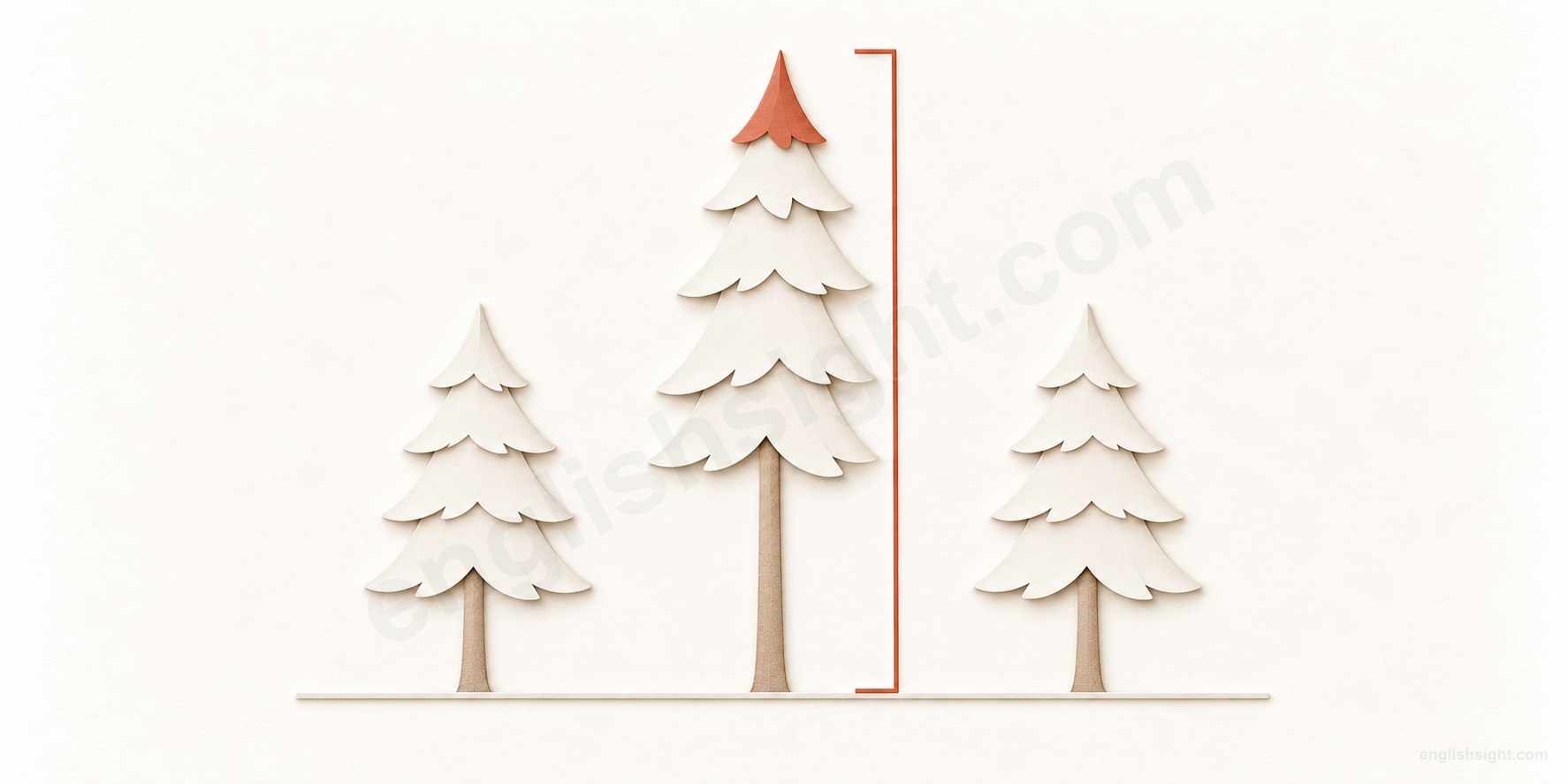
Three pine trees stand on one level ground line.
tall
The middle tree extends much farther upward than its two neighbors.
Compare each tree from its trunk base to its tip.
The bracket marks the middle tree’s own bottom-to-top height; this is a comparison, not growth over time.
Tall directs attention to how far a person or an upright thing extends from bottom to top. Without a measurement, it usually compares that height with what is normal for its kind.
The sketch compares three trees on the same ground level. It shows a height relation, not motion or growth over time. Idioms about difficulty, exaggeration, and confidence need their own explanations.
A tall person, a tall tree, and a tall building all draw attention to vertical extent. Usually, tall without a measurement means greater height than expected for that kind of person or thing.
A measured height works differently: a toy can be only ten centimetres tall. The number states its bottom-to-top size; it does not say the toy is unusually large.
The tree comparison is a teaching aid. It does not represent a mental picture shared by all English speakers, and it cannot predict the meanings of every idiom.
01
People, upright things, and measurements
Start with physical height. Notice whether tall gives a general description or follows a specific measurement.
01
a tall + person noun; person + be / look / seem + tall
a tall person / be tall
have greater body height than expected
Situation / reference
You describe the person waiting by the entrance.
What the expression tells us
The description helps someone identify her.
Tall describes body height, not age, weight, or importance.
Use tall before a noun or after a linking verb: a tall woman; the woman is tall. A tall child has considerable height compared with the relevant children, not necessarily compared with adults.
For a neutral question about someone’s height, ask How tall are you? Short is the usual opposite for people. Big is less precise because it can refer to overall size.
In a sentence
The tall woman beside the entrance is our guide.
Watch the difference Use tall for ordinary body height, not a high woman.
02
tall + upright object; object + be + tall
tall trees / a tall building / a tall glass
have considerable vertical extent
Situation / reference
Several pines grow beside the path.
What the expression tells us
Their tops rise a long way above their bases.
Tall concerns an object’s own height, not the height of its location.
Trees, buildings, chimneys, and glasses are natural nouns with tall. For objects, it often suggests a strong upright dimension: a tall glass is a glass with considerable bottom-to-top extent. In gardening, a tall variety is one that grows higher than comparable varieties; it does not mean the plant is placed higher up.
It does not follow that everything tall must be thin. A building can be both tall and wide. For a glass placed on a shelf, distinguish its own shape from its elevated position.
In a sentence
Tall pines shade the path to the lake.
Watch the difference A tall glass describes the container; tall does not specify the drink’s temperature or ingredients.
03
be + measurement + tall; a + number-unit-tall + noun
two metres tall / a two-metre-tall fence
specify a bottom-to-top measurement
Situation / reference
You measure a fence before buying a screen.
What the expression tells us
You report a height of two metres.
A number plus tall states height without necessarily calling it unusual.
Place the measurement before tall: The fence is two metres tall. How tall is the fence? asks for that dimension. Even a tiny model can be three centimetres tall.
Before a noun, a measurement can form a hyphenated modifier: a two-metre-tall fence. Keep the unit singular there. Compare two metres tall after the noun, where the ordinary plural returns. American spelling uses meter; imperial examples include six feet tall and a six-foot-tall player.
In a sentence
We need a screen for a two-metre-tall fence.
Watch the difference Say two metres tall or two metres in height, not two metres height.
02
Compare height and choose the right word
Comparison, change, and suitability come from the surrounding grammar. High and tall overlap in some contexts but answer different questions in others.
04
taller than; the tallest + noun / in a group; as tall as
taller than / the tallest / as tall as
compare height with another person or thing
Situation / reference
You compare two children’s heights.
What the expression tells us
One child has greater height than the other.
Comparative grammar supplies the relation; taller need not mean tall overall.
Use taller than for unequal height, the tallest for the greatest height in a stated group, and as tall as for equality. A short child can be taller than another short child.
My sister is taller than me is ordinary English; taller than I am is also possible. A measurement can state the difference: She is five centimetres taller than me. Say much taller or a little taller, not very taller.
In a sentence
Maya is a little taller than her older brother.
Watch the difference Use as tall as for equality, not as tall than. Older does not automatically mean taller.
05
grow / get + taller; make + object + taller
grow taller / get taller
increase in height over time
Situation / reference
A child’s old trousers no longer reach the ankles.
What the expression tells us
The child now has greater height than before.
Grow or get supplies change; taller names the changing dimension.
He grows taller every year describes an increase, whereas He is tall describes a state. You can also say He is getting taller. The adjective itself does not supply a time sequence.
In We made the fence taller, make describes causing a change and taller describes the resulting height. This does not turn tall into a verb.
In a sentence
Our son has grown taller since the spring.
Watch the difference Do not say He has talled. Use a verb such as grow with the adjective.
06
tall enough to + verb; too tall to + verb; too tall for + noun; tall for + reference group
tall enough to / too tall for
judge height against a practical requirement
Situation / reference
Someone wants to reach a shelf without a stool.
What the expression tells us
Their height may meet the requirement.
Enough marks sufficient height; too marks excessive height for a purpose.
Tall enough to reach the shelf says the height is sufficient for that task. Too tall to stand upright in the tent says the person’s height prevents that action there.
Use for with a person, object, or setting: too tall for this doorway; tall for her age. The second compares her with an age-based expectation; it does not say her height causes a problem.
In a sentence
Nora is tall enough to reach the top shelf.
Watch the difference Put enough after the adjective: tall enough, not enough tall. Too tall is not a neutral synonym for very tall.
07
tall + object; object + high above + reference point
a tall lamp / a lamp high above the floor
distinguish an object’s height from its elevation
Situation / reference
A small lamp is fixed near the ceiling.
What the expression tells us
Its position is high, although the lamp itself is small.
High can describe elevation; tall usually describes the thing’s own vertical extent.
A tall lamp has a long upright form. A lamp high above the floor is located at a considerable elevation. Raising a short lamp onto a shelf does not make the lamp taller.
For people’s body height, choose tall. High is usual for mountains, ceilings, and distances above the ground. Buildings can be high or tall; a fence can also be two metres high or tall when reporting its vertical size. This is a usage distinction, not a ban on high for all objects.
In a sentence
The lamp is high above the floor, but it is only twenty centimetres tall.
Watch the difference How high is the plane? asks about altitude, not the aircraft’s bottom-to-top dimensions.
03
Established figurative expressions
These phrases use ideas of size or uprightness in conventional ways. Learn the whole expression and its situation rather than substituting tall freely.
08
be / seem like + a tall order; a tall order to + verb
a tall order
a task or requirement that is very difficult to meet
Situation / reference
A customer requests a week’s work by tomorrow.
What the expression tells us
You judge the demand very difficult to satisfy.
The whole noun phrase evaluates a demand, not physical height.
Finishing by tomorrow is a tall order means the task is demanding. Order here can be a requirement or request, not necessarily an instruction from a manager or a purchase.
The expression is informal and does not automatically mean impossible. The size-of-a-demand connection can help you remember it, but tall does not freely replace difficult: a tall problem is not the ordinary equivalent of a difficult problem.
In a sentence
Repairing every bike before lunch will be a tall order.
Watch the difference Learn a tall order as a unit. Do not change it to a high order for the same meaning.
09
tell + a tall tale / story; a tall tale about + topic
a tall tale / a tall story
an exaggerated account that is hard to believe
Situation / reference
A speaker claims to have caught an impossibly large fish.
What the expression tells us
Listeners doubt the exaggerated account.
Tall evaluates credibility through an established phrase, not story length.
A tall tale describes an account that seems exaggerated and unlikely to be true. Tall story is especially British; tall tale is the usual North American form. Both can be understood beyond those regions.
A long story has many details or takes time to tell. It can be entirely true. A tall tale may be short, and the phrase can describe playful exaggeration as well as an account you seriously doubt.
In a sentence
Leo told us a tall tale about a fish bigger than his boat.
Watch the difference Do not assume tall tale simply means a lengthy story or any kind of fictional story.
10
stand tall; stand tall in the face of + difficulty
stand tall
show pride, courage, or strength
Situation / reference
A team faces public criticism after a difficult season.
What the expression tells us
Its members respond with dignity and resolve.
Figurative uprightness concerns attitude, not extra body height.
Stand tall can encourage someone to remain confident or courageous, especially when facing difficulty. It does not claim that the person has grown or must be physically tall.
Context can also make stand tall literal: The pines stand tall beside the road. In Stand tall and keep your shoulders relaxed, it can be a posture instruction. Read the situation before choosing the figurative meaning.
In a sentence
Even after the defeat, the young team could stand tall.
Watch the difference The established phrase is stand tall, not stand tallly. In its figurative use, courage is not restricted to tall people.
11
walk tall; can walk tall again
walk tall
feel or show pride and confidence
Situation / reference
Someone has completed a demanding course.
What the expression tells us
They carry themselves with new confidence.
Walking upright supplies a helpful image; the meaning can be emotional.
Walk tall describes feeling proud and confident or behaving in a way that shows self-respect. A person does not have to be walking at the moment: After that success, she can walk tall again concerns her confidence.
Compare walk quickly, which tells you the speed of actual movement. In walk tall, the whole expression conveys an attitude. It overlaps with stand tall, while stand tall can particularly emphasize resolve under pressure.
In a sentence
After earning her qualification, Aisha could walk tall again.
Watch the difference Walk tall does not mean walk on your toes to become physically taller.
Keep height, grammar, and idioms distinct
Forms and word classes
Tall is mainly an adjective: tall, taller, tallest. Use taller and tallest in ordinary comparisons, rather than more tall and most tall. Dictionaries also record adverbial tall, especially in established expressions such as stand tall and walk tall. Do not invent a general adverb tallly.
A description is not a change
She is tall describes height; she is getting taller describes change. Tall is not an ordinary verb, so it has no passive, tense system, or productive phrasal-verb family. In make the fence taller, make supplies the causative meaning and taller describes the result.
A model has limits
The tree sketch helps with physical height and comparisons. A tall order is a difficult demand; a tall tale is exaggerated; stand tall and walk tall can concern confidence. These conventional meanings are not claims about literal growth.
An additional saying
Great oaks from little acorns grow also has the variant Tall oaks from little acorns grow. It means that a large achievement can begin in a small way. This is a saying about development, not a rule that tall alone means successful.
Read the height or the whole phrase
Choose the expression that fits the intended meaning.
1. You want to ask about an adult’s body height. Which question fits?
2. A model tree is eight centimetres tall. What must be true?
3. Sam and Priya have equal height. Which sentence says this?
4. A small lamp is mounted near the ceiling. You want to describe its position above the floor, not its own size.
5. The deadline is tomorrow, and there is far too much work. What does That’s a tall order express?
6. Someone describes catching a fish larger than their boat, and you doubt the exaggerated account. What would you call it?
Sources and teaching notes
The source pages below support the meanings, grammar, and usage distinctions. Explanations and examples are original; the tree comparison is a teaching model.
The diagram explains a height relation; it is not a shared picture inside every speaker’s mind.