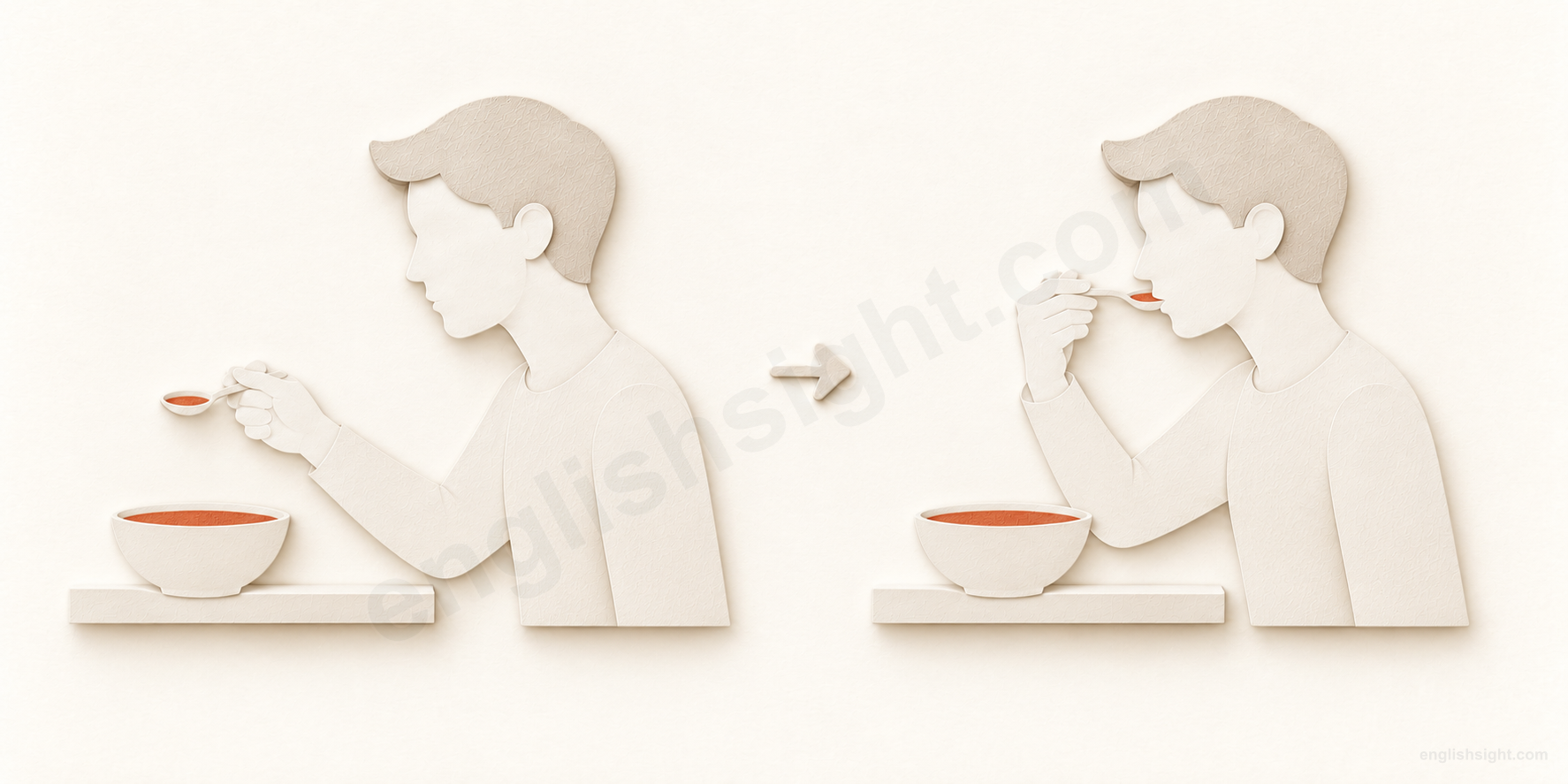
From food in the mouth to brief experience, preference, and judgment.
Contact, sensation, and related branches
Contact makes a quality available to the senses
The person holds a small spoonful above the bowl, away from their mouth.
taste
Contact with the food makes its flavour available to the senses.
They bring the spoonful to their lips.
A little food reaches the mouth, making its flavour available to the person.
Taste connects food in the mouth with the quality a person senses. Trying a little also offers a teaching connection to brief experience; preference and judgment form further branches.
The picture shows deliberate sampling, one concrete starting point. It does not show every use: a food can taste good without a deliberate test, and a taste for adventure involves no food.
Taste is both a noun and a verb, pronounced /teɪst/. Start with food in the mouth: someone tries it, senses a flavour, and may form a preference. These are connected ideas, but they need different sentence patterns.
I taste the soup puts the person in the subject position. The soup tastes good puts the food there. My taste in food concerns preferences rather than the current flavour. Keeping these roles clear is more useful than memorizing one translation.
01
Food, sensing, and small samples
Separate the flavour, the ability to sense it, the act of trying food, and the food’s own qualities. The grammatical subject is a useful clue.
01
the taste of + food; have a/an + adjective + taste
the taste of…
the flavour experienced in the mouth
Situation / starting point
You eat a piece of fruit.
Meaning in this situation
You describe its flavour.
Taste can name a quality of food rather than an action.
The noun names what food or drink is like in your mouth. A taste of lemon can describe a flavour; a taste of the soup can instead mean a small sample. Context tells you whether taste names a quality or a quantity.
Compare The sauce has a sharp taste with The sauce tastes sharp. The noun needs has here; the verb links sauce directly to sharp. A sweet taste does not necessarily mean a taste you personally enjoy.
In a sentence
The berries have a sharp taste, so I added some yogurt.
Watch the difference Use taste for flavour and texture for qualities such as smoothness or crunchiness.
02
a / your sense of taste; taste buds
sense of taste
the ability to sense flavours
Situation / starting point
You discuss the senses.
Meaning in this situation
You name the ability rather than a particular flavour.
Sense of taste is an ability; a taste is something sensed.
In sense of taste, taste is uncountable. Someone can lose their sense of taste; a particular meal can have very little taste. Those sentences discuss the person’s ability and the food’s flavour respectively.
In everyday food talk, taste and flavour overlap. Flavour can also involve smell and texture, so this lesson does not claim that everything experienced while eating comes from the tongue alone. Taste buds is the familiar name for structures involved in sensing taste.
In a sentence
The activity asks children to compare their senses of smell and taste.
Watch the difference For preferences, say tastes or taste in music, not sense of taste in music.
03
person + taste + food / drink
taste the soup
try a little food or drink
Situation / starting point
The cook is unsure about the seasoning.
Meaning in this situation
A small spoonful helps the cook decide.
The person is the subject; the food is the object.
Here taste is a deliberate action: put a little in your mouth to find out what it is like. Taste it is a natural invitation or instruction. You do not need to finish a portion or decide that you like it.
I am tasting the soup is possible when you describe the action now. The soup tastes salty describes its quality instead. A passive is possible for deliberate testing: Each sauce was tasted by two cooks. That is different from trying to make the linking use passive.
In a sentence
Taste the soup before you add the cream.
Watch the difference Taste it, not taste of it, is the neutral everyday instruction.
04
can / could + taste + flavour / ingredient + in + food
can taste the garlic
notice a flavour in something
Situation / starting point
You try a sauce.
Meaning in this situation
You recognize garlic among its ingredients.
Recognizing a flavour need not be a deliberate test.
I can taste garlic means I notice its flavour, whether or not I was checking for garlic. Compare I tasted the sauce, which reports trying the sauce but does not say what I detected.
Can and could often accompany sensory recognition: Can you taste the ginger? I couldn’t taste it. The negative can mean the flavour was not noticeable; it does not by itself mean the speaker refused to try the food.
In a sentence
I can taste a little ginger in the dressing.
Watch the difference I can taste it reports perception; I like it reports preference.
05
food / drink + taste + adjective; How does it taste?
taste good / salty
have a particular flavour
Situation / starting point
You take a sip of broth.
Meaning in this situation
You describe the broth as salty.
The food is the subject; an adjective describes it.
In The broth tastes salty, taste is a linking verb. Salty describes the broth, not the manner in which a person performs an action. Use How does it taste? to ask for a description.
Say tastes good, tastes strange, or tastes delicious, rather than tastes deliciously. To ask about a change, you can say Does it still taste the same? Neutral everyday English normally uses the simple form for this meaning, even when the tasting happens now.
In a sentence
The broth tastes salty, but the noodles taste fine.
Watch the difference The broth is tasting salty is not the usual neutral choice for a current flavour.
06
food + taste like + noun; food + taste of + flavour
taste like / taste of
compare or identify a flavour
Situation / starting point
You try a pale sauce.
Meaning in this situation
Its flavour reminds you of lemon.
Like makes a comparison; of identifies a noticeable flavour.
Tastes like lemon compares the flavour with lemon. Tastes of lemon says that lemon is a noticeable flavour. Neither wording alone proves that actual lemon was used: an artificial flavour can create the same impression.
Both patterns occur with food and drink. Like highlights resemblance; of highlights a flavour you notice. Keep the subject in view: The sauce tastes of lemon describes the sauce, while I taste the sauce describes a person’s action.
In a sentence
This sauce tastes like lemon, but the label says it contains lime.
Watch the difference Say It tastes sweet or It tastes like honey; avoid It tastes like sweet.
07
have / has + (never / ever) + tasted + food
the best… I have ever tasted
refer to eating or drinking experience
Situation / starting point
You have tried many desserts.
Meaning in this situation
You compare today’s dessert with earlier ones.
Taste can refer to having eaten something, without an organized test.
That is the best pie I have ever tasted compares food you have experienced. Taste need not describe taking one tiny sample on a particular occasion here.
I have never tasted that fruit means I have never tried eating it. It differs from I can’t taste the fruit, which can mean the fruit’s flavour is not noticeable in something I am eating now.
In a sentence
This is the smokiest cheese I have ever tasted.
Watch the difference Use eaten or drunk when the amount consumed is the point; taste does not tell you how much was finished.
08
have / get / give someone + a taste of + food
have a taste of…
try a small amount
Situation / starting point
A friend offers some dessert.
Meaning in this situation
You try a spoonful rather than a serving.
The noun a taste names a small sample.
Have a taste of this dessert invites someone to try a little. Give me a taste asks for a small sample. Taste is countable here, usually singular, so the article a matters.
Compare I like the taste of this dessert, where taste is its flavour. Have a taste of something can also introduce a brief experience beyond food; the following noun and situation establish that extension.
In a sentence
Would you like a taste of my dessert?
Watch the difference A taste of the dessert is a sample; a taste for desserts is a liking.
09
add + seasoning + to taste; season to taste
season to taste
adjust seasoning to your preference
Situation / starting point
A recipe gives no fixed amount of pepper.
Meaning in this situation
You add an amount you find pleasant.
To taste describes how much seasoning to use.
A recipe can say Add pepper to taste or Season to taste. The cook chooses the quantity according to the flavour they want. This fixed phrase does not specify one universal amount.
Compare Taste the sauce to check the seasoning: taste is a verb there. In add pepper to taste, to taste means according to preference; it is not an instruction to add pepper solely for the purpose of taking a sample.
In a sentence
Stir in the yogurt, then add black pepper to taste.
Watch the difference Keep the whole phrase to taste; to your taste is a broader expression of suitability.
02
A little experience
A small food sample provides a useful connection to a brief experience. Abstract objects make the figurative meaning clear.
10
a / your first taste of + experience; give someone a taste of…
a first taste of…
a brief introduction to an experience
Situation / starting point
You join a team for one afternoon.
Meaning in this situation
You find out a little about the work.
A small sample becomes a limited experience.
A taste of an activity gives you some direct experience without implying full knowledge. A first taste highlights an introduction; get a taste and give someone a taste describe receiving or providing that introduction.
The food sample offers a useful teaching connection, but no eating is involved. A taste of something does not guarantee that the person enjoys it: a taste of office politics may be unpleasant.
In a sentence
The afternoon shift gave me my first taste of restaurant work.
Watch the difference A taste of restaurant work is experience; a taste for it is a liking.
11
taste + success / freedom / defeat / an experience
taste success / defeat
experience a situation or feeling directly
Situation / starting point
A team reaches a final for the first time.
Meaning in this situation
Its members experience success personally.
The verb takes an abstract experience as its object.
Taste success, taste freedom, and taste defeat use food language to make an experience vivid, often as a first or limited experience. The meaning comes from the abstract object and context, not from a hidden physical flavour.
These expressions often suit storytelling, sport, or expressive writing. Experience is a more neutral alternative in many reports. Do not assume the experience is pleasant: defeat and disappointment can also be tasted.
In a sentence
After months of losing, the team finally tasted success.
Watch the difference This use is figurative; taste is not a general replacement for experience in every sentence.
12
a taste of things to come
a taste of things to come
an early example of what will happen later
Situation / starting point
The first event reveals a new problem.
Meaning in this situation
You see it as a sign of more similar events.
The brief sample also points forward.
A taste of things to come presents an event as an indication of future conditions. Things to come means later events, so the full phrase adds a forward-looking interpretation to the sample idea.
It can introduce something exciting or something unwelcome. Calling one busy day a taste of things to come is an interpretation of the future, not proof that every later day will be identical.
In a sentence
The crowded opening night was a taste of things to come.
Watch the difference Things to come refers to the future; it does not mean things arriving for a meal.
03
What you like and how you choose
Taste can describe preferences and judgments. Of, for, in, and to organize different relationships; learn the full construction.
13
have / develop / acquire + a taste for + noun
have a taste for…
like or come to enjoy something
Situation / starting point
You try unfamiliar music repeatedly.
Meaning in this situation
You begin to enjoy it.
For points to the thing someone likes.
Have a taste for something describes a liking. Develop or acquire a taste for it describes that liking growing. The object may be food, a kind of entertainment, an activity, or a way of life.
Compare a taste of adventure, a little experience of adventure, with a taste for adventure, an enjoyment of it. Experience may lead to a preference, but the preposition does not say that this always happens.
In a sentence
During the trip, I developed a taste for strong coffee.
Watch the difference Say a taste for coffee to describe liking it, rather than a taste of coffee.
14
someone’s taste in + field; tastes; a matter of taste
taste in music / different tastes
preferences within a particular area
Situation / starting point
Friends choose different playlists.
Meaning in this situation
Their preferences explain their choices.
In names the area; plural tastes can collect several preferences.
Taste in music concerns the music a person prefers. Taste for jazz highlights a liking for jazz itself. In marks a field of choice, while for marks something liked; neither is a particle making a phrasal verb.
People have different tastes and tastes change over time. For all tastes means for people with varied preferences. A matter of taste marks a choice as personal rather than something settled by a single factual answer.
In a sentence
We have similar taste in music but very different tastes in films.
Watch the difference Taste in music does not require a or a plural; different tastes is also natural when contrasting preferences.
15
be (not) to + possessive + taste; too + adjective + for + possessive + taste
to my taste / for my taste
suit or be judged against someone’s preferences
Situation / starting point
A room has very bright decoration.
Meaning in this situation
You say how it fits your own preferences.
A personal viewpoint is different from a claim about everyone.
Not to my taste means not what I personally like. Too bright for my taste means brighter than I would prefer. Both can discuss food, clothes, art, or other choices.
Compare decorated to my taste, arranged in a way I like, with add salt to taste, the recipe instruction. With a person’s possessive, to my taste can make a disagreement less sweeping: you are identifying your own preference.
In a sentence
The room is a little too bright for my taste.
Watch the difference Use my taste here, not my tasting; tasting names an action or an event.
16
have / show + good / bad / poor taste; with taste
have good / bad taste
show choices the speaker approves or disapproves of
Situation / starting point
Someone chooses fabrics for a room.
Meaning in this situation
You evaluate their choice of colours and patterns.
Good taste praises judgment, not a flavour.
You have good taste praises someone’s choices. Bad or poor taste criticizes them. The field can follow in: good taste in clothes. Furnished with taste similarly praises the way choices were made.
These are evaluations from a person or a community, not measurements of an objective sensory quality. Compare The food has a bad taste, about flavour, with He has bad taste in food, about his choices.
In a sentence
You have good taste in colours; those fabrics work beautifully together.
Watch the difference Do not say a good taste when praising someone’s general judgment; a good taste normally points to a particular flavour.
17
something + be + an acquired taste
an acquired taste
something people may learn to like
Situation / starting point
A flavour seems unfamiliar at first.
Meaning in this situation
Repeated experience can make it enjoyable.
The expression names the thing that takes getting used to.
Calling something an acquired taste suggests that immediate enjoyment is not to be expected. It may take familiarity to appreciate it. The phrase can describe foods, music, humour, or other experiences.
Compare I acquired a taste for olives, which describes a change in my preference, with Olives are an acquired taste, which describes the food as something people may learn to enjoy. The second does not guarantee that everyone eventually likes it.
In a sentence
Her dry humour is an acquired taste, but I now find it hilarious.
Watch the difference Acquired does not mean bought here. A taste for something and an acquired taste have different grammatical roles.
04
Social judgments and fixed expressions
These expressions evaluate behaviour, emotional after-effects, or reactions to success. Their full meanings belong to the established phrases.
18
remark / joke / behaviour + be + in bad / poor / good taste
in bad / good taste
socially inappropriate or appropriate
Situation / starting point
Someone makes a joke at a difficult moment.
Meaning in this situation
You judge whether the remark suits the situation.
In bad taste evaluates the expression or behaviour itself.
A joke in bad or poor taste is considered offensive or insensitive in its situation. In good taste gives a positive judgment of appropriateness. This is a social evaluation, not the flavour of a joke.
Compare He has bad taste in jokes, criticism of what he chooses to enjoy, with His joke was in bad taste, criticism of that joke’s appropriateness. The two can overlap, but their grammar focuses on different things.
In a sentence
The joke about her recent loss was in very poor taste.
Watch the difference Keep in: The joke was in bad taste, not The joke was bad taste in this construction.
19
event + leave + a bad / nasty taste + in someone’s mouth
leave a bad taste in someone’s mouth
leave an unpleasant feeling after an experience
Situation / starting point
A customer discovers hidden charges.
Meaning in this situation
The customer still feels unhappy about the transaction.
An unpleasant experience leaves a figurative after-effect.
The expression can describe lingering resentment, disgust, disappointment, or unease. No food is necessary. The mouth image makes the emotional after-effect vivid.
Compare The coffee left a bitter taste in my mouth, which can be literal. With a dishonest deal as the subject, the phrase describes a reaction to the experience. A bad or nasty taste and in my mouth or in the mouth are familiar forms.
In a sentence
The hidden fee left a bad taste in my mouth, even after they refunded it.
Watch the difference The idiom does not specifically mean physical nausea or an unpleasant flavour.
20
give someone / get + a taste of + possessive + own medicine
a taste of your own medicine
the bad treatment you gave others returned to you
Situation / starting point
A person regularly interrupts colleagues.
Meaning in this situation
Others interrupt that person in return.
Your own refers to the treatment you previously gave.
Give someone a taste of their own medicine means treat them in the same unpleasant way they have treated others. Here a taste is an experience, while medicine is part of the fixed figurative expression.
The possessive follows the person receiving the returned treatment: give him a taste of his own medicine. The phrase often sounds retaliatory or approving of retaliation; it is not a neutral description of resolving a disagreement.
In a sentence
When the habitual interrupter was interrupted, she got a taste of her own medicine.
Watch the difference This is about returned bad treatment, not taking an actual medical dose.
21
there is / there’s no accounting for taste
There’s no accounting for taste.
comment on preferences you find hard to understand
Situation / starting point
A friend loves a design you dislike.
Meaning in this situation
You remark on how surprising preferences can be.
The whole saying comments on a difference in liking.
People use this saying when another person enjoys something they themselves dislike or find surprising. Accounting for means explaining here; there is no calculation or financial account.
It can be humorous, but it may also sound dismissive of the other person’s choice. I suppose we just like different things is a gentler alternative. Learn the saying as a whole instead of treating it as a new verb meaning of taste.
In a sentence
He loves that neon wallpaper—there’s no accounting for taste!
Watch the difference The saying can imply criticism; it is not always a tactful way to respect someone’s preference.
22
person / team + taste blood
taste blood
gain an appetite for more after an initial success
Situation / starting point
A team wins the first game decisively.
Meaning in this situation
It becomes eager to keep winning.
A forceful idiom turns a first experience into appetite.
In competitive or dramatic contexts, taste blood can suggest that an early success makes someone eager for more. The hunting image gives the phrase an aggressive edge; the successful team is not literally drinking blood.
The same words can be literal: I could taste blood after biting my lip. Read the subject and situation before choosing the figurative interpretation. This is a recognition item for sport and storytelling, rather than neutral wording for every successful activity.
In a sentence
After taking an early lead, the team had tasted blood and pushed for another goal.
Watch the difference Taste blood is stronger than experience success and can suggest destructive eagerness.
Keep the roles and the whole phrase in view
A person tastes; food tastes good
Taste the soup has an object. The soup tastes good has a subject complement: good describes the soup. There is no passive version of this linking pattern. Deliberate testing can be passive, as in The samples were tasted separately.
Action, state, and forms
The verb forms are taste, tastes, tasted, tasted, and tasting. Tasted has two syllables: /ˈteɪstɪd/. Use I am tasting it for a deliberate action now; use It tastes salty as the ordinary description of flavour. Sense verbs are not subject to an absolute ban on progressive forms, but learners should start with this distinction.
Articles and countability
A taste of soup is a small sample; the taste of soup is its flavour. Taste as an ability or general judgment is normally uncountable. Tastes can mean distinct flavours or different preferences. The surrounding construction determines the reading.
The model has limits
Direct sensory contact, a limited experience, and preference are useful connected branches, not proof of one historical meaning behind every phrase. Fixed idioms need their own explanation. No single diagram predicts whether a new combination will be natural.
Choose the meaning that fits
Use the subject, the preposition, and the situation to choose.
1. You want to describe the flavour of a drink. Which sentence does that?
2. A short workshop introduces you to acting, but you do not yet know whether you enjoy it. Which sentence fits?
3. A recipe says “add pepper to taste.” What should the cook do?
4. A remark was insensitive during a serious discussion. Which expression judges the remark’s appropriateness?
5. You notice mint in a sauce you are already eating. Which sentence specifically reports noticing that flavour?
6. A dishonest sale still bothers you days later. What does “It left a bad taste in my mouth” mean here?
Sources and teaching notes
The dictionary pages below were read to check senses, constructions, and expressions. The explanations, examples, and visual teaching connection are original to this lesson.
The picture is a teaching aid; English speakers do not all share one mental image for taste.