Describe what someone or something is prone to do, and how wider patterns develop.
A leaning with possible exceptions
More likely, not inevitable
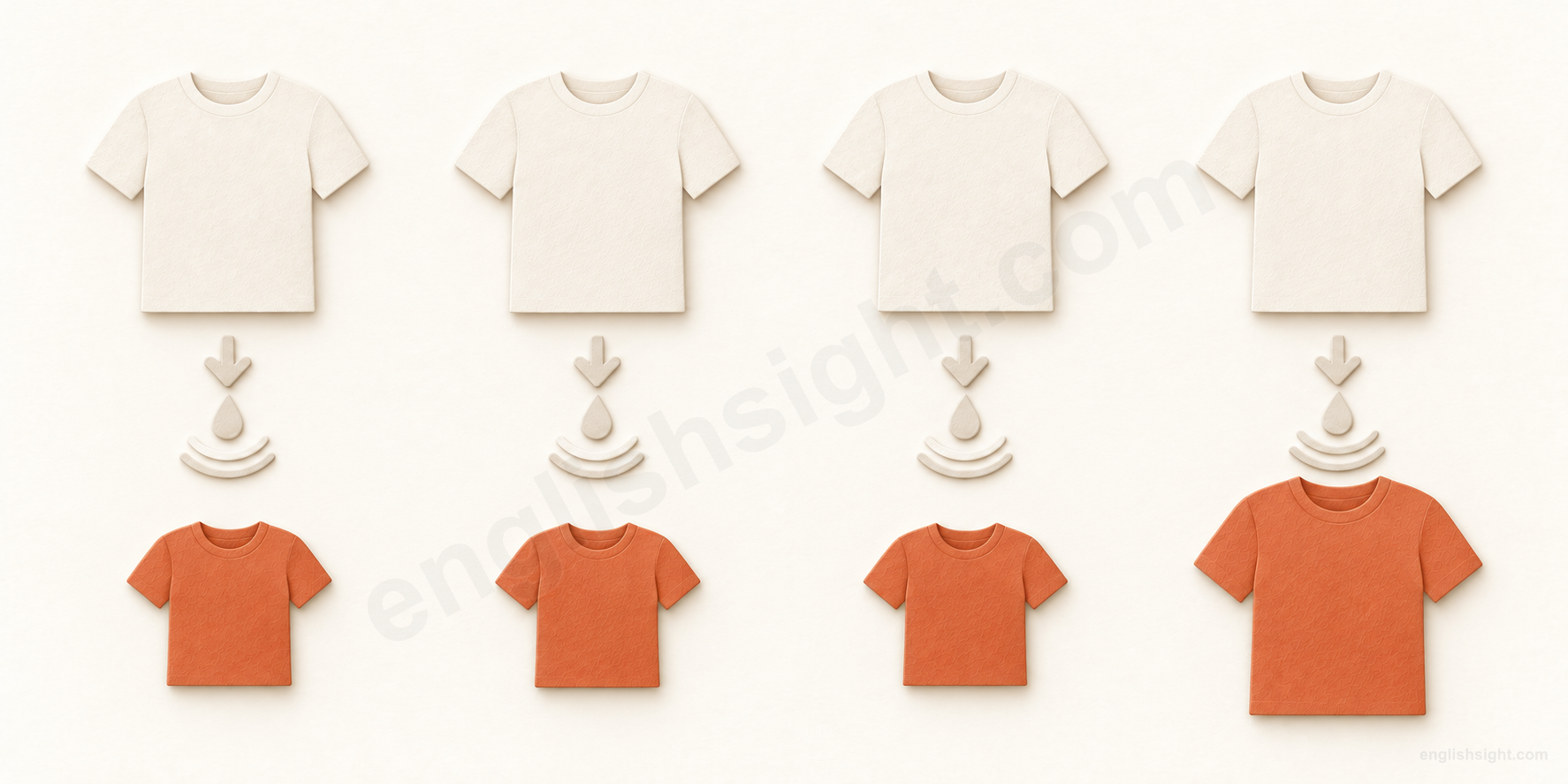
Four similar shirts before washing.
tendency
Three shirts shrink; one remains about its original size.
Washing is shown by downward arrows and water symbols.
A tendency to shrink still allows an exception. These comparisons illustrate an inclination, not a measured probability.
A tendency is a leaning that makes a particular kind of action, state, or development more likely, without making it certain.
The repeated alternatives illustrate an inclination, not a measured probability. A developing trend and the political-group use need their own context.
A tendency makes one kind of behavior, state, or development more likely. It may concern a person, a material, or a whole community. It does not mean that the outcome happens every time.
Start with the inclination, then read the complement: to do names an action, towards something names a direction or quality, and for someone to do names who is involved. A specialized political use can name a faction.
01
People, things, and qualities
Describe an inclination, then choose an action or a quality to explain it.
01
person + have / has + a tendency + to + base verb
have a tendency to do something
be inclined to behave in a particular way
Situation
You often speak too quickly when you feel excited.
What you describe
You describe that recurring behavior while allowing exceptions.
The person has the tendency; the infinitive names the behavior.
I have a tendency to rush describes something I am prone to doing. It can be a familiar habit or a disposition that becomes noticeable in certain circumstances. It does not say that I choose or want to rush.
The infinitive gives the action: a tendency to interrupt, to worry, or to forget names. You can add a condition to make the claim precise. Saying when I am excited avoids suggesting that the behavior happens in every situation.
Compare I tend to speak quickly, a shorter way to express a similar inclination. A habit emphasizes repeated behavior, often a routine; a tendency can also describe a likelihood that has not become a regular routine. Neither expression means always.
In a sentence
I have a tendency to speak too quickly when I am excited.
Watch the difference Use a tendency to speak, not a tendency to speaking. The to before the verb introduces an infinitive.
02
thing / material / process + have / has + a tendency + to + base verb
something has a tendency to…
a thing or process is liable to behave in a certain way
Situation
A drawer sometimes sticks during damp weather.
What you describe
You describe a recurring property rather than a single fault.
An inanimate subject can have a tendency without any intention.
The same construction applies to materials, objects, and processes. The drawer has a tendency to stick reports how it is liable to behave. The subject need not be a person with a habit or a preference.
A tendency to do something can concern an unwelcome result, such as a device switching off, but it is not necessarily negative. Seeds can have a tendency to sprout early. The evaluation comes from the surrounding words and situation.
A strong tendency is pronounced, while a marked tendency is clearly noticeable; a slight tendency is weaker. A natural tendency suggests that the inclination comes from the nature of the person or thing. These modifiers do not give a numerical probability or prove an outcome inevitable.
In a sentence
This drawer has a tendency to stick in damp weather.
Watch the difference A tendency is a general likelihood. The drawer stuck yesterday reports one event and does not by itself establish a tendency.
03
a tendency + towards / toward + noun or -ing form
a tendency towards caution
an inclination towards a quality, state, or kind of behavior
Situation
A team regularly avoids risks when making decisions.
What you describe
You name caution as its general inclination.
Towards introduces a noun or an -ing form, rather than an infinitive.
In a tendency towards caution, caution names the quality the team leans towards. Compare a tendency to avoid risks: the infinitive names what the team does. The two patterns can describe a similar disposition from different angles.
Toward and towards are both standard. Toward is especially common in American English, while towards is especially common in British English. After either preposition use a noun phrase or an -ing form: a tendency toward overworking.
You may also meet to followed by a noun, as in a tendency to caution, especially in more formal writing. This is prepositional to, unlike to in to avoid. For a straightforward learner pattern, use towards + noun or to + base verb.
In a sentence
The team has a tendency towards caution when money is tight.
Watch the difference Say a tendency towards caution or a tendency to be cautious; do not put the bare adjective cautious directly after towards.
02
Name the participants and the wider pattern
Use for or among to locate a tendency, and growing to describe a developing custom.
04
there is a tendency + for + noun phrase + to + base verb; a tendency among + group + to + base verb
a tendency for someone or something to…
state explicitly who or what is likely to act or change
Situation
New learners often choose the first answer they see.
What you describe
You describe the pattern and name the people involved.
The noun phrase after for supplies the subject of the following infinitive.
There is a tendency for new learners to choose the first answer means that new learners are liable to do this. There introduces the existence of a pattern; it does not refer to a location. For new learners identifies who does the choosing.
The same frame works with things: There is a tendency for costs to rise during the winter. You can also name the group with among: There is a tendency among new learners to choose the first answer. Here among locates the tendency within a group.
When the people are already clear, there is a tendency to… can leave them unstated: When people are in a hurry, there is a tendency to overlook details. Formal writing may use a tendency on the part of managers to…; on the part of names whose behavior is being described.
In a sentence
There is a tendency for new learners to choose the first answer they see.
Watch the difference For identifies the person or thing involved; it does not introduce a purpose or a benefit in this construction.
05
a growing / increasing tendency + to + base verb; a tendency + towards / toward + noun phrase
a growing tendency towards…
a pattern of behavior or development that is becoming more common
Situation
More people in a town are choosing to cycle to work.
What you describe
You describe a developing social pattern.
The tendency belongs to a wider pattern, not necessarily to one person’s character.
A growing tendency can describe a developing custom or a direction of change across a group. Growing says that the pattern is becoming more noticeable or widespread. It need not mean that each individual has a stronger personal preference.
Both complement types remain available: a growing tendency to cycle to work names an action; a growing tendency towards cycling names an activity. A tendency towards smaller homes describes the direction of a wider development.
Trend often fits when you mean an overall social or statistical direction. Tendency can instead focus on what someone or something is prone to do. Thus a trend towards cycling can be close to this example, while my tendency to lose my keys describes an individual inclination.
In a sentence
There is a growing tendency for people in this town to cycle to work.
Watch the difference A growing tendency does not say that everyone follows the pattern, or that the change will continue forever.
03
Traits, attitudes, and political groups
Read the adjective and the context carefully: a disposition is not the same thing as a faction.
06
have / show / display / exhibit + adjective + tendencies
show artistic / aggressive tendencies
display inclinations that suggest qualities or attitudes
Situation
Someone’s behavior provides signs of a particular disposition.
What you describe
You describe those signs with an adjective and plural tendencies.
The adjective identifies the kind of inclination being noticed.
Show, display, or exhibit tendencies can describe signs of a disposition. Artistic tendencies may suggest an interest or inclination towards artistic work. Aggressive tendencies suggest a disposition towards aggressive behavior. Tendencies is a noun here, not a verb.
Plural tendencies can gather several signs or aspects of a disposition. It does not simply count the number of incidents: one aggressive action and aggressive tendencies make different claims.
The adjective controls the evaluation. Violent or aggressive tendencies are worrying, but artistic tendencies are not inherently bad. Political adjectives such as reformist can name a leaning in opinion without necessarily naming an organized faction.
Have a tendency to… can soften the wording of a criticism, but calling someone’s behavior a tendency still makes a general claim. An unfortunate tendency expresses a negative judgment; reduce or resist a tendency describes efforts to make the behavior less likely.
In a sentence
The character shows aggressive tendencies whenever he feels challenged.
Watch the difference Do not assume that tendency always means a bad habit, or infer a settled character trait from a single action.
07
a / the + political adjective + tendency + within / in + political group
a tendency within a political party
a faction or grouping inside a larger political organization
Situation
Some party members share views distinct from those of the wider party.
What you describe
A political report refers to this grouping as a tendency.
In this specialized use, tendency can refer to people as a group.
In British political writing, a tendency can be a faction within a larger political group. It often has more radical or extreme views than the rest. This is a recognition use for reading political reports, rather than the main everyday pattern.
The party’s tendency to compromise describes behavior. A radical tendency within the party may refer to a group of people. Read the context: political tendencies can also simply mean political leanings, without identifying a faction.
The general idea of a shared leaning helps connect these uses, but the group meaning is an established convention. You cannot use tendency as a general replacement for team or club.
In a sentence
The report describes a radical tendency within the party.
Watch the difference This use names a political grouping, not a guaranteed future direction for the whole party.
Keep the likelihood and the grammar separate
A countable noun
Use a tendency for one inclination and tendencies for the plural: a tendency to worry; several worrying tendencies. The ordinary singular needs a determiner, such as a, this, or my. A growing tendency can also name one developing pattern across many people.
Tendency, habit, intention, and trend
A tendency concerns what is likely or characteristic; a habit emphasizes repeated behavior; an intention concerns what someone plans to do. Trend often describes an overall direction of change. Their meanings can overlap, but they are not interchangeable in every sentence.
Complements do different jobs
Use to + base verb for an action, towards / toward + noun or -ing for a quality or activity, and for + noun phrase + to + verb to name the participant. The noun can also stand alone when the inclination is already clear: We need to reduce this tendency.
Scope of this lesson
The noun is pronounced /ˈtendənsi/ and has the plural tendencies. There is no phrasal-verb family or ordinary passive / causative system to learn for this noun. Central tendency in statistics, tendency tone in music, and literary uses for a work’s purpose or general drift are outside this everyday lesson.
Choose the meaning and the pattern
Look for the action, the participant, and whether the claim allows exceptions.
1. Maya has a tendency to arrive early. What follows from this?
2. Choose the standard action pattern.
3. Complete the phrase with the noun caution.
4. In There is a tendency for costs to rise, what does for costs do?
5. A growing tendency for people to work from home describes…
6. A British political report calls a group inside a party a radical tendency. Here tendency refers to…
Sources and teaching notes
The sources below support the noun’s uses and constructions. The explanations, examples, and visual teaching model were created for this lesson.
The sketch illustrates a teaching relationship; it does not represent a mental image shared by every native speaker.