Use than to connect a comparison, a limit, or an established contrast.
A relation needs a reference
A relation needs a reference
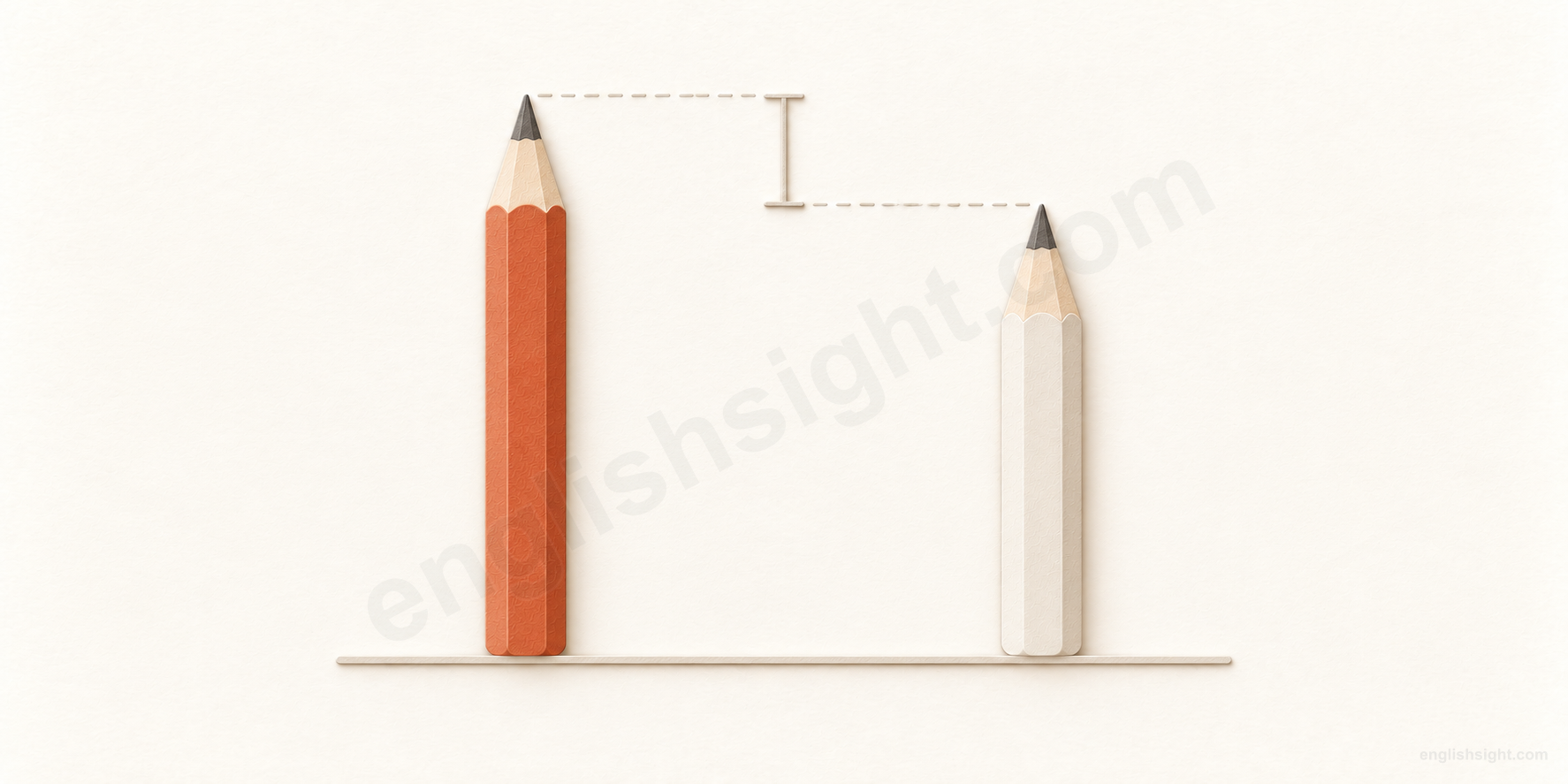
The longer left pencil is the item being described.
than
The shorter right pencil supplies the reference.
The shared baseline and the marked gap between the tips make their lengths easy to compare.
The left pencil is longer than the right one. Longer states the relation; than introduces the reference. This is a comparison, not a change over time.
Put two items on a shared basis. A comparative states how they differ, and than introduces the reference on the second side.
The picture models a measurable comparison. Rather than, other than, and no sooner…than… have their own established constructions; the bars do not explain every meaning by themselves.
Lighter tells us the direction of a comparison; than that bag tells us what we compare with. The same small word helps us compare quantities, choose alternatives, and recognize familiar complete expressions.
This lesson groups modern common uses by the choices a speaker needs to make. The sketch is a teaching aid, not a claim that every English speaker pictures than in the same way.
01
Compare qualities, actions, and amounts
Find the quality or amount being compared, then identify what follows than. The second side can be a person, a quantity, a situation, or a clause.
01
comparative adjective / adverb + than + reference
taller / more carefully than
introduce the reference for an unequal comparison
Situation / starting point
You compare two bags by weight.
Meaning / comparison
The first bag has a lower weight.
The comparative gives the direction; than supplies the other side.
In This bag is lighter than that one, lighter describes the relation and than that one identifies the reference. Than itself does not mean bigger or better. Adverbs work too: Lea packs more carefully than Tom.
Much lighter, far better, and a little warmer describe the size of a difference. Use as heavy as for equal weight; than belongs to the unequal comparison here.
In a sentence
This bag is much lighter than that one.
Watch the difference Say lighter than, not more lighter than. Equality uses as…as, not as…than.
02
comparative + than + clause / time expression
than I expected / than before
compare with another situation or an earlier standard
Situation / starting point
You predicted a difficult repair.
Meaning / comparison
The repair turns out to be easier.
The reference can be a whole situation, with repeated words left out.
Than I expected compares the actual difficulty with the difficulty in your prediction. A full clause can follow than, but repeated material is often understood: than I expected it to be.
It is quieter than before compares now with an earlier time. Better than usual compares with the normal standard; busier than ever compares with all earlier occasions. Keep the comparison logical: compare this room’s size with the other room’s size, not with the other room’s owner.
In a sentence
The repair was easier than I expected.
Watch the difference Than is not a general word for a later event. First we checked it, then we repaired it uses then.
03
than + object pronoun; than + subject + verb
than me / than I am
choose a pronoun or spell out the comparison
Situation / starting point
You describe a difference between your age and Jo’s age.
Meaning / comparison
A short phrase or a complete clause supplies the reference.
An object pronoun after prepositional than differs from a subject inside a clause.
Jo is older than me is ordinary English. Jo is older than I am makes the clause explicit and works in formal writing too. Than I, without am, is also possible but sounds formal.
With some verbs a short comparison can hide two readings. Lea likes Jo more than I do compares Lea’s liking with mine; Lea likes Jo more than she likes me compares two people Lea likes. Add the missing words when the intended contrast matters.
In a sentence
Jo is older than I am.
Watch the difference Do not mark every than me as incorrect. In a full clause use its subject form: than I am, not than me am.
04
more / less / fewer + than + quantity
more / less / fewer than
place an amount above or below a reference
Situation / starting point
You count the guests and measure the available time.
Meaning / comparison
You report how the totals relate to a number.
More, less, and fewer supply the quantity relation.
More than twenty guests means the number exceeds twenty. Less than an hour means the duration is below an hour. These do not state an exact total.
Use fewer than for individual countable items in careful writing: fewer than ten chairs. Less than is normal with time, distance, and measurements such as less than ten minutes. More than works for both countable and uncountable quantities.
In a sentence
We have fewer than ten chairs and less than an hour to find more.
Watch the difference More than ten excludes exactly ten. Do not confuse fewer guests with less time.
05
different than + noun / clause; different from + noun / what-clause
different than
introduce a difference, especially in North American usage
Situation / starting point
You compare the actual room with your earlier mental picture.
Meaning / comparison
You find that the two are not the same.
Different expresses difference without being a comparative form like bigger.
Different than is established, especially in North American English. It is convenient before a clause: The room looks different than I remembered. Different from what I remembered gives the same comparison with another structure.
Different from is the most widely shared choice before a noun in British and North American English. Different to is also used, especially in British English. This variation belongs to different; it does not allow replacing every from with than.
In a sentence
The room looks different than I remembered.
Watch the difference Use different from for a broadly neutral noun comparison; do not call all different than examples ungrammatical.
02
Set a limit or emphasize a number
More, less, no, and not determine whether a number is above, below, or at a boundary. Than connects the number to that boundary.
06
no / not more than + number; no more than + noun phrase
no / not more than
set a maximum, sometimes with an only-like emphasis
Situation / starting point
A venue has a strict capacity.
Meaning / comparison
The permitted number must stay at or below it.
Negating more than includes the boundary itself.
No more than six visitors means six is the maximum. Six is allowed; seven is not. Not more than six also sets an upper limit.
Context can add an only-like emphasis: We had no more than five minutes suggests very little time. The numerical ceiling and the speaker’s judgment are different layers.
In a sentence
The room can hold no more than six visitors.
Watch the difference No more than six does not require exactly six. A maximum is different from an exact count.
07
no / not less than + amount; no fewer than + count
no less than
state a lower boundary or draw attention to a large number
Situation / starting point
A repair takes a surprisingly long time.
Meaning / comparison
You emphasize the amount of time involved.
Distinguish an emphatic reported total from a minimum requirement.
In a report such as The repair took no less than thirty hours, the phrase can emphasize the reported total: a full thirty hours. In a requirement such as a deposit of no less than fifty dollars, it sets a minimum: fifty or more.
Not less than is useful for an explicit minimum in rules. The number alone does not prove surprise; the situation and tone supply that emphasis. For individual items, no fewer than is also available.
In a sentence
The repair took no less than thirty hours.
Watch the difference Less than thirty is below thirty. No less than thirty does not mean below thirty.
08
no / not later than + time
no later than
give the latest acceptable time
Situation / starting point
The application must arrive by a deadline.
Meaning / comparison
The stated time is allowed, but a later time is not.
Later gives a time scale; no rules out going beyond its limit.
No later than Friday means by Friday, including that day. If an exact time is supplied, it gives a more precise boundary: no later than 4 p.m. on Friday.
Not later than has the same deadline use. Earlier than Friday is different: it excludes Friday itself. Confirm the time zone or closing time when a real deadline needs that precision.
In a sentence
Send the form no later than 4 p.m. on Friday.
Watch the difference No later than is not the same as after. The deadline is a final limit, not a starting time.
03
Choose, contrast, and make exceptions
Learn the whole combinations rather than and other than. These compare alternatives or identities, rather than measuring height or size.
09
would rather / sooner + base verb + than + base verb
would rather…than…
say which action you prefer
Situation / starting point
You can take the bus or walk.
Meaning / comparison
You say that walking is your preferred option.
Rather marks preference; than introduces the alternative you prefer less.
For one person’s choice, use would rather with a base verb: I would rather walk than wait. The contracted form I’d rather is common. Would sooner…than… can also express preference; sooner here need not mean earlier in time.
Compare prefer walking to waiting, or prefer to walk rather than wait. The preferred verb patterns differ. Rather you than me! is an informal response meaning you would not want someone else’s task or situation.
In a sentence
I’d rather walk than wait for another bus.
Watch the difference Use I’d rather walk, not I’d rather to walk. Learn prefer with its own pattern.
10
A rather than B; rather than + base verb / -ing form
rather than
select one alternative or describe a contrast
Situation / starting point
A team can repair a chair or replace it.
Meaning / comparison
They select repair instead of replacement.
Rather than connects alternatives; it does not require would.
Rather than can contrast things, qualities, or actions: tea rather than juice; helpful rather than critical; repair rather than replace. A contrast need not be a personal preference: a paper rather than a plastic bag describes which material was used.
Both verb patterns occur: They chose to repair it rather than replace it; Rather than replacing it, they repaired it. Match the two sides clearly. Sooner rather than later asks for action after a short delay.
In a sentence
They chose to repair the chair rather than replace it.
Watch the difference Do not assume rather than means the same as the time word then. It marks an alternative.
11
more + description A + than + description B
more a…than a…
say which description fits better
Situation / starting point
A gathering has a few practical announcements but mostly social conversation.
Meaning / comparison
You describe it mainly as a social occasion.
The comparison weighs descriptions rather than counting objects.
More a celebration than a meeting says celebration is the more accurate label. The event may still contain elements of a meeting; this is not necessarily an absolute denial.
The pattern also works with qualities: more tired than angry. Compare more meetings than celebrations, which normally compares numbers. Word order and the nouns determine the intended comparison.
In a sentence
It was more a celebration than a meeting.
Watch the difference More a celebration than a meeting does not mean that there were several celebrations.
12
negative statement + other than + exception; other than that
other than
name an exception or what remains outside it
Situation / starting point
All the shops in a small arcade are closed except the bakery.
Meaning / comparison
You identify the single exception.
Other supplies the exclusion; than introduces the exception.
No shops were open other than the bakery means the bakery was the exception to no shops being open. Other than often follows a negative statement, but it can also introduce a qualification: Other than a short break, we worked all morning.
Other than that sets aside something already mentioned: The room is small; other than that, it suits us. Here that points back to the small size.
In a sentence
No shops were open other than the bakery.
Watch the difference Rather than selects an alternative; other than makes an exception. They are not interchangeable.
13
someone / something other than + identity; other than + adjective / adverb
anything / someone other than
refer to a different identity or quality
Situation / starting point
A caller needs a person who is not the manager.
Meaning / comparison
The caller asks for a different person.
Other than can mean different from, not only except.
Someone other than the manager means a person who is not the manager. No ranking or numerical difference is involved.
In more formal language, behave other than politely means behave in a way that is not polite. I never knew her to be other than kind says every experience of her was kind. Read the negative around the phrase carefully.
In a sentence
Could I speak to someone other than the manager?
Watch the difference The word other changes the relation. Than alone cannot replace different from in this sentence.
14
none other than + person / identity
none other than
emphasize a surprising identity
Situation / starting point
You discover that a familiar person wrote an anonymous message.
Meaning / comparison
You reveal the writer with emphasis.
The whole expression singles out exactly who someone is.
None other than introduces a striking reveal. The surprise may concern a famous person or someone unexpected in the local situation.
The expression is emphatic and can sound theatrical. In a plain factual report, was written by Sam gives the same identity without the reveal. None does not negate the identity of the named person.
In a sentence
The anonymous note was from none other than our quiet neighbor.
Watch the difference None other than our neighbor means it was our neighbor, not that the neighbor was excluded.
04
Go beyond a label or soften criticism
More than and less than also evaluate qualities and roles. Their conventional meanings depend on what follows them.
15
more than (just) + noun phrase; nothing more than + noun phrase
more than just a…
say a role or label does not fully describe someone or something
Situation / starting point
A library also serves as a place for people to meet.
Meaning / comparison
You say the label library does not capture all its value.
The phrase goes beyond a category, not beyond a numerical count.
More than just a library says that library is true but incomplete as a description. What follows usually explains the additional value or role.
Compare more than one library, which counts libraries. Just emphasizes the limitation of the label; it does not make the noun untrue. By contrast, It is nothing more than a storage room minimizes its role or importance: it is only a storage room. This is an evaluation, not a count of rooms.
In a sentence
This is more than just a library; it is a meeting place for the neighborhood.
Watch the difference More than a teacher usually expands someone’s role. It does not mean several teachers.
16
more than + adjective; more than enough; more than a little + adjective
more than happy / enough
express a strong quality or exceed what is needed
Situation / starting point
Someone asks for help, and you welcome the request.
Meaning / comparison
You express strong willingness.
The phrase strengthens a quality or goes beyond a sufficiency threshold.
I’m more than happy to help is a warm way to say you are very willing to help. Happy is not in the comparative form happier: more than modifies the whole evaluation.
More than enough means the available amount exceeds what is needed. More than a little worried means quite worried, with emphasis. These familiar combinations should be learned as wholes rather than applied freely to every adjective.
In a sentence
I’m more than happy to explain the route.
Watch the difference More than happy is not identical to happier than someone: no second happy person is required.
17
less than + positive adjective / adverb
less than helpful / perfect
make a negative evaluation, often indirectly
Situation / starting point
Instructions leave many important questions unanswered.
Meaning / comparison
You criticize how useful they are.
The quality falls short; the expression may understate strong criticism.
Less than helpful normally means not helpful, often with deliberately restrained wording. It is not simply a measurement a little below helpful.
Less than perfect likewise rejects the description perfect. The tone may be polite, ironic, or dissatisfied. Compare less helpful than yesterday’s instructions, a direct comparison of two degrees of usefulness.
In a sentence
The instructions were less than helpful.
Watch the difference Less than helpful does not praise a small amount of helpfulness. Context often makes it a criticism.
05
Recognize familiar complete expressions
Time sequences, habits, advice, and sayings have established patterns. The comparison sketch helps with some connections, but does not generate every expression.
18
no sooner + auxiliary + subject + verb + than + clause
no sooner…than…
say a second event followed immediately
Situation / starting point
A video call connects.
Meaning / comparison
Almost immediately, the screen freezes.
This fixed pair expresses close timing; it does not measure two objects.
No sooner had the call connected than the screen froze puts the two events very close together. Fronting no sooner triggers subject–auxiliary inversion: had the call, rather than the call had.
The unfronted form is also possible: The call had no sooner connected than the screen froze. The fronted version is especially associated with formal or narrative writing. Hardly…when… is a related pattern, also used with scarcely or barely; dictionaries also record than after these words.
In a sentence
No sooner had the call connected than the screen froze.
Watch the difference Keep the learned pair no sooner…than…. Do not replace than with then inside this construction.
19
more often than not + clause; clause + more often than not
more often than not
describe what usually or typically happens
Situation / starting point
A friend tends to arrive early on most visits.
Meaning / comparison
You describe the usual pattern without claiming every visit.
The negative part represents occasions when it does not happen.
More often than not means usually or typically in ordinary conversation. It presents a recurring pattern, not a promise that there are no exceptions.
The comparison is between occasions when something happens and occasions when it does not. It is not a claim to have counted a precise percentage.
In a sentence
More often than not, Maya arrives before the doors open.
Watch the difference Do not interpret not as negating the main verb. The sentence still says that early arrival is typical.
20
know better than + to-infinitive
know better than to…
have enough judgment to avoid a foolish action
Situation / starting point
You have learned that an unknown link may be untrustworthy.
Meaning / comparison
You avoid opening it without checking.
The full expression concerns sensible behavior, not superior factual knowledge.
Know better than to do something means you recognize that doing it would be unwise or wrong. I know better than to open it presents the action as one you avoid.
You should have known better than to do that criticizes an action that has already happened. The criticism comes from should have and the context, not from than on its own.
In a sentence
I know better than to open a link from an unknown sender.
Watch the difference The infinitive names the action to avoid. It does not say you are especially skilled at opening links.
21
be easier said than done; Easier said than done.
easier said than done
point out the gap between suggesting something and achieving it
Situation / starting point
Someone proposes a simple-sounding solution.
Meaning / comparison
You explain that carrying it out will be difficult.
The two sides compare talking about an action with doing it.
Easier said than done acknowledges that advice or a plan may sound straightforward while being hard to put into practice. It can stand alone as a reply or follow be.
The familiar wording uses said and done, with the repeated action understood. It questions ease of execution; it need not reject the goal.
In a sentence
Finding a quiet hour every day is easier said than done.
Watch the difference The expression does not mean the action is impossible. It says doing it is harder than suggesting it.
22
(It is) better late than never
better late than never
welcome a delayed action instead of no action
Situation / starting point
A friend finally sends a long-delayed reply.
Meaning / comparison
You accept that a late reply is preferable to none.
The alternatives are happening late and not happening at all.
Better late than never can reassure someone after a delay, or express relief that something finally happened. It is a fixed saying with It is understood.
Tone matters: it can also sound like a mild complaint about lateness. It does not promise that every missed deadline can be repaired by acting late.
In a sentence
“I finally replied to your message.” “Well, better late than never.”
Watch the difference Never is the rejected alternative. This saying does not mean that being late is better than being on time.
23
(It is) better safe than sorry
better safe than sorry
recommend a precaution to avoid later regret
Situation / starting point
The forecast is uncertain, and you can carry a small umbrella.
Meaning / comparison
You choose the precaution.
The alternatives are taking care now and regretting a preventable problem later.
Better safe than sorry supports an extra precaution even when it may turn out to be unnecessary. Sorry here means regretful, not apologizing to someone.
The sentence often stands alone, with It is understood. The advice belongs to the whole saying; than only connects the alternatives.
In a sentence
I’ll take an umbrella; better safe than sorry.
Watch the difference Sorry in this saying is about later regret. It is not an instruction to say sorry.
Read the whole comparison
Than and then
Than introduces a comparison or belongs to a fixed contrast or time construction. Then usually refers to a time or a next step: Check the address, then send it. In no sooner…than…, keep than even though the sentence concerns time.
Comparable things and clear clauses
Identify both sides and the shared quality. If a short phrase hides who does what, expand it into a clause: more than I do; more than she likes me. Equality normally uses as…as. Prefer has its own patterns, such as prefer tea to coffee.
Grammar and pronunciation
Dictionaries list than as a preposition and a conjunction. It has no inflections, tenses, passive, or particle-verb family. It is often unstressed /ðən/ in connected speech; the strong form is /ðæn/. These are pronunciation forms, not different meanings.
Where the model stops
A height comparison illustrates a relation to a reference. It cannot predict all idioms, emphasis, or regional patterns. This lesson covers common modern constructions and selected sayings, without claiming an exhaustive list of every expression containing than.
Choose the relation
Check the comparator, the reference, and any fixed expression before you answer.
1. A room can hold no more than six visitors. Which number stays within that limit?
2. Choose the complete clause that compares Jo’s age with your age.
3. You prefer walking to waiting. Which sentence expresses that choice naturally?
4. All the shops are closed except the bakery. Which sentence has that meaning?
5. The screen froze immediately after the call connected. Choose the fixed narrative pattern.
6. A colleague says the instructions were less than helpful. What does that usually communicate?
7. You describe two steps: first check the address, next send the letter. Which sentence fits?
Sources and teaching notes
Dictionary entries and usage notes below support the English constructions. The explanations, examples, and diagram are original teaching material. The visual model is a limited teaching interpretation.
The sketch explains one relation; it is not a picture shared by every native speaker.