Use then to refer to a time, order steps, and connect a response to what is already known.
A point in time or a following step
A point in time or a following step
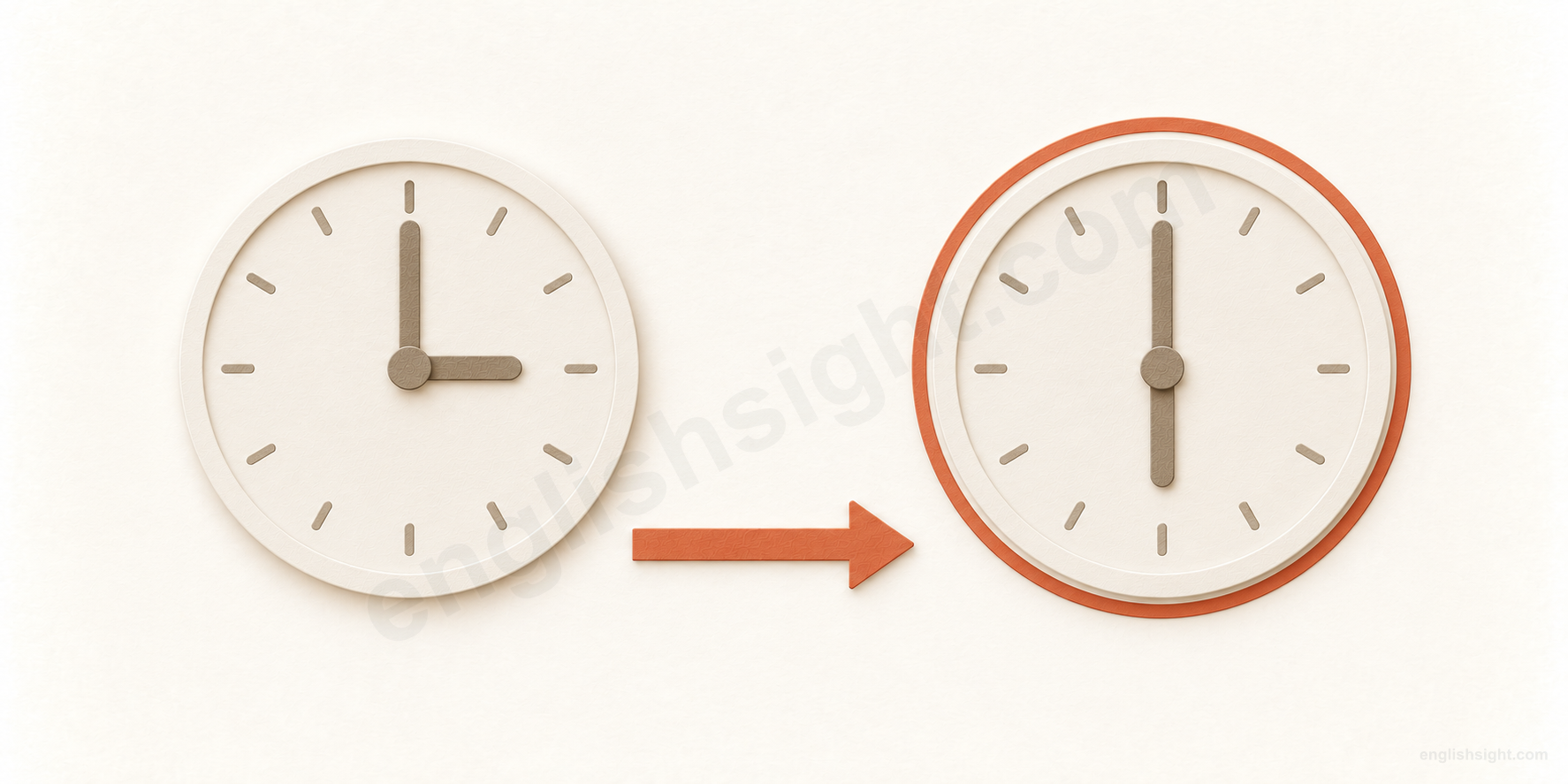
An earlier moment: three o’clock.
then
Six o’clock: a time that can be referred to with then.
Follow the arrow to a later moment.
Then can refer to a known time or introduce what follows. Here the arrow marks time order, not cause.
Then points to a time already identified, or marks the next step in events or reasoning.
The sketch illustrates time and sequence: the same clock is shown at two moments. A step in reasoning need not involve elapsed time, and fixed conversational expressions need their own explanations.
Then often asks you to recover a reference from context: which time, which previous step, or which situation are we talking about? At that time and after that are different readings, so the surrounding sentence matters.
A useful teaching connection is a point in an unfolding sequence, including a sequence of ideas. This connects several common uses without making every fixed expression predictable.
01
Point to a time
Then can identify a past or future point. Prepositions tell you whether that point is a deadline, an endpoint, or the beginning of a span.
01
clause + then; back then, + clause
then / back then
at the time understood from the context
Context / starting point
You are talking about your first year at college.
Reference / following step
You describe your circumstances during that year.
Then can point back to a time without moving the story forward.
The surrounding conversation supplies the date or period. I was living with my sister then places the living situation at that time; it does not mean I moved in afterward.
Back then highlights a past period, often in contrast with now. Plain then can also refer to the future: The shop opens at nine; I will call then. The verb and context supply the time reference.
In a sentence
I started college in 2018. Back then, I lived with my sister.
Watch the difference Then is not always later. First identify the time it refers to.
02
just / right then + clause; clause + right then
just then / right then
at that exact moment
Context / starting point
You are about to leave.
Reference / following step
An interruption occurs at precisely that point.
Just or right sharpens the time reference supplied by then.
Just then is useful when a story reaches a particular moment and something happens at that moment. It often introduces an interruption or coincidence.
Right then also emphasizes an exact time. In I cannot talk right then, it may refer to a future time already proposed. Neither expression must mean a moment immediately after now.
In a sentence
I was about to lock the door. Just then, my phone rang.
Watch the difference Just then means at that moment; just now usually points to the present or the very recent past.
03
by then + clause; clause + by then
by then
at or before that time
Context / starting point
A future meeting time has been established.
Reference / following step
You expect your work to be complete no later than that point.
By sets a deadline or a point for assessing the situation.
Then names the reference time; by makes it a latest limit. If you will finish by then, you may finish earlier. At then is not the ordinary way to express this deadline.
By then often accompanies a perfect tense when looking back from a later point: By then, we had already eaten. It also works with states: By then, the room was empty. It does not require one particular tense.
In a sentence
Our meeting is at four. I will have finished the draft by then.
Watch the difference By then does not say the work continues all the way to four; until then can express continuation.
04
until / till / before then; between now and then
until then / before then
use that time as an endpoint or a dividing point
Context / starting point
Someone plans to return on Monday.
Reference / following step
You distinguish what continues until Monday from what happens earlier.
Until extends a situation to a point; before places something earlier.
Wait until then means continue waiting up to the named time. Till then is a less formal alternative. I had never used it until then says that the earlier period contained no use, normally with a change at that point. Up to then also sets that time as the end of a preceding period: Up to then, I had never used it.
Before then simply means earlier than the reference time: Please send the form before then. Compare between now and then, which names the interval between the present and that future point. The preposition supplies the boundary relation.
In a sentence
The office reopens on Monday. Until then, please contact us by email.
Watch the difference Before then does not itself mean continuously until that time. Do not write until than.
05
only then + auxiliary / modal + subject + verb; not until then + auxiliary + subject + verb
only then / not until then
at that point and not earlier
Context / starting point
An explanation finally makes the situation clear.
Reference / following step
You emphasize that understanding came at that point, not before.
Only or not until excludes earlier times; fronting the phrase changes word order.
I understood only then emphasizes that I did not understand earlier. Then supplies the time; only supplies the restriction. Not until then has a similar time restriction: I did not understand until then. Then and only then strongly emphasizes that exact restriction.
In an emphatic, often formal version, put the restrictive phrase first and place the auxiliary before the subject: Only then did I understand. Not until then did I understand works in the same way. With did, use understand, not understood.
An existing auxiliary or modal moves before the subject instead: Only then could we relax. Plain Then I understood does not trigger this inversion; its ordinary subject-before-verb order is correct.
In a sentence
I read the final paragraph. Only then did I understand the joke.
Watch the difference Use Only then did I understand, not Only then I understood in this fronted emphatic construction. Plain Then I understood is correct.
06
have / has + past participle + since then; had + past participle + since then
since then
from that past time to a later reference point
Context / starting point
You moved to a different neighborhood in May.
Reference / following step
You describe what has happened during the period afterward.
Since makes then the starting point of a continuing time span.
With a present reference point, a present perfect is common: We have stayed in touch since then. The period begins at the earlier event and reaches now; the contact may consist of repeated messages. Ever since then adds emphasis to the span from that point.
A past narrative can use a past perfect: By December, she had visited twice since then. Contrast for two months, which measures duration, with since then, which identifies its starting point.
In a sentence
I moved away in May, but we have stayed in touch since then.
Watch the difference Use since then for a starting point, not for then. Since then does not require continuous action every moment.
07
from then on / onwards + clause
from then on / from then onwards
begin at that time and continue afterward
Context / starting point
A mistake leads you to adopt a different routine.
Reference / following step
Your new habit starts at that point.
From establishes a starting point; on or onwards extends beyond it.
From then on presents a new phase in a story. It fits a past habit, a later development, or a future arrangement: The new timetable starts in June; from then on, we will open at eight.
Since then commonly looks back over an interval from a reference point. From then on follows the story forward from its starting point and readily works with a simple past habit. From then onwards expresses the same extension.
In a sentence
I lost a file once. From then on, I saved a second copy every evening.
Watch the difference Unlike from now on, from then on takes its starting time from the story or context.
08
the / possessive + then + role noun; subject + be + then + description
the then manager
the person holding that role at the time mentioned
Context / starting point
An event occurred while a previous manager held office.
Reference / following step
You identify the manager relevant to that historical event.
Before a noun, then locates a role or status at the referenced time.
The then manager means the manager at that time. It is especially useful in reports, history, and formal accounts when the person’s role later changed.
Compare She was then the manager: here then modifies the statement about her role. Former manager describes someone as no longer holding the role relative to a later viewpoint; then manager anchors the role directly to the time under discussion.
In a sentence
The then manager approved the plan in 2012.
Watch the difference This then goes before the noun. It does not mean the next manager or a person who subsequently became manager.
02
Take the next step
Order actions, move through a list, or add a further consideration. Sequence in a description is not always sequence in real time.
09
first + clause; then + clause; clause + and then + clause
first … then … / and then
place one event after another
Context / starting point
You explain two steps in preparing a parcel.
Reference / following step
The listener knows which step comes next.
Then advances from an established event to a following event.
Use then to order instructions or a narrative. First close the box; then tie the ribbon presents two successive steps. And then links the second step more explicitly to the first.
Then need not mean immediately afterward and does not by itself prove causation. We met in 2010 and then worked together in 2015 allows a long gap. For a full written clause, use a clear sentence boundary or and: I checked the address, and then I left.
In a sentence
First close the box; then tie the ribbon around it.
Watch the difference After is different grammatically: after lunch or after we eat works, but then lunch alone is not an equivalent time phrase.
10
item, then + item; first + item, then + item
A, then B, then C
move through a list or a physical arrangement
Context / starting point
You describe the layout of a building.
Reference / following step
The listener follows the items in the order given.
Next in order need not mean next in time.
Then can order names, places, or items rather than actions. A description of rooms from the entrance inward can use then even though all the rooms exist simultaneously.
The arrangement or direction must be clear from context. Then does not itself tell the listener left, right, larger, or more important. First in a list may reflect your chosen order rather than an objective ranking.
In a sentence
From the entrance, there is a small hall, then the kitchen, then the garden.
Watch the difference Do not assume that everything after then is a later event; here it is the next place in a description.
11
statement + and then + clause; and then there is / are + noun phrase
and then there is …
add a further fact or consideration
Context / starting point
You have already given one reason a trip will be expensive.
Reference / following step
You add another cost to consider.
Then can add to an argument without describing a later event.
And then there is introduces another item for consideration. In a discussion of costs, the rent and the transport bill may be due together; the sequence is in the speaker’s presentation.
Compare We booked the room and then bought the tickets: that is a sequence of actions. To interpret then, ask whether the speaker is ordering events or adding information. Both uses can occur with and.
In a sentence
The room is expensive, and then there is the cost of getting there.
Watch the difference Do not force the meaning afterward into every and then. Here also or in addition captures the connection.
03
Follow a condition or conclusion
A step in reasoning can replace a step in time: if that is the situation, what follows? The previous conversation may supply the condition.
12
if + condition, (then) + result clause
if … (then) …
introduce what follows from a condition
Context / starting point
You consider the possibility that the bus fails to arrive.
Reference / following step
You give the plan for that possible situation.
The step is in reasoning: given this condition, this result or response follows.
If introduces the condition; then can mark the result. If the bus does not come, then we will walk does not assert that the bus will fail to come. The result is conditional.
Then is often optional: If the bus does not come, we will walk is complete. The construction can express a decision, a prediction, or a logical relation. It need not describe one event physically causing another.
In a sentence
If the bus does not come, then we will walk.
Watch the difference Then does not introduce the condition. Do not substitute than for then in an if-result sentence.
13
then + clause; clause, then?; statement + what then?
Then … / …, then?
draw a conclusion or ask what follows
Context / starting point
Someone tells you that every ticket has been sold.
Reference / following step
You infer that booking is too late.
Then can mean in that case, even when no if-clause is spoken.
A previous remark can supply the premise. “All the tickets are gone.” “Then we are too late” draws a conclusion from it. So you are leaving, then? asks for confirmation of an inference.
What do we do, then? asks for the practical consequence of the situation. What then? can ask about the next event or about consequences; context decides. In more formal writing, This, then, is our main problem can sum up the preceding argument.
In a sentence
“Every ticket has been sold.” “Then we are too late to book.”
Watch the difference A conclusion marked by then is still the speaker’s conclusion; the word does not guarantee that the reasoning is correct.
04
Manage the conversation
Use familiar combinations to turn attention to a question, settle a plan, qualify a statement, or reconsider a choice.
14
now then, + question / instruction; well then, + response
now then / well then
take the conversation to the next point
Context / starting point
A group has finished discussing travel arrangements.
Reference / following step
You focus attention on the next question.
These combinations organize talk rather than locate an event in the past.
Now then can gather attention before a question, a task, or a new point: Now then, who needs a ticket? Well then can acknowledge what has been said and move toward a response: Well then, let us choose another date.
Now then can also introduce a mild reprimand: Now then, no pushing. Tone matters; an adult’s corrective tone may sound patronizing between equals. This is an established conversational use, not a literal conflict between now and a past then.
In a sentence
Now then, who is going to collect the tickets?
Watch the difference Now then has no and. Now and then is a different expression meaning occasionally.
15
okay / all right then; agreed detail + then; see you then
okay then / that is settled, then
accept a decision or bring an exchange to a close
Context / starting point
You and a friend have agreed on a meeting place.
Reference / following step
You confirm the arrangement and finish the exchange.
Then links the closing response to what has just been agreed.
Okay then can accept a proposal, signal readiness to act, or help end an exchange. Six at the station, then confirms a plan without repeating the whole discussion. See you then points to the agreed meeting time.
The same words can open a next step: Okay then, let us begin. Intonation and context distinguish a friendly close, a reluctant acceptance, and a transition. Then alone does not impose one emotion.
In a sentence
“Six at the station?” “Okay then. See you there.”
Watch the difference Okay then can close a topic or start the next activity. Do not interpret it as a command to do something later in every context.
16
statement, but then + qualifying clause
but then
qualify a statement or make it less surprising
Context / starting point
You mention that a skilled player lost a game.
Reference / following step
You add information that changes how the loss should be viewed.
But introduces a qualification; then connects it to the preceding thought.
But then can add a balancing explanation: She lost, but then she was playing with an injured wrist. The second fact makes the result less surprising rather than describing what happened afterward.
It can also introduce a counter-consideration. Compare I intended to walk, but then it started raining: in that story then may simply mean afterward. The words are identical; the relation between the clauses tells you which reading fits.
In a sentence
She lost the match, but then she was playing with an injured wrist.
Watch the difference Do not always translate but then as but afterward. In a qualification, no later event is required.
17
statement. Then again, + counterpoint; but then again, + clause
then again / but then again
introduce another side of the question
Context / starting point
You consider choosing the cheaper room.
Reference / following step
You reconsider because another room has an advantage.
The phrase reopens a judgment by adding a counterpoint.
Then again presents a reason to qualify or reconsider what was just said. It can introduce doubt about your own suggestion without rejecting it entirely. But then again is a familiar expanded form.
This is a discourse expression. Again does not mean the event happens twice. Compare I called, and then called again: that sentence really does describe a repeated call.
In a sentence
The smaller room costs less. Then again, the larger one has a desk.
Watch the difference Then again does not announce a final decision; it adds another perspective.
05
Read the whole expression
Even, now and, there, and some contribute meanings that cannot be recovered by replacing every then with afterward.
18
statement; even then, + clause; even then, at + time, + clause
even then
despite those circumstances, or surprisingly at that time
Context / starting point
You describe taking an extra precaution.
Reference / following step
The expected success still does not occur.
Even highlights a surprising case; then supplies the relevant circumstances or time.
I restarted it twice; even then, it would not work means the problem persisted despite those attempts. In a condition, You may need a reservation, and even then you might have to wait says that meeting the condition may still be insufficient.
A time reading is also possible: Even then, at age six, she could read music expresses surprise that the ability existed at that early age. This does not mean afterward. Look for whether then refers to a time or to a situation just described.
In a sentence
I restarted the device twice; even then, it would not connect.
Watch the difference Even then is not the same as then again: one emphasizes an unexpected result or early time; the other adds a counterpoint.
19
(every) now and then + clause; clause + (every) now and then
(every) now and then
occasionally rather than regularly or continuously
Context / starting point
Someone asks how often you eat out.
Reference / following step
You describe an occasional habit.
The whole expression indicates frequency, not a two-step sequence.
Now and then means on some occasions. Every now and then is a common expanded form; now and again and every now and again are alternatives. The phrase does not promise a fixed interval.
I eat out now and then can be placed after the activity. Every now and then, I eat out puts the frequency phrase first. Contrast now then, which manages a conversation, and between now and then, which names an interval.
In a sentence
Every now and then, we eat at the little café near the park.
Watch the difference Every does not make the expression mean every day. Learn now and then as a unit.
20
(right) then and there; there and then
then and there / there and then
at that very time and place, without delay
Context / starting point
You discover a wrong charge while still at the counter.
Reference / following step
You deal with it immediately instead of postponing it.
Time and place combine to emphasize acting on the spot.
Then and there often emphasizes an immediate decision or action. There and then is also used, and right can add emphasis: right then and there. The relevant time may be past, not the present moment.
The meaning belongs to the established combination. Compare then and later, which simply coordinates two times. Here there anchors the place and the whole phrase rules out putting the action off.
In a sentence
I noticed the wrong charge and asked for a correction then and there.
Watch the difference This expression does not mean at some later place. Keep and between then and there.
21
amount / degree expression + and then some
and then some
more than the amount or degree just mentioned
Context / starting point
Someone asks whether a task occupied the whole afternoon.
Reference / following step
You say it took that long and more.
The phrase pushes beyond an already stated amount or expectation.
And then some is an emphatic, conversational way to say that the stated amount was exceeded. It can follow a duration, a cost, an effort, or an evaluation such as got our money’s worth.
Some here leaves the extra amount unspecified. The expression is not an instruction to do another activity later. For precise reporting, give the actual amount instead of relying on this emphasis.
In a sentence
The repairs took the whole afternoon and then some.
Watch the difference Do not infer an exact extra quantity from some. This is an established expression rather than an ordinary sequence.
Find the reference before choosing the meaning
Then and than
Then /ðen/ concerns time, order, or a response to a situation. Than belongs in comparisons: cheaper than, more than, rather than. Spelling changes the grammar; I would rather wait than leave compares alternatives.
Then, after, and so
Then can stand alone as a time adverb: I will call then. After normally needs a complement when used as a preposition or conjunction: after lunch, after we eat. Then often marks sequence; so often marks a result. One event following another does not establish that the first caused the second.
Grammar labels and placement
Dictionaries commonly label then as an adverb, also as a noun in expressions such as since then, and as an adjective before a role noun. Some also use connector or conjunctive labels for linking uses. It has no tense forms, objects, passive, or verb-particle family. In a simple narrative, Then she left, She then left, and She left then are all possible, but the final position can favor at that time; context and emphasis matter.
Scope and the visual model
The clock sketch models temporal reference and sequence, not every conversational function. This lesson selects useful modern constructions and idioms rather than claiming every regional, literary, or technical use or a measured frequency ranking.
Read the relation
Choose the expression that matches the context, not just a familiar translation.
1. You want to describe your circumstances in 2014, without saying something happened afterward. Which sentence fits?
2. The meeting begins at four. Your draft must be finished no later than four. Which phrase fits?
3. You visit the café occasionally. Which phrase expresses that frequency?
4. You favor the cheaper room but want to mention the other room’s desk as a reason to reconsider. Which opening fits?
5. In If the key does not work, then call me, what does then introduce?
6. Choose the correct spelling for a comparison.
7. You start an emphatic sentence with Only then and use a past simple verb. Which word order fits?
Sources and teaching notes
Usage was checked against the dictionary pages below. The explanations, examples, and visual teaching connection were written for this lesson. The sources organize grammar and senses differently; the course groups them by the choices a learner needs to make.
This diagram is a teaching aid; it does not describe an image shared by every native speaker.