Use theory for explanations, systems of principles, and the gap between an expectation and real conditions.
Observations and an explanatory model
Connect observations with an explanation
Separate observations
theory
A connected account to examine and use
An explanatory model relates them.
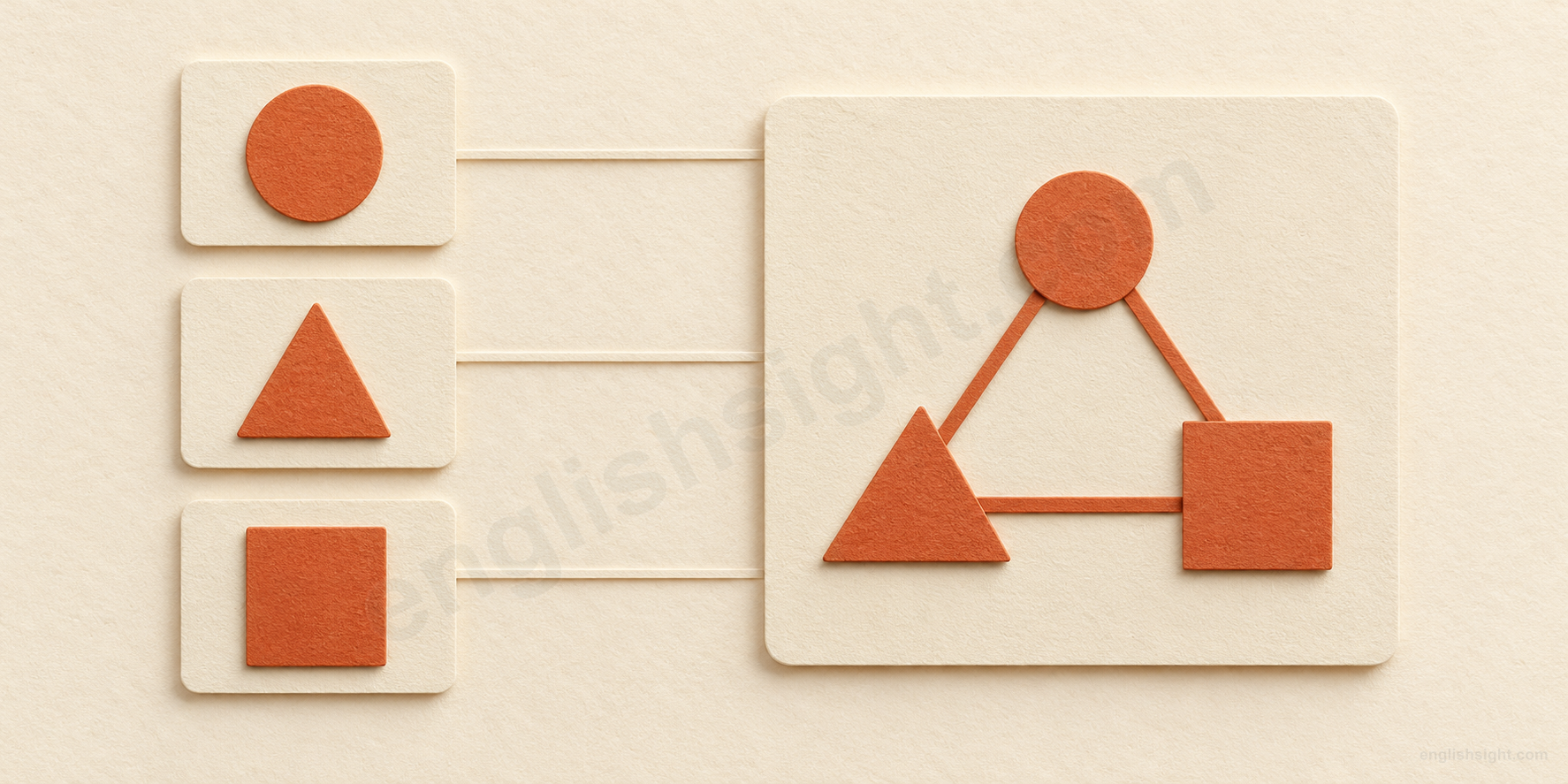
A theory relates observations within an explanatory model. The links illustrate an explanation, not proof that it is correct.
A theory gives an explanation or set of principles that makes sense of something; how well it is supported depends on the context.
The link is explanatory, not a physical movement. A casual theory may be tentative; a scientific theory may be strongly supported. Studying theory emphasizes principles, and in theory contrasts expected conditions with actual experience.
You may have a theory about a missing parcel, study music theory, or read about a scientific theory. These uses all involve ideas that make sense of something, but they do not all have the same evidence, purpose, or grammar.
This lesson separates a personal explanation, an organized framework, a subject’s principles, and the expression in theory. The sketch is a teaching model, not a shared mental picture attributed to all English speakers.
01
Offer an explanation
Use a countable theory for an account of what happened, a personal interpretation, or an assumption you are using while you investigate.
01
have + a theory + about / on + noun or question clause
have a theory about / on something
offer a possible explanation
Situation / starting point
The same room gets cold every evening.
Meaning / outcome
You suggest that the window does not close properly.
A theory offers an explanation beyond the observation itself.
In everyday conversation, a theory can be your explanation of what is happening, before you know whether it is right. Have a theory introduces that explanation; it does not mean you invented a scientific system.
About or on introduces the topic. About why the room gets cold gives a question the explanation answers. My theory on the ending can also introduce an interpretation or prediction about a story.
A theory is countable here: one theory, two theories. I have an idea is broader: the idea might be a plan, while a theory normally accounts for something or proposes how it works.
In a sentence
I have a theory about why this room gets cold at night.
Watch the difference Use a determiner with the singular countable sense: I have a theory, not I have theory.
02
theory + that + clause; my theory + is + that + clause
the theory that… / My theory is that…
state the content of an explanation
Situation / starting point
The room’s temperature needs explaining.
Meaning / outcome
You give a complete statement of the suspected cause.
That introduces what the theory says; about introduces its topic.
The theory that the window leaks air contains a statement of the theory. The theory about the window only names a topic and leaves the explanation unstated.
My theory is that… is a convenient way to present your explanation. Follow that with a clause containing a subject and verb. Compare My theory is that the window leaks with My theory concerns the window.
That does not itself make a theory tentative or scientific. The context and evidence determine which sense is intended.
In a sentence
My theory is that cold air is coming through the window frame.
Watch the difference Do not use about that as the connector here: a theory that the window leaks, not a theory about that the window leaks.
03
work / act + on the theory that + clause; a working theory
work on the theory that… / a working theory
use an explanation as a basis for action
Situation / starting point
A search team does not yet know where a lost dog has gone.
Meaning / outcome
It checks familiar places first because the dog may have gone home.
The clause provides an assumption guiding the action, rather than a confirmed result.
Work on the theory that… means proceed using a particular explanation as your current basis. On the theory that… can follow other actions too, giving the reasoning behind them.
A working theory is a provisional explanation useful while you gather information. It can be revised. This is different from working on a theory, which can simply mean developing the explanation itself.
The on phrase expresses the basis for action. It does not give theory an ordinary verb meaning, and work on the theory is not a particle verb formed from theory.
In a sentence
We checked the dog’s home first, on the theory that it might have returned there.
Watch the difference Acting on a theory does not show that the theory has been confirmed.
04
someone’s pet theory; a pet theory that + clause
a pet theory
refer to someone’s favorite explanation
Situation / starting point
A friend repeatedly offers the same explanation of people’s habits.
Meaning / outcome
You identify it as a view that friend is especially attached to.
Pet expresses personal attachment, not the strength of the evidence.
A pet theory is a theory a person particularly likes or often returns to. Pet is an adjective here; the phrase is unrelated to an animal’s behavior unless the actual topic happens to be an animal.
It can sound affectionate or mildly critical, suggesting that personal enthusiasm plays a part. It does not automatically say the theory is false.
In a sentence
His pet theory is that people choose cafés mainly for the chairs.
Watch the difference Do not confuse pet theory with a theory about pets: only the second phrase names animals as the topic.
02
Build and evaluate explanatory frameworks
In formal and scientific discussion, read the evidence and the surrounding verbs. Theory can name a substantial system rather than a casual hunch.
05
a scientific theory; the theory of + noun; uncountable subject + theory
a scientific theory / the theory of…
name an organized explanatory framework
Situation / starting point
Researchers have observations that an explanation must account for.
Meaning / outcome
A framework connects those observations and supports further investigation.
In science, theory can name a substantial evidence-based explanation.
A scientific theory brings principles together to explain a range of observations. Calling it a theory does not reduce it to an unsupported guess. The strength of support must be judged from the relevant evidence.
Theory of often occurs in established names, such as the theory of evolution. A theory about something or a theory on something can also describe a formal explanation; the preposition alone does not mark it as casual.
Use a theory or several theories for individual frameworks. Uncountable scientific theory or economic theory can refer more broadly to explanatory work or a body of ideas.
In scientific writing, hypothesis often means a proposed explanation to be tested. In casual speech, theory and hypothesis may overlap. Do not treat every occurrence of either word as having one fixed level of certainty.
In a sentence
The class compared two scientific theories that explain the same observations.
Watch the difference Just a theory can suggest a casual guess, but that reading should not be imposed on an established scientific theory.
06
develop / formulate / advance + a theory; come up with + a theory
develop / formulate / advance a theory
construct or propose an explanation
Situation / starting point
An investigator has separate observations.
Meaning / outcome
The investigator organizes them into an explanation and presents it.
The verb tells whether someone is building or proposing the explanatory model.
Develop a theory focuses on building it, often over time. Formulate a theory emphasizes giving it a clear form. Advance a theory means put it forward for consideration, especially in formal writing.
These are ordinary verb–noun combinations. Theory is the object, not part of a new verb. Someone can develop a theory without persuading anyone else that it is correct.
For an informal conversation, come up with a theory is natural too. The idea of proposing an explanation remains; the wording is less formal than formulate or advance.
In a sentence
After comparing the records, the team developed a theory about the missing deliveries.
Watch the difference Advance a theory means propose it; it does not necessarily mean improve an existing theory.
07
test / support / challenge / disprove + a theory; the theory suggests / predicts that + clause
test / support / challenge a theory
check an explanation against evidence
Situation / starting point
An explanation has been proposed.
Meaning / outcome
Measurements may support it or reveal a problem with it.
Testing an explanation and accepting it are different actions.
Test a theory means examine whether observations or experiments fit what it implies. Evidence can support a theory, while conflicting findings can challenge it. Challenge means question or dispute, not automatically disprove.
Disprove a theory is a stronger claim that the explanation is wrong. Support is useful when evidence favors an explanation but does not settle every question.
The theory suggests that… or predicts that… attributes a claim to the explanation. The theory is not a person: these verbs are a conventional way to report its implications.
In a sentence
The measurements support our theory, but we need to test it under different conditions.
Watch the difference A test is a check, not necessarily a success. Do not replace tested with proved when the outcome is unknown.
08
according to + a / the / this theory, + clause
according to the theory
report what an explanatory framework says
Situation / starting point
You want to state a result that follows from a model.
Meaning / outcome
You attribute the result to that model.
According to identifies the source or framework of the claim.
According to this theory means that the following claim comes from this explanation or follows from its principles. The speaker may endorse it or merely report it; the phrase itself does not decide that.
Compare according to the theory with in theory. The first names a framework as the source; the second qualifies a statement as an expectation that may differ from reality.
In a sentence
According to this theory, the two groups should respond differently.
Watch the difference Use according to, not according with, when naming the source of a statement.
03
Understand principles and apply them
Theory can be the knowledge underlying a subject or skill. This is the contrast between principles and practical activity.
09
study / teach + subject + theory; the theory and practice of + subject; a theory test
study music theory / theory and practice
learn the principles of a subject
Situation / starting point
A learner wants to understand how a skill works.
Meaning / outcome
The learner studies its principles as well as doing practical tasks.
Theory names the knowledge side of a field, not a guess about it.
Music theory concerns how music is organized. More generally, theory can mean the principles underlying a subject or skill, contrasted with practical activity.
This sense is normally uncountable: study music theory, not study a music theory when you mean the subject as a whole. A particular explanatory system within a field can still be a theory.
Theory and practice compares understanding principles with applying them. In British English, a driving theory test checks knowledge, while a practical test checks driving performance. Theory modifies test as a noun; it has not become a verb.
In a sentence
Our course combines music theory with regular playing practice.
Watch the difference Learning theory is not automatically learning something untrue or useless; it names a kind of knowledge.
10
the theory behind + noun or -ing form
the theory behind something
explain the reasoning or principles underlying it
Situation / starting point
You see a method being used.
Meaning / outcome
Someone explains why the method is expected to work.
Behind points to the underlying explanation, not a physical location.
The theory behind a method is the reasoning or set of principles that makes sense of the method. You can ask about it when you know what to do but want to understand why.
The theory of a subject often names its principles as a field of study. The theory behind a particular exercise focuses on the rationale for that exercise. They overlap, but the focus differs.
Theory behind does not guarantee a sound rationale. The explanation can still be tested or criticized.
In a sentence
The trainer explained the theory behind repeating the movement slowly.
Watch the difference Do not read behind as earlier in time or physically at the back here; it marks an underlying rationale.
11
put + theory / the theory + into practice; move from theory to practice
put theory into practice
apply principles in real activity
Situation / starting point
You understand a method from study.
Meaning / outcome
You use the method in a real task.
Put…into practice expresses application, not proof that the theory is correct.
Put theory into practice means use ideas or principles when doing something. Here theory is general knowledge; put the theory into practice can identify a particular set of ideas already discussed.
You can also move from theory to practice. The contrast is between understanding and doing, not between false and true.
Theory can be useful even when applying it requires adjustments. Putting it into practice does not promise that the attempt will succeed.
In a sentence
After the lesson, we put the theory into practice by interviewing a volunteer.
Watch the difference Use practice as a noun in into practice. The expression does not mean memorize more principles.
04
Read the whole expression
In theory and conspiracy theory have meanings contributed by the full combination. Neither is a definition of every use of theory.
12
in theory, + clause; clause + in theory; in theory… but in practice…
in theory, but in practice…
separate expected conditions from actual experience
Situation / starting point
A timetable allows enough time for a connection.
Meaning / outcome
Real delays may make the connection difficult.
In theory marks what should hold under stated or ideal conditions.
In theory qualifies a whole statement: something is supposed to be true, possible, or workable, although actual conditions may differ. In practice introduces what happens when people really try it.
The contrast can be explicit, as in the example, or left unstated. A short reply such as In theory can cautiously acknowledge a possibility without promising it works in reality.
This expression does not automatically mean never or impossible. You may be reserving judgment about real conditions. It also differs from according to a theory, which explicitly attributes a claim to a model.
In theory normally has no article. In the theory of music, by contrast, the belongs to a particular noun phrase and is not part of this fixed expression.
In a sentence
In theory, we have twenty minutes to change trains, but in practice the first train is often late.
Watch the difference Do not turn may differ from reality into must be false. In theory can describe a possibility that really does work.
13
a conspiracy theory; a conspiracy theory about + event
a conspiracy theory
name an explanation involving secret powerful actors
Situation / starting point
An event prompts competing explanations.
Meaning / outcome
One explanation attributes it to a secret plot by a powerful group.
The compound names a particular kind of explanation, not any disagreement.
A conspiracy theory explains an event by claiming that a secret powerful group is responsible. Conspiracy supplies the secret-plot content; theory by itself does not contain that meaning.
In ordinary discussion the label often signals a disputed explanation. Calling something a conspiracy theory is not the same as providing evidence for or against it.
Compare a scientific theory, which may have extensive supporting evidence. The shared noun does not make these two compounds identical in method or evidential status.
In a sentence
The documentary examined a conspiracy theory about the city’s power failure.
Watch the difference An ordinary mistake or an unpopular opinion is not, by itself, a conspiracy theory; the secret-plot claim matters.
Keep the context and the grammar
A noun with countable and uncountable uses
The plural is theories. Use a theory for one explanation and theories for alternatives. General principles can be uncountable, as in music theory. Theory has no ordinary verb tense, passive form, or particle-verb family; the verbs in test a theory and put theory into practice supply the action.
Explanation, evidence, and law
A fact can be an observation that an explanation accounts for. A hypothesis is often proposed for testing; a scientific theory can connect a broad body of evidence. Do not imagine a simple vocabulary ladder on which every theory must turn into a law. Read how each term is used in its field.
Useful connection, limited picture
The model links observations with an explanation. It does not establish that the explanation is right, or replace the separate teaching of principles and the fixed expression in theory. Technical fields such as number theory and game theory have their own subject matter and are not taught in detail here.
Choose the meaning that fits
Look at the whole construction and the situation. The noun does not have one fixed level of certainty.
1. A textbook calls an established explanatory framework a scientific theory. What follows from the word theory?
2. You want to state the actual explanation, rather than only its topic. Which sentence does that?
3. You have studied interview principles and now use them with a volunteer. What are you doing?
4. “In theory, the connection is possible.” What is the speaker leaving open?
5. Which sentence naturally describes learning the principles of music in general?
Sources and teaching notes
The sources below were read to check senses, constructions, and expressions. Explanations, examples, exercises, and the explanatory diagram are original teaching material.
This teaching diagram illustrates a connection between ideas; it does not claim a picture shared by every English speaker.