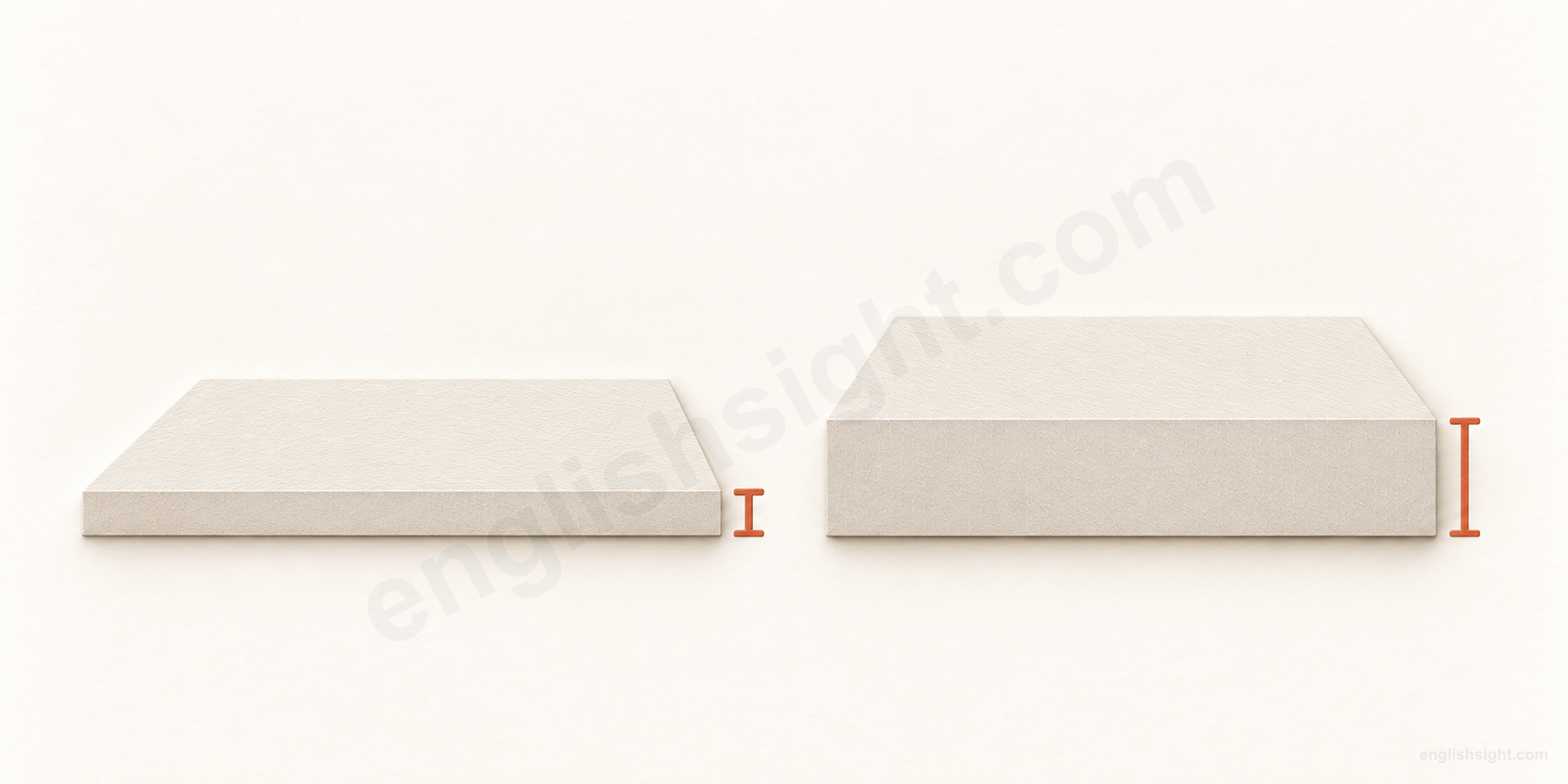
Use thick for physical dimensions, dense coverings, slow-flowing liquids, and a set of established expressions.
A particular dimension, then related uses
Compare the distance between opposite faces
Thin reference piece
thick
Thicker comparison piece
Compare the vertical distance between each piece’s upper and lower faces.
Compare thickness through the material, not length along it. These are two pieces, not stages of a change.
For a solid object, thick describes a relatively large distance between opposite surfaces. Density and consistency uses offer related learning connections, while social meanings and idioms need their own explanations.
The diagram compares two objects at one time; it does not show one turning into the other. The highlighted dimension is thickness, not length. It does not depict the literal meaning of every idiom.
Start with two pieces viewed from the edge: the thick one has more distance between its opposite faces. Then notice how the noun changes the question. With hair or woodland, you usually describe closely packed growth; with sauce, you describe consistency.
This lesson connects those uses as a learning aid and gives separate explanations where the connection stops being predictable. The sketch is not a claim that every English speaker imagines the same picture, and fixed sayings must be learned as whole expressions.
01
Objects, measurements, and consistency
Describe a particular dimension, state an exact measurement, or explain how freely a substance flows. The noun and construction tell you which property matters.
01
a thick + noun; noun + be / feel / look + thick
a thick slice / book / coat
having a relatively large distance between opposite surfaces
Situation / question
Two pieces are equally long, but their opposite faces are different distances apart.
What the expression tells us
You choose the piece with more material between those faces.
Thickness is a particular dimension, not overall size.
Imagine looking at the edge of a slice rather than at its broad face. Thick directs attention to the distance through the slice. A slice can be thick without being long or wide, and a small book can be thick because its many pages make a deep stack.
The noun tells you which surfaces matter. Thick gloves or socks have substantial material between the inside and outside; thick branches have a large diameter. These uses do not say the material is hard: a thick blanket can be soft.
Thick is an adjective before a noun or after a linking verb: a thick blanket; this blanket feels thick. It is relative to the object and purpose. A thick sheet of paper would still be thin compared with a floorboard.
Example in context
The book is small enough for my bag, but it is too thick for this gap on the shelf.
Watch the difference Wide describes a different dimension. A wide slice need not be a thick slice; heavy describes weight.
02
how thick + be + noun?; number + unit + thick; thicker than; as thick as
two centimetres thick / thicker than
state, ask about, or compare the distance between surfaces
Situation / question
You need a panel that fits into a particular space.
What the expression tells us
You give a thickness measurement rather than a vague size description.
A measurement can specify thickness without calling the object unusually thick.
In The panel is two centimetres thick, the measurement comes before thick. How thick is it? asks for this dimension. Even paper can be 0.1 millimetres thick: the measurement use does not mean it has a large thickness.
Before a noun, combine the measure into an adjective: a two-centimetre-thick panel. In this written pattern, the unit is singular. After be, use the ordinary plural: the panel is two centimetres thick.
Compare with thicker than and the thickest: This panel is thicker than that one; choose the thickest panel. As thick as compares equal thickness. The forms are thick, thicker, thickest, with no extra k.
Example in context
This panel is two centimetres thick, so it is thicker than the old one.
Watch the difference Write a two-centimetre-thick panel, not a two-centimetres-thick panel. Do not use more thicker.
03
thick + liquid noun; be / get + thick; make + liquid + thicker
thick soup / sauce / paint
having a consistency that does not flow easily
Situation / question
A sauce moves slowly off a spoon and holds its shape briefly.
What the expression tells us
You describe its consistency or decide whether to add liquid.
Here thick concerns flow, not the depth of a serving.
A deep bowl can contain thin soup, and a shallow spoon can hold thick sauce. The container’s depth and the food’s consistency are different properties. In cooking, thick contrasts with thin or runny.
The sauce is getting thicker describes a change; the sauce is thick describes its present state. To make it thicker or thicken it tells someone to change that consistency. Thick itself is not the ordinary verb.
The same choice applies to paint and mud. Thick paint may be hard to spread, even when the layer on the wall is thin. Thick is not a promise of strong flavor, high quality, or greater weight for a whole container.
Example in context
The sauce is too thick to pour, so add a little water.
Watch the difference Do not say thick the sauce for the instruction: use thicken the sauce or make the sauce thicker.
02
Closely packed or present in large amounts
Move from individual surfaces to many elements in a covering or space. Distinguish density, visibility, and the contents introduced by with.
04
thick + hair / fur / vegetation / forest
thick hair / fur / forest
having many strands, plants, or similar elements close together
Situation / question
A small area contains many closely spaced strands or trees.
What the expression tells us
You describe how densely the elements grow.
Many nearby elements can make a covering thick.
Thick hair usually describes a full covering, whereas long hair describes length. Someone can have short, thick hair. Likewise, a thick forest has closely growing trees and vegetation; it need not cover an especially large area.
For a single strand, a thick hair can instead mean a strand with a large diameter. Hair without a normally refers to the covering as a whole. The noun and context distinguish diameter from density.
This is a useful connection with the solid model: closely packed material can form a substantial covering. It is a teaching link, not a rule that every dense collection has the same physical depth.
Example in context
His hair is short but thick, so his scalp is hardly visible.
Watch the difference Do not treat thick hair as a synonym of long hair or curly hair; these describe different features.
05
thick + fog / smoke / cloud; fog + grow / get + thicker
thick fog / smoke / cloud
dense enough to make seeing through it difficult
Situation / question
The road is present, but fog prevents a clear view of it.
What the expression tells us
You explain poor visibility rather than the road’s width.
The concentration of material limits what can be seen through it.
Thick fog describes a dense mist, and thick smoke describes a concentrated mass of smoke. The important everyday consequence is poor visibility. The phrase does not give an exact distance between two surfaces as a measurement does.
The fog grew thicker means its density increased. Fog can be thick in a small valley, so thick is not the same as widespread. With air, the context may also suggest that it feels hard to breathe.
Notice the noun-specific combinations. Heavy traffic is a neutral way to describe many vehicles; dense fog or thick fog describes visibility. You cannot replace every use of heavy or strong with thick.
Example in context
Thick fog hid the far end of the bridge.
Watch the difference A thick fog is a dense fog; it does not mean the fog itself is a solid wall.
06
place / surface + be + thick with + noun
thick with dust / people / tension
full of, covered in, or crowded with a large amount of something
Situation / question
You identify a place or surface, then notice much of something in or on it.
What the expression tells us
You name both the setting and what fills or covers it.
The noun after with identifies the abundant contents or covering.
In The shelves were thick with dust, shelves is the subject and dust supplies the covering. With does not mean accompanied by an equal partner here; it introduces what is present in a large amount. Compare thick dust, where dust itself is directly described.
With air, streets, or a beach, the construction can indicate contents or crowds: air thick with smoke, streets thick with shoppers. Context supplies whether something fills a space or covers a surface.
The room was thick with tension is figurative: people strongly feel an uncomfortable atmosphere. No measurable layer of tension is claimed. The construction connects a setting to an intense presence, but each noun still needs a natural context.
Example in context
The unused shelves were thick with dust.
Watch the difference Use with in this construction: thick with dust. The with-phrase supplies the material or people, not a measurement.
03
Speech, feelings, and relationships
These descriptions and fixed sayings concern people. Learn their tone and context; a physical model alone cannot predict their meanings.
07
speak / answer + in / with + a thick + regional adjective + accent
a thick accent
a strongly noticeable regional or national way of pronouncing words
Situation / question
A speaker’s pronunciation makes a regional background very noticeable.
What the expression tells us
You comment on the strength of that accent.
Thick describes the accent’s marked character, not the speaker’s intelligence.
An accent can be described as thick when its regional or national features are especially noticeable. It does not describe the physical thickness of someone’s tongue. A strong accent is an available alternative, and naming the region can be more precise.
A listener may find an unfamiliar accent difficult to follow, but thick accent does not itself mean incorrect grammar, poor ideas, or low ability. Oxford notes that the wording can sound disapproving, so consider the effect of commenting on another person’s speech.
Keep this separate from a thick voice: an accent concerns a pattern of pronunciation associated with a background; a voice thick with emotion concerns how someone sounds in a particular state.
Example in context
The caller spoke with a thick regional accent, so I asked her to repeat the address.
Watch the difference Thick accent and thick voice are not interchangeable, and neither means that the speaker is stupid.
a voice that sounds less clear, often deep or strained, because of a condition or feeling
Situation / question
Someone is upset and struggles to speak as clearly as usual.
What the expression tells us
The listener hears the emotion in the voice.
The condition affects the sound of the voice, not a person’s regional accent.
The subject of Her voice was thick with emotion is voice. With emotion identifies what affects its sound. Illness or intoxication can also be associated with thick speech, but the word alone does not identify a cause.
Here the link with physical thickness is a teaching analogy: speech seems less clear or less freely produced. It is an established descriptive use, not a medical explanation and not a measurement of sound.
The phrase is useful in accounts of emotional moments. For a neutral practical description, say what you hear or need: Her words were unclear; could you speak more clearly? Thickly can modify spoke or replied in descriptive writing.
Example in context
His voice was thick with emotion as he thanked the volunteers.
Watch the difference Thick does not simply mean loud, and a thick voice does not establish why the speaker sounds that way.
09
person + be + thick; (as) thick as two short planks
be thick / as thick as two short planks
an insulting way to call someone slow to understand
Situation / question
A speaker is frustrated that someone has not understood.
What the expression tells us
The speaker attacks the person instead of explaining the difficulty.
This is an informal insult, especially associated with British English.
Calling a person thick in this sense is offensive, rather than a neutral description of a learning need. It is different from describing thick hair or thick fingers. Context determines which sense applies.
The British expression as thick as two short planks intensifies the insult; as thick as a brick is another established variant. These are fixed comparisons: knowing the normal thickness of a plank or brick will not help you decode their social meaning.
For useful communication, describe the problem rather than label the person: I don’t understand this step; could you explain it again? Recognize the insult when reading or listening without treating it as a recommended way to address someone.
Example in context
“I’m not thick,” he said. “I just haven’t used this program before.”
Watch the difference Do not use thick as a polite equivalent of confused or new to a subject.
10
have / wake up with + a thick head; get it into + possessive + thick head + that-clause
a thick head / your thick head
a condition involving a headache or difficulty thinking clearly, or an insulting reference to poor understanding
Situation / question
A phrase mentions someone’s head, but the surrounding situation changes its meaning.
What the expression tells us
You distinguish a physical condition from an angry insult.
Similar words can belong to two different established uses.
I woke up with a thick head can describe a headache or difficulty thinking clearly, for example after illness or drinking too much alcohol. It describes how the person feels; it does not mean the skull has become thicker.
Get it into your thick head that… is different. A frustrated speaker uses your thick head to insult the other person for supposedly failing to understand. The following that-clause states what the speaker wants understood.
The condition reading is about feeling unwell; the insult reading attacks understanding. Listen for the whole sentence. These expressions are useful to recognize, but I have a headache and please understand that… are clearer neutral choices.
Example in context
I woke up with a thick head and could not concentrate on the report.
Watch the difference Do not infer an insult from every mention of a thick head; the physical-condition and angry-address uses differ.
11
people + be + (as) thick as thieves; be thick with + person
thick as thieves / thick with someone
very close or friendly, sometimes suggesting shared secrets
Situation / question
Two people spend time together and seem to share private plans.
What the expression tells us
Someone comments on their unusually close relationship.
Social closeness is an established meaning, not a judgment about intelligence.
They are thick as thieves means they are very close. The expression may be playful or suggest that they share secrets; it does not assert that they steal. The first as is optional: as thick as thieves.
Be thick with someone also means to be very friendly with that person, often with an implication of suspicious closeness. Compare thick with dust: a person after with points to social association, whereas dust names a covering.
For a straightforward description without a possible hint of secrecy, use They are close friends. Do not derive this sense from the insulting use of thick: the complete expression directs the interpretation.
Example in context
Since they started planning the surprise party, those two have been thick as thieves.
Watch the difference The idiom does not call the people stupid and does not necessarily accuse them of a crime.
12
have / need / develop + a thick skin; be thick-skinned
have / develop a thick skin
be able to receive criticism without becoming easily upset
Situation / question
A person receives criticism or unkind remarks.
What the expression tells us
The remarks do not easily hurt the person’s feelings.
A protective covering becomes a metaphor for emotional resilience.
Have a thick skin describes a response to criticism, not a measurement of someone’s body. Develop a thick skin emphasizes gradually becoming less easily hurt. The metaphor of a substantial protective layer can help you remember this established expression.
The related adjective is thick-skinned: a thick-skinned person. Thin-skinned describes someone who is easily offended. In a literal context, thick-skinned fruit has a substantial outer covering.
Being able to tolerate comments does not mean every criticism is wrong or that the person refuses to listen. Whether the description sounds approving or critical depends on the surrounding judgment of the person’s response.
Example in context
She developed a thick skin after years of having her designs criticized.
Watch the difference A thick skin concerns sensitivity to criticism; it does not mean someone is unintelligent.
13
Blood is thicker than water.
Blood is thicker than water.
a saying that gives family ties priority over other relationships
Situation / question
Someone must choose between helping a relative and another person.
What the expression tells us
A speaker invokes family loyalty to explain or defend a choice.
The whole saying expresses a social belief, not a universal fact.
In this saying, blood stands for family relationship. The comparison expresses the belief that family bonds are stronger than other connections. It is not a statement about fluid consistency in the situation being discussed.
A speaker can use it to justify choosing family. Someone else may reject that priority, so learning the saying does not require agreeing with it. Read it as the speaker’s position in a conversation.
Keep the established wording together. The literal soup sense of thicker does not let you calculate which relationships matter more, and the proverb is not evidence about how every family behaves.
Example in context
He chose to help his cousin first, saying, “Blood is thicker than water.”
Watch the difference This is a proverb expressing a viewpoint; do not present it as a rule everyone follows.
04
Involvement, commitment, quantity, and effect
Read each established expression as a whole. The final unit returns to the literal result of cutting or spreading.
14
be / get + in the thick of + activity / things / it
in the thick of things / the action
closely involved in the busiest or most intense part of an activity
Situation / question
Preparations, requests, and decisions are happening all around someone.
What the expression tells us
You describe that person as actively involved rather than watching from outside.
The thick is a noun within an established expression.
In the thick of the preparations puts someone in the center of the activity. It can be exciting, demanding, or dangerous depending on what follows of. It need not mean a geometrical center or a physically crowded room.
In the thick of things uses things as a general reference to what is happening. In the thick of it refers back to an already understood activity or situation. The word the belongs to these expressions.
The connection with density is useful: imagine many demands concentrated around a participant. That is a memory aid. The construction itself supplies the conventional meaning of involvement, including activities with no material thickness.
Example in context
By nine, Maya was in the thick of the preparations, answering calls and arranging chairs.
Watch the difference Use in the thick of, not in thick of. Thick is not an adjective describing the word preparations here.
15
support / stand by / stay with + someone or something + through thick and thin
through thick and thin
continue supporting someone or something in good and difficult circumstances
Situation / question
Circumstances change and sometimes become difficult.
What the expression tells us
Support or commitment continues despite those changes.
Through applies across changing circumstances, not through a literal thick object.
Stay together through thick and thin promises continuity, including when things go badly. Stick by someone and support a team are natural contexts because the expression emphasizes lasting commitment rather than a single easy favor.
Thick and thin work together as a fixed pair. Do not assign thick to one exact kind of hardship or thin to one exact kind of success. The ordinary modern point is persistence across favorable and unfavorable conditions.
The expression can describe a friendship, relationship, organization, or long-term project. It does not say that every decision is sensible or that the person must approve of everything the other person does.
Example in context
Her friends stood by her through thick and thin while she rebuilt the business.
Watch the difference Keep the order thick and thin and the preposition through; through thick alone does not express this idiom.
16
things / events + come / arrive / happen + thick and fast
come thick and fast
arrive or happen rapidly in large numbers
Situation / question
Many questions or requests appear within a short time.
What the expression tells us
You describe both their number and their rapid succession.
Fast adds speed; thick contributes abundance in the fixed phrase.
After the announcement, messages came thick and fast means that many messages arrived with little time between them. It is more specific than one message arriving quickly.
Questions, offers, complaints, goals, and other repeated events can come thick and fast. The phrase acts adverbially after a verb; it is not a description of the physical thickness of each item.
The density connection is easy to remember as many events packed into a short period. Keep that connection separate from a claim that thick by itself normally means quick.
Example in context
Once the booking page opened, reservations came thick and fast.
Watch the difference Both abundance and rapid succession matter. A single quick reply does not come thick and fast.
17
lay / laid + it + on + (too) thick
lay it on thick
exaggerate praise, a description, or an emotion for effect
Situation / question
Someone wants a compliment or story to make a strong impression.
What the expression tells us
They present it in an excessive or exaggerated way.
The whole informal expression supplies the exaggeration meaning.
If someone lays it on thick, they overdo the way they describe or express something. Praise is a familiar setting, but an exaggerated account can also make things seem worse rather than better.
A heavy layer is a useful metaphor, yet the expression does not mean physically spreading a substance in this context. It is different from a literal instruction to apply paint thickly.
The verb changes form: lay, laid, laid; She laid it on thick. Keep the pronoun in the established expression: lay it on thick. Don’t lay it on too thick asks for less exaggeration.
Example in context
He called every dish “the best meal ever”; I thought he was laying it on a bit thick.
Watch the difference Use laid in the past, not layed. Do not confuse the idiom with lie down.
18
plural noun + be + thick / thin on the ground
thick / thin on the ground
available or present in large / small numbers in a place or field
Situation / question
You look for a type of person, service, or opportunity.
What the expression tells us
You comment on how plentiful or scarce they are.
The British expression extends beyond things literally lying on the ground.
Cafés are thick on the ground means that many cafés can be found in the area. Thin on the ground means few are available. The contrast concerns number or availability, not the thickness of café walls.
The expression also works with people and opportunities: qualified applicants may be thin on the ground. Not exactly thick on the ground is a restrained way to say that something is scarce.
This is especially British usage. In broader international communication, there are many… or …are hard to find makes the same practical point directly.
Example in context
Repair shops are not exactly thick on the ground in this village.
Watch the difference Not exactly thick on the ground normally suggests scarcity; do not miss the effect of the negative wording.
cut substantial pieces or put on a substantial layer
Situation / question
Someone is deciding how to cut a loaf or apply a spread.
What the expression tells us
The action produces a thick piece or covering.
Thick can function adverbially in a limited set of familiar patterns.
Cut the bread thick directs the cutting so that thick slices result. Thick follows the object, rather than describing the speed of the cutting. Cut it thick is also possible when the object is a pronoun.
Thickly is the regular adverb in many other contexts: spread the butter thickly; a thickly wooded hillside. Compare a thick layer of butter, where thick directly modifies the noun layer.
Do not generalize the short adverb to every verb. The verb and construction matter. This result-oriented cutting use and fixed expressions such as thick and fast explain why a dictionary lists an adverb without making every adjective use interchangeable with an adverb.
Example in context
Cut the loaf thick, then spread the butter thickly over each slice.
Watch the difference Thick after cut describes the resulting slices, not how quickly or forcefully the knife moves.
Choose the property and read the whole expression
Thick, wide, heavy, dense, and strong
These words overlap only in particular contexts. A board can be wide and thin, a coat thick but light, and a sauce thick but mild. Dense is useful for closely packed trees; strong is a neutral alternative for a marked accent. Do not replace one word mechanically with another.
Forms and grammar
The pronunciation is /θɪk/. The usual comparative and superlative are thicker and thickest. Thick is primarily an adjective; a measurement can precede it, as in five millimetres thick. The short adverb occurs in patterns such as cut it thick. Thickly is a related adverb, thickness a noun, and thicken the ordinary verb. Passive, causative, and particle-verb families of thick are not applicable to this adjective lesson.
Tone changes with the phrase
Thick with dust, thick with someone, and a voice thick with emotion share words but describe a covering, a social relationship, and a voice respectively. Calling someone thick can be insulting. A thick skin concerns reactions to criticism, not intelligence.
Scope and recognition
The lesson covers modern general uses and familiar sayings without claiming an exhaustive frequency list. A bit thick can mean excessive or unreasonable in chiefly British informal usage. Give someone a thick ear refers to hitting the head as punishment; it is a recognition item, not an everyday instruction taught here. Literary thick darkness or thick silence, specialist uses, and body-description slang such as thick or thicc are not developed in this introductory lesson.
Which property or expression fits?
Use the noun, the construction, and the situation. Physical thickness does not explain every answer.
1. A slice is long and wide but measures only a few millimetres between its flat faces. What describes that last dimension?
2. Choose the standard written form before a noun.
3. There is only a spoonful of sauce, but it hardly flows. Which description fits?
4. “Those two are thick as thieves.” What does the speaker normally mean?
5. A friend stayed supportive when things went well and when they went badly. Which expression fits?
6. Maya is answering urgent calls and making decisions during an event. She is “in the thick of it.” What does this mean?
Sources and teaching notes
Dictionary meanings and usage labels were checked against the publisher pages below. The explanations and examples are original. Connections between meanings are teaching interpretations, not a claim about the historical origin of every expression.
The diagram illustrates a physical comparison. It does not represent a mental picture shared by every native speaker.