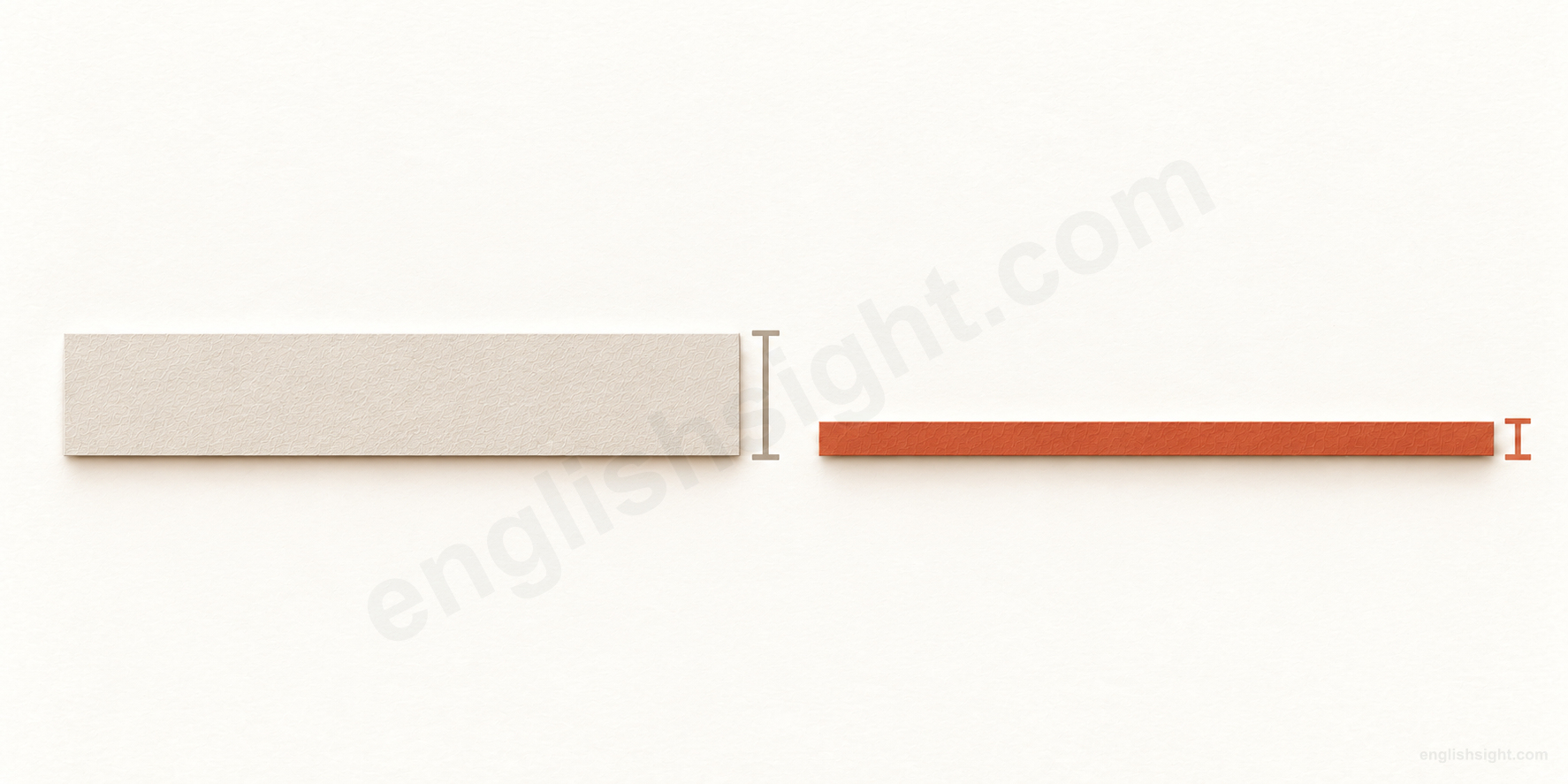
Find what is thin, then read the whole expression.
Thickness as a starting point
Compare the relevant thickness
Reference: more thickness
thin
Thin: little thickness
Compare the distance between the top and bottom surfaces.
The right panel is just as long, but much thinner. This compares thickness, not a change in size.
Thin means having little thickness; in related uses it describes low density, limited body, or little supporting substance.
The diagram compares thickness while keeping length the same. It shows a state, not an object shrinking. Sparse crowds, thin liquids, and fixed expressions need their own contextual explanations.
Thin /θɪn/ can describe a sheet’s thickness, a person’s build, a sparse crowd, a runny sauce, or weak support for an argument. The noun tells you which property matters.
A useful teaching connection is little material or substance in the relevant dimension. It is a memory aid, not a rule that predicts every idiom or a mental picture shared by all English speakers.
01
Thickness, shape, and people
Start with the dimension being measured. Thin describes thickness or build, not every kind of smallness.
01
thin + noun; be thin; thinner than; too thin to + verb; thin enough to + verb
thin paper / a thin layer
a small distance between opposite surfaces
Situation / comparison
You compare two sheets of the same length.
Meaning in context
One has much less thickness.
Thickness is separate from length and overall size.
A thin sheet can be large. A thin layer of paint tells you about the depth of the coating, not how much wall it covers. Thin clothing uses light fabric and may provide little warmth.
Use thin before a noun or after be, look, or feel. Thinner and thinnest compare thickness; too thin to use says it fails a particular requirement. Thin enough to fold says it meets one.
In a sentence
This paper is thin enough to fold into small flowers.
Watch the difference Thin does not automatically mean weak, cheap, or transparent. Those depend on the material.
02
thin + wire / thread / line; a thin line of + noun
a thin wire / line
a small width or diameter
Situation / comparison
You need wire that fits a tiny opening.
Meaning in context
You choose one with a small cross section.
A long object can be thin because it has little width.
Thin applies to wires, threads, drawn lines, and similar shapes. A thin line can run across a whole page; its length is not the dimension described.
Narrow often describes limited width across a road or opening. A narrow street is the usual choice; a thin wall concerns wall thickness. Choose the adjective for the relevant dimension.
In a sentence
Draw a thin line under the date.
Watch the difference Do not use thin as a general replacement for small or short.
03
a thin person; look / become / get thin
a thin person
a body with little fat or flesh
Situation / comparison
You describe someone’s build.
Meaning in context
You identify a relatively slight body shape.
Body description is not a medical diagnosis.
Thin can describe a person, animal, face, arms, or legs. It may be neutral, or it may suggest concern in a context such as thin and tired.
Slim often sounds approving; skinny can sound critical. Lean suggests little fat with a fit or muscular appearance. These words are not interchangeable judgments of health. Uninvited comments about someone’s body may be unwelcome.
In a sentence
The actor playing the detective is tall and thin.
Watch the difference Thin alone neither proves illness nor means attractively slim.
02
How much is present?
Hair, crowds, liquids, air, sound, and evidence involve different kinds of density or substance. The noun determines the comparison.
04
thin hair; be thin on top; thinning hair
thin hair / thin on top
hair that grows sparsely
Situation / comparison
You can see much of the scalp between hairs.
Meaning in context
You describe low hair density.
Thin hair usually concerns how much hair there is, not each strand’s diameter.
In everyday descriptions, thin hair means there is relatively little hair. Fine hair describes individual strands that are small in diameter; hair can be fine yet dense.
Thin on top is an informal way to describe sparse hair on the top of the head. Hair is thinning describes a change, whereas hair is thin describes its present state.
In a sentence
His hair is getting thin on top.
Watch the difference Avoid assuming that thin hair means every hair has a small diameter.
05
a thin crowd; thin attendance; thin vegetation
a thin crowd / thin attendance
relatively few people present
Situation / comparison
An event has many empty spaces.
Meaning in context
You describe a small turnout.
Thin can describe sparse distribution or low numbers.
A thin crowd has few people compared with the space or expected turnout. Thin attendance similarly concerns the number attending.
The people themselves do not have to be physically thin. Compare a thin man in a large crowd: thin then describes one person’s build. Thin vegetation also means plants are sparsely distributed.
In a sentence
Despite the publicity, the opening attracted only a thin crowd.
Watch the difference The noun decides whether thin concerns people’s bodies or the size of a gathering.
06
thin + liquid noun; the sauce is too thin
thin soup / sauce / paint
a liquid with little body or low thickness
Situation / comparison
The sauce runs quickly off the spoon.
Meaning in context
You describe its consistency as thin.
Thin concerns consistency; it is not a universal judgment of taste.
Thin contrasts with thick when talking about how freely a liquid flows. A sauce may be thinner than you want, but a thin broth can be intentional.
Weak tea usually means tea lacking flavor or strength. Thin sauce concerns consistency; the two judgments can overlap but are not identical. A thin layer of paint instead describes the depth of the applied coating.
In a sentence
The sauce is too thin to coat the pasta.
Watch the difference Thin soup need not be tasteless, and thin paint is different from a thin coat of paint.
07
thin air / atmosphere / smoke; the smoke thins
thin air / smoke
low-density air or a less dense cloud of smoke
Situation / comparison
You compare the air at altitude with air lower down.
Meaning in context
You notice that the air is less dense.
Literal thin air concerns density, not an empty place.
At high altitude, thin air has lower pressure and less oxygen available in each breath. The proportion of oxygen is not what this everyday description primarily compares.
Thin smoke or mist is less dense and easier to see through than a thick cloud. Smoke is thinning describes the cloud becoming less dense; air is thin describes a state.
In a sentence
The climbers moved slowly in the thin mountain air.
Watch the difference Do not confuse literal mountain air with the idiom out of thin air.
08
a thin voice / sound; thin light
a thin voice / thin light
sound lacking fullness; light lacking strength
Situation / comparison
A recording has little warmth or resonance.
Meaning in context
You describe the voice as thin.
Thin extends to limited perceptual richness.
A thin voice or sound lacks fullness and often sounds weak or high. A quiet voice simply has low volume: quiet and thin do not describe exactly the same quality.
In descriptive writing, thin light means weak light, such as a little daylight through cloud. This is a related extension, not a claim that light has the thickness of a sheet.
In a sentence
The old speaker made her voice sound thin.
Watch the difference Thin sound is not automatically sound spoken by a thin person.
09
give / manage a thin smile; smile thinly
a thin smile
a restrained smile without much warmth
Situation / comparison
Someone hears an unwelcome remark.
Meaning in context
They smile with little enthusiasm.
The smile’s emotional quality matters more than lip thickness.
Give someone a thin smile often suggests reserve, displeasure, or little genuine warmth. It does not necessarily mean a broad happy response.
Compare thin lips, a physical description. In a thin smile the noun names an expression, so the interpretation concerns the expression’s quality.
In a sentence
Mara gave a thin smile when they praised her replacement.
Watch the difference A thin smile alone does not establish exactly what a person is thinking.
The shortage is in supporting substance, not physical size.
Thin evidence gives limited grounds for a conclusion. A thin argument or excuse is unconvincing or poorly supported. Neither expression by itself proves that a claim is false.
The noun guides the evaluation: a thin plot lacks development; thin knowledge lacks depth. These are judgments about substance, not measurements of paper or length.
In a sentence
That is thin evidence for such a serious accusation.
Watch the difference A short explanation may be excellent; thin criticizes its substance, not just its length.
11
thinly disguised / veiled + noun; a thin disguise
a thinly disguised attack
a hidden intention that is easy to recognize
Situation / comparison
Criticism is presented as friendly advice.
Meaning in context
The hostile intention remains easy to see.
The covering metaphor is only partly successful concealment.
Thinly disguised and thinly veiled describe something concealed so poorly that its real nature is apparent. A thin disguise uses the same idea.
Thinly is the adverb describing how completely something is hidden. A thinly veiled threat remains a threat, even if its wording avoids a direct statement.
In a sentence
His helpful suggestion was a thinly disguised criticism.
Watch the difference Thinly does not mean slightly critical here: it describes the ineffective disguise.
03
Making or becoming thinner
Distinguish an adjective describing a state from a verb describing a change, and read out, down, and with in their constructions.
Slice the cucumber thin and slice it thinly are both natural. Thin is also used as an adverb in cutting and spreading instructions; thinly is the more general adverb form.
Compare thin slices, where thin describes the pieces, and thinly sliced cucumber, where thinly describes the cutting. Thinly populated instead concerns distribution, not the thickness of residents.
In a sentence
Slice the cucumber thin so it fits neatly in the sandwich.
Watch the difference Do not replace every adverb thinly with thin: say thinly populated, not thin populated.
13
something thins (out); thin something (out); thin it / them out
thin (out)
become fewer or remove some from a group
Situation / comparison
Plants grow too close together.
Meaning in context
Some are removed, leaving more space.
Thinning changes density or numbers; it need not change each item’s size.
The crowd thinned out has no object: fewer people remained. We thinned out the seedlings has an object: we removed some plants. Thin without out is also possible in these senses.
With an object, thin out is separable: thin the seedlings out or thin out the seedlings. With a pronoun use thin them out. Clouds can thin too: the cloud cover becomes less dense rather than individual objects necessarily being removed.
In a sentence
We thinned the seedlings out to give the remaining plants more room.
Watch the difference Thin them out, not thin out them. A crowd thinning out does not mean its members lose weight.
14
thin something (down) with something; thin it down; be thinned with
thin something (down) with…
make a mixture less thick or concentrated
Situation / comparison
A sauce is too thick to pour.
Meaning in context
You mix in extra liquid.
With names what is added; down belongs to the optional particle pattern.
Thin the sauce with water names the mixture and the added liquid. Thin down the sauce and thin the sauce down are also possible. With a pronoun, say thin it down.
Thinning the sauce changes its consistency; slicing it thin would concern cutting solid material. Passive forms are possible: The paint was thinned with water. With products such as paint, the appropriate added substance depends on the product.
In a sentence
I thinned the sauce with a little cooking water.
Watch the difference Down is not obligatory, and with introduces the added substance, not the result.
04
Established expressions in everyday situations
Learn the whole expression and its purpose. A physical comparison can help you remember an idiom but does not supply its complete meaning.
Repeated use or delay reduces what remains acceptable.
My patience is wearing thin means I am becoming less willing to wait or tolerate something. The joke is wearing thin means repetition is making it less amusing or acceptable.
Wear supplies the gradual loss; thin describes the resulting weakness. The subject is what loses strength or acceptability: patience wears thin, and repeated excuses wear thin.
Compare literal wear thin: The fabric at the elbows has worn thin means repeated rubbing has reduced its thickness. Here wear describes physical damage and thin is the resulting state; with patience or excuses, the loss is figurative.
In a sentence
After the third delay, our patience was wearing thin.
Watch the difference With patience or excuses, wear thin concerns tolerance or acceptability; with fabric, it can describe actual loss of thickness through use.
16
be / skate / walk on thin ice
be / skate on thin ice
take a risk that could lead to trouble
Situation / comparison
Someone has already broken a rule.
Meaning in context
Further risky behavior may bring consequences.
The ice is an image for insecure support.
You are on thin ice warns that someone’s behavior puts them close to trouble. Skate or walk on thin ice gives a similar warning about taking risks.
The situation need not involve water, winter, or an immediate physical danger. Read the whole expression; thin on its own does not mean disobedient.
In a sentence
After missing another deadline, he knew he was on thin ice with his manager.
Watch the difference The idiom warns of possible consequences; it does not say punishment has already happened.
17
disappear / vanish into thin air
vanish into thin air
disappear completely or without explanation
Situation / comparison
Your keys were here a moment ago.
Meaning in context
You cannot find them or explain their disappearance.
Into marks the imagined disappearance, not a destination you can identify.
Disappear or vanish into thin air presents a sudden or puzzling disappearance. Speakers often use it with frustration or exaggeration about ordinary missing objects.
The idiom does not assert that an object physically turned into gas. It describes the disappearance from the speaker’s perspective.
In a sentence
My keys seem to have vanished into thin air.
Watch the difference Use into for disappearance; out of thin air describes appearance or creation.
18
appear / produce / conjure / make something up + out of thin air
appear / invent out of thin air
appear unexpectedly or create without an apparent basis
Situation / comparison
Nobody has seen anyone approaching.
Meaning in context
Someone seems to appear from nowhere.
Out of marks an imagined source with nothing visible there.
Appear out of thin air describes a surprising arrival with no obvious source. Produce or conjure something out of thin air suggests creating it from nothing: often a speaker says that this is impossible.
Make up a figure out of thin air can criticize a number invented without evidence. That is different from merely seeing a person arrive unexpectedly; context and the main verb supply the distinction.
In a sentence
We cannot produce the extra money out of thin air.
Watch the difference This is not literal low-density air at altitude. Keep out of, rather than into, for the imagined source.
19
spread yourself too thin; be stretched (too) thin
spread yourself too thin / be stretched thin
divide limited time or resources among too many demands
Situation / comparison
You take on several additional projects.
Meaning in context
Too little time remains for each one.
The shortage comes from distributing a limited resource too widely.
Spread yourself too thin means trying to do so much that you cannot give the activities enough attention. The reflexive pronoun matches the subject: I spread myself; she spreads herself.
Staff or resources can be stretched thin when demands leave little capacity to spare. Literal spread the butter thin concerns a physical layer; the resource comparison helps explain the figurative use.
In a sentence
With three clubs and two jobs, I am spreading myself too thin.
Watch the difference Thin does not describe the person’s weight in this expression.
20
people / things + be thin on the ground
be thin on the ground
be scarce or difficult to find
Situation / comparison
You look for volunteers in a small community.
Meaning in context
Very few are available.
The phrase concerns scarcity, including things that are not on the ground.
Especially in British English, people or things that are thin on the ground are scarce in a particular place or situation. It can describe volunteers, jobs, or ideas.
There need not be a literal ground surface involved. Compare a thin layer on the ground, which describes a physical layer’s thickness.
In a sentence
Weekend volunteers are thin on the ground this month.
Watch the difference Learn on the ground as part of the expression; it does not mean people are lying down.
21
stand by / support someone through thick and thin; stick together through thick and thin
through thick and thin
continue in good times and despite difficulties
Situation / comparison
A friend encounters repeated setbacks.
Meaning in context
You keep supporting the friend.
The fixed pair expresses endurance across changing circumstances.
Stand by someone through thick and thin emphasizes loyalty even when life becomes difficult. Stick together or continue working through thick and thin emphasizes persistence.
Through introduces the range of circumstances. Do not assign thick only to success and thin only to failure as a rule that predicts other expressions; this is a conventional phrase.
In a sentence
They stood by each other through thick and thin.
Watch the difference Keep the established order thick and thin. This is not a comparison of body shapes.
22
have a thin skin; be thin-skinned
have a thin skin / be thin-skinned
be easily upset by criticism
Situation / comparison
Someone receives a small critical comment.
Meaning in context
They react with hurt or anger.
Skin is a metaphor for emotional protection.
Have a thin skin describes sensitivity to criticism or offensive remarks. Thin-skinned is the related adjective: a thin-skinned official; the official is thin-skinned.
The expression is often critical, so it may itself offend. It describes reactions, not a medical condition of the skin. Thick-skinned expresses greater resistance to such remarks.
In a sentence
He has a thin skin when people question his work.
Watch the difference Use a in have a thin skin; do not read the phrase as a literal measurement.
23
a thin line between A and B; walk / tread a fine / thin line between A and B
walk / tread a thin line between…
handle a distinction where a small change can cause trouble
Situation / comparison
A speaker wants to be honest without being hurtful.
Meaning in context
The speaker must choose words carefully.
The small gap represents a delicate distinction, not physical thickness.
A thin line between two things means their distinction can be slight. Walk or tread a fine/thin line between them stresses the difficulty of keeping to an acceptable course.
Fine line is an established alternative in this expression. Between names the two sides; neither side needs to be a physical place.
In a sentence
The review walks a thin line between honesty and cruelty.
Watch the difference A thin line on paper is literal. Between honesty and cruelty signals the figurative distinction.
24
be / see something as the thin end of the wedge
the thin end of the wedge
a small beginning feared to lead to a larger harmful change
Situation / comparison
A minor new charge is proposed.
Meaning in context
Someone worries that bigger charges will follow.
A small initial step is presented as the start of something worse.
Especially in British English, the thin end of the wedge voices concern that a seemingly limited change will lead to more serious consequences.
The wedge image helps explain the expression: its narrow end can open a way for the wider part. Calling a proposal this does not prove the predicted developments will happen.
In a sentence
Some residents see the new parking fee as the thin end of the wedge.
Watch the difference The phrase reports a concern about escalation, not merely that something is small.
Choose the dimension and the construction
Forms and spelling
The adjective forms are thin, thinner, thinnest. The verb forms are thin, thins, thinned, thinning: double the final n before -er, -est, -ed, and -ing. Thinly is an adverb and thinness a noun. Thin /θɪn/ ends with /n/; thing ends with /ŋ/.
State, change, and cause
The sauce is thin describes a state. The smoke is thinning describes change in progress. We thinned the sauce describes causing change. Only a transitive use has an ordinary passive, as in The sauce was thinned with water.
Do not extend one model to every phrase
Thin can be neutral, desirable, or inadequate in context. Fixed expressions such as through thick and thin carry meanings that cannot be calculated from thickness alone. This selection covers common modern uses, with a few clearly identified British expressions; it is not a frequency ranking.
Compounds and scope
Paper-thin, wafer-thin, and razor-thin intensify small thickness. A razor-thin margin means a very small difference, especially in election results in North American usage. This lesson does not expand technical photography, golf, financial-market, or blood-thinning terminology.
Choose what thin is doing
Look at the noun, any particle, and the whole situation.
1. A sheet is thin. Which statement must match the description?
2. The crowd thinned out after the concert. What happened?
3. You want to make the sauce less thick. Which instruction has the ordinary pronoun order?
4. After waiting through several delays, Lina says her patience is wearing thin. What does she mean?
5. “I cannot create a budget out of thin air.” Which meaning fits?
6. Which description specifically reports a change rather than just a present state?
Sources and teaching notes
The sources below support the English uses and constructions. Explanations and examples are original; the connection between physical thickness and related meanings is a teaching model.
The diagram is a teaching comparison, not a mental picture shared by every English speaker.