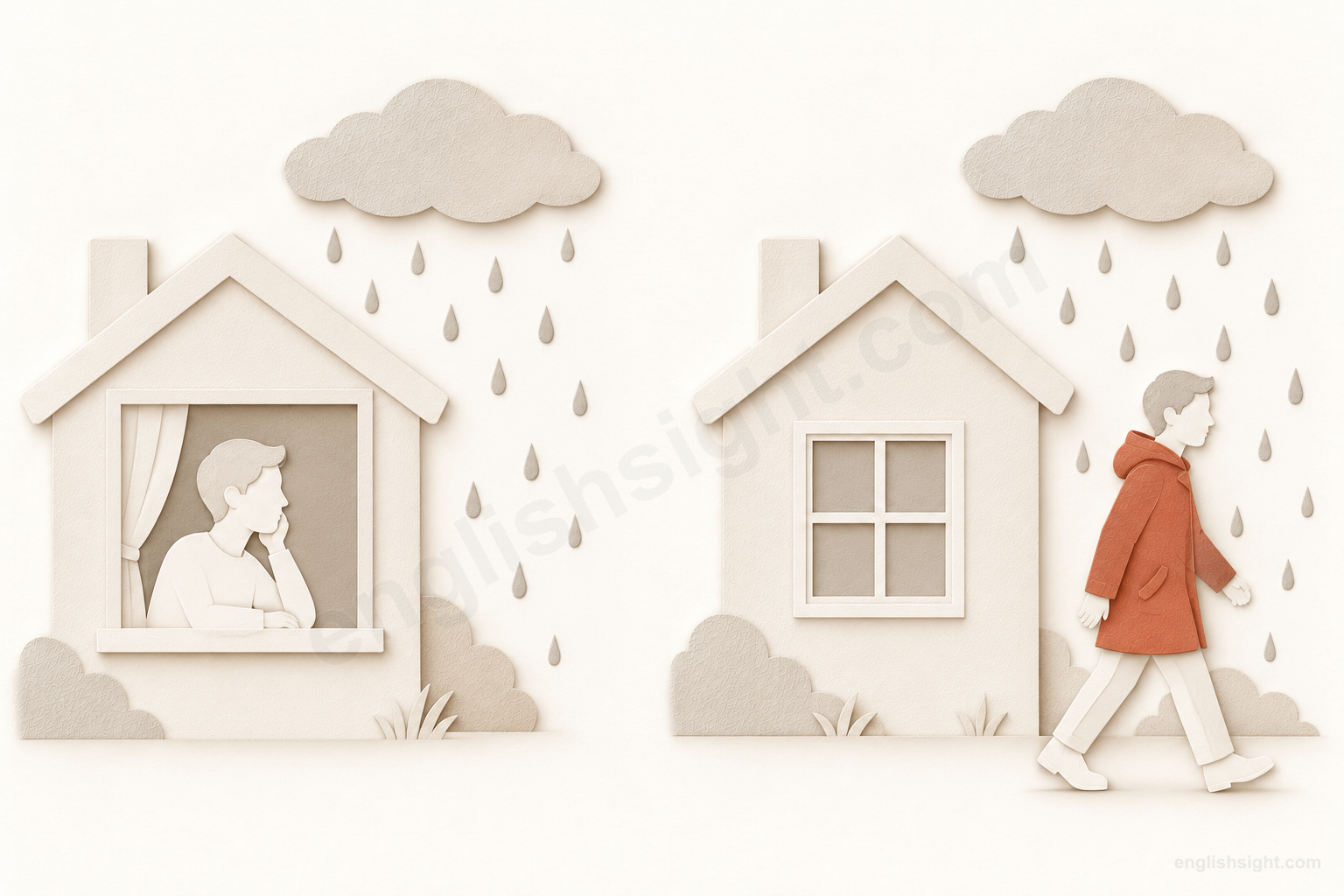
Use though to concede, qualify, or add an afterthought; learn as though as a separate construction.
Acknowledge it; keep the main point
Acknowledge it; keep the main point
Possible expectation: stay indoors when it rains.
though
Stated situation: the person walks outside while it is still raining.
Acknowledge the rain; keep the walk as the main point.
Though it is raining, the person takes a walk.
Though acknowledges a contrasting fact or possibility while keeping the main assertion in place.
The two panels compare an expectation with the stated situation; they are not a timeline or a promise that obstacles are always overcome. As though is a separate comparison construction.
Though often asks us to hold two ideas together: acknowledge one circumstance, yet keep a contrasting main point. The contrast may be surprising, or it may simply limit an earlier claim.
The diagram illustrates one concessive relationship, not a mental picture shared by every English speaker. As though belongs to a comparison pattern and needs its own explanation.
01
Acknowledge a contrast
Present a circumstance without letting it cancel the main point. Clause order, emphasis, and reduced forms change how you package that contrast.
01
though + subject + verb, main clause; main clause + though-clause
Though it was raining, …
acknowledge a fact that might suggest a different result
Context / expectation
Rain might make us stay indoors.
Main point / qualification
We take the walk anyway.
Both the rain and the walk are presented as real.
Though introduces a subordinate clause. The other clause carries the main assertion: rain provides a possible objection, but the walk still happens.
The contrast depends on context, not a rule that rain always prevents walks. Though it was raining, we walked and We walked though it was raining express the same basic concession. Put a comma after an opening though-clause.
In a sentence
Though it was raining, we took our usual walk.
Watch the difference For this two-clause pattern, say Though it rained, we walked or It rained, but we walked; avoid Though it rained, but we walked.
02
main clause, though + contrasting clause
…, though I would prefer…
add a reservation to a main statement
Context / expectation
You agree to a proposed meeting time.
Main point / qualification
You mention a different preference.
The reservation limits the agreement without withdrawing it.
A following though-clause can adjust a claim rather than report a dramatic surprise. In the example, Tuesday remains acceptable; Thursday is only preferable.
Compare Tuesday works because I prefer it: because supplies a reason. Though signals a contrasting consideration. Although can replace though in this full-clause use; though is comfortable in everyday conversation.
In a sentence
Tuesday works for me, though I would prefer Thursday.
Watch the difference A preference after though does not automatically cancel the earlier acceptance; read what both clauses actually say.
03
even though + clause, main clause
even though
emphasize a surprising contrast with an accepted fact
Context / expectation
The bag costs a lot.
Main point / qualification
You buy it in spite of that fact.
Even strengthens the concession.
Even though puts extra weight on the contrast. Here the speaker accepts that the bag was expensive and emphasizes the purchase despite its price.
Even if it is expensive, I will buy it instead leaves the price open: the purchase is planned whether that condition holds or not. This is a useful everyday contrast, though ordinary though can also introduce a possibility in other constructions.
In a sentence
Even though the bag was expensive, I bought it.
Watch the difference Use the whole connector even though; even alone cannot replace it here.
04
though + adjective / past participle; subject, though + description, predicate
though tired / though not perfect
concede a description without repeating the subject and be
Context / expectation
The proposal has faults.
Main point / qualification
You still judge it useful.
The shortened clause describes the same subject as the main clause.
The proposal, though not perfect, is useful expands to though it is not perfect. A reduced clause can interrupt the main clause or follow it. This compact wording is common in careful description.
Though tired, Maya finished the report similarly means though Maya was tired. Keep the understood subject clear. Compare Despite the delay, we finished: despite takes a noun phrase, whereas a normal full though-clause has its own subject and verb.
A past participle can work the same way: Though delayed by traffic, Maya arrived before the talk began means though she was delayed. Maya is understood as the delayed person; the talk is not the subject of delayed.
In a sentence
The proposal, though not perfect, gives us a useful starting point.
Watch the difference Do not write Though the delay, we finished. Use Though we were delayed or Despite the delay.
05
adjective + though + subject + verb, main clause
Difficult though it is, …
give a concessive description extra prominence
Context / expectation
You acknowledge that a decision is difficult.
Main point / qualification
You insist it must be made.
The adjective comes before though in this marked construction.
Difficult though it is means although it is difficult. This order is more emphatic and more characteristic of careful or literary wording than an ordinary opening though-clause.
The subject still precedes its verb: Difficult though it is, not Difficult though is it. This is a special concessive pattern, not the comparison in as though.
In a sentence
Difficult though it is, we must make a decision today.
Watch the difference Do not replace though with although while keeping this fronted adjective order.
06
though + subject + may / might + verb, main clause
Though we may fail, …
concede a possibility without giving up the main point
Context / expectation
Failure is possible.
Main point / qualification
You commit to trying.
May makes the conceded situation possible rather than established.
Though is not restricted to known facts. With may or might it can grant an uncertain possibility: the risk does not change the decision.
This has a more deliberate tone than We might fail, but we will try. For an ordinary open condition, even if is often the clearer choice: Even if the shop is closed, we can check the opening hours on its door.
In a sentence
Though we may fail, we will try a different method.
Watch the difference The sentence does not state that failure has already happened.
02
Balance a remark in conversation
Add a contrasting afterthought or acknowledge that you are praising your own work.
07
clause + though; subject, though, predicate
It was useful, though.
add a contrasting point after an earlier remark
Context / expectation
You have criticized a course as expensive.
Main point / qualification
You balance that criticism by calling it useful.
Adverb though links back without introducing another subordinate clause.
At the end of a clause, though can mean however or nevertheless: The course was expensive. It was useful, though. The second point balances the first. The earlier contrast may also be supplied by another speaker.
It can occur within the sentence too: The evening class, though, was free. Commas mark the inserted comment. Although and even though cannot replace this adverb. Thanks, though can acknowledge an offer while maintaining a refusal: I already have a ticket. Thanks, though.
In a sentence
The course was expensive. I learned a lot, though.
Watch the difference In I learned a lot, though, no clause is missing after though. Do not replace it with although at the end.
08
positive claim + though I (do) say so / it myself
though I say so myself
acknowledge that a compliment comes from you about your own work
Context / expectation
You want to praise something you made.
Main point / qualification
You show awareness that this is self-praise.
The whole phrase softens or playfully frames your compliment.
Though I say so myself and though I say it myself are conversational expressions used while praising yourself or your own work. They acknowledge that the speaker is not an impartial judge.
Do can add emphasis: though I do say so myself. The phrase can sound humorous; it does not guarantee that listeners will find the praise modest.
In a sentence
This soup is excellent, though I say so myself.
Watch the difference Myself refers to the speaker doing the praising; the expression is not a report of someone else’s compliment.
03
Learn as though as a whole expression
As though compares appearances or behavior with a situation. It does not mean although.
09
look / sound / feel / seem + as though + clause
look / sound as though…
describe an appearance or a possible explanation
Context / expectation
You hear a strained voice.
Main point / qualification
You think the speaker may have a cold.
As though introduces the situation suggested by the evidence.
As though works much like as if: You sound as though you have a cold presents a possible explanation of the voice. The cold may be real; this pattern does not automatically mean pretending.
Look, sound, feel, and seem can introduce such impressions. Compare Though you have a cold, you sound cheerful: that concedes a cold instead of inferring one. As changes the construction and must stay with though.
In a sentence
You sound as though you have a cold.
Watch the difference As though is a comparison or appearance expression; it cannot be replaced by although.
10
act / behave + as though + clause; unreal past or past perfect when appropriate
act as though…
compare behavior with an imagined or contrary situation
Context / expectation
Mina does not own the office.
Main point / qualification
She behaves like its owner.
The comparison can be unreal without being a concession.
As though can introduce an imagined situation that explains the style of someone’s behavior. In the example, a past form, owned, marks distance from reality rather than past ownership.
With be, were is possible for an unreal comparison: He acts as though he were the manager. Was also occurs in informal speech. Earlier imagined events can use had plus a past participle: She looked at me as though I had broken her phone. Context decides whether such an event is merely suspected or known to be unreal.
In a sentence
Mina acts as though she owned the office, but she is only a visitor.
Watch the difference Do not infer unreality from as though alone. Compare the possible cold in the previous unit.
Keep meaning and grammar together
Though, although, but, and despite
Though and although introduce concessive clauses. But joins contrasting main clauses. Despite and in spite of normally take a noun phrase or an -ing form: despite the rain; despite feeling tired. Choose a complete pattern rather than translating a connector in isolation.
A fact, a possibility, or an impression?
Even though usually presents the conceded circumstance as accepted. Even if leaves a condition open. Though we may fail grants a possibility. As though can describe a real possibility or an unreal comparison; context and verb forms matter.
Sound, spelling, and scope
Though is pronounced /ðəʊ/ in British English and /ðoʊ/ in American English, with a voiced initial sound as in this and silent gh. It is not through or thought. It has conjunction and adverb uses, with no tense forms, passive, or phrasal-verb family. The expressions what though and make as though to do are outside this lesson.
Choose the relationship
Check whether the speaker concedes a fact, adds an afterthought, or makes a comparison.
1. You know the room is small, but you still choose it. Which sentence states that accepted fact?
2. You have said the meal was expensive. Which sentence adds a natural balancing afterthought?
3. A voice suggests illness, but you do not know whether the person has a cold. Which sentence expresses the impression?
4. What does “The plan, though imperfect, is useful” mean?
Sources and teaching notes
Dictionary uses were checked against the linked publisher pages. Explanations, examples, and the visual teaching model are original; the model does not define every construction.
The diagram is a teaching aid, not a picture shared by every native speaker.