From sewing material to connected ideas, online replies, and careful movement.
A continuous strand links separate parts
A continuous strand links separate parts
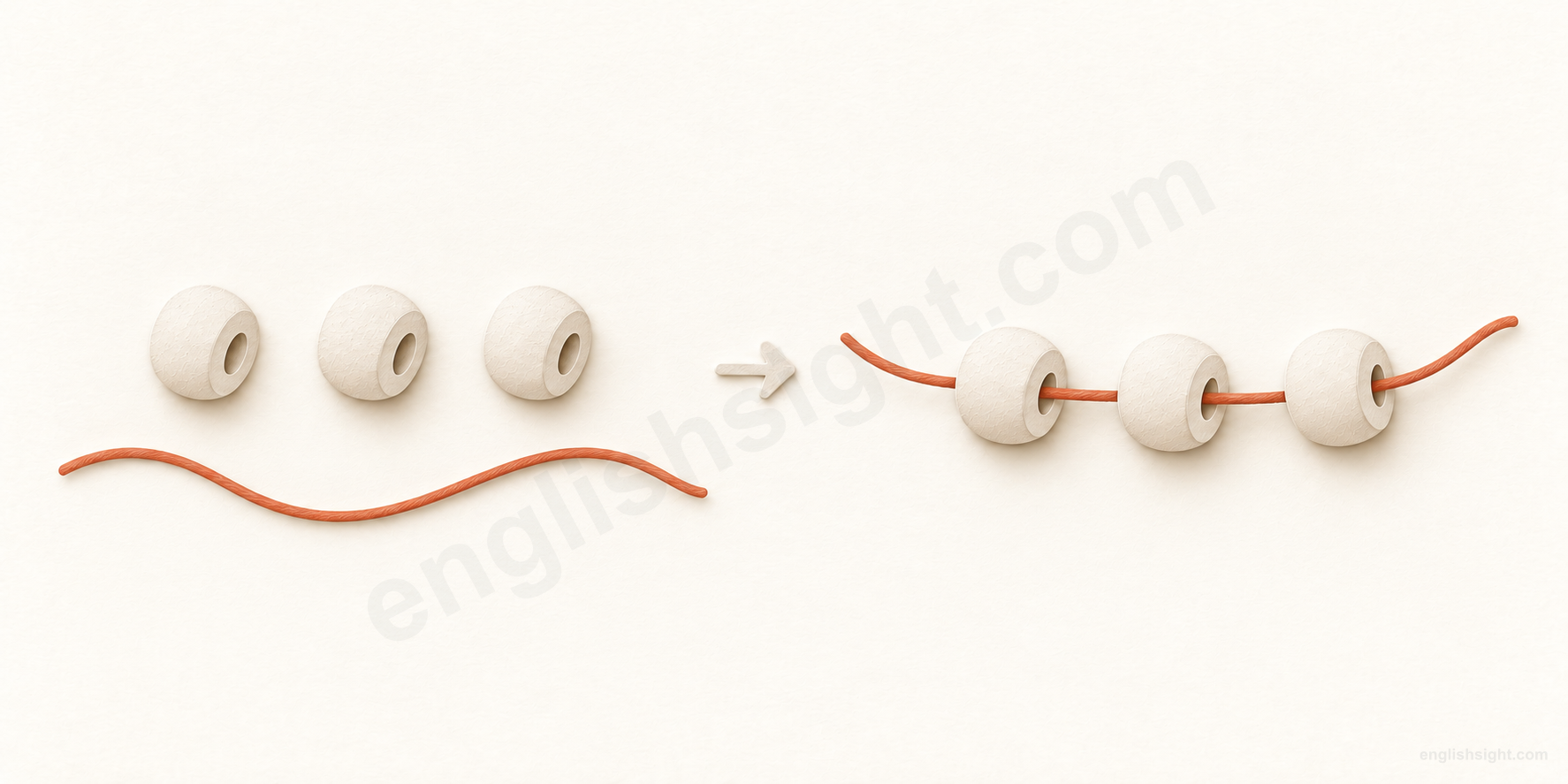
Separate beads and a loose strand
thread
Three beads connected on one continuous strand
The strand passes through each bead’s hole.
One fine strand links separate parts.
A thread is a fine continuous strand; that continuity helps us understand connections running through separate parts.
The beads illustrate one concrete connection. The same teaching comparison helps with ideas and messages, but it does not predict every idiom, and a screw thread is a separate spiral-ridge sense.
A thread is a fine continuous strand. Its shape and continuity offer a useful teaching link to a line of light, a developing idea, or connected messages. The verb often involves guiding something through small openings or joining things on a strand.
The constructions still matter: thread a needle, thread cotton through it, and thread beads onto cotton describe different objects and relationships. Screw threads and fixed expressions need their own explanations.
01
Fine material, lines, and a spiral ridge
Start with the concrete noun. Context tells you whether thread is sewing material, a fine line, or the ridge that lets a screw turn into place.
01
thread (material); a thread / threads; a length / spool of thread
a needle and thread
fine strands used for sewing or making cloth
Situation
A button has come off your shirt.
Meaning / result
You choose suitable sewing material.
Thread can name material in general or one individual strand.
For a repair, you need thread: no article is needed when you mean the material. Ask for some black thread or a spool of thread. A thread is one strand; threads can be individual strands in fabric or a spider’s web.
A loose thread hangs free from cloth. You might say There is a loose thread on your sleeve. A length of thread or a piece of thread specifies an amount without treating all the material as one countable object.
For ordinary shopping, sewing thread, knitting yarn, and string for tying a parcel identify different intended uses. They are not interchangeable labels for everything long and thin; the exact material and thickness depend on the product.
In a sentence
I need some black thread to sew this button back on.
Watch the difference Use some thread for an unspecified amount; a thread means a particular strand.
02
a thread of + substance / light
a thread of light
a very narrow line or stream of something
Situation
The door is nearly closed.
Meaning / result
A fine line of light is still visible.
The noun emphasizes a long, slender shape.
A thread of light, smoke, or water compares its shape to a fine strand. The of-phrase names what makes up the line; it does not mean the light or water is made of sewing material.
This descriptive use often appears in stories and detailed descriptions. A thread of water suggests a narrow stream; a drop of water suggests a separate rounded amount.
In a sentence
A thread of light showed beneath the closed door.
Watch the difference Thread describes the shape here; it is not the ordinary name for a broad beam or a large flow.
03
the thread on a screw; an internal thread; thread + pipe / hole
the thread on a screw
the spiral ridge used to fasten parts by turning
Situation
A screw will not tighten properly.
Meaning / result
You inspect the ridge that should grip the matching surface.
A screw thread winds around a cylinder.
The thread on a screw is the raised spiral ridge around it. A matching internal thread in a nut or other fitting lets the parts engage when turned. This is a separate established noun sense, connected visually with a winding line.
The thread is damaged can explain why parts will not fit or tighten. In technical work, to thread a pipe or hole means to form a screw thread on or in it; it does not mean to put sewing cotton there.
In a sentence
The thread on this screw is damaged, so it will not tighten.
Watch the difference Do not confuse a screw’s thread with a loose strand of fabric; the surrounding object identifies the sense.
02
Following connected ideas and messages
A continuous strand is a useful comparison for a theme, a train of thought, or a linked conversation. Each noun use has its own everyday constructions.
04
a common thread; a thread runs through + works / discussion
a common thread
a shared idea connecting different things
Situation
You compare several otherwise different stories.
Meaning / result
You identify the idea they share.
A thread can connect parts without being a physical strand.
A common thread is a feature or theme shared by several things. A thread runs through something means that the idea can be found across its parts. The subject of runs is the theme; no one is literally running.
The threads of a plot are its different developing strands of events. A writer can draw them together. A loose thread in a story can mean a detail or question left unresolved, extending the physical loose-strand image.
In a sentence
A common thread runs through all three films: the search for home.
Watch the difference Common means shared here; it does not mean the theme is dull or unoriginal.
05
follow / lose the thread of + argument / conversation; lose my / your thread
follow / lose the thread
understand, or stop following, the connected course of ideas
Situation
An explanation moves from one point to the next.
Meaning / result
You either keep track or can no longer see how it connects.
The thread is the continuity of the argument or thought.
Follow the thread of an argument means understand how its points fit together. Lose the thread means stop understanding that sequence. You may still understand individual words while missing the connection.
A speaker can also lose their thread: forget where they were going with their own explanation. I lost my train of thought is a useful alternative for that speaker’s experience. Losing the thread need not mean forgetting the entire subject.
In a sentence
When the speaker changed topics again, I lost the thread of her argument.
Watch the difference Use the thread or a possessive such as my thread in these expressions; not I lost thread.
06
start / read / reply to a thread; an email / comment thread
a discussion thread
a connected series of online messages about one topic
Situation
Someone posts a question online.
Meaning / result
Replies form a conversation that can be followed together.
A post is one message; a thread connects messages.
You can start a thread, reply to a thread, or read a comment thread. In email and forums, replies may be grouped under the same subject. On social media, one writer can also publish a series of linked posts as a thread.
The exact display depends on the service. A thread describes the connection between messages; it is not the same as the whole forum, all your messages, or necessarily a live chat.
In a sentence
Please reply in the existing thread so everyone can follow the discussion.
Watch the difference A reply may belong to an existing thread; starting a new thread creates a separate conversation.
03
Passing through, joining, and finding a way
Look carefully at the verb’s object: you can thread a needle, thread cotton through it, or thread beads onto cotton. The object names different participants.
07
thread + needle + (with thread); thread + cotton + through a needle
thread a needle
put thread through the needle’s eye
Situation
The needle and a length of cotton are separate.
Meaning / result
The cotton passes through the small hole, ready for sewing.
The needle is the object even though the thread passes through it.
To thread a needle, pass the end of the sewing thread through its eye, the small hole near one end. Thread a needle with cotton names the material after with.
You can describe the same action as thread cotton through a needle. Now cotton is the direct object and through names its path. Compare the two patterns instead of assuming that the direct object is always the item moving.
In a sentence
Could you thread this needle for me?
Watch the difference Threading a needle prepares it for sewing; it does not by itself mean making stitches.
08
thread + object + through / into + place; thread + machine
thread the cable through
feed a long, thin object along a restricted path
Situation
A cable must reach the other side of a small opening.
Meaning / result
You guide it through without catching it.
The direct object is the long item being guided.
Thread a cable through a hole and thread a shoelace through the eyelets describe guiding a long object through openings. Through gives the route; into instead focuses on entry into a place.
To thread a sewing machine is to arrange its thread along the required guides so it can work. Film or tape can similarly be threaded through equipment. The machine may be the object, or you may name the material and its route.
Passive wording is natural when the route matters more than the person: The cable is threaded through the hole. With a pronoun, say thread it through the hole. These are ordinary verb-plus-path constructions, not a single idiom whose meaning comes from through alone.
In a sentence
Thread the cable through the small hole before fitting the plug.
Watch the difference Push can describe applying force; thread highlights careful feeding along the path and does not require force.
09
thread + beads / pieces + onto / on + support
thread beads onto a string
join objects by passing a thin support through them
Situation
Several beads are separate.
Meaning / result
They sit together on one string.
The beads are the objects being put onto the support.
Thread beads onto a string puts the beads in the object position. The string passes through their holes, joining them. On is also used; onto makes their placement on the support especially clear.
The support need not be flexible sewing thread. You can thread pieces of food onto a skewer. String the beads is a close alternative for beads; sew the beads suggests attaching them with stitches instead.
In a sentence
Thread the wooden beads onto the cord, then tie the ends.
Watch the difference Thread the beads onto it is natural when it means the cord. The bead and the support have different grammatical roles.
10
thread + possessive + way + through / between; thread through / between
thread your way through
move carefully between obstacles or through a narrow route
Situation
Tables fill the room, leaving only small gaps.
Meaning / result
You choose a route between them.
A person’s route resembles a fine strand winding between things.
Thread your way through a crowd describes careful movement while avoiding people. The possessive follows the person: I threaded my way, she threaded her way, we threaded our way.
Way is not essential: The waiter threaded between the tables is also possible. Through identifies a surrounding area; between points to the gaps separating obstacles. The sense is more specific than simply go through.
With a moving subject such as a car, thread through traffic describes its winding progress. The verb does not require someone to be carrying literal thread.
In a sentence
We threaded our way between the crowded tables to reach the door.
Watch the difference Do not use your with every subject: we threaded our way, not we threaded your way.
11
be threaded with + material / colour; noun + threaded with…
threaded with silver
having fine strands worked or scattered through something
Situation
You look closely at dark fabric or hair.
Meaning / result
Fine contrasting strands appear within it.
With names the material that appears as strands.
A scarf threaded with silver has silver-colored or silver material running through it. This pattern often appears as be threaded with or as a description after a noun: a scarf threaded with silver.
Dark hair threaded with grey extends the image to pale strands among darker ones. It does not mean someone sewed grey thread onto a person’s head. This is descriptive language, distinct from threading separate beads onto a support.
In a sentence
She wore a dark scarf threaded with silver.
Watch the difference With names the added strands; through usually names the route or surrounding material in a feeding construction.
04
Fixed expressions and register
These expressions use the image of a fine strand or a small opening, but their established meanings need to be learned as whole expressions.
12
something hangs / is hanging by a thread
hang by a thread
be in a dangerously uncertain position
Situation
One last source of support may disappear.
Meaning / result
Failure or loss is a serious possibility.
The image is weak support that could break.
If a project, agreement, or someone’s life hangs by a thread, its survival is very uncertain. The whole idiom suggests that very little support remains. It is much stronger than merely saying something is unfinished.
The progressive form is natural for a current crisis: The agreement is hanging by a thread. Failure is threatened, not already confirmed. The image of a fine strand helps explain the expression but cannot tell you the actual chance of failure.
In a sentence
Without the final payment, the project is hanging by a thread.
Watch the difference The project is at risk; the idiom does not say it has already failed.
13
pick up the threads (of + activity / life)
pick up the threads
resume an activity or rebuild continuity after an interruption
Situation
Work or ordinary life has been interrupted.
Meaning / result
You return to it and reconnect with what came before.
Picking up the strands is a metaphor for starting again.
Pick up the threads of a project means resume it after a break. Pick up the threads of your life can describe returning to ordinary activities after a difficult period.
The familiar plural expression is pick up the threads, often followed by of plus the interrupted activity. The image suggests recovering continuity, but the phrase does not promise to undo everything that happened during the break.
In a sentence
After a long break, she began to pick up the threads of her research.
Watch the difference Here pick up means resume as part of the whole expression; it does not describe physically lifting sewing material.
14
thread the needle; thread the needle between + competing demands
thread the needle
handle a difficult task with precise judgment
Situation
A decision must satisfy requirements that are hard to combine.
Meaning / result
You try to find a workable solution with care.
A small opening becomes an image for a demanding task.
Beyond sewing, thread the needle can describe doing something that demands great precision, especially balancing conflicting requirements. The difficulty comes from having little room for error.
In The team must thread the needle between a low price and reliable quality, the team needs a workable balance. Between names the competing demands. This figurative use is established; thread alone does not mean compromise in every sentence.
In a sentence
The team must thread the needle between a low price and reliable quality.
Watch the difference The context distinguishes this figurative task from literally putting thread through a needle.
15
threads (plural, informal) = clothes
nice threads
clothes, in informal language
Situation
Someone comments casually on an outfit.
Meaning / result
Threads refers to the clothes themselves.
The plural names clothing rather than separate strands.
Nice threads! can be a casual compliment on someone’s clothes. Dictionaries mark this use as informal, especially North American; Oxford also marks it old-fashioned.
Recognize it in dialogue, but clothes or outfit is a neutral choice for ordinary description. A loose thread on a jacket still means a strand, so the surrounding sentence matters.
In a sentence
“Nice threads!” he said when he saw my new suit.
Watch the difference Keep the plural for this clothing sense. A thread usually means a strand, a connection, or another singular noun sense.
Keep the strand, the route, and the construction distinct
Noun and verb forms
Pronunciation is /θred/. The noun can be material (some thread) or a countable item (a thread, two threads). Verb forms are thread, threads, threaded, threading; threaded has an extra syllable, /ˈθredɪd/.
Objects change the viewpoint
Thread a needle names the object being prepared. Thread cotton through a needle names the material being guided. Thread beads onto a cord names the items being joined. The preposition identifies the route or support; it does not replace the verb’s object.
Grammar follows the meaning
An ongoing action can be progressive: I am threading the machine. A passive can describe a result or route: The cable was threaded through the opening. In thread your way, match the possessive to the traveler. There is no general thread someone to do something causative pattern.
A useful connection with limits
A fine continuous strand is a teaching model, not a claim about every speaker’s mental picture or a rule for inventing new expressions. Specialist programming, manufacturing, beauty-treatment, and historical senses are not developed here. Derived words such as threadbare need separate learning.
Follow the meaning in context
Choose the expression that fits the object, situation, or construction.
1. You need an unspecified amount of sewing material. Which request fits?
2. The sewing thread must go through the needle’s eye. Which sentence describes preparing the needle?
3. You understand the words in a talk but no longer understand how its points connect. What can you say?
4. The wooden beads are separate. You want them joined on one cord. Which instruction fits?
5. An agreement is hanging by a thread. What does that tell you?
6. After months away, someone picks up the threads of her work. What happens?
Sources and teaching notes
Dictionary meanings and constructions were checked against the publisher pages below. The BBC lesson supports the figurative needle expression. Explanations and examples are original; the strand-and-connection model is a teaching comparison.
The diagram illustrates a connection; it does not claim every English speaker sees the same image.