Follow through across space, time, processes, and established expressions.
Follow the route within
Inside the route, toward its endpoint
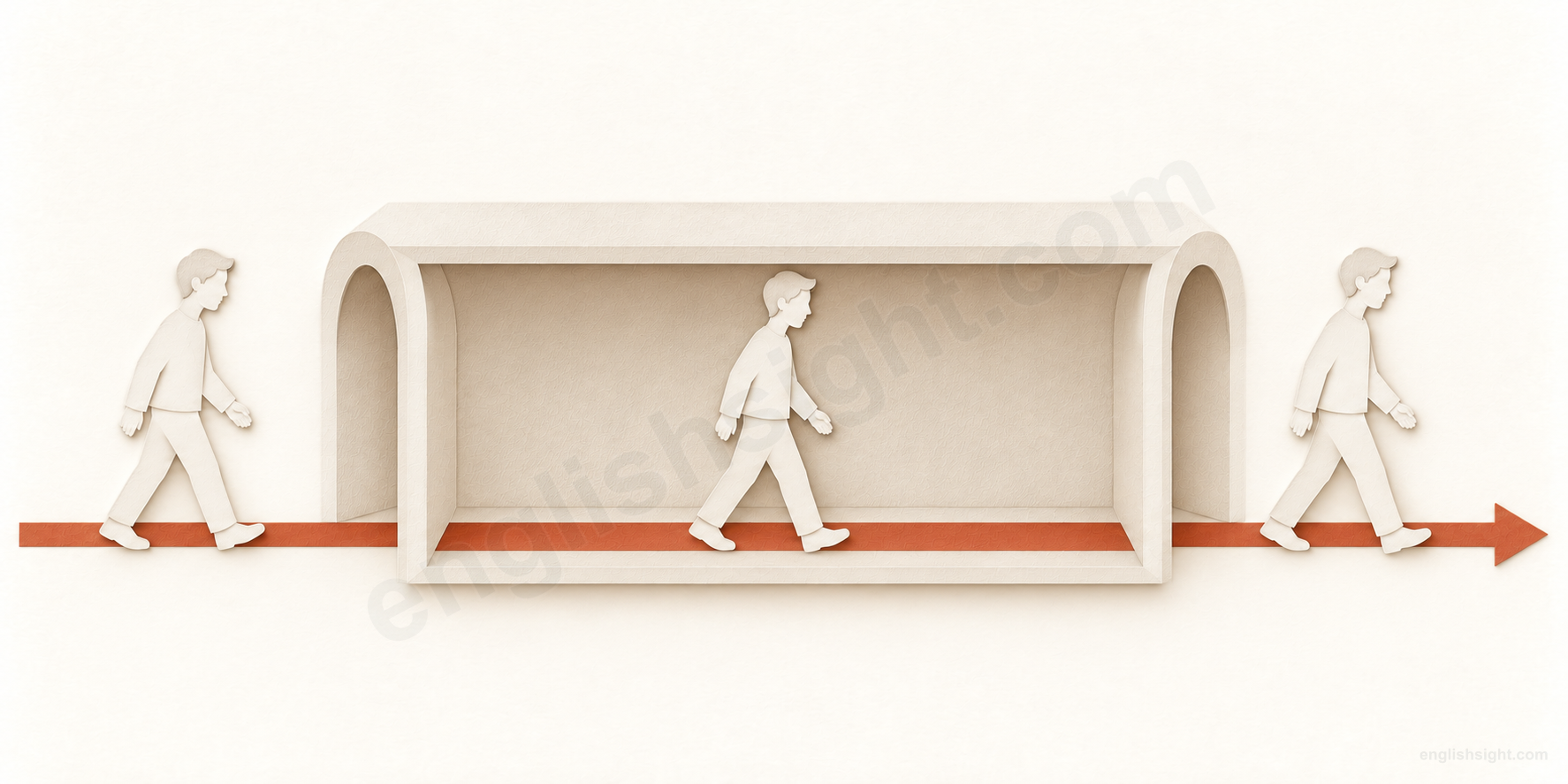
The walker approaches the near entrance.
through
The walker emerges on the far side.
The route continues inside the passage.
Through highlights the route within a span toward its far side. The three positions show successive moments.
The arrow enters a span, follows a path within it, and reaches the other side. The middle matters, not just the destination.
The span can represent space, time, or a process. This analogy helps connect uses; it does not predict every idiom or imply that every through phrase describes successful completion.
Through often presents a route within something and toward its far side or endpoint. What lies along that route may be a place, a period, a process, or a difficulty.
This is a teaching model, not a claim that every native speaker sees the same picture. Some expressions have conventional meanings that must be learned as a whole.
01
Space, perception, and penetration
A route can run inside a place, pass a barrier, or spread through material.
01
verb + through + place / material
through a tunnel
move within something toward its other side
Starting situation
The tunnel lies between us and the beach.
Result / interpretation
We reach its other end.
The route passes inside the space.
Through can mark a tunnel, a crowd, a town on a route, or a hole in material. A path through a forest need not be enclosed. With the route understood, Let them through uses through as an adverb.
Cut through a rope means cut across its full thickness. Drive through a red light means pass it without the required stop.
Cut through a park or another place can mean take a shorter route across it: We cut through the park to reach the bus stop. This is a shortcut, not necessarily an act of cutting material.
Original example
We walked through the tunnel to the beach.
Watch the distinction Across emphasizes crossing an area; through emphasizes a route within it. Neither requires a completely enclosed object.
02
see / hear + object + through + barrier
see / hear through
perceive something across an intervening barrier
Starting situation
A wall separates the listener and the music.
Result / interpretation
Sound reaches the listener.
The barrier lies between source and observer.
Light or sound can pass through glass, mist, or walls. The wall need not be transparent for sound to pass. See through glass is literal; see through a lie means recognize deception.
Original example
I could hear the music through the wall.
Watch the distinction Use look through the window for the viewing route; look at the window makes the window the object of attention.
03
adjective + through; spread / run + through + area
wet through / spread through
affect the whole thickness or spread within an area
Starting situation
Rain reaches the coat; cold affects the body.
Result / interpretation
The coat is soaked; the body shivers.
An effect reaches inside or throughout something.
Wet through and soaked through mean completely wet. News can spread through a town; a thought can go through your mind. These conventional extensions concern distribution or mental activity, not a literal tunnel.
Original example
My coat was wet through, and a shiver ran through me.
Watch the distinction Thorough means careful or complete; it is a different word. A thorough check is not a through check.
02
Time, progress, and inclusive ranges
Read whether the phrase describes a duration, a position in a task, or an included endpoint.
04
verb + (all) through + period; sit through + event
through the night
continue for the duration of a period
Starting situation
Night begins while work remains.
Result / interpretation
Work continues until morning.
The period is treated as a span to pass through.
All through the night emphasizes the whole period. Sleep through an alarm means fail to wake despite it; sit through a lecture means remain until it ends, often with some boredom. During only places an event within a period.
Original example
The nurses worked through the night.
Watch the distinction An event during the night need not last all night. Through emphasizes continuation across the period.
05
be + fraction + through + task; verb + all the way through
halfway / all the way through
locate progress or completion within a whole
Starting situation
One reader is in the middle; another has finished.
Result / interpretation
Their positions in the book differ.
The endpoint measures how much is complete.
Halfway through a book means half of the reading is complete. Read it through means read to the end; cook it all the way through means cook the interior too. The activity comes from the verb or context.
Get through a report or a pile of work means manage to complete it. There is a lot to get through means that much work remains; through alone does not tell you whether the work is already finished.
Original example
I am halfway through the book, but Ana has read it all the way through.
Watch the distinction Halfway through is progress, not a deadline. By Friday sets a deadline; through Friday can include that whole day.
06
(from) + start + through + final day / number
Monday through Friday
include both ends of a range
Starting situation
The first working day is Monday.
Result / interpretation
Friday is included too.
North American through explicitly includes the endpoint.
This range use is especially North American. In a range such as questions 2 through 6, question 6 is included. British English often uses Monday to Friday; add inclusive when explicit inclusion matters.
Original example
The office is open Monday through Friday.
Watch the distinction Until Friday can leave the exact stopping point unclear; through Friday includes Friday. Thru is an informal spelling, not the default in formal prose.
03
Channels, methods, and causes
A person, system, or circumstance can connect an action to its result.
07
through + intermediary / means / -ing form
through an agent / practice
use an intermediary, channel, or method
Starting situation
We need a room and an agent can arrange it.
Result / interpretation
The agent makes the booking possible.
A result is reached by a particular channel.
Through can name an agent, an app, practice, or working together. The noun or -ing form supplies the means. Hear something through the grapevine means hear it informally from other people.
Original example
We booked the room through a local agent.
Watch the distinction Through an agent describes the channel; by an agent after a passive can identify who performed the action.
08
through + cause; through no fault of + person
through an error
identify a cause or deny responsibility
Starting situation
A delay occurs, but we did not cause it.
Result / interpretation
Responsibility is explicitly excluded.
A causal link is not always a chosen method.
Through carelessness or through an error gives the cause of a result. Through no fault of mine denies that my fault caused it. Because of is often a plainer alternative; an error is not a tool being used intentionally.
Original example
The parcel was delayed through no fault of ours.
Watch the distinction Distinguish cause from intention: something happening through an error was not necessarily planned.
04
Reading, reasoning, and using resources
The verb and object determine whether we inspect, discuss, rehearse, finish, or consume.
09
read + text + through; leaf / skim through + text
read / leaf through
read completely or browse its pages
Starting situation
Two documents need different amounts of attention.
Result / interpretation
One is read fully; the other is browsed.
The verb determines depth and speed.
Read through focuses on reaching the end. Leaf through and flip through mean look quickly through pages or other items without reading everything carefully. Skim through means read quickly for the main points. Through marks movement through the material, not guaranteed understanding.
Original example
I read the form through, then leafed through the brochure.
Watch the distinction Do not translate every through as thoroughly: skimming through can miss details.
10
go / look through + collection / details
go / look through
search or examine items in sequence
Starting situation
The payment is not accounted for.
Result / interpretation
The receipts are checked one by one.
A collection becomes a route for attention.
Go through can mean examine carefully, review arguments, or carry out a procedure. Look through can mean search or read. The object and purpose distinguish these from physically passing through a place.
With a person as object, look through can mean ignore them as if invisible: Nora looked straight through me at the station. This describes ignoring me, not examining me.
Original example
We went through the receipts to find the missing payment.
Watch the distinction Keep the object after through: go through them, not go them through.
11
think / talk + object + through; talk + person + through + process
think / talk it through
consider fully or explain step by step
Starting situation
A decision and a procedure are unclear.
Result / interpretation
The implications and steps become clearer.
Through suggests following the reasoning to its end.
Think a plan through means consider its consequences. Talk it through means discuss it fully. Talk someone through a process gives that person a guided explanation; the person is not the subject being discussed.
Original example
Let us think it through; then I will talk you through the steps.
Watch the distinction Use think it through and talk it through with a pronoun. Talk you through it has two distinct objects.
12
run through + plan / performance
run through
review or rehearse from start to finish
Starting situation
The presentation needs a practice run.
Result / interpretation
The speakers have rehearsed its sequence.
The route is a sequence of points or actions.
Run through the plan gives a quick review; run through a scene can mean rehearse it. Run through money instead means spend it, so the object changes the sense.
Original example
We ran through the presentation before the guests arrived.
Watch the distinction A run-through is a noun, often hyphenated; run through is the verb expression.
13
go / get / run through + quantity / supplies
go / get through supplies
use or consume an amount
Starting situation
We start with a supply of water.
Result / interpretation
Three litres have been consumed.
The supply is used until that amount is gone.
Go through and get through can describe consumption, often more than expected. Run through savings means spend them, usually quickly. The subject consumes the object; it is not moving inside it.
Original example
We went through three litres of water on the walk.
Watch the distinction Getting through a report normally means completing work on it; getting through water normally means using it.
05
Experience, survival, and acceptance
Distinguish undergoing a process from managing it, qualifying, or completing it officially.
14
go through + experience; put + person + through + ordeal
go through / put someone through
experience difficulty or cause someone to experience it
Starting situation
A prolonged uncertainty affects her life.
Result / interpretation
She experiences a difficult period.
The experiencer and the cause have different grammatical roles.
Go through a bad time describes the person’s experience. Put someone through something makes someone undergo it. Go through the mill and put someone through the mill intensify the idea of a hard experience.
Original example
She went through a difficult year; the uncertainty put her through a lot.
Watch the distinction Do not make the sufferer the cause: she put him through it means she caused his ordeal.
15
get / live / pull through + difficulty; get / pull + person + through (+ difficulty)
get / live / pull through
cope with difficulty, survive it, or recover from serious illness
Starting situation
An illness creates a difficult period.
Result / interpretation
She manages with support.
The far side represents getting beyond the difficulty.
Get through a crisis means cope and reach its end. Live through a disaster emphasizes having experienced and survived it. Get someone through a crisis means help them cope; it does not necessarily mean cure them.
Pull through can mean recover after a serious illness or operation: The doctors hope Leo will pull through. It can also mean succeed despite serious difficulty. Pull someone through means help them recover or succeed, so compare Leo pulled through with the treatment helped pull Leo through.
Original example
Her friends helped her get through the illness.
Watch the distinction Go through emphasizes experiencing; get through emphasizes managing to reach the other side.
16
get through + test; get / be through to + next stage
get through to the final
pass a test or qualify for a later round
Starting situation
The team faces an earlier round.
Result / interpretation
It qualifies for the final.
A successful stage opens the next one.
Get through an exam can mean pass it, especially in British English. Get through to the final and be through to the final mean qualify. Sail through an exam adds that it was easy.
Original example
Our team got through to the final.
Watch the distinction Be through to the final does not say that the team has won the final.
17
proposal / deal + go through; get / put + proposal + through
a deal goes through
be officially accepted or completed
Starting situation
The sale is awaiting formal completion.
Result / interpretation
It becomes a completed transaction.
An institutional process reaches its endpoint.
A law, deal, or payment can go through. Get a bill through parliament or put a deal through makes the subject responsible for completing the process. Mere physical movement does not explain the full business meaning.
Original example
The sale finally went through on Tuesday.
Watch the distinction A deal falling through means failure; going through means successful acceptance or completion.
06
Contact, understanding, and delivery
Reaching a person can involve a phone connection, an explanation, a message, or practical help.
18
get through to + person; put + caller + through to + person
get / put through to
establish a telephone connection
Starting situation
The caller has reached a reception desk.
Result / interpretation
The caller asks to be connected to the manager.
The call reaches its intended person.
Get through means succeed in making contact by phone. Put someone through means connect their call. In a phone-connection context, You are through means the connection is established, rather than that the conversation is finished.
Original example
Could you put me through to the manager?
Watch the distinction Put me through, not put through me. Context distinguishes connected on the phone from finished.
19
get through to + person
get through to someone
make someone understand or accept a message
Starting situation
A warning is explained.
Result / interpretation
The listener still does not take it in.
The obstacle concerns understanding, not the phone network.
Get through to someone can mean make them understand, especially after difficulty. The same words can describe phone contact. Here the explanation and danger select the understanding sense.
Original example
I explained the danger, but I could not get through to him.
Watch the distinction Reaching someone by phone does not guarantee that you get your point through to them.
20
message / news / supplies + come / get through
a message comes through
arrive through a communication or delivery system
Starting situation
Confirmation is expected.
Result / interpretation
It is received.
Information reaches the receiving end.
A message or official confirmation comes through when it arrives. Supplies getting through means reaching people despite obstacles. A quality coming through in someone’s voice means becoming noticeable: Her relief came through clearly in her voice.
Original example
The confirmation came through just before lunch.
Watch the distinction The subject is what arrives or becomes apparent; a person coming through a crisis is a different use.
21
come through (for + person) (with + help); come through + ordeal
come through for someone
provide needed help or succeed when it matters
Starting situation
We need somewhere to stay.
Result / interpretation
Sam provides a room.
A hoped-for result is delivered.
Come through can mean do what was needed or promised, often with help or money. Come through an operation instead means survive or recover. These established senses need their own contexts.
Original example
Sam came through for us with a spare room.
Watch the distinction For names the beneficiary; with names what is provided. Through itself does not mean promise.
07
Endings, commitment, and obstacles
Object position and the full construction separate finishing, rejecting, detecting, and persisting.
22
be through (with + task / object)
be through with a task
have finished doing or using something
Starting situation
Someone is using the scissors.
Result / interpretation
You ask whether they have finished.
The current activity has reached its endpoint.
Especially in North American English, I am through and I am through with the work mean finished. With an object such as scissors, the question often asks whether someone else may use it now.
Original example
Are you through with the scissors?
Watch the distinction A through train uses through before a noun; be through with is a different, predicative construction.
23
be through with + person / activity; people + be through
be through with someone / something
refuse further involvement or end a relationship
Starting situation
The speaker has had enough of an argument.
Result / interpretation
The speaker rejects further argument.
The endpoint can be a deliberate break.
I am through with you can end a relationship. We are through can mean our relationship is over. Through with arguing expresses a decision to stop, stronger than merely finishing a task.
Original example
I am through with arguing about this.
Watch the distinction Through with a person can sound final and hostile; do not use it casually for finishing a friendly call.
24
see through + person / deception
see through a lie
recognize hidden dishonesty or intention
Starting situation
An excuse tries to conceal the truth.
Result / interpretation
Mina recognizes the deception.
The apparent surface no longer conceals the truth.
See through someone or their excuse means recognize what they are really doing. This established figurative use differs from seeing through transparent glass. It is normally not progressive.
Original example
Mina saw through his excuse immediately.
Watch the distinction See through it detects deception; see it through means persist until completion. The object position matters.
25
see / follow / carry + task + through; see / carry + person + through + period
see it through / follow through
finish a commitment or provide support until an endpoint
Starting situation
A project needs commitment; winter requires resources.
Result / interpretation
Work will continue and funds will support us.
The endpoint belongs to a task or a period of need.
See a job through means stay with it until it is finished. Follow through on a promise means take the action needed to fulfil it. See someone through a period means support them until its end.
Carry a plan through also means complete it successfully. Carry someone through a difficult period means help them survive it: Her determination carried her through the final week. These are established verb constructions, not a rule that every verb plus through means finish.
Original example
We will see the project through, and these funds will see us through the winter.
Watch the distinction See it through finishes the task; see through it recognizes deception. In sports, follow through also means continue the stroke after hitting.
26
go through with + planned action
go through with it
carry out a planned action despite hesitation
Starting situation
An interview is planned, but she is anxious.
Result / interpretation
She carries out the plan.
A decision is acted on despite difficulty.
Go through with something emphasizes doing what was planned, often something difficult or unpleasant. With is part of this expression. Go through an interview simply focuses on the experience or procedure.
Original example
She was nervous but went through with the interview.
Watch the distinction Keep the pronoun after with: go through with it, not go it through with.
27
plan / arrangement + fall through
fall through
fail to happen or reach completion
Starting situation
A holiday has been arranged.
Result / interpretation
The arrangement fails.
This idiom breaks the expected path to completion.
Plans, deals, and arrangements fall through when they cannot be completed. This is an established idiom, not a literal fall through a hole. The plan is normally the subject.
Original example
Our holiday plans fell through when the ferry was cancelled.
Watch the distinction Fell is the past of fall; felt belongs to feel. A person does not fall a plan through.
28
break through + barrier; break through
break through
force a passage, overcome a barrier, or emerge
Starting situation
Clouds hide the sun.
Result / interpretation
Sunlight becomes visible.
An obstruction no longer blocks passage or visibility.
People can break through a barrier; sunlight breaks through clouds. Figuratively, researchers break through when they make an important advance. These uses add the force or achievement supplied by break.
Original example
The sun broke through the clouds at noon.
Watch the distinction Breakthrough is the noun or adjective, as in a breakthrough; break through is the verb expression.
08
Education, travel, and fixed expressions
These conventional combinations need their own objects, contexts, and limits.
29
put + person + through + school / college
put someone through college
pay for or arrange someone’s education
Starting situation
Her son needs support for his education.
Result / interpretation
Her work helps finance his studies.
Support carries someone through an educational course.
Put someone through college or university commonly means finance their studies. With an ordeal instead of college, put someone through something means make them undergo hardship; the object controls the reading.
Original example
She worked evenings to put her son through college.
Watch the distinction This does not mean physically push someone through a college building.
30
through + train / traffic / road / ticket
a through train / no through road
describe a continuing route or service
Starting situation
Passengers want to reach the coast.
Result / interpretation
They can stay on the same train.
The route continues to its far end.
A through train requires no change of trains, though it may stop. Through traffic passes through a place rather than ending there. No through road marks a route closed at one end; a through ticket covers the whole journey.
Original example
This is a through train to the coast.
Watch the distinction Through train does not always mean non-stop. Read the timetable for intermediate stops.
31
description + through and through
through and through
completely, in every aspect
Starting situation
Music is central to his identity.
Result / interpretation
The description applies deeply and completely.
The repeated word emphasizes completeness.
Through and through is an idiom meaning completely or in every respect. It often describes someone’s character, identity, or commitment. The picture of reaching all parts is a memory aid, not a claim about all speakers’ thoughts.
Original example
He is a musician through and through.
Watch the distinction Do not change this fixed expression to through by through.
32
stand by / support + person + through thick and thin
through thick and thin
remain loyal in good and bad circumstances
Starting situation
Circumstances change, sometimes becoming difficult.
Result / interpretation
Their support continues.
Loyalty persists across changing conditions.
Through thick and thin is a fixed idiom about continuing support despite difficulties. Thick and thin do not describe the physical size of the people involved. Learn the whole expression with stand by or support.
Original example
They stood by each other through thick and thin.
Watch the distinction Keep thick before thin. The expression does not promise that every problem will be solved.
33
go through the motions (of + -ing form)
go through the motions
perform expected actions without real feeling or effort
Starting situation
An apology is expected.
Result / interpretation
The words are said without sincerity.
The outward sequence lacks inward commitment.
Go through the motions means do something mechanically or without real interest. It is different from neutrally going through a required procedure. The idiom’s critical judgment comes from the whole expression.
Original example
He went through the motions of apologizing, but his tone was indifferent.
Watch the distinction Going through a procedure is not automatically insincere; the motions expression adds that meaning.
Read the complete construction
Grammar is part of the meaning
Through is a preposition before its complement, an adverb when no complement follows, and an adjective in a through road or be through. It has no verb inflections; threw is the past of throw. Phrasal verbs follow the grammar of their verb, not one universal through rule.
The route is a teaching analogy
Through does not always mean finished: halfway through is incomplete, and fall through means fail. Across, over, during, throughout, and by overlap in some contexts but do not replace through automatically.
Keep the object in its proper place
Go through it and see through it keep the object after through. Think it through, put me through, and see it through put a pronoun before the particle. Passive forms such as the caller was put through follow the particular construction.
Choose the intended meaning
Use the context, the object, and its position.
1. A North American notice says Monday through Friday. Is Friday included?
2. You want to say you will finish a project despite difficulties. Which expression fits?
3. A receptionist says You are through to the manager. What has happened?
4. Does a through train necessarily travel without stopping?
Sources and teaching notes
Publisher entries were read to check usage. Explanations, examples, and the diagram are original; the visual connection is a teaching interpretation.
One diagram connects selected uses; it does not represent every speaker’s mental image.