From gripping and signalling to the expressions thumbs up, all thumbs, and a rule of thumb.
The thumb’s place on the hand
A side digit that works with the fingers
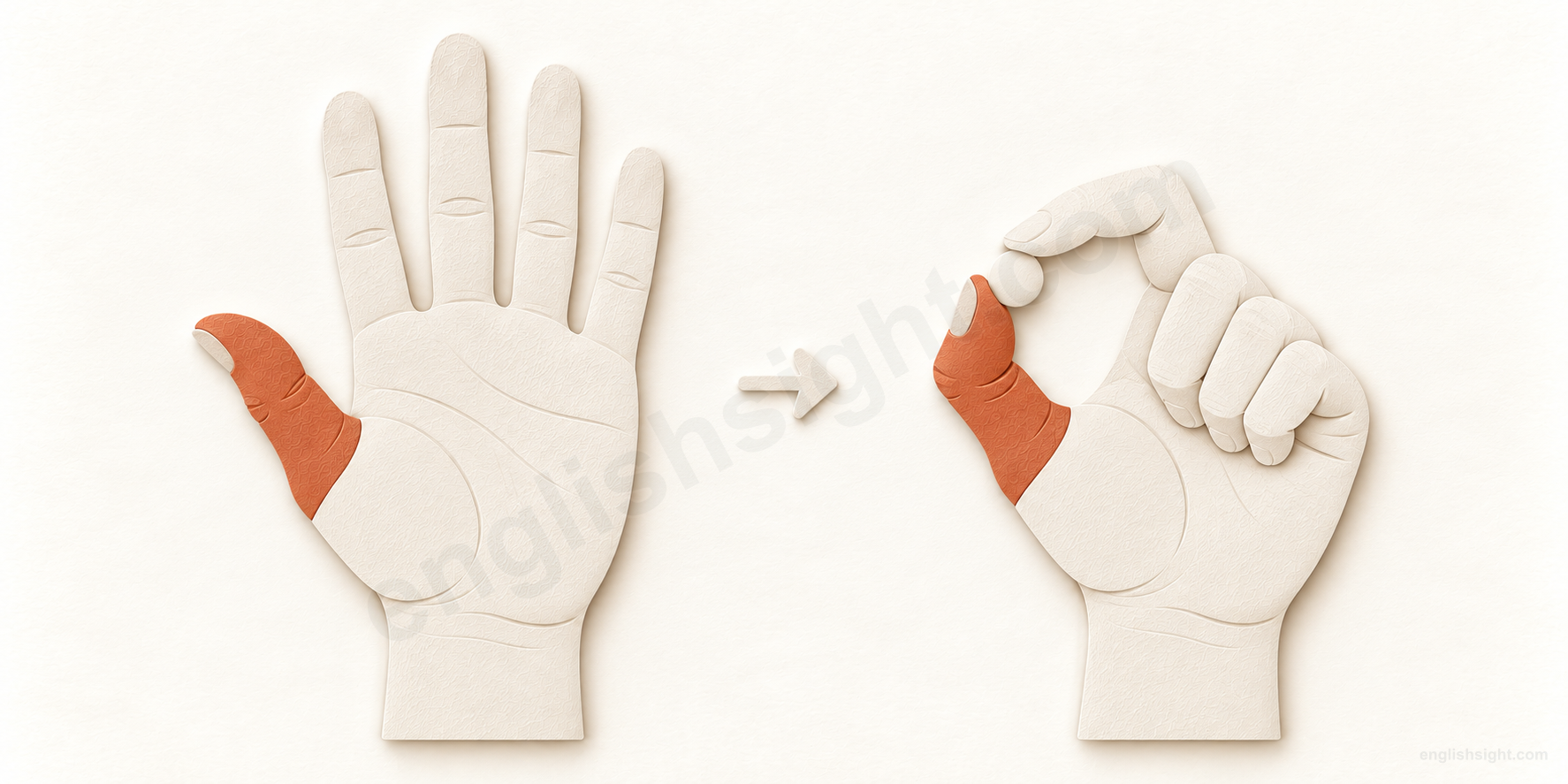
An open hand has four long fingers and a short thumb at the side.
thumb
Thumb and index finger hold a small bead between them.
The thumb bends toward the index finger.
The side thumb can work against the fingers to hold things. This physical model does not explain every fixed expression with thumb.
A thumb is the hand’s short side digit, positioned to work against the fingers when gripping or handling things.
The hand diagram locates the body part. It is a teaching aid, not a claim that every speaker sees the same mental picture. The fixed expressions need their own explanations.
The thumb is the short, thick digit at the side of your hand. Its position lets it work against your fingers when you hold or move something. That concrete body part is a useful starting point for the noun and several actions.
Other uses belong to familiar gestures, compounds, and fixed expressions. A thumb signal can name approval, while under someone’s thumb names control. These connections can help you remember the expressions, but they do not make every phrase predictable.
01
The body part and things named after it
Start with the thumb’s position on the hand. A glove part and a small storage device use the same word in different naming patterns.
01
a / your + thumb; between (your) thumb and forefinger
my thumb; between thumb and forefinger
name the short, thick digit at the side of a hand
Situation
You need to pick up a tiny bead.
What is happening?
Your thumb and first finger hold it together.
The thumb sits to one side and can work against the fingers.
Thumb is a countable noun: one thumb, two thumbs. In everyday descriptions, a hand has four fingers and a thumb; the broader anatomical word digit includes all five. Use a possessive to identify it: my left thumb, her right thumb.
Hold something between your thumb and forefinger means use those two digits together. Forefinger and index finger name the same finger. Suck your thumb describes putting the thumb in the mouth and sucking, often as a childhood habit.
The body part can also supply a rough size comparison: a thumb of ginger is a piece about the size of a thumb. This is an approximate cooking description, not a standard unit of weight.
Example in context
I held the bead between my thumb and forefinger.
Watch the difference A big toe belongs to a foot. Do not call it a thumb in ordinary English.
02
the thumb of + glove / mitten
the thumb of a glove
name the glove section that covers a thumb
Situation
You inspect a damaged glove.
What is happening?
You locate the hole in its thumb section.
The covered body part gives its name to the covering.
The thumb of a glove or mitten is the shaped part into which your thumb goes. In There is a hole in the thumb, the clothing context makes clear that thumb means fabric, not injured skin.
This is a regular countable noun use: the thumb of this glove; the thumbs of both gloves. It is a naming extension from the body part, not a separate body part inside the glove.
Example in context
There is a hole in the thumb of my woollen glove.
Watch the difference Without a clothing context, I hurt my thumb normally refers to your body.
03
a thumb drive; save / copy files to a thumb drive
a thumb drive
name a small portable device for storing computer files
Situation
You want to move files to another computer.
What is happening?
You copy them onto a small USB storage device.
Thumb is part of a compound name; drive supplies the device category.
A thumb drive is a small portable storage device that plugs into a USB connection. The expression is especially North American; USB drive, flash drive, and pen drive are alternative names.
The compound is countable: a thumb drive, two thumb drives. Put files on a thumb drive or copy them to it. Thumb alone does not ordinarily mean a storage device.
Example in context
I copied the photos to a thumb drive before leaving.
Watch the difference The plural goes on drive: thumb drives, not thumbs drive.
02
Using a thumb to act
The verb can name handling something, turning pages, or signalling for a ride. The object and following words show which action is meant.
04
thumb + object + optional direction
thumb something
touch or move something using a thumb
Situation
A small lever needs moving.
What is happening?
Your thumb pushes it forward.
The noun becomes a verb naming the body part used for the action.
As a transitive verb, thumb can describe touching, handling, or moving an object with a thumb. The object names the thing handled; a following word such as forward or aside can specify the movement.
For instance, thumbed the lever forward identifies both the body part used and the direction. Pushed the lever forward is a more general alternative that does not specify a thumb.
This action verb can be progressive: She is thumbing the lever. Its regular forms are thumbs, thumbed, and thumbing. A passive such as The lever was thumbed forward is grammatically possible, though everyday speech often names the person doing it.
Example in context
She thumbed the small lever forward.
Watch the difference This verb is more specific than touch or press; use it when the thumb is relevant.
05
thumb through + book / pages / files / pronoun
thumb through a book
turn pages while looking briefly at their contents
Situation
You have a few minutes before your appointment.
What is happening?
You glance through a magazine without reading every page.
Through indicates looking across the contents as pages are turned.
Thumb through a book, magazine, or set of files means turn the pages and look over them briefly. The action may be casual browsing or a quick search; it does not promise careful reading or complete understanding.
Keep the thing examined after through: thumb through it. Do not use thumb it through for this browsing meaning. Leaf through and flip through are useful alternatives.
Thumb the pages is also possible when focusing on turning or handling them. A well-thumbed book has been handled and used a great deal, often leaving wear; the description does not mean the reader understood every page.
Example in context
I thumbed through the magazine while I waited.
Watch the difference Compare read through the report: that can imply reading it from beginning to end, rather than just browsing.
06
thumb a lift / ride; thumb + route / destination phrase
thumb a lift / ride
signal to passing drivers to ask for transport
Situation
A traveller stands beside the road.
What is happening?
They hold out a thumb to ask a driver for a lift.
The gesture names the request for a ride, not approval of a driver.
Thumb a lift is the usual British pairing; thumb a ride is the North American pairing. The traveller uses a thumb signal to ask passing drivers to stop. Depending on context, the expression can describe seeking a ride or successfully getting one.
Thumb can also occur without a ride object: They thumbed across the country means they travelled by hitchhiking. Across the country supplies the route. These are transport uses of the verb, not the approval expression thumbs up.
The body-part connection is visible here, but the accepted transport meaning belongs to the whole use. You cannot replace lift with any noun and keep this meaning.
Example in context
We waited by the road, hoping to thumb a lift to the village.
Watch the difference The example describes a hope, so it does not say that a driver actually stopped.
03
Signals, decisions, and defiance
A physical gesture can become a way of describing a judgment or attitude, even when nobody actually makes the gesture.
07
give + person / thing + the thumbs up; give a thumbs-up
give something the thumbs up
signal approval, acceptance, or that things are all right
Situation
The organiser checks the new room arrangement.
What is happening?
She signals that she approves.
An upward-thumb signal also names a favorable judgment.
A thumbs-up can be a physical sign made with a raised thumb. Giving someone a thumbs-up can reassure them that all is well. The written form thumbs-up is also common, especially in a thumbs-up sign.
Give the plan the thumbs up or give the thumbs up to the plan means approve or accept it. No hand movement is required: a committee can give a proposal the thumbs up in a written decision.
The expression is informal. The fixed s stays even if one person makes the sign with one thumb: a thumbs-up. For formal reporting, approve the proposal is more neutral.
Example in context
The organiser gave our new layout the thumbs up.
Watch the difference Do not confuse this approval with thumbing a ride; the context determines what the thumb signal is doing.
08
give + person / thing + the thumbs down; get the thumbs down
give something the thumbs down
signal rejection or disapproval
Situation
The team considers an expensive design.
What is happening?
They reject it.
Down reverses the judgment in the established approval/rejection pair.
Give an idea the thumbs down means refuse or disapprove of it. It can describe an actual downward-thumb gesture or a decision expressed in speech or writing.
The proposal got the thumbs down presents the proposal as receiving that judgment. As with thumbs up, the s belongs to the fixed phrase and does not count the people or hands involved.
Thumbs down is informal. It conveys an unfavorable judgment but does not explain the reason or necessarily mean the idea was physically removed.
Example in context
The team gave the expensive design the thumbs down.
Watch the difference Thumb down is not the noun expression taught here; retain thumbs in the thumbs down.
09
thumb + possessive + nose + at + person / thing
thumb your nose at someone or something
show deliberate disrespect or defiance
Situation
A firm knows about a regulation.
What is happening?
It openly behaves as though the regulation does not matter.
The idiom describes a dismissive attitude, not necessarily a visible gesture.
Literally, thumb your nose at someone can refer to a rude gesture with a thumb against the nose. Figuratively, it means show that you do not respect a person, rule, or institution, often by deliberately disregarding them.
Use a possessive matching the subject: I thumb my nose; she thumbs her nose; they thumb their noses. At introduces the target of the disrespect. This is a fixed idiom, not an instruction to press another person’s nose.
It is stronger and more defiant than simply disagree with. The whole expression supplies that attitude; neither thumb nor at alone means reject a rule.
Example in context
The company thumbed its nose at the new regulations.
Watch the difference The company need not have made any physical hand gesture.
04
Established expressions for everyday situations
These phrases describe control, awkwardness, waiting, conspicuous difference, gardening skill, and practical judgment. Learn each whole expression rather than guessing from thumb alone.
10
be under + possessive + thumb; have + person + under + possessive + thumb
under someone’s thumb
be strongly controlled by another person
Situation
A manager makes every choice for an assistant.
What is happening?
The assistant has little freedom to decide.
Under represents domination in this fixed expression.
If someone is under another person’s thumb, that other person controls them closely. The expression is informal and usually critical of an unequal relationship.
The person after under is the controller: He is under his sister’s thumb means his sister controls him. She has him under her thumb describes the same relationship with the controller as subject.
Imagining pressure from a thumb can help you remember the relationship, but that is a teaching analogy. The idiom does not describe literal physical pressure, and it is stronger than receiving ordinary advice or supervision.
Example in context
He is under his older brother’s thumb and never makes a decision alone.
Watch the difference Track whose thumb it is: that person controls the other one.
11
be all thumbs; be all fingers and thumbs
be all thumbs
be awkward when using your hands
Situation
You try to fasten a tiny button.
What is happening?
You keep fumbling and dropping the fabric.
The expression evaluates manual coordination, not the number of body parts.
I am all thumbs means I am clumsy with my hands, either generally or in the current situation. It is often a light, self-critical explanation when a small task is going badly.
Be all fingers and thumbs is another established form. In both versions, be links the person to a description; thumbs is not an object of an action.
The imagined excess of thumbs is a memory aid, not an anatomical claim or a rule about people’s abilities. Use the expression for fumbling, rather than as a general synonym for being confused about ideas.
Example in context
I’m all thumbs when I try to sew on a button.
Watch the difference Say I am all thumbs, not I have all thumbs, for the ordinary idiom.
12
twiddle + possessive + thumbs; sit / be left + twiddling + possessive + thumbs
twiddle your thumbs
wait without doing anything useful
Situation
The equipment has not arrived.
What is happening?
You cannot start the job and have nothing useful to do.
Idle waiting is the idiomatic meaning; the hands need not actually move.
Literally, twiddling your thumbs means rotating them around each other while the fingers are joined. The familiar figurative use describes being idle, often because you are waiting and cannot get on with a task.
Sit twiddling your thumbs is a common frame. Match the possessive to the subject: I twiddle my thumbs; they twiddle their thumbs. The progressive is natural when describing a period of waiting.
The tone can suggest boredom, frustration, or criticism. It does not simply mean enjoy a relaxing break, and it does not require a real thumb movement.
Example in context
We were left twiddling our thumbs until the equipment arrived.
Watch the difference Keep the plural thumbs in this expression.
13
person / thing + stick / stand out + like a sore thumb
stick / stand out like a sore thumb
be conspicuous because of an awkward difference
Situation
All the nearby buildings are low and pale.
What is happening?
A tall black tower is very noticeable among them.
The comparison highlights a mismatch with the surroundings.
Stick out like a sore thumb and stand out like a sore thumb mean be extremely noticeable, usually because something is unusual or does not fit. The subject can be a person, object, or design feature.
A sore thumb is a painful thumb literally; the full comparison is an idiom and need not involve injury or physical pain. In the example, the tower’s appearance contrasts sharply with its surroundings.
Stand out alone can be complimentary: Her excellent work stands out. Like a sore thumb usually adds an uncomfortable or inappropriate contrast, so it is not the best neutral praise for excellence.
Example in context
The black tower sticks out like a sore thumb among the little white houses.
Watch the difference The phrase describes noticeability, not proof that the subject is harmful or badly built.
14
have a green thumb; have green fingers (British English)
have a green thumb
be good at growing plants
Situation
A friend regularly keeps difficult plants healthy.
What is happening?
You describe their skill at gardening.
Green thumb is a fixed expression for growing skill, not skin color.
To have a green thumb means to be good at making plants grow. It is especially North American; have green fingers is the familiar British counterpart.
Keep the article in have a green thumb. The whole noun phrase describes a person’s practical skill. It need not refer to a job, a qualification, or a thumb stained by plants.
This use cannot be worked out just by combining any color with thumb. Learn green thumb as an established expression rather than using the diagram to predict other color phrases.
Example in context
My aunt has a green thumb; even her tiny balcony is full of healthy plants.
Watch the difference It describes gardening ability, not general luck or skill at every activity.
15
as a rule of thumb, + clause; a rule of thumb is to + verb
a rule of thumb
use a practical guide based on experience rather than exact calculation
Situation
You need a quick starting estimate.
What is happening?
You use a useful general guide, allowing for exceptions.
The phrase names approximate practical judgment.
A rule of thumb is a useful general principle or way of estimating that comes from experience rather than precise calculation. It offers a starting point, not an absolute law or a guarantee.
As a rule of thumb introduces a guideline. A good rule of thumb is to… introduces a recommended practice; A good rule of thumb is that… introduces a whole statement. The plural is rules of thumb.
You can imagine rough measurement as a memory aid, but you do not need to measure anything with your hand. The expression also applies to planning and decisions with no physical measurement involved.
Example in context
As a rule of thumb, I allow extra time when I travel to an unfamiliar place.
Watch the difference An exact requirement is not automatically a rule of thumb; the phrase suggests an approximate guide.
Keep the body part, grammar, and idiom apart
Say the written word naturally
Thumb is pronounced /θʌm/: the b is silent. Thumbs is /θʌmz/ and thumbed is /θʌmd/. The noun is countable; the action verb has regular forms thumb, thumbs, thumbed, thumbing.
Not every combination is a phrasal verb
Thumb through is a browsing construction; thumb a ride is a verb with a noun object. Thumbs up/down are noun expressions for a sign or judgment. Under someone’s thumb and a rule of thumb are fixed phrases. Keep the grammar of the whole expression.
Limits of the picture and this selection
The diagram shows the physical thumb’s position, not the origins of every phrase. This lesson covers modern everyday uses and a useful compound; it does not teach anatomical terminology, architectural mouldings, specialist instrument techniques, or the South African expression hold thumbs. There is no general causative pattern or productive family made by adding any small word to thumb.
Choose the meaning in context
Identify the situation and read the complete expression.
1. You turn the pages quickly and look briefly at them. Which sentence fits?
2. Mara is under Leo’s thumb. Who controls whom?
3. The board gave the plan the thumbs down. What happened?
4. A useful estimate comes from experience and allows exceptions. What is it?
5. You keep dropping a tiny screw while trying to fasten it. Which comment fits?
Sources and teaching notes
Dictionary entries below support the uses and grammar. Explanations, examples, and the diagram were written for this lesson; suggested visual connections are teaching aids.
The diagram is a learning aid, not a picture shared by every native speaker.