Use till for the end of a period, then recognize its shop and farming meanings.
Continue to a time boundary
A continuing interval reaches a boundary
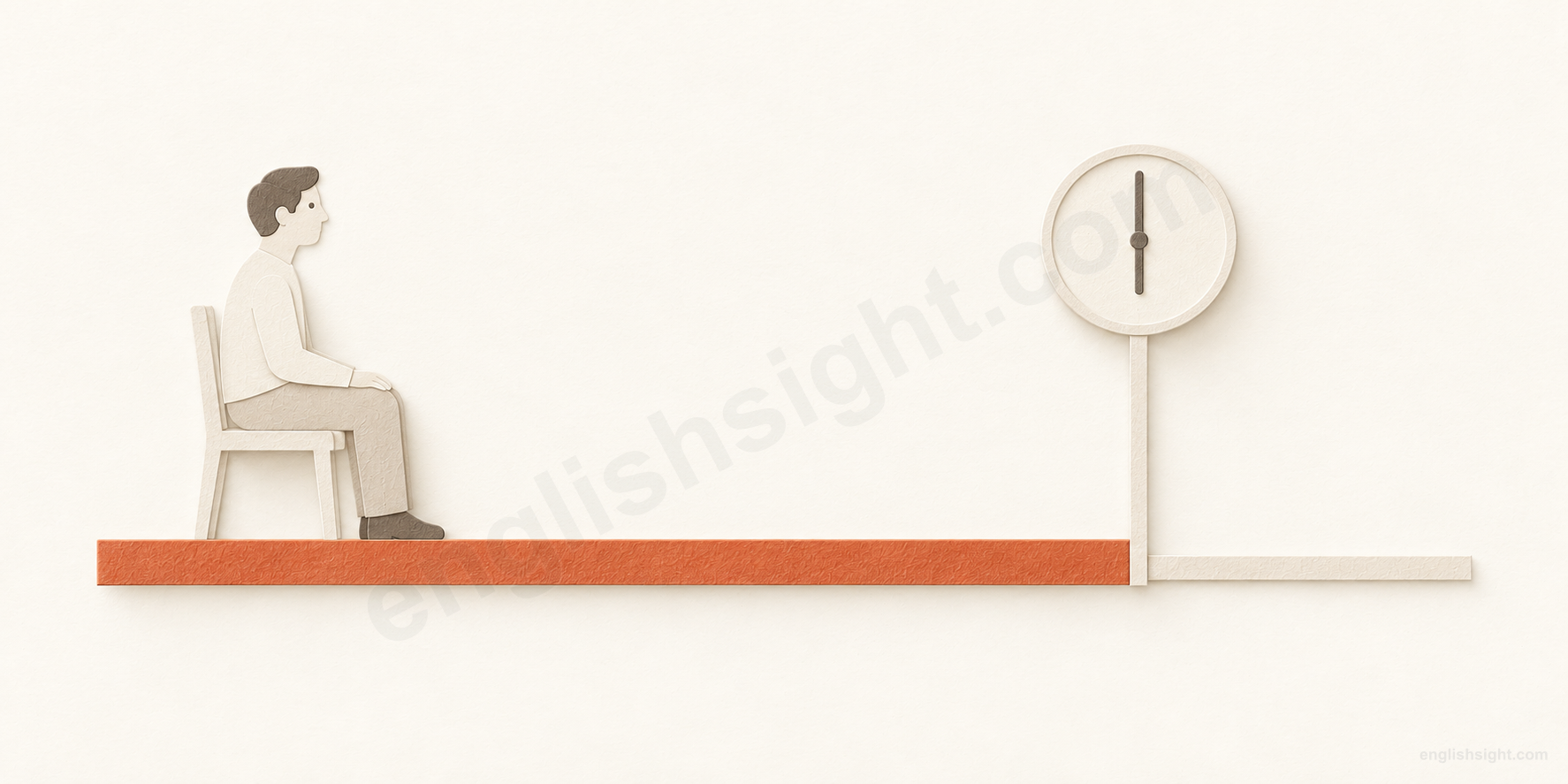
A person remains seated, waiting.
till
The pale band beyond the boundary leaves later events unspecified.
The orange band represents waiting continuing up to the clock-marked boundary.
Till names the endpoint of an interval. Here, waiting continues up to the clock-marked boundary; later events are left unspecified.
Think about the situation before the endpoint, then identify the time or event named after till.
The main verb and any negative tell us what continues. Context tells us what happens at and after the boundary; the line is not a promise about all later time.
Till /tɪl/ often answers a time question: how far does this situation continue? In Stay till six, the stay continues to six. In Don’t leave till six, not leaving is what holds during the earlier period.
Till and until have the same central time meaning. Till is standard English, though it often feels more conversational; until is a natural choice in formal writing and at the start of a sentence. Till is not simply until with letters removed, so it needs no apostrophe.
The sketch is a teaching model for temporal till. It is not a claim that every English speaker imagines the same picture, and it does not explain the separate noun and farming verb.
01
Carry a situation up to a time
The words after till supply an endpoint. What lasts before it may be an activity, a state, or the absence of an event.
01
verb / be + state + till + time expression
stay till six
continue up to a stated time
Before the limit
The visitor is staying here.
At the limit
Six o’clock is the endpoint of the planned stay.
Till points to the far end of a period, not its length.
Till is a preposition before a time expression: till six, till Monday, till next week, or till the end of the lesson. It attaches a time boundary to the main situation.
We are open till six describes an open state lasting up to closing time. Till does not itself say when that state began. Till further notice means the arrangement continues until another announcement changes it.
The line in the sketch stands for the continuing situation. The marked boundary is the time named after till. A date alone may leave practical details unclear: ask for an exact closing time when it matters.
Example in context
You can stay in the reading room till six.
Avoid this mix-up Say wait for two hours for a duration; wait till two names an endpoint.
02
main clause + till + subject + verb
wait till the rain stops
continue until an event supplies the endpoint
Before the limit
Rain is keeping us inside.
At the limit
The rain stopping ends the wait.
A clause can define the boundary without giving a clock time.
Till is a conjunction before a clause with its own subject and verb. We wait; the rain stops. The two clauses describe different situations linked in time.
For an ordinary future time clause, use a present form after till: We’ll wait till the rain stops. Do not add will just because the stopping is in the future. Till you have finished emphasizes completion: Keep the receipt till you have checked the bill.
For a past story, a past form is natural: We waited till the rain stopped. The clause supplies the endpoint; it does not always express a cause.
Example in context
We’ll wait inside till the rain stops.
Avoid this mix-up Use till she arrives, not till she will arrive, in an ordinary future time clause.
03
not / do not + verb + till + time or clause
not leave till…
delay an event until a particular time or event
Before the limit
Departure does not happen during the earlier period.
At the limit
The named time is when departure can happen or did happen.
The negative, rather than the departure itself, extends to the boundary.
I didn’t leave till ten says that I left at ten, with no departure before then. Compare I stayed till ten: staying continues during the earlier interval. Different verbs can describe the same timetable.
In Don’t open it till your birthday, the earlier interval is one in which opening is prohibited. Your birthday is the first allowed time; the instruction does not force you to open it then.
Not till tomorrow can be a short answer: When does the sale start? — Not till tomorrow. A past report often identifies the actual event time, whereas a future rule may only set the earliest time.
Example in context
I didn’t leave the office till ten.
Avoid this mix-up Not till means not before; it does not mean that a positive action continues throughout the earlier period.
04
from + starting time + till + ending time
from nine till five
give both ends of a time span
Before the limit
Work begins at nine.
At the limit
The working period extends to five.
From supplies the start; till supplies the finish.
From A till B names the two limits of a period. From nine to five is also natural. Till is the time connector here, not a verb and not a particle in a phrasal verb.
From morning till night can summarize a whole day of repeated activity. It need not claim that someone acted without a single break. To the last or till the very last similarly emphasizes persistence to the end.
Example in context
The help desk is staffed from nine till five.
Avoid this mix-up For an ordinary spatial range, use from the station to the park; till is primarily a time word in modern general English.
05
(up) till now / then + clause
up till now
look back over the period ending at the present
Before the limit
Earlier experience or a situation stretches toward the present.
At the limit
Now is the point at which you assess it.
Up can emphasize the whole stretch before the present boundary.
Till now and up till now look back to the present. Up is optional in this time expression; it is not a direction of movement.
The present perfect is natural for experience extending to now: Up till now, I’ve always paid in cash. A past form can highlight a newly ended arrangement: Till now, the shop was closed on Sundays. The surrounding sentence tells us whether a change is happening.
Up till then does the same job relative to a previously mentioned past time. Neither expression tells you how far back the period began.
Example in context
Up till now, I’ve always paid in cash.
Avoid this mix-up Do not treat till now as a promise that the situation will continue unchanged.
06
till then / tomorrow / next time; till then + clause
Till then! / till next time
refer to a known next meeting or intervening period
Before the limit
We have mentioned a later meeting or event.
At the limit
That event provides the next time boundary.
Then borrows its time from the conversation.
In I’ll see you on Friday; till then, take care, till then covers the period before Friday. You can also close a conversation with Till tomorrow! or Till next time! The fuller goodbye is understood from context.
Till then can refer to a past boundary too: The café opened in May; till then, the building had been empty. Then does not always mean a future time.
Example in context
Our next class is on Friday. Till then, keep practising.
Avoid this mix-up Till then refers to a contextual time; by then would set a deadline for a completed result.
07
there is / are + duration + till + event; how long till + event?
three days till…
measure the time remaining before an event
Before the limit
The event has not happened yet.
At the limit
A three-day interval separates now from the event.
The number measures the gap; till identifies its far end.
Only three days till the trip is a common short countdown. A full version is There are only three days till the trip. How long till lunch? asks for the remaining interval.
Here no activity has to last for three days. We are measuring the period before the named event. Compare We’re staying for three days: for gives the length of the stay itself.
Example in context
There are only three days till our trip.
Avoid this mix-up Three days till Friday is a countdown; till Friday is an endpoint phrase, not by itself a duration.
02
Choose the right time expression
A period continuing to a boundary differs from a task completed by a deadline. Clock expressions also have regional conventions.
08
continue / work / stay till + time; finish / arrive + by + time; have till + time + to + verb
work till five / finish by five
distinguish a continuing activity from a deadline
Before the limit
Work occupies a period, or a task needs a completed result.
At the limit
Five can be the stopping point or the latest completion time.
Till tracks continuation; by sets the latest time for a result.
I’ll work till five says how long the work continues. I’ll finish by five promises a completed result at five or earlier. Finishing earlier is compatible with by five.
Till can follow a completion verb in a negative sentence: I won’t finish till five means completion will not happen before five. The negative supplies the continuing absence of a result.
Till can also name the end of the time available: You have till Friday to finish the report. You may finish earlier; the available period extends to Friday. Compare Finish the report by Friday, which states the latest completion time directly. Till does not mean that you must keep working for the whole available period.
Compare Stay here till noon and Be here by noon. The first requires a continuing stay; the second requires arrival no later than noon.
Example in context
I’ll work till five, but I’ll send the report by four.
Avoid this mix-up For a latest completion time, say Finish it by Friday. Finish it till Friday does not normally express that deadline.
09
number of minutes + till + next hour
ten till four
say that it is ten minutes before four
Before the limit
The clock has not yet reached four.
At the limit
Ten minutes remain before the hour.
In this regional clock pattern, till is equivalent to to.
In parts of the United States, It’s ten till four means 3:50. The minutes come before till; the following hour is the one being approached.
Ten to four is widely understood, and three fifty avoids regional differences. This clock convention does not mean that any use of till can replace to.
Example in context
It’s ten till four, so we still have a few minutes.
Avoid this mix-up Ten till four is not 4:10. For that time say ten past four or four ten.
03
Anticipation, results, and exaggeration
Some expressions use a real stopping point; others use a conventional exaggerated one. Learn the whole expression and its tone.
10
(just) wait till + subject + present verb
Wait till you see…!
build excitement about a coming discovery
Before the limit
The listener has not seen the surprise.
At the limit
Seeing it will bring the expected reaction.
The whole imperative invites anticipation.
Wait till you see the view! suggests that the view will impress or surprise the listener. It need not be a practical instruction to stop moving and wait.
Till still introduces a future endpoint, but the enthusiastic meaning comes from the whole conversational pattern and tone. Just can add emphasis: Just wait till you hear the news!
Example in context
Wait till you see the view from the roof!
Avoid this mix-up This pattern can also introduce a warning; use the situation and tone to tell which meaning fits.
11
(just) wait till + person + present verb
Just wait till…!
warn of trouble or punishment at a later moment
Before the limit
Someone has done something the speaker dislikes.
At the limit
A later meeting or discovery is presented as a threat.
The threatening force belongs to the whole utterance, not till alone.
Just wait till the coach hears about this! warns that the listener will face consequences when the coach finds out. It can sound angry or intimidating, though friends may use it jokingly.
Compare the cheerful Wait till you see your present! The grammar is similar; the expected consequence and tone change the communicative purpose.
Example in context
Just wait till the coach hears about this!
Avoid this mix-up Do not use this warning casually when you mean a neutral request to wait.
12
activity verb + till + resulting event or state
laugh till you cry
continue so intensely that a result occurs
Before the limit
Laughter continues.
At the limit
Tears appear as a result of laughing.
A resulting condition can serve as the endpoint.
The tears in laugh till you cry come from strong laughter; they do not necessarily mean sadness. Till introduces the point reached through the activity.
The same time-to-result link appears in Stir till the sauce is smooth and Run till you are out of breath. The cause-and-result reading depends on the activity and following clause; till alone does not mean because.
Example in context
We laughed till we cried at the old family videos.
Avoid this mix-up Read the result clause: laughing till you cry is different from crying till someone comforts you.
13
verb + till the cows come home
till the cows come home
continue for an extremely long time
Before the limit
An activity could keep going far beyond a useful length.
At the limit
The speaker imagines a very distant endpoint.
This informal idiom exaggerates duration.
You can discuss it till the cows come home means you can discuss it for a very long time. No actual cows or farm are needed in the situation.
It often appears with a following contrast: the long activity will still not settle the issue. That lack of success comes from the whole sentence; the idiom itself mainly supplies a very long duration.
Example in context
We could discuss the colours till the cows come home, but we need to choose today.
Avoid this mix-up Learn the whole idiom; replacing cows with another animal does not preserve the established expression.
14
argue / explain / talk + till + person + be blue in the face
till you are blue in the face
try at length without achieving the desired effect
Before the limit
Someone keeps explaining or arguing.
At the limit
The effort still does not succeed.
The idiom combines prolonged effort with futility.
Argue till you are blue in the face is an informal, exaggerated way to describe arguing as hard and as long as you can without changing the outcome. It is not a literal instruction about breathing.
The pronoun agrees with the person making the effort: I explained till I was blue in the face. The negative result is part of the established idiomatic reading, often reinforced by but.
Example in context
I explained till I was blue in the face, but he still refused to listen.
Avoid this mix-up Unlike a neutral till-clause, this idiom suggests wasted effort; it does not simply mean for a while.
15
shop till + subject + drop
shop till you drop
do a very large amount of shopping
Before the limit
Shopping continues from place to place.
At the limit
Exhaustion is imagined as an exaggerated limit.
The familiar slogan is normally playful, not literal.
Shop till you drop describes an extended shopping session. Drop evokes becoming too tired to continue, but someone can say this without meaning that a shopper actually collapses.
In a past account, the pronouns and tense can change: We shopped till we dropped. The whole phrase supplies the playful exaggeration; till still connects the activity to its imagined limit.
Example in context
We shopped till we dropped on Saturday.
Avoid this mix-up This is informal, often humorous or promotional; it is stronger than simply saying that you went shopping.
16
stay up / work / talk + till all hours
stay up till all hours
continue until very late
Before the limit
Someone remains awake late into the night.
At the limit
The endpoint is unusually late, without an exact time.
All hours is an established vague expression for lateness.
Till all hours means until very late. Stay up till all hours may describe chatting, studying, or watching something well into the night.
It does not mean every hour of every day. Depending on context, it can sound disapproving, amused, or simply descriptive.
Example in context
We stayed up till all hours talking about the trip.
Avoid this mix-up If an exact finishing time matters, give that time instead of all hours.
04
A shop noun and a farming verb
These uses share the spelling and pronunciation of temporal till, but need their own meanings. The time diagram does not explain them.
17
a / the till; at / behind / on the till; plural tills
pay at the till
pay at the shop’s register or checkout
Before the limit
A shopper has selected goods.
At the limit
The purchase is paid for at the payment point.
Here till is a countable noun, especially in British English.
In British English, a till can mean the cash register or the checkout where you pay. At the till focuses on the payment point; on the till can describe an employee assigned to operate it: I’m on the till this morning.
A shop can have several tills. A till receipt is the receipt issued at the register. In American English, cash register or register is usually the clearer word for the machine; checkout identifies the payment area.
This shop noun is a separate meaning branch. It does not mean a time limit, and the timeline sketch is not a proposed explanation of its origin.
Example in context
Please pay for your books at the till near the door.
Avoid this mix-up At the till names a place; till six names a time boundary. The surrounding grammar tells you which word use you have.
18
money / cash + in the till; open / empty / count + the till
money in the till
refer to the cash drawer of a register
Before the limit
A business receives cash.
At the limit
The cash is stored in the register’s drawer.
In the till focuses on the container and its contents.
Till can name the drawer that holds money inside a register, especially in North American English. There is a difference between standing at the till and putting notes in the till.
Count the till can refer to checking the cash it contains at the end of a shift. The extension from container to contents does not change the temporal till into a money word: this is the noun branch.
Example in context
The cashier left a few small notes in the till for change.
Avoid this mix-up A till is not a customer’s wallet. In the till refers to money held by the business.
19
have / be caught with + one’s fingers / hand + in the till
have your fingers in the till
steal money from the place where you work
Before the limit
An employee has access to the employer’s money.
At the limit
The employee takes some of it dishonestly.
This British informal idiom makes a theft accusation.
Have your fingers in the till means steal money from your employer. Hand in the till is a related established variant. It can refer to dishonest transfers as well as physically taking notes from a drawer.
The cash-container meaning makes the image understandable, but the theft meaning belongs to the full idiom. A cashier can legitimately put a hand inside the drawer without committing the dishonesty meant by the expression.
Example in context
The manager was dismissed for having his fingers in the till.
Avoid this mix-up This is an accusation of dishonesty, not a neutral description of operating a register.
20
till + land / soil / a field; land + be tilled
till the soil
prepare or work land for growing crops
Before the limit
Land needs preparation for cultivation.
At the limit
The soil is worked so crops can be grown.
Here till is an action verb with land or soil as its object.
To till land is to work or cultivate it for crops, for example by turning the soil. It does not mean harvest the finished crop. The usual forms are till, tills, tilled, and tilling.
The object can become the subject of a passive: The soil was tilled before planting. Tilled can also modify a noun, as in freshly tilled soil. These are ordinary verb forms, not uses of the time preposition.
Usage labels differ: Oxford marks the verb old use and Collins COBUILD marks it literary, while Merriam-Webster gives it without that restriction. It remains useful in farming and gardening contexts; everyday general talk often uses work the soil or prepare the ground.
Example in context
They tilled the soil before planting beans.
Avoid this mix-up Tilled and tilling are forms of the farming verb. In till noon, till is an unchanging time word, not that verb.
Keep the time meaning and grammar clear
Till, until, and spelling
Till and until are standard alternatives for time. Till has two l’s and no apostrophe. ’Til occurs in informal writing and advertising; until or till is a clearer default for learners. Avoid ’till. Dictionaries differ in how strongly they label the variants, so a variant appearing in a dictionary does not make it equally suitable for formal prose.
A boundary is not an entire future
Till often suggests a change at the endpoint, but it need not tell you everything afterward. In Don’t start till noon, starting later is allowed too. Date-only instructions can be unclear about exact hours; use an explicit time for an important deadline.
Time, not an infinitive marker
Say wait till she returns or wait till Monday. To return is an infinitive; till return is not its replacement. A destination can sometimes stand for an arrival event, as in stay on the train till London, meaning till you reach London; that does not make till a general substitute for spatial to.
Different parts of speech
Temporal till does not take verb endings or form a passive. Tills can be the plural shop noun or the verb with he/she/it; tilled and tilling belong to the farming verb. The shop noun and farming verb are taught separately rather than forced into one time metaphor.
Coverage boundary
This lesson selects common time constructions and useful fixed expressions, plus the retail noun and cultivation verb. The geological term for material deposited by glaciers, historical or regional spatial uses, and additional ritual or literary expressions are outside the main course. This is a usage guide, not an exhaustive inventory or a frequency ranking.
Choose the right reading
Check what lasts before the endpoint, and whether till is a time word, a noun, or a verb.
1. The report must be complete no later than Friday. Which sentence gives that deadline?
2. We plan to stay inside until the rain stops. Which ordinary future time clause fits?
3. I didn’t leave till ten. What does the speaker report?
4. A British shop assistant says, Please pay at the till. What is till here?
5. The soil was tilled before planting. Which explanation fits?
6. Someone uses the American clock expression ten till four. What time is it?
Sources and teaching notes
Usage was checked against the publisher pages below. The explanations, examples, and drawing are original teaching material. Source-linked coverage records distinguish established meanings from teaching applications.
The diagram is a teaching aid for time expressions, not a picture shared by all native speakers.