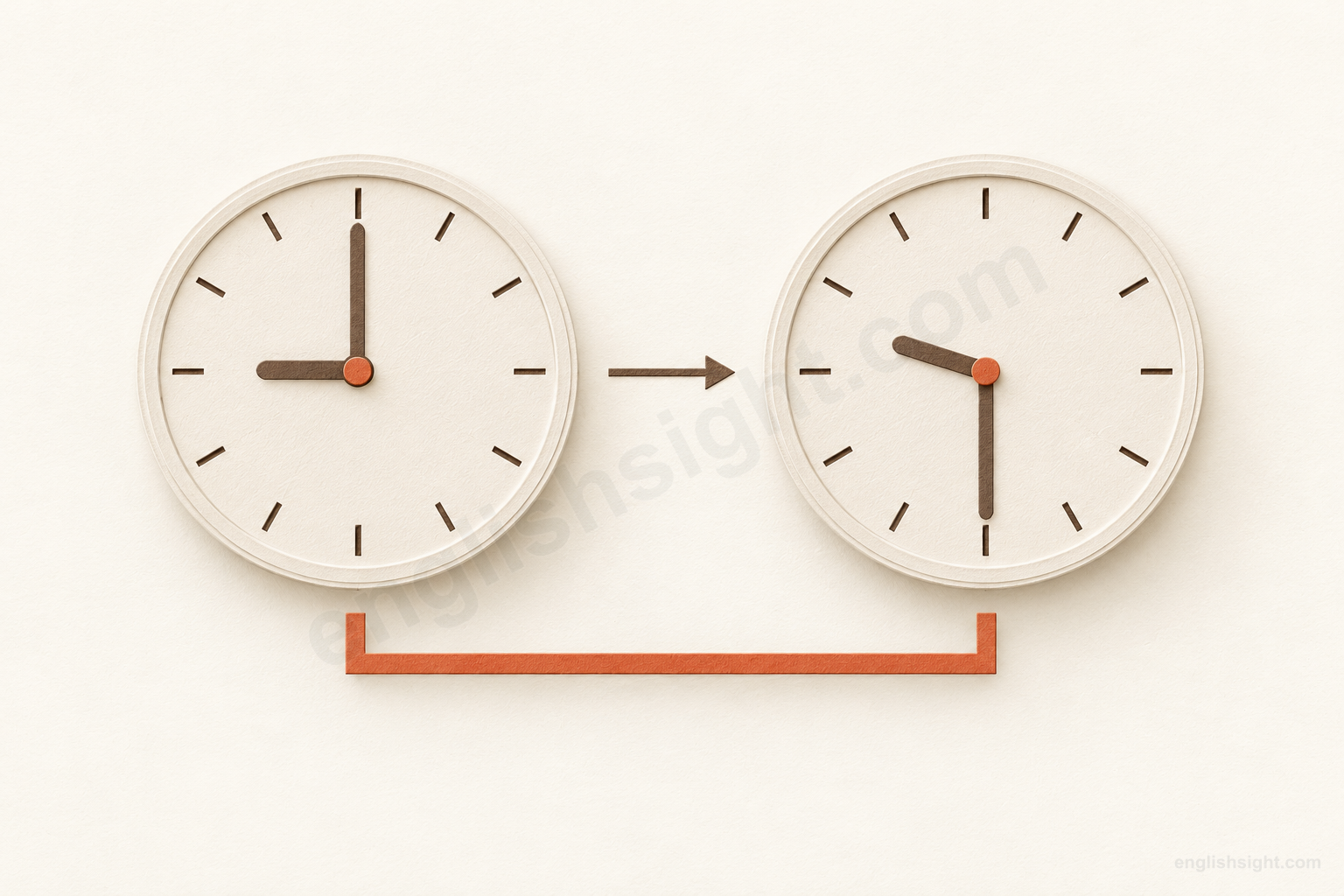
Use time for moments, intervals, occasions, and the expressions built around them.
A moment and an interval
A moment and an interval
An earlier moment: nine o’clock.
time
A later moment: half past nine.
Thirty minutes pass between the two readings.
The clocks mark moments; the bracket spans thirty minutes.
Time lets us locate events as earlier or later and measure how long the interval between them lasts.
The clocks illustrate a position and a duration. They do not explain every idiom: do time, have a good time, and mathematical times are established branches taught separately.
A clock can tell you when a train leaves; an interval tells you how long the trip lasts; three times counts separate trips. These are related uses, but they answer different questions.
A useful teaching model is to place events in an earlier–later sequence and measure the intervals between them. Counted occasions, personal experiences, musical patterns, and fixed idioms need their own explanations. This is a learning model, not a claim about a picture shared by every English speaker.
01
Locating an event
Ask when, arrange a suitable moment, or compare an event with a schedule or deadline. A point in time answers a different question from a length of time.
01
What time is it?; What’s the time?; tell (the) time
What time is it?
ask for or read a clock time
Situation / reference point
You need to know where you are in the day.
Meaning in this situation
A clock reading identifies the moment.
Clock time locates a moment; it does not measure an activity’s length.
What time is it? and What’s the time? ask the same basic question. What time does the shop open? asks for an event’s clock time; How long is it open? asks for duration.
Tell the time means read a clock in British English; tell time is usual in American English. A watch that keeps good time continues to show an accurate reading. A watch can gain or lose time if it runs fast or slow.
In a sentence
Do you have the time? My phone is dead.
Watch the difference Do you have the time? usually asks for a clock reading; Do you have time? usually asks whether you are free.
02
arrival / departure / opening time; at + clock time; local time
departure time / local time
specify a scheduled moment or a clock system
Situation / reference point
A journey crosses regions with different clocks.
Meaning in this situation
You know which reading the schedule uses.
A named event or location fixes the reference for the time.
Departure time names when leaving is scheduled. Arrival times and opening times can be plural because several events or schedules are being listed. Set a time for a meeting means agree when it will happen.
Local time and a named time zone specify the clock system. This time tomorrow means at approximately the same point in tomorrow’s day: This time tomorrow, we’ll be on the train. The reference is a point, not a twenty-four-hour task.
In a sentence
Our departure time is 8:20, local time.
Watch the difference Local time is a clock convention, not the duration of a journey.
03
a good / bad / right time to + verb; at the time
a good time to talk
judge whether a moment suits an activity
Situation / reference point
You want to interrupt someone.
Meaning in this situation
You check whether the moment is convenient.
Good describes suitability here, not enjoyment.
A time to do something is a possible or appropriate occasion for that action. Have I called at a bad time? checks whether your call is inconvenient. When the time comes refers to the occasion when the action becomes relevant.
At the time points back to the moment already under discussion: I didn’t understand the joke at the time. At that time makes the reference explicit; it does not by itself say the situation is still true.
In a sentence
Is this a good time to talk about the budget?
Watch the difference Have a good time describes enjoyment; a good time to talk asks about suitability.
04
(at) any time; any time now; not / question + anytime soon; at no time + auxiliary + subject
at any time / any time now
leave a moment unspecified or say an event is expected soon
Situation / reference point
The exact moment is not fixed.
Meaning in this situation
You allow a choice or describe an unpredictable arrival.
Any time leaves the moment open; now can add an expectation of nearness.
Call me any time offers a choice without a fixed moment. Anytime is also an adverb spelling, especially familiar in American English; after the preposition at, use the two words any time. In The alarm could sound at any time, the point is unpredictability rather than permission.
The informal expression any time now says an event is expected very soon: They should arrive any time now. Anytime soon is common in questions and negatives about the near future: Are you moving anytime soon? It does not identify an exact date.
At no time is a formal way to say never during the relevant period. At the start of a clause it normally requires inversion: At no time did we leave the door unlocked. Compare the ordinary order We did not leave it unlocked at any time.
In a sentence
The parcel could arrive at any time, so I’m staying home.
Watch the difference At any time does not mean repeatedly. At times means sometimes. At no time means never during the relevant period.
05
it’s time for + noun; it’s time (for someone) to + verb; it’s time + subject + past form
It’s time to leave.
say an action should happen now
Situation / reference point
The appropriate moment has arrived.
Meaning in this situation
You prompt the next action.
Time for introduces a noun; time to introduces a verb.
It’s time for dinner names the activity with a noun. It’s time to eat uses an infinitive. For us identifies who should act in It’s time for us to eat.
It’s time we left is another established pattern. The past form expresses that an action is due, rather than reporting a past departure. It’s high time you apologized and It’s about time you apologized add a sense of delay or impatience; tone matters.
About time! can respond to something that has finally happened: You’ve fixed the light—about time! It may sound critical. There’s no time like the present encourages acting now rather than postponing.
In a sentence
It’s time for us to leave.
Watch the difference It’s time we left refers to what we should do now, although left has past form.
06
by the time + clause, main clause
by the time…
use one event as the latest point for another situation
Situation / reference point
One action will occur before another reference event.
Meaning in this situation
You describe the situation already reached at that point.
By establishes a boundary; the following clause supplies its event.
By the time connects two situations. In the example, getting home provides the boundary and cooking is expected to be complete by then. A perfect tense is useful for completed actions, but it is not compulsory: By the time you arrive, I’ll be asleep.
For a past sequence, By the time we arrived, the shop had closed places closing before arrival. When we arrived simply locates an event; by adds the idea of reaching a limit.
In a sentence
By the time you get home, I’ll have cooked dinner.
Watch the difference In a time clause referring to the future, use the present form: by the time you get home, not by the time you will get home.
07
be / arrive / start / finish + on time
on time
meet an arranged schedule
Situation / reference point
The meeting is scheduled for ten.
Meaning in this situation
People arrive as arranged.
The reference is an agreed or expected time.
On time says that an event meets its schedule rather than being late. Right on time emphasizes a close match to the expected moment. Please be on time asks someone to respect the arrangement.
A train can arrive on time but leave you too little time to catch another train. Conversely, a delayed train can still get you to a show in time to see the opening. Choose the expression according to the reference you mean.
In a sentence
The meeting started on time, at ten.
Watch the difference On time concerns the schedule; it does not automatically mean early enough for a separate purpose.
08
in time for + noun; in time to + verb; just in time
in time for / in time to…
arrive or act before an opportunity is lost
Situation / reference point
Tickets will soon stop being available.
Meaning in this situation
You act early enough to get one.
The boundary is the last useful moment, not necessarily a timetable.
In time means early enough for a purpose. Just in time adds that there was very little margin. In the nick of time is an informal stronger version used when an undesirable result is only narrowly avoided: The repair stopped the leak in the nick of time.
In good time usually means comfortably early: Submit the form in good time. All in good time! instead asks for patience and means the thing will happen when appropriate. It is not a promise to be early.
In a sentence
We arrived in time to buy the last two tickets.
Watch the difference In time to buy uses to + verb; in time for the show uses for + noun.
09
ahead of time; behind time; amount + ahead of / behind time
ahead of time / behind time
compare an event with its expected moment
Situation / reference point
Work has an expected finishing point.
Meaning in this situation
Actual finishing is earlier or later.
Ahead and behind compare actual and expected positions in a sequence.
Ahead of time can mean earlier than expected or in advance: Please send the list ahead of time. Behind time means later than expected; behind schedule is also useful in ordinary planning.
The image is a comparison of positions along time, not literal travel. The expected moment must come from the context, such as a schedule or deadline.
In a sentence
We finished the checks an hour ahead of time.
Watch the difference Ahead of your time concerns ideas beyond an era; ahead of time concerns being early.
10
in + number + plural unit + ’ time; in a week’s time
in two days’ time
locate a future event after a measured interval
Situation / reference point
Today is your reference point.
Meaning in this situation
An event is two days later.
In + interval can answer when; for + interval answers how long.
In two days’ time places the event two days after the present reference point. The shorter in two days usually does the same. For two days says something continues for that duration.
Context can also make in two days describe the time used to finish a task: She wrote the report in two days. Ask whether the sentence gives a future starting point or a completion duration.
In a sentence
The results will be ready in two days’ time.
Watch the difference Use days’ after plural days, but a day’s after singular day. In two days is also natural.
02
Using an interval
An interval can be available, required, used well, or allowed to pass. The verbs and prepositions explain what someone does with that interval.
11
have / need / allow / give + time + to-infinitive; time for + noun
have time to help
have an available interval for an activity
Situation / reference point
A request needs part of your afternoon.
Meaning in this situation
You have enough availability to help.
Time is an amount available to someone, not a count of occasions.
Have time to do something means the activity can fit into your available interval. Need more time, give me time, and allow time for delays all treat duration as a resource. Thank you for your time acknowledges someone’s attention and availability.
In this sense time is normally uncountable: little time, enough time, an amount of time. We have no time to lose means we must act immediately, rather than that time can literally be misplaced.
Time to spare means time remaining beyond what is needed: We reached the gate with ten minutes to spare. Spare time instead names free time outside commitments. We have all the time in the world is a reassuring exaggeration meaning there is no need to hurry, not a literal claim of unlimited duration.
In a sentence
Do you have enough time to check this page?
Watch the difference Use much time or a lot of time for duration; many times asks about repeated occasions.
12
something takes + time; it takes (someone) + time + to + verb
It takes time.
describe the duration a task requires
Situation / reference point
You want to complete a repair.
Meaning in this situation
The job needs an interval before completion.
The task requires time; a person may be named separately.
It takes time to learn a skill says the process cannot normally happen instantly. It takes me twenty minutes to walk there adds the person whose duration is measured.
A long time and a short time are established singular phrases: We waited a long time. For a time means for a period, often without saying how long: She worked abroad for a time. Take up time emphasizes occupying someone’s available interval: These calls take up my mornings.
Some time can name an unspecified interval, often a fairly long one: We waited some time for a reply. Do not confuse that duration with sometimes, meaning occasionally, or sometime, meaning at an unspecified moment. The two-word spelling some time can also have the latter adverbial meaning; the sentence determines the reading.
In a sentence
It took me an hour to repair the chair.
Watch the difference Say It took me an hour to fix it or I spent an hour fixing it, not I spent an hour to fix it.
13
spend + time + -ing; spend + time + on + noun
spend time doing / on something
say how someone uses an interval
Situation / reference point
You have part of the evening available.
Meaning in this situation
You use it for an activity.
The person is the subject; the activity follows spending.
Spend time doing something names the activity that occupies the interval. Spend time with someone names company: I spent the afternoon with my sister. It does not imply paying that person.
Put time into a project emphasizes effort invested. The interval model helps organize these uses, but spend and put provide the idea of allocation; time alone does not mean work.
In a sentence
I spent an hour checking the figures.
Watch the difference Use spent time checking, not spent time to check. On can introduce a noun: time on the report.
14
save time (by + -ing); waste time (on + noun / -ing); a waste of time
save time / waste time
evaluate how efficiently an interval is used
Situation / reference point
A repeated task can be streamlined.
Meaning in this situation
Less time is needed for the same result.
The speaker evaluates the use of duration.
Save time means reduce the duration required or avoid unnecessary delay. Waste time means use an interval without sufficient benefit in the speaker’s judgment: Stop wasting time arguing about the font.
Don’t waste time can urge immediate action. Waste no time doing something likewise means act promptly: They wasted no time sending the replacement. The saying Time is money stresses the value of time; it is a practical comparison, not a definition.
In a sentence
This shortcut saves us time when we prepare invoices.
Watch the difference A waste of time evaluates an activity; it does not mean the activity literally has no duration.
15
make / find time for + noun; make / find time to + verb
make / find time for someone
fit something into a busy schedule
Situation / reference point
Other commitments fill your day.
Meaning in this situation
You deliberately reserve an interval.
Make time creates availability in a schedule, not additional hours.
Make time suggests prioritizing and arranging; find time emphasizes managing to fit an activity in. Both can take for a person or activity, or to followed by a verb.
Can you spare me five minutes? asks someone to give up a small part of their available time. I can’t spare the time means the commitment would use time needed elsewhere.
In a sentence
I try to make time for a walk after lunch.
Watch the difference Make time differs from make good time, which describes quick progress on a journey.
16
take your time (over + noun / -ing / to + verb)
take your time
proceed without hurrying, or be criticized for slowness
Situation / reference point
Someone feels under pressure to finish.
Meaning in this situation
You allow a comfortable pace.
The possessive makes this an established expression about pace.
Take your time encourages someone to use as long as they need. You can specify an activity: Take your time reading the instructions. This does not give a measured duration in the way take ten minutes does.
In your own time can mean when you are ready, or in free time outside work. In your own sweet time often adds annoyance at someone’s slow or self-chosen pace. Context and tone choose between permission and criticism.
In a sentence
Take your time choosing; the shop stays open until nine.
Watch the difference You certainly took your time! can criticize a delay. It is not always reassurance.
17
in your free / spare time; take time off (work); take time out (from + noun)
free time / time off / time out
describe freedom from work or a pause in activity
Situation / reference point
Work usually fills this part of the week.
Meaning in this situation
You have an interval for rest or something else.
Free describes availability; off and out mark a break from a usual activity.
Free time and spare time mean time without fixed work or other commitments: I draw in my spare time. Time off usually frames the interval as absence from work or study, whether for rest, illness, or another purpose.
Take time out from an activity means pause it, often to rest or reconsider: She took time out from coaching. Neither expression automatically means a paid holiday; that depends on the arrangement.
In a sentence
I’m taking some time off work to visit my family.
Watch the difference Take time off is not the computing verb time out. Time is the noun object of take here.
18
someone runs out of time; time runs out; time is up
run out of time / time’s up
reach the end of an available interval
Situation / reference point
A test has a fixed finishing point.
Meaning in this situation
No allowed time remains.
The remaining interval shrinks to zero.
Run out of time presents the person as having no time left. Time is running out presents the interval as approaching its end. Time’s up announces that the allotted interval has ended.
Out of time can also concern musical coordination, as in The drummer is out of time with the band. It does not always mean a deadline has expired; the surrounding activity matters.
In a sentence
I ran out of time before I answered the last question.
Watch the difference Say We ran out of time or Time ran out, not We ran out time.
19
pass the time + -ing; kill time + -ing; have time to kill
pass the time / kill time
occupy a waiting interval
Situation / reference point
You are waiting for a delayed bus.
Meaning in this situation
An activity makes the waiting more bearable.
The interval continues; you choose what to do during it.
Pass the time focuses on occupying an otherwise empty interval. Kill time is informal and often suggests an activity with no major purpose beyond waiting. Have time to kill and have time on your hands both suggest unoccupied availability.
Time passes or goes by describes the interval continuing, without anyone deliberately occupying it. Time flies says it seems to pass quickly, often because you are absorbed or looking back. Time drags says it seems to pass slowly.
In a sentence
We passed the time comparing our holiday photos.
Watch the difference Pass the time of day with someone means exchange a brief friendly conversation, a separate fixed expression.
20
over time; with time; in time
over time / in time
describe development across a period or an eventual result
Situation / reference point
A new routine is unfamiliar.
Meaning in this situation
Gradual practice changes how it feels.
The interval allows development; time is not itself a guarantee of improvement.
Over time presents change across a period. With time often presents the passage of an interval as a circumstance for change. In time can instead point to an eventual result: In time, she felt at home in the village.
This use does not identify an exact day. It also does not prove that waiting alone will solve a problem. In the course of time is a more formal way to describe a result after an interval.
In a sentence
With practice, the movements become easier over time.
Watch the difference In time can mean eventually or early enough. A purpose such as to catch the bus usually selects early enough.
21
in (next to) no time; no time to + verb
in no time / no time to…
describe speed or urgent lack of availability
Situation / reference point
A small repair is needed.
Meaning in this situation
It is completed surprisingly quickly.
The position of in changes the expression’s function.
In no time and in next to no time are informal exaggerations for a very short interval. They do not literally claim zero duration.
No time to lose and There’s no time to explain express urgency. They focus on the absence of a usable interval, rather than the speed of a completed action.
In a sentence
The technician had the screen working again in no time.
Watch the difference In no time means quickly; I have no time means I am unavailable, not that I work quickly.
22
for the time being
for the time being
describe a temporary arrangement
Situation / reference point
A lasting solution is not ready.
Meaning in this situation
A practical arrangement applies for now.
The present interval is limited even if its ending is unknown.
For the time being means for now, with an expectation that circumstances may change. It can cover a short or fairly long interval; temporary does not necessarily mean only a few minutes.
For a time describes an interval, often in a past account: We shared an office for a time. At the time points to the relevant moment. These prepositions are not interchangeable.
In a sentence
For the time being, we’re using the smaller office.
Watch the difference For the time being does not say exactly when the arrangement will end.
23
work / race against time; buy / gain time; play for time
against time / buy time
work under a deadline or create a delay
Situation / reference point
A decision is approaching before you are ready.
Meaning in this situation
You either hurry or gain a longer interval.
A deadline can motivate speed or an attempt to postpone the next event.
Work against time and a race against time describe pressure to finish before it is too late. Against marks the limiting pressure, not physical movement.
Buy time or gain time means create a delay so there is more opportunity to prepare: The temporary repair bought us time to order a replacement. Play for time means deliberately seek such a delay, sometimes by avoiding a decision. Bide your time means wait patiently for a suitable opportunity.
In a sentence
We’re racing against time to finish before the storm.
Watch the difference Buy time means obtain a delay, often without paying money. It does not mean finish quickly.
24
make good time; make up for lost time
make good time / make up for lost time
describe quick travel or compensate for earlier delay
Situation / reference point
An earlier delay has reduced progress.
Meaning in this situation
Later action is faster or more intensive.
These expressions evaluate progress across intervals.
Make good time usually describes covering a journey quickly. It need not mean exceeding a speed limit or arriving before a particular deadline.
Make up for lost time means act more quickly, intensely, or often to compensate for an earlier lack: After months apart, we talked all night to make up for lost time. The earlier interval is not literally recovered.
In a sentence
We made good time on the empty roads.
Watch the difference Make good time is not make time for someone. The first evaluates progress; the second reserves availability.
03
Counting and connecting occasions
A time can be one occurrence rather than an amount of duration. Plural times also appears in comparisons and arithmetic; learn that branch separately.
25
the first / last time (that) + clause; next / this / every time + clause
the first / last / next time
identify one occurrence of an event
Situation / reference point
An activity can happen on several occasions.
Meaning in this situation
You identify one occasion in that series.
A time is countable when it means an occurrence.
The first time I visited the island names one past occasion. This is the first time I’ve visited it connects the first experience to now. For the first time describes how an event occurs: I saw snow for the first time last winter.
Next time you visit, bring your camera uses present visit for a future occasion. Every time the bell rings, the dog barks means on each such occasion. Do not add when automatically after every time; the expression already links the clauses.
This time round or this time around means on this occasion in a repeated series. Better luck next time! encourages someone after failure. Every time can also express a firm preference in informal speech: Given a choice, I’d take the train every time.
In a sentence
This is the first time I’ve used a telescope.
Watch the difference After This is the first time, the present perfect is the usual choice for experience up to now.
26
once / twice / three times + a day / week; how many times
three times a week
count how often something happens
Situation / reference point
You repeat a class within each week.
Meaning in this situation
You report its frequency, not its duration.
A number of times counts events.
Once and twice are the usual words for one time and two times when giving frequency. From three onward, use a number plus times. How many times did you call? asks for a count; How much time did you spend calling? asks for duration.
Nine times out of ten is an idiomatic way to say usually or almost always, without necessarily reporting a measured statistic: Nine times out of ten, a restart fixes it. Most of the time means usually or for most of a relevant interval, depending on context.
In a sentence
I swim three times a week, for half an hour each time.
Watch the difference Three times means three occasions; three hours means an amount of duration.
27
number + at a time; for + duration + at a time
one at a time / for hours at a time
specify the size or length of each turn
Situation / reference point
Several people need to use one scanner.
Meaning in this situation
They use it in separate turns.
At a time groups what happens in each occurrence.
One at a time means separately, in individual turns. Two at a time means in groups of two. The expression does not say how many turns there will be in total.
For hours at a time describes how long each continuous session lasts: She can read for hours at a time. Take things one day at a time advises concentrating on manageable stages rather than the whole uncertain future.
In a sentence
Please place two documents at a time in the scanner.
Watch the difference At a time groups turns; at the same time means simultaneously.
28
all the time; the whole time; at all times
all the time / at all times
describe continuity, repetition, or an always-applying rule
Situation / reference point
A situation lasts throughout a visit or happens repeatedly.
Meaning in this situation
You emphasize its extent or recurrence.
All the time has two common readings; context selects one.
All the time can cover an entire interval, as in the example. The whole time can do the same: The key was on the desk the whole time. Alternatively, She loses her keys all the time describes repeated events rather than continuous losing.
At all times means always and is especially useful in formal rules: Keep the exit clear at all times. Of all time is different: it compares across the whole of history, as in one of the best films of all time.
In a sentence
The fan was running all the time we were there.
Watch the difference All the time need not mean uninterrupted: He calls all the time usually means very often.
29
at times; from time to time; time after time / time and again
at times / from time to time
describe occasional events or states
Situation / reference point
A situation is not constant.
Meaning in this situation
You say it occurs on some occasions.
Repeated occasions are separated by intervals.
At times means sometimes. From time to time often suggests occasional recurrence without a fixed schedule: We exchange messages from time to time. Neither expression specifies an exact frequency.
Time after time and time and again emphasize many repetitions: Time and again, the same error appeared. They are not simply longer versions of from time to time; the repeated-event emphasis can matter in praise or complaint.
In a sentence
The path gets muddy at times, especially after rain.
Watch the difference From time to time means occasionally; time after time means repeatedly and often emphatically.
30
at the same time; but / yet at the same time
at the same time
connect simultaneous events or balance two considerations
Situation / reference point
Two activities overlap, or two facts need consideration.
Meaning in this situation
You connect them without putting one after the other.
The temporal meaning extends to holding two considerations together.
In We both reached for the phone at the same time, the events overlap. This is the direct temporal meaning, distinct from taking turns one at a time.
In the example, at the same time introduces another consideration that qualifies the first. It is close to saying nevertheless or also, but it asks the listener to hold both points together rather than canceling the first.
In a sentence
The room is small, but at the same time it feels welcoming.
Watch the difference The balancing use does not require two physical events happening simultaneously.
31
number + times + as much / as many / the size; number + times + number
three times as much / three times four
multiply a quantity or compare amounts
Situation / reference point
You compare two prices or calculate a product.
Meaning in this situation
One quantity is expressed as a multiple of another.
This times is about a multiplier, not elapsed duration.
Times after a number can compare amounts: three times the price, twice as much water, four times as many chairs. The countable or uncountable noun determines many or much.
In arithmetic, three times four is twelve uses times as a multiplication word. This is an established mathematical branch. It cannot be explained by saying that the word always names a period on a clock.
In a sentence
This box holds three times as many cards as that one.
Watch the difference Three times as many describes a threefold total. Three times more can be interpreted inconsistently; use an explicit ratio when precision matters.
04
Lives, attitudes, and established expressions
Time can name an experience or an era. Fixed expressions also convey enjoyment, impatience, respect, and uncertainty; their meanings belong to the whole expression.
32
have a good / great / wonderful time (doing something)
have a good time
evaluate an experience as enjoyable
Situation / reference point
You attend a party.
Meaning in this situation
You describe the experience positively.
A time can be an experience, not simply its length.
Have a good time evaluates what an occasion feels like. The adjective can change the evaluation: an awful time, a relaxing time, a wonderful time. Good times can mean pleasant experiences remembered together.
Have the time of your life is an emphatic informal expression for enjoying an experience enormously: She had the time of her life at the festival. The phrase does not simply mean a person’s lifetime.
In a sentence
We had a great time exploring the harbor.
Watch the difference Have a good time means enjoy yourself; have time means be available.
33
have a hard time + -ing; give + person + a hard time (about / over something)
have a hard time / give someone a hard time
experience difficulty or make an experience difficult for someone
Situation / reference point
A learner struggles with an unfamiliar task.
Meaning in this situation
You describe difficulty or someone’s treatment of the learner.
Have names the sufferer; give introduces someone causing trouble.
Have a hard time doing something describes difficulty. Have a hard time of it can describe an unpleasant or difficult period more generally. Have an easy time of it gives the opposite evaluation.
Give someone a hard time means make their situation unpleasant, for example by persistent criticism, tough questioning, or teasing: Don’t give her a hard time about one mistake. It does not mean you give that person an extra-long interval.
In a sentence
I’m having a hard time remembering everyone’s name.
Watch the difference A hard time remembering uses -ing, not normally a hard time to remember.
34
in ancient / modern times; hard times; at one time; for old times’ sake
hard times / old times
talk about an era or a period of life
Situation / reference point
You look back on a period with particular conditions.
Meaning in this situation
The period is identified by what life was like.
Plural times can describe shared circumstances rather than a count of clock readings.
In ancient times and in modern times name historical eras. Times have changed means circumstances or accepted practices are different now. At one time means formerly: At one time, this building was a school.
Fall on hard times often refers to worsening financial circumstances. Like old times recalls familiar past experiences; for old times’ sake means doing something because of a valued shared past: Let’s meet at the old café for old times’ sake.
Before my time can mean before I was born, can remember, or joined a place: That manager was before my time. In someone’s time can refer to the period when they were alive or active. A sign of the times is something viewed as revealing present conditions.
In a sentence
They helped each other through hard times.
Watch the difference Hard times can mean economic or other difficult circumstances; a hard time doing something focuses on difficulty with an activity.
35
be ahead of your time; be behind the times; move / keep up with the times
ahead of your time / behind the times
compare ideas with the standards of an era
Situation / reference point
An inventor’s idea is not accepted yet.
Meaning in this situation
Later generations recognize its value.
Time here means an era and its expectations.
Ahead of your time evaluates ideas as advanced for the period in which you live. Behind the times describes ideas or methods as old-fashioned. The plural and article in behind the times are part of this fixed expression.
Move with the times or keep up with the times means adapt to modern practices. These expressions concern social or technical expectations, not whether a watch shows the correct hour.
In a sentence
Her designs were ahead of their time and became popular years later.
Watch the difference Ahead of time means early; ahead of your time means advanced relative to your era.
36
have no / not much time for + noun; have a lot of time for + person
have no time for someone / something
express dislike, impatience, or respect rather than availability
Situation / reference point
Someone repeatedly offers excuses.
Meaning in this situation
You express your unwillingness to accept them.
Availability language can convey an attitude toward its object.
Have no time for someone or something can mean dislike or refuse to tolerate them. It is often informal. Context separates it from literal lack of availability: I have no time for lunch today is normally about a schedule.
Have a lot of time for someone can express liking or respect, especially in British English: I have a lot of time for our new coach. Not give someone the time of day is a stronger informal idiom for refusing even to acknowledge or speak to them.
In a sentence
I have no time for excuses that blame everyone else.
Watch the difference I have no time to talk usually means I’m busy; I have no time for liars expresses an attitude.
37
it’s (only) a matter of time before + clause; (only) time will tell
only a matter of time / time will tell
distinguish an expected outcome from an uncertain one
Situation / reference point
The result has not yet become clear.
Meaning in this situation
You express certainty about eventual occurrence or reserve judgment.
Both expressions involve waiting, but they take different positions on certainty.
It’s only a matter of time before the battery fails says the speaker regards failure as certain, although its date is unknown. The certainty is the speaker’s judgment; the expression is not evidence that it must happen.
Time will tell whether it works says later developments will reveal the answer. No exact interval is promised. Time is on our side instead says we can afford to wait or expect delay to help us.
In a sentence
Only time will tell whether the new timetable works.
Watch the difference Time will tell leaves the outcome open; a matter of time presents the outcome as expected or inevitable.
38
Long time no see!; once upon a time
Long time no see! / once upon a time
use established formulas for a reunion or a story
Situation / reference point
You meet an old friend or begin a traditional tale.
Meaning in this situation
A formula establishes the social or story setting.
Learn the complete formula rather than copying its grammar into ordinary sentences.
Long time no see! greets someone after an extended separation. A long time ago instead locates an event in the past: We met a long time ago. A long time answers a duration question; ago places that duration before now.
Once upon a time is a conventional opening for a fairy tale or similar story, suggesting an unspecified distant past: Once upon a time, a tiny village stood beside the lake. It is a story formula, not an ordinary precise date.
In a sentence
Long time no see! How have you been?
Watch the difference Long time no see is informal and fixed. It does not make no see a normal substitute for haven’t seen.
39
do time (for + offense)
do time
serve a prison sentence
Situation / reference point
Someone has been convicted of an offense.
Meaning in this situation
They spend a period in prison.
The prison meaning belongs to the idiom, not to time on its own.
Do time is an established informal expression for spending time in prison. For introduces the offense: She did time for fraud. The duration can be supplied elsewhere in the sentence.
The core interval model helps remember that a sentence lasts for a period, but it cannot predict the prison meaning. Learn the pairing do time as a lexical unit.
In a sentence
He did time for a series of burglaries.
Watch the difference Doing time is informal and normally refers to imprisonment; doing a task for a long time does not have this meaning.
05
Measuring, choosing, and keeping time
The verb time can measure a duration or choose a moment. Musical time concerns beats and coordination, while time out has a specific computing use.
40
time + object; time how long + clause; be timed at + duration
time a run
measure how long an event takes
Situation / reference point
A runner starts and finishes a course.
Meaning in this situation
You record the interval between those events.
As a verb, time can mean perform a measurement.
Time takes an object when it means measure duration: Time me while I solve the puzzle. Time how long it takes gives the measured question explicitly. The forms are time, times, timed, timing; timed is both past and past participle.
A race result can be a time: Her best time is 58 seconds. Several results are times. In record time means faster than before or, in everyday exaggeration, exceptionally quickly. Passive measurement is natural: The runner was timed at 58 seconds.
In a sentence
We timed her run at just under six minutes.
Watch the difference Time a run measures its duration; time an arrival for noon arranges its moment.
41
time + object + for + moment; time + object + to + verb; be timed to + verb; time + object + well / right
time it right / be timed to…
choose a moment for an event or action
Situation / reference point
An announcement should match another event.
Meaning in this situation
You arrange its moment deliberately.
The object is an event whose position in the sequence is chosen.
Time our visit for May means choose May for the visit. Time it right means choose a suitable moment. A well-timed question comes at a useful moment; a poorly timed joke is badly placed in its context.
The passive is common when the chosen event matters more than the planner: The meeting is timed for two. In sport, time a pass or a shot means execute it at the right moment relative to play, not necessarily measure its duration.
In a sentence
The announcement was timed to coincide with the exhibition opening.
Watch the difference The to-infinitive gives the intended coordination; it does not mean arrange for another person to time something.
42
a page / session / task times out; time + object + out
the session timed out
stop a computing task after a time limit
Situation / reference point
A form waits without being completed.
Meaning in this situation
Its allowed interval expires and the session ends.
Out marks reaching a programmed limit in this phrasal verb.
In computing, a page, session, or task can time out after a set interval even if the user has not finished. The verb can also take an object: The system times inactive sessions out. With a pronoun use times it out, not times out it.
This is a genuine particle verb. Compare take time out, where time is a noun after take and the meaning is a break from activity. Knowing the separate words does not make the computing behavior predictable.
In a sentence
The session timed out while I was looking for my card.
Watch the difference The verb is time out; timed out is its past form. A timeout can be the related noun.
43
keep / beat time; in / out of time (with / to + music); in three-four / four-four time
keep time / in time with the music
follow a beat or describe its regular grouping
Situation / reference point
A group plays or moves to music.
Meaning in this situation
Their beats or movements stay coordinated.
Musical time organizes intervals into beats and patterns.
Keep time means maintain or follow a steady musical beat. Beat time means mark it, for example with a hand or a foot. Play out of time means fail to match the expected rhythm or speed.
In three-four time describes a pattern with three quarter-note beats in each bar; four-four time has four. Meter concerns how beats are grouped, whereas tempo concerns how fast they occur. These are connected to measured intervals but are specific musical uses.
Outside music, a clock that keeps time stays accurate. The object and activity select the intended reading; there is no one translation of keep time that fits every sentence.
In a sentence
We clapped in time with the drummer.
Watch the difference Musical in time means rhythmically coordinated; in time for the concert means early enough to attend.
Keep the question and the construction together
When, how long, or how often?
What time? asks for a moment. How much time? or How long? asks for duration. How many times? asks for a count of occasions. I have little time and I have been there many times use different senses and different quantity words.
Some time, sometime, and sometimes
We waited some time describes an interval. Let’s meet sometime next week leaves the moment unspecified; some time is also an accepted spelling for this adverb. We sometimes meet after work means on some occasions. Use the whole sentence to distinguish duration, an unspecified moment, and frequency.
Articles change the reading
Do you have the time? commonly asks for a clock reading. Do you have time? asks about availability. Have a good time evaluates an experience. At a time groups separate turns; at the time points to a relevant moment; at times means sometimes.
Prepositions carry real information
On time matches a schedule; in time can mean early enough or eventually. For two days describes duration; in two days can locate a future event or describe a completion interval. By the time introduces a boundary supplied by another event. Learn each full pattern with its purpose.
A noun, a verb, and a multiplication word
Duration time is normally uncountable; occasions and race results are countable. The transitive verb has the forms time, times, timed, timing and can be progressive or passive when appropriate: I’m timing the run; the visit was timed for May. Mathematical times is a separate established multiplication use. Compounds such as time limit name a relation to time rather than a new verb.
Limits of the model
An earlier–later sequence helps connect moments and intervals. It does not mechanically generate do time, long time no see, or have no time for excuses. The lesson covers practical modern uses and selected idioms, not every technical compound, regional formula, or philosophical theory of time.
Choose the meaning that fits
Use the situation to decide whether the sentence concerns a moment, an interval, an occasion, or an established expression.
1. The bus was scheduled for 7:30 and arrived at 7:30. Which expression directly describes the schedule match?
2. The concert began at eight. You reached the door at 7:58 and saw the opening. What emphasizes that you did not miss it?
3. You used forty minutes to read a report. Which construction fits?
4. Your colleague asks how often you visited the museum last month. Which answer counts occasions?
5. It is already late and you think leaving should happen now. What does It’s time we left mean?
6. A manager says, I have no time for dishonest excuses. What is the likely meaning?
7. A coach says, I’m timing your run. What is the coach doing?
8. Which statement leaves open whether a new plan will succeed?
Sources and teaching notes
The publisher pages below support the usage inventory. The explanations, examples, and compatibility diagram are original teaching material; the moment-and-interval model is a teaching interpretation.
The diagram illustrates a relationship for learning; it is not a universal mental picture.